A Schedule P reconciliation shows that the data an appointed actuary used for the reserve opinion ties to Schedule P of the company's annual statement, the statutory exhibit of losses, loss adjustment expenses, premiums and claim counts by line and accident year. Regulators expect it to be detailed, not summary. The NAIC's Actuarial Opinion (C) Working Group says in its 2026 guidance that a reconciliation combining all years and all lines does not demonstrate data integrity, and that the actuary should map the analysis segments to Schedule P lines and reconcile at the finest practical level, including claim counts and earned premium where material, on both a direct-and-assumed and a net basis. In practice that means a map from every reserving triangle to Part 1, and a tie for every material data element. Botminds' Reserving Data Validation ties each quarter's extract to the general ledger and year-end incurred to Schedule P, Part 1, so the year-end reconciliation starts from data that has been tied all year.
Examples use a fictional mutual insurer's nine reserving segments as they run through the solution. The map below is that sample insurer's, written to show the mapping patterns regulators describe; check any real map against the current Annual Statement Instructions.
One insurer's map: nine reserving segments to Schedule P lines, and what must tie
| Reserving segment | Schedule P line | Mapping | What to tie |
|---|---|---|---|
| Personal Auto Liability | Private Passenger Auto Liability/Medical | One to one | Paid, case, DCC, claim counts, earned premium; by accident year |
| Auto Physical Damage | Auto Physical Damage | One to one, short tail | Paid and case by accident year; salvage and subrogation if analysed gross |
| Homeowners | Homeowners/Farmowners | One to one | Paid, case, claim counts, earned premium; catastrophe years shown separately if the analysis does |
| Commercial Auto Liability | Commercial Auto/Truck Liability/Medical | One to one, until a recode moves a coverage | Paid, case, DCC, claim counts; every coding-table change named |
| General Liability and Umbrella | Other Liability – Occurrence and Products Liability – Occurrence | Two segments to two lines: aggregate both sides before comparing | Paid, case, DCC by accident year, after minimal aggregation, with a note saying so |
| Workers’ Compensation | Workers’ Compensation | One to one | Paid, case, claim counts; reopened claims counted the same way on both sides |
| Commercial Multi-Peril | Commercial Multiple Peril | One to one | Paid and case by accident year |
| Commercial Property | Special Property | Part of a line | Paid and case; the rest of the line documented as outside the analysis |
What is a Schedule P reconciliation?
It is an exhibit in the appointed actuary's Actuarial Report, required by the NAIC's property and casualty annual statement instructions, which the Academy's practice note quotes: "An exhibit that reconciles and maps the data used by the Appointed Actuary, consistent with the segmentation of exposure or liability groupings used in the Appointed Actuary's analysis, to the Annual Statement Schedule P line of business reporting. An explanation should be provided for any material differences" (Academy practice note, 2025, quoting the 2025 Instructions). The opinion's scope paragraph then says so in public; the instructions' illustrative language reads, "I also reconciled that data to Schedule P, Part 1, of the Company's current Annual Statement" (NAIC AOWG 2026 guidance).
Schedule P is also what most people mean by "Schedule P data". The Casualty Actuarial Society's research data set describes it as "information on claims for major personal and commercial lines for all property-casualty insurers that write business in the United States", drawn from Part 1 (earned premium and summary loss data), Part 2 (incurred net loss triangles), Part 3 (paid net loss triangles) and Part 4 (bulk and IBNR reserves) (CAS Reserve Research Working Group). Even that research set screens for consistency: an insurer was kept only if, among other tests, "the claims from Schedule P of year 1997 match those from subsequent years". Schedule P disagreeing with itself across years is a known enough problem that researchers filter for it.
Is a summary reconciliation enough?
No. The 2026 guidance is direct:
A summary reconciliation that combines all years and all lines is an insufficient demonstration of data integrity.
NAIC Actuarial Opinion (C) Working Group, 2026 Regulatory Guidance
The guidance goes on: "A reconciliation should include enough detail to reflect the segmentation of exposures used in the reserve analysis, the accident years of loss activity, and the methods used by the Appointed Actuary." The reason is arithmetic. A total can tie while two lines are wrong by the same amount in opposite directions, which is exactly what a coding-table change produces, and while accident years are shuffled, which is what a defaulted accident date produces. Development factors are applied by line and accident year, so the tie has to be at that level to protect them.
The same guidance makes a sharper point about which data must tie. Reconciling what the company handed the actuary is not the test; the data the actuary actually used is. "It is important for the Appointed Actuary to demonstrate that, in the process of performing the actuarial analysis, data was neither created nor destroyed. This is commonly accomplished by showing a clear mapping from the Appointed Actuary's analysis exhibits to the actuarial data shown in the Schedule P reconciliation" (NAIC AOWG, 2026).
How do you reconcile reserving data to Schedule P? Map, then tie
Build the map first, at the finest level that is possible and practical, then tie each material data element through it. The regulators accept that segments and lines rarely line up: "the Appointed Actuary chooses the data segmentation for the analysis, and there is often not a direct correspondence between analysis segments and Schedule P lines of business." The Academy's practice note sets out how to handle the common cases, paraphrased here:
- Finer than Schedule P. Where the analysis subdivides a line or uses accident quarters, aggregate the analysis data up to the Schedule P level.
- Coarser than Schedule P. Where the analysis combines Schedule P lines, aggregate the Schedule P data the same way.
- Crossing groupings. Where analysis groups each contain parts of several lines, compare after minimal aggregation of both sides, or compile finer data that reproduces both, and say at what level the comparison was made.
- Adjusted data. Where older years were adjusted for the analysis, compare the data before adjustment.
- Expenses by payment year. Adjusting and other expense grouped by payment year can be compared on the latest calendar year by line.
(Academy practice note, 2025, section 3.7.1.) The sample insurer's General Liability and Umbrella segments are the crossing case: both contain occurrence liability, and General Liability also holds products and completed operations, so the comparison is made after combining both segments and both Schedule P lines, with a note saying so.
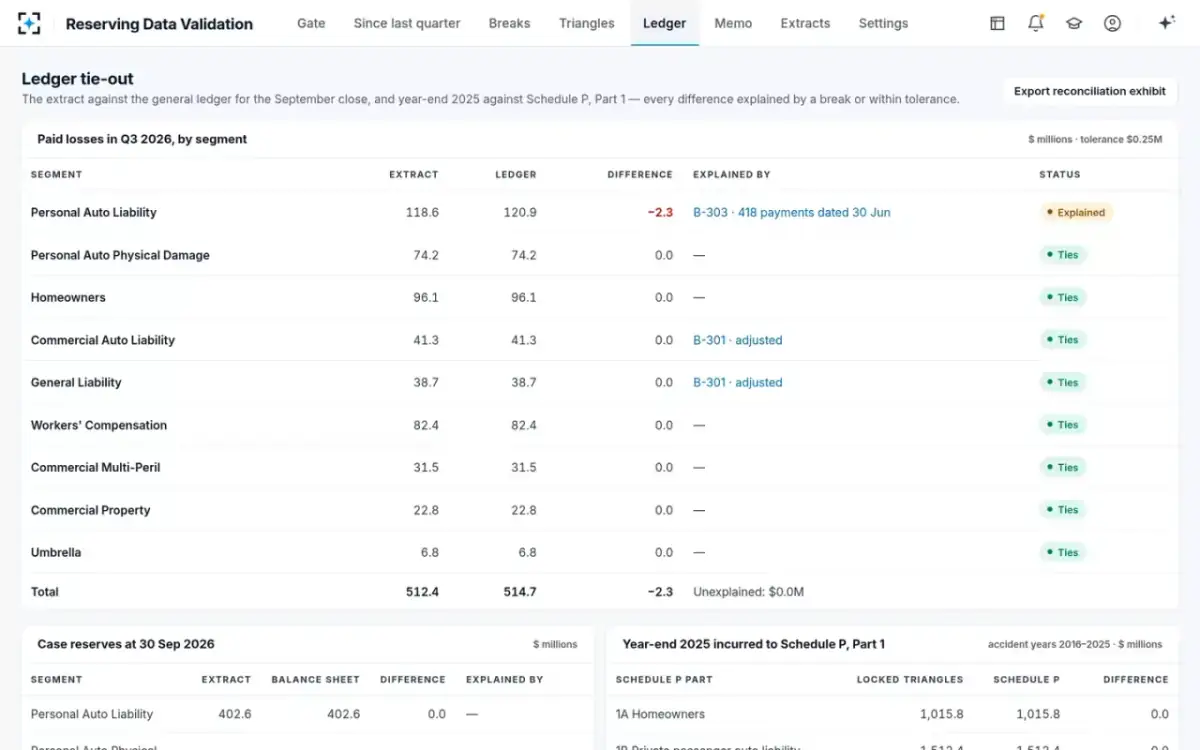
Paid to the general ledger each quarter, incurred to Schedule P, Part 1 at year end
Do claim counts need to be reconciled to Schedule P?
Yes, if the analysis relies on them, or the Actuarial Report must say why not. "The Appointed Actuary should reconcile all data material to the analysis, including claim counts and earned premium if appropriate. If the Appointed Actuary chooses not to reconcile certain data elements used in the analysis, such as claim counts, a brief explanation should be included in the Actuarial Report to make it clear that these elements were not inadvertently overlooked" (NAIC AOWG, 2026).
Counts are where definitions bite. The Academy's committee on financial reporting notes issues in how claims are counted, "per claim versus per occurrence, the availability of assumed claim counts", and that "there is no requirement to audit the claim counts presented in Schedule P" (Academy practice note, 2025). Its comments on the NAIC's proposed rewrite of the Schedule P instructions add a gap: because the instructions limit the lines for which counts are reported, "the absence of claim counts for certain lines of business in Schedule P means that this reconciliation cannot be performed for those lines of business" (Academy letter to the NAIC, March 2026).
Data elements to reconcile to Schedule P, if the analysis relies on them
- Paid losses
Cumulative or current calendar-year, by line and accident year.
- Case-basis loss reserves
Year-end, by line and accident year.
- Defense and cost containment, paid and case
At the level the analysis uses; explain any deviation.
- Adjusting and other expense, paid
Often by payment year, compared on the latest calendar year by line.
- Salvage and subrogation received
If losses are analysed gross of them, or analysed separately.
- Claim counts
If counted the same way on both sides; otherwise explain in the Actuarial Report.
- Earned premium
If it drives expected loss ratios or other methods.
- Both bases
Direct and assumed, and net of reinsurance, or a stated reason for one.
Direct and assumed, and net: why both bases?
Because reinsurance changes what a triangle means, and an error can hide on either side of it. The guidance expects reconciliations "on both a direct and assumed basis and on a net of reinsurance basis"; if company circumstances lead the actuary to use one basis, "the rationale for this decision should be explained in the Actuarial Report" (NAIC AOWG, 2026). Schedule P's development triangles are net of reinsurance, so a gross analysis needs its ceded side tied as well.
Intercompany pooling is the classic complication. In its comments on the proposed Schedule P rewrite, the Academy suggested the instructions say plainly that "intercompany pooling will cause the numbers reported in Schedule P not to reconcile to other parts of the Annual Statement", noting that "a 0% pool participant will show nothing in Schedule P, but could have significant direct business in the Underwriting & Investment Exhibit" (Academy letter, March 2026). A pooled company's reconciliation therefore has to show the pool share explicitly, or it will appear not to tie at all.
The actuary's tie is not the auditor's test
The two checks overlap in name only, and regulators say so. The Working Group "draws a distinction between two types of data checks": the actuary's Schedule P reconciliation, showing that the data significant to the analysis ties to Schedule P, and the independent CPA's annual testing of the completeness and accuracy of Schedule P data or the data given to the actuary.
Two data checks regulators keep apart
Independent CPA testing: That Schedule P, or the data provided to the actuary, is complete and accurate.
The appointed actuary's Schedule P reconciliation: That the data significant to the analysis ties to Schedule P.
Independent CPA testing: “generally apply auditing procedures to loss and loss adjustment expense activity that occurred in the current calendar year”
The appointed actuary's Schedule P reconciliation: Cumulative data by accident year, because development factors apply to cumulative amounts.
Independent CPA testing: Samples of transactions.
The appointed actuary's Schedule P reconciliation: Segments and accident years, through a map from the analysis exhibits.
Independent CPA testing: Earlier years’ cumulative amounts in the triangles.
The appointed actuary's Schedule P reconciliation: Whether any individual payment is real; that is an audit question.
The practical lesson is the one in the caption. A tie of this year's payments, all accident years together, says little about whether the cumulative paid triangle the factors are applied to is right. A payment batch dated into a closed quarter, or a claim whose accident year changed in a conversion, leaves the calendar-year total intact and the triangle wrong. In the sample insurer, a check that compares every earlier cell with last quarter's locked triangle, flagging changes above 0.25%, is what protects the cumulative history between year ends.
What if the data cannot be reconciled to Schedule P?
Document why, disclose it, and decide whether it changes the opinion. The Working Group accepts that mergers, acquisitions, changes in claim systems and underwriting-year data can make reconciliation difficult, encourages actuaries to disclose reconciliation issues, and says that if data cannot be reconciled the actuary "should document the reasons for the discrepancy". Differences the actuary views as immaterial should still be acknowledged in the Actuarial Report, so regulators know they were seen. Migration quarters are the usual cause, and the claims system migration guide for reserving covers how to keep the tie through one.
When significant differences remain after trying to resolve them
Agent
Name every differenceEach difference by line and accident year, explained by a known break or marked unexplained, with the claims behind it where the data allow.
Never: nets offsetting differences
A person decides
Confirm both data owners knowThe people responsible for the analysis data and for Schedule P are aware of the differences.
A person decides
Recommend telling the outside auditorsThe company informs its external auditors of the unexplained differences.
A person decides
Disclose, and consider the opinion typeDiscuss in the SAO and the Actuarial Report; material unexplained differences could lead to a qualified opinion or no opinion under ASOP No. 36.
Who performs the reconciliation, and what changed for 2026?
Often someone other than the appointed actuary, and since 2026 the report must say who. Among the changes to the 2026 instructions, the guidance says the reconciliation must compare the data the appointed actuary actually used with Schedule P, and sets out the actuary's duties when someone else produced it: the report must say who did the work and that the appointed actuary checked it was reasonable (NAIC AOWG, 2026; the amended wording is quoted in the 2026 NAIC annual statement instructions).
That makes quarterly ties worth keeping. A reconciliation built once in February from a fresh pull is easy to produce and hard to review; one built from the same locked triangles the analysis used, with every difference named when it first appeared, is easy to review because the explanations already exist. What the Actuarial Report must show is set out in the actuarial report template; how released triangles then develop against expectations is in actual vs expected in actuarial reserving.
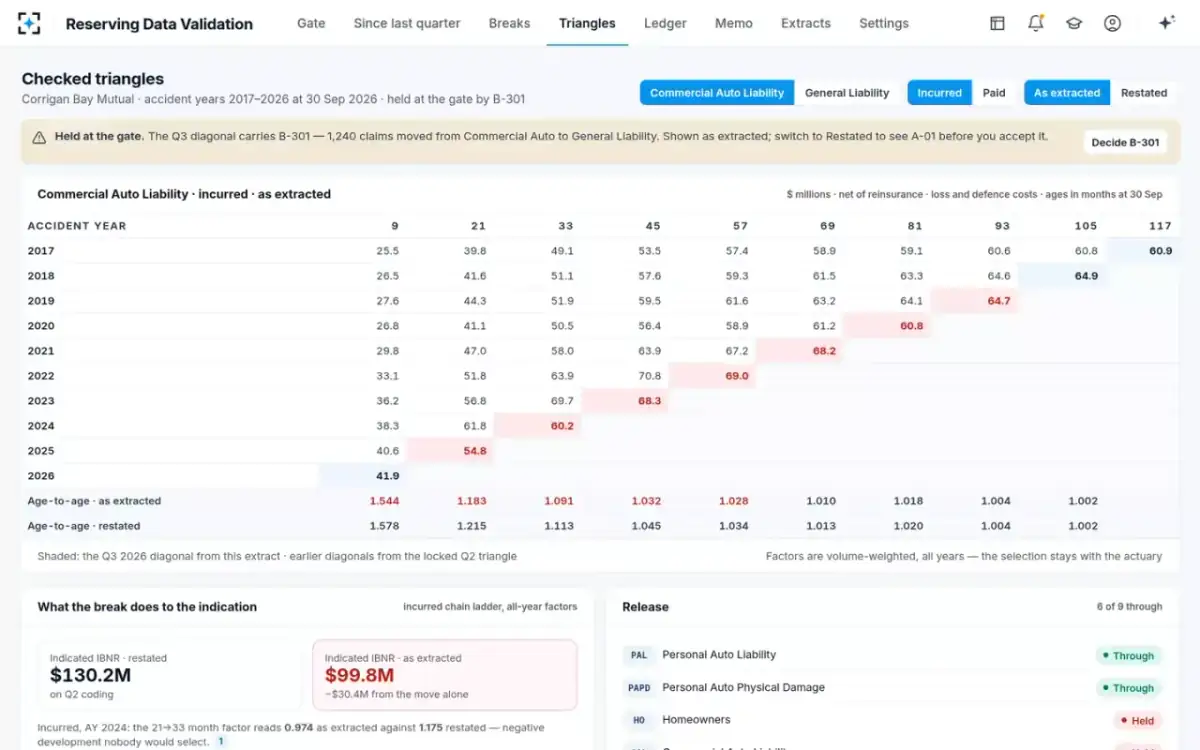
Triangles net of reinsurance, built from released data
What would the Schedule P Phase 2 proposal change?
It is a proposal under exposure, not adopted text. The NAIC's Casualty Actuarial and Statistical (C) Task Force exposed a rewrite of the Schedule P instructions, "Schedule P Phase 2", on 10 February 2026, and the Academy's Committee on Property and Liability Financial Reporting commented on 26 March 2026 (Academy letter to the CASTF). Three of its comments touch reconciliation directly: the intercompany pooling note above, the missing claim counts for some lines, and a draft count instruction that, the Academy wrote, "could create confusion with respect to re-opened claims, as it could imply that re-opened claims should be double-counted". Whatever is adopted, a reconciliation that states its counting basis line by line will adapt more easily than one that does not. How reopened claims enter a triangle in the first place is set out in how to create a loss triangle, and the quarterly tie that feeds the year-end exhibit is described on the Reserving Data Validation page.
Questions people ask
What is Schedule P, Part 1?
Part 1 is the summary section of Schedule P: by line and accident year it reports premiums, losses and loss adjustment expenses paid and unpaid, and, for some lines, claim counts. The opinion's illustrative scope language refers to reconciling the actuary's data to Part 1, and Parts 2 to 4 hold the incurred and paid triangles and bulk and IBNR reserves.
Should the reconciliation match the annual statement to the dollar?
Not necessarily at the statement's own level of detail; the practice note answers that question "Not necessarily", because analysis segments and Schedule P lines differ. What matters is that differences are explained, material ones in the Actuarial Report and immaterial ones at least acknowledged.
Does a reconciliation done on September data count for year end?
Analysis is often done on data before year end and rolled forward; the practice note says the data source used would typically still be reconciled to Schedule P, and the actuary compares actual year-end data with what the earlier evaluation expected. Quarterly ties make that comparison quicker because each quarter's differences are already explained.
Can the reconciliation be on an all-years-combined basis?
For some items, where comparison by year is impossible: the practice note gives calendar-year paid losses and year-end case reserves as examples, and discontinued lines. For data relied on significantly by line and accident year, regulators expect detail; a summary of all years and lines is called insufficient.
Does a Schedule P reconciliation tie IBNR?
The elements the Academy's practice note lists are paid and case-basis amounts, expenses, salvage and subrogation, claim counts and earned premium; IBNR is the estimate, not data. Schedule P's incurred triangles include bulk and IBNR reserves, which Part 4 shows separately, so a case-incurred triangle is compared with Schedule P only after those are taken out.