An actuarial report template for a property and casualty appointed actuary follows paragraph 7 of the NAIC annual statement instructions: a narrative that explains the findings and their significance to management, the board and the regulator, and a technical part that shows the analysis "from the basic data (e.g., loss triangles) to the conclusions," with six required elements, from the actuary's relationship to the company to the extended comments on unusual IRIS ratios. A template gives the order and the headings. It does not give the hours back, because most of the cost of a year-end Actuarial Report is in making its exhibits agree with an annual statement that keeps changing, explaining the change from last year, and documenting every assumption well enough that another actuary could appraise it. That is the work Botminds' Actuarial Opinion & Report Automation was built for: its agents draft the report from the reserve analysis, keep every number tied to the posted statement and list each documentation gap by paragraph, and the appointed actuary accepts every change and signs.
Where one year-end report's senior actuarial days go, by hand
What is included in an actuarial report?
The instructions name the parts. The report must be consistent with ASOP No. 41, contain a narrative and a technical component, and include six specific elements, A to F, plus disclosures for A&H long-duration contracts and, from 2026, for any material part of the reserves analysed by someone outside the actuary's direction. It must reproduce the opinion's signature details and add the date the report was finalized (paragraphs 7 and 8 of the 2025 instructions, as reproduced in the Academy's practice note).
A P&C Actuarial Report template, section by section, with the rule behind each
| Section | What it must contain | Rule |
|---|---|---|
| 1 · Relationship and board | The actuary's relationship to the company and role in advising the board and management on carried reserves; how and when the analysis was presented to the board | Instructions ¶7A |
| 2 · Data, reliance and reconciliation | An exhibit that reconciles and maps the data used, by the analysis segments, to Schedule P lines, explaining material differences; for 2026, a comparison of the data used with Schedule P, and who performed the reconciliation if not under the actuary's direction | ¶7C; AOWG 2026 II.B |
| 3 · Methods and assumptions | Methods, procedures, assumptions and data with enough clarity for an objective appraisal; a descriptive rationale for each assumption | ASOP No. 41 §3.2; AOWG II.J.4 |
| 4 · Results against carried | An exhibit that ties to the annual statement and compares point estimates and ranges with carried amounts, by the analysis segments | ¶7B |
| 5 · Change from the prior report | The change in estimates, net and gross if relevant, with extended discussion of material changes and explanations for fluctuations within accident years or segments | ¶7D; AOWG II.J.2 |
| 6 · Risk of material adverse deviation | Extended comments on trends that show the presence or absence of risks that could cause material adverse deviation | ¶7E |
| 7 · IRIS ratios | Extended comments on factors behind unusual reserve ratios and how prior and current analyses addressed them | ¶7F |
| 8 · Reliance on others | For another party's analysis covering a material portion: the amount and share of reserves, how far it was reviewed, and conclusions | AOWG 2026 II.C |
| Appendix · Exhibits | The technical component, from loss triangles to conclusions, for another actuary to evaluate | ¶7 |
The test every section has to pass is ASOP No. 41's. The report must identify its methods, procedures, assumptions and data clearly enough for another actuary qualified in the same practice area to make an objective appraisal of the work from the report alone (ASOP No. 41, section 3.2; the test is applied pick by pick in ASOP 41 summary). A template that leaves room for a heading and a table but not for the reasoning fails that test however tidy it looks.
Is there a template for a P&C actuarial report?
There is no official one. The NAIC prescribes the content of the report and the exact format of the opinion's Exhibits A and B, but not a report layout, and the working group encourages actuaries to use whatever language clearly conveys their opinion and its basis. The nearest thing to a public template is the American Academy of Actuaries' annual practice note on statements of actuarial opinion, which walks through each report requirement with illustrative wording; it is not binding and says so.
In practice most appointed actuaries' template is last year's signed report. That is a sound starting point for structure, exhibit numbering and house style, and a risky one for content, for reasons set out below. In the solution's fictional sample year-end, the report runs to 84 pages and 41 exhibits in eight sections: introduction and relationship, data and reconciliation, methods and assumptions, results by line, change from the prior report, risk of material adverse deviation, IRIS ratios and reinsurance, followed by the exhibits from page 45.
How long does it take to write an actuarial report?
Our estimate is about three weeks of senior actuarial time for the report and opinion, on top of the reserve analysis itself; we found no regulator, standards body or academic study that publishes a benchmark. The split in the chart above is the useful part. Seven of the fifteen days go on building exhibits and re-tying them every time statutory reporting posts a new statement version. Three go on the change from the prior report, which the working group wants explained not only in total but for significant swings within accident years or segments (AOWG 2026, section II.J.2; how to build that explanation through the year is in actual vs expected in actuarial reserving). Narrative and documentation checks take the rest.
Pricing those days is simple arithmetic and depends on the reader's own rates. At the median wage for actuaries in May 2025, $130,000 a year according to the Bureau of Labor Statistics, an hour costs about $62.50 before benefits and overhead, so fifteen days of eight hours is about $7,500 in salary alone. Appointed actuaries are rarely paid the median, consultants bill at their own rates, and the cost that matters most is not on any invoice: the days fall in the last fortnight before 1 March, when the same people are also finishing the opinion.
The same report: days by hand and with the agents drafting and tying
By hand · 15 days
- Exhibits · 27%
- Re-tying · 20%
- Change from prior · 20%
- Narrative · 20%
- Checks · 13%
With the agents · 3 days
- Exhibits · 17%
- Re-tying · 17%
- Change from prior · 17%
- Narrative · 32%
- Checks · 17%
The second bar's largest share is narrative, and that is the intended shape. With exhibits and ties no longer hand work, the actuary's remaining time goes on the part regulators read for: the narrative that, in the working group's words, should "clearly convey the significance of the Appointed Actuary's findings and conclusions, the uncertainty in the estimates, and any differences between the Appointed Actuary's estimates and the carried reserves."
What happens if the actuarial report is inadequate?
The commissioner can have it redone at the company's expense. Under Model #745, if the company fails to provide the report or workpapers on request, or the commissioner finds them "otherwise unacceptable," the commissioner "may engage a qualified actuary at the expense of the company to review the opinion and the basis for the opinion and prepare the supporting Actuarial Report or workpapers" (NAIC Model #745, section 2C). The model's drafting note goes further.
"The commissioner can also fine or require the company to have the workpapers redone with proper documentation."
NAIC Property and Casualty Actuarial Opinion Model Law (#745), drafting note to section 2C
The cheaper consequence is the one that is easy to miss: losing the examination shortcut. The working group says regulators should be able to rely on a well-documented report that complies with ASOP No. 41 in place of building their own reserve estimates during a statutory financial examination, and that this speeds the examination and may save the company money. A thin report gives that up. For the actuary personally, documentation failures are a recurring disciplinary theme: among the material violations alleged in cases before the Actuarial Board for Counseling and Discipline in 2025 were "Violating ASOP No. 41, Actuarial Communications, by failing to identify key assumptions used in an actuarial report" and "failing to appropriately document work" (ABCD Annual Summary 2025).
When is the actuarial report due?
The report must be available by 1 May of the year after the year-end it supports, or within two weeks of a request from a state commissioner, and it must be kept with the workpapers for seven years (paragraph 7). It is not filed with the annual statement and is meant to be confidential. In the calendar it follows the opinion, filed with the annual statement by 1 March, and the confidential Actuarial Opinion Summary, due to the domiciliary state by 15 March. The two-week clock means a report that exists only as a draft on 2 March is a risk: a department can ask for it the day after the opinion is filed.
What must the actuarial report reconcile?
Three things, and they are different. The data used in the analysis must reconcile and map to Schedule P by segment, which regulators expect at a level of detail that reflects the segmentation, accident years and methods; a single summary across all years and lines will not do. How that data work is done is set out in Schedule P reconciliation. The report's results exhibit must tie to the annual statement's carried amounts. And the report, the opinion, the summary and the statement must agree with one another, with any difference explained in the right document, such as non-tabular discount shown gross in Exhibit A and net in the report.
The second and third are where a template is no help and where the solution does most of its work. Every number in the sample report carries a link to its statement line, and when a late statement version moved $6.8 million of IBNR between two lines, the links showed four exhibit cells and three sentences to update within minutes. The mechanics are traced in actuarial AI agents: inside the one that ties the report out.
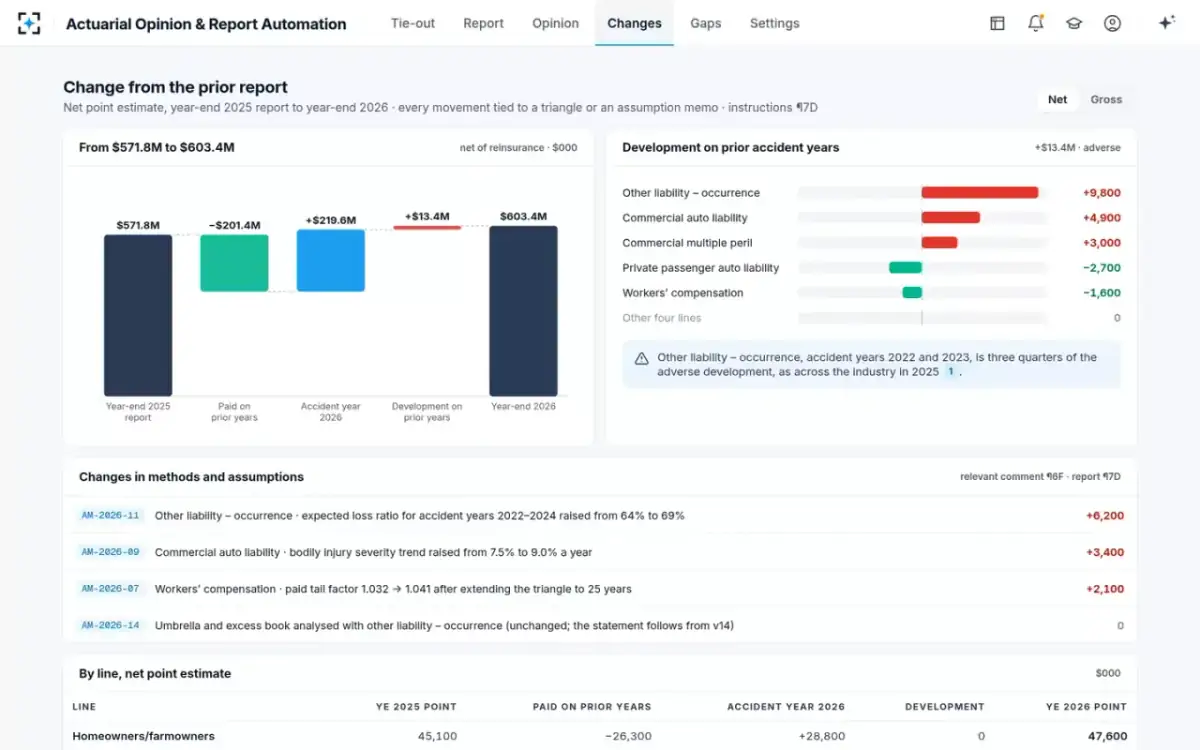
The change from the prior report, with every movement cited
Can an actuarial report be reused year to year?
The structure can; the content cannot. Three rules push against carrying text forward. ASOP No. 36 asks the actuary to determine whether this year's assumptions, procedures, methods or models differ from those behind the prior opinion and whether the changes are likely to have a material effect; the instructions require a material change to be described in the opinion's relevant comments and in the report's change exhibit. ASOP No. 23 asks the actuary reviewing data to consider comparing it with the data used in the prior analysis (ASOP No. 23, section 3.3; set out in ASOP 23 data quality). And the working group's 2026 guidance asks for support behind every assumption: a phrase such as "actuarial judgment" in a footnote is not support, and expected loss ratio selections in particular need their rate changes, trends and on-levelling written down.
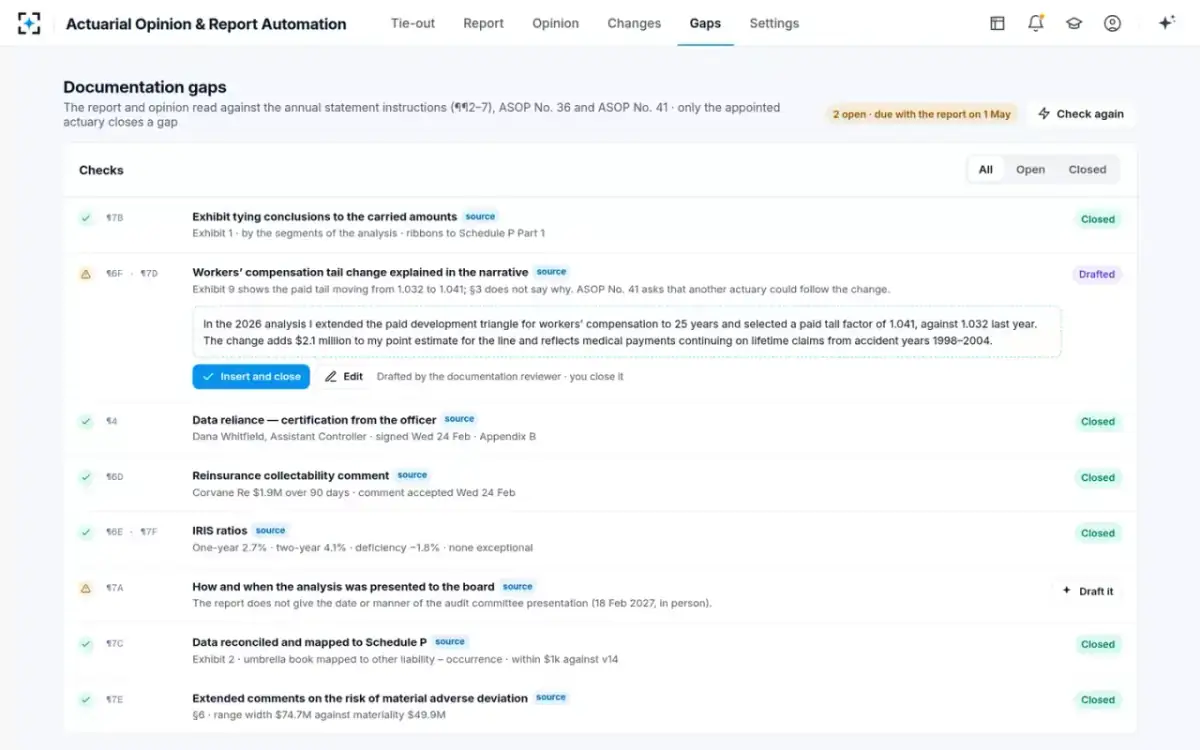
A sentence copied from last year is therefore a liability unless someone confirms it is still true. In the sample year-end, the documentation reviewer caught exactly that kind of gap: Exhibit 9 showed the workers' compensation paid tail moving from 1.032 to 1.041 while section 3 of the report did not say why. It drafted a paragraph; only the actuary could insert it. Documenting assumptions as they are selected, rather than at report time, is the subject of the assumption register.
Gaps listed by paragraph, closed only by the actuary
What to look for in a report template or tool
Buy for the expensive sections, not the headings. A template, a document generator and an agent-based tool all produce a report with the right section titles; they differ in whether the numbers stay right after 20 February and whether the reasoning keeps up with them.
Questions to ask before choosing an actuarial report template, generator or tool
- Does every exhibit number trace to a statement line or an analysis cell?
If the answer is a paste, the re-tying days stay.
- What happens when statutory reporting posts a new version?
Ask to see the list of cells and sentences that a version changes.
- Does it draft the change from the prior report from cited memos?
Paragraph 7D wants material changes discussed, net and gross if relevant.
- Does it check the report against paragraphs 7A to 7F and ASOP No. 41, and say where it is short?
A gap list by paragraph is worth more than a green tick.
- Who can change a selection or the opinion paragraph?
Only the appointed actuary should be able to.
- Does it export to the format your reviewers and regulators read?
Reviewers and regulators read a document, not your tool; the solution exports the draft report to Word.
- Can you test it on last year's signed report before using it this year?
A replay on a report you know is the cheapest proof.
Actuarial Opinion & Report Automation fits where the statement moves late and the report is long: many lines, several statement versions after the first full one, a peer reviewer who should be reading judgement rather than ties. It does not do the reserve analysis, select assumptions or write the opinion paragraph, and it does not prepare the confidential summary. If your statement rarely moves after its first full version and your report changes little from year to year, a disciplined template and review may be enough. If not, the way to decide is to run the solution on last year's signed report, which is the plan laid out in actuarial AI software: live before the 1 March opinion.
Questions people ask
What are the actuarial report requirements?
Paragraph 7 of the NAIC instructions: consistency with ASOP No. 41, narrative and technical components, and six required elements covering the actuary's relationship and board presentation, results against carried amounts, data reconciliation to Schedule P, change in estimates, risk of material adverse deviation and unusual IRIS ratios. The report must be available by 1 May and kept for seven years.
Who can see the actuarial report?
The board, the domiciliary regulator on request or at examination, and other regulators who agree to keep it confidential. Under Model #745 the report, workpapers and opinion summary held by the department are confidential by law and privileged, unlike the opinion itself, which is public.
Is the actuarial report the same as the Actuarial Opinion Summary?
No. The summary is a short confidential document, due to the domiciliary state by 15 March, comparing carried reserves with the actuary's point estimate and range, net and gross. The report is the full documentation of the analysis behind both the opinion and the summary, due by 1 May.
Does the actuarial report have to be in a particular format?
No format is prescribed for the report itself, only its content; Exhibits A and B of the opinion, by contrast, follow the NAIC's exact format and are filed in print and data-capture form. The report must reproduce the opinion's signature details and add the date it was finalized.
Can the actuarial report be written before year-end data is final?
Much of the analysis usually is, on data before year-end rolled forward, and regulators accept that. The working group expects the report to show why ultimate selections changed in the roll-forward and how; a bare list of final selections does not count as support (the PBC request list quotes the guidance).