The appointed actuary's responsibilities are to be appointed by the insurer's board, to meet the NAIC definition of a qualified actuary, to sign each year a Statement of Actuarial Opinion on the reserves management carries, to report to the board on those reserves, and to keep an Actuarial Report and workpapers that let a regulator follow the work from loss triangles to conclusion. The responsibilities are set by the NAIC Property and Casualty Annual Statement Instructions, the state law based on the NAIC's Model #745, and the actuarial standards, chiefly ASOP No. 36. What makes the job hard is timing: the opinion is signed in the last weeks before the 1 March filing, while the statement is still moving. Botminds' Actuarial Opinion & Report Automation exists for that part of the job. Its agents draft the report from the reserve analysis and keep every number tied to the posted annual statement, and the appointed actuary accepts every change and signs.
The chain below runs from appointment to filed opinion. Where the page shows the solution, it uses a fictional sample mutual insurer and its sample year-end; nothing on the screens is a customer's result.
Appointment to filed opinion: who signs, and in what order
A person decides
The board appointsAppoints a qualified actuary by 31 December, reviews the qualification documentation and minutes its review; the company tells the commissioner within five business days.
A person decides
Management carries the reserveBooks one number for losses and one for loss adjustment expense on the Liabilities page; the decision on what to book is management's.
Agent
Agents draft and tie outDraft exhibits and narrative from the reserve analysis, keep each number tied to the posted statement, and list what a late version breaks.
Never: change a selection, write the opinion paragraph or alter the statement
A person decides
The appointed actuary signsSigns the opinion filed with the annual statement by 1 March, the confidential summary by 15 March, and stands behind a report available by 1 May.
A person decides
Regulators relyRead the public opinion, the confidential summary and, on request or at examination, the report and workpapers.
What are the responsibilities of an appointed actuary?
The appointed actuary has five duties that the instructions name: be qualified, be appointed properly, opine on the reserves in scope, report to the board each year, and keep a supporting report and workpapers for seven years. Each comes with a document someone else can inspect, which is why the role is better understood as a chain of signatures than as a job description.
The opinion itself has a fixed shape. The instructions require four clearly designated sections: an IDENTIFICATION paragraph, a SCOPE paragraph, an OPINION paragraph and one or more RELEVANT COMMENTS paragraphs, followed by Exhibit A, which lists the amounts opined on, and Exhibit B, which carries the disclosures, including the materiality standard in dollars and whether there are significant risks that could result in material adverse deviation. An annotated statement of actuarial opinion example walks through each section and the errors reviewers find in them.
Behind the opinion sits the obligation regulators care most about. The NAIC working group says an appointed actuary "has a responsibility to know and understand both the Instructions and the expectations of state insurance regulators," and that it is the actuary's job to identify which actuarial standards apply (NAIC AOWG, 2026 Regulatory Guidance). The instructions name ASOP Nos. 23, 36, 41 and 43 as the floor, "including, but not limited to." That clause matters every year a standard changes: ASOP No. 36 was revised for opinions issued from 1 October 2024, and the Actuarial Standards Board has a third exposure draft of ASOP No. 41 out (March 2026, not adopted) and a task force forming to revise ASOP No. 43.
Every signature in the chain, and what it commits the signer to
| Document | Who signs or approves | When | What it commits them to |
|---|---|---|---|
| Appointment and notice to the commissioner | Board, or a committee reporting to it; the company sends the notice | Appointment by 31 December; notice within five business days | Name and title, how the appointment was made, and a statement that the person is a qualified actuary and that documentation went to the board |
| Qualification documentation | Appointed actuary; board documents its review | At initial appointment (annual until year-end 2023 opinions) | Enough detail to show each part of the qualified actuary definition is met; available to examiners |
| Statement of Actuarial Opinion | Appointed actuary | With the annual statement, 1 March | A public opinion on the amounts in Exhibit A, the materiality standard and the risk conclusion |
| Actuarial Opinion Summary | Appointed actuary | 15 March, or the state's later date | A confidential comparison of carried reserves with the actuary's point estimate and range, net and gross |
| Actuarial Report and workpapers | Appointed actuary | Available by 1 May, or within two weeks of a commissioner's request | Analysis another actuary could evaluate, from basic data to conclusion, kept seven years |
| Notice of an opinion in error | Appointed actuary to the board; company to the commissioner | Five business days after the actuary determines it | A summary of the finding and an amended opinion |
Who appoints the appointed actuary, and how is the regulator told?
The board appoints. The instructions require the appointed actuary to be "appointed by the Board of Directors by Dec. 31 of the calendar year for which the opinion is rendered," and define the board broadly enough to include "an appropriate committee directly reporting to the Board of Directors," so an audit committee can make the appointment (2025 instructions, paragraphs 1 and 1A, as reproduced in the Academy practice note).
On an initial appointment the company has five business days to tell the domiciliary commissioner three things: the actuary's name and title, and the firm for a consultant; the manner of appointment, meaning who made it and when; and a statement that the person meets the qualified actuary definition, or was approved by the commissioner, and that documentation was provided to the board. Once that notice is given no further notice is needed for the same person until the board stops appointing or retaining the actuary or the actuary stops qualifying. The Academy's practice note adds a practical answer to a common question: the instructions do not necessarily require reappointment every year, but where an appointment is specific to a year-end, reappointment would normally be necessary.
Replacing an appointed actuary is a different procedure with its own clock: notice within five business days of the board's action, a letter about disagreements in the previous 24 months within ten more, and the former actuary's reply within ten business days of the company's request. The NAIC change in appointed actuary procedure sets out the whole timeline and the handover file a successor needs.
What is qualification documentation, and how often is it due?
Qualification documentation is the appointed actuary's written showing that each part of the NAIC "Qualified Actuary" definition is met, given to the board. It has been required since the 2019 instructions. From year-end 2024 opinions it is due at initial appointment only; before that it was due at appointment "and annually thereafter," as the working group's 2026 guidance records.
The definition has three parts. The actuary must meet the basic education, experience and continuing education requirements of the Academy's specific qualification standard for NAIC property and casualty opinions; must hold and maintain an Accepted Actuarial Designation; and must belong to a professional association that requires the Academy's Code of Professional Conduct, requires the U.S. Qualification Standards and participates in the Actuarial Board for Counseling and Discipline. An actuary evaluated by the Academy's Casualty Practice Council can qualify by that route instead of the first two parts, and the company must then attach the approval letter to the opinion each year.
The working group's guidance shows what good documentation contains: résumé-type information, designations and the years first attained, at least three years of responsible experience relevant to the subject of the opinion, and continuing education of at least 15 hours a year directly relevant to the listed topics, at least six of them through interaction with outside actuaries or other professionals (AOWG 2026, section IV). Separately, an actuary subject to the U.S. Qualification Standards must attest each year to meeting the continuing education requirement, and the Casualty Actuarial Society and the Society of Actuaries make those attestations available to the public. For 2026, the definition of Accepted Actuarial Designation itself changed, which is one of the seven items in the 2026 NAIC annual statement instructions.
What must the appointed actuary tell the board?
The appointed actuary must report to the board every year on the items within the scope of the opinion, and the opinion and the Actuarial Report must both be made available to it. Since 2016 the board's minutes must say how the information was presented, for example in person, by webinar or in writing. The working group "strongly encourages" an in-person presentation so the risks can be discussed, and it is specific about content.
"Therefore, the Board of Directors should be made aware of the Appointed Actuary's opinion regarding the risk of material adverse deviation, the sources of risk, and what amount of adverse deviation the Appointed Actuary judges to be material."
NAIC Actuarial Opinion (C) Working Group, 2026 Regulatory Guidance
The reason the guidance gives is worth repeating to any board. The balance sheet can carry only one number for each reserve line, while actuarial estimates are uncertain by nature and a point estimate says nothing about how far the outcome could vary (the guidance is quoted in reserving committee terms of reference). A presentation that gives the board only the point estimate and the word "reasonable" leaves out the part the regulators asked for. What the risk conclusion means, and how the materiality standard behind it is chosen, is the subject of the risk of material adverse deviation, in plain words.
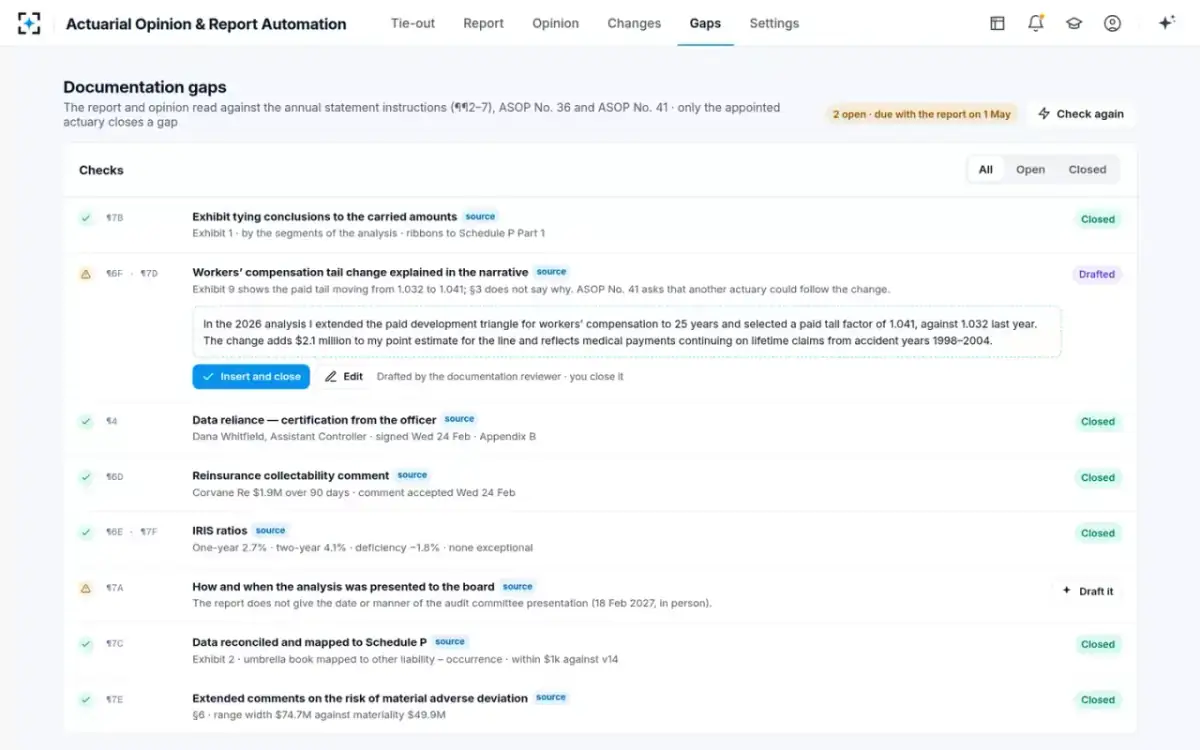
The Actuarial Report must say when and how the presentation happened. Paragraph 7A of the instructions requires the report to identify "how and when" the actuary presents the analysis to the board and, where applicable, to the officers responsible for the carried reserves. It is a small requirement that is easy to miss in a draft, and in the solution's sample year-end it was one of the two documentation gaps still open after the opinion was signed.
A missing board date is a documentation gap, listed by paragraph
Is the appointed actuary responsible for the reserves?
No. Management sets and books the carried reserve; the appointed actuary opines on whether it makes a reasonable provision. The Academy's overview for audit committee members describes the estimate as the product of many disciplines, "with the final decision on the estimate to book being the responsibility of company management" (Appendix III.6 of the 2025 practice note). The opinion is about management's number, measured against the actuary's own range: under ASOP No. 36 the reserves make a reasonable provision when they fall inside a range of estimates the actuary considers reasonable (ASOP No. 36, section 3.8.1; the test is worked through in the risk of material adverse deviation).
The separation is not a technicality, and enforcement cases show why it is guarded. In 2020 the SEC charged AmTrust Financial Services and its former chief financial officer, alleging that the company disclosed its general actuarial process but not that the CFO's consolidated adjustments departed from the actuarial estimates without properly considering them, and that by the end of 2015 those adjustments exceeded $300 million. Without admitting or denying the allegations, they agreed to pay a combined $10.5 million (SEC Litigation Release No. 24838; the case is read in top side entries meaning). The appointed actuary's protection in such a case is the document trail: an Actuarial Report whose exhibits compare the actuary's conclusions with what was carried, line by line.
When management's number and the actuary's estimate diverge, the report must say so. Paragraph 7B requires "an exhibit that ties to the Annual Statement and compares the Appointed Actuary's conclusions to the carried amounts," and the working group expects the narrative to make any gap between the actuary's estimates and the carried reserves plain (its wording is quoted in actuarial report template). Case-by-case adequacy is a different job, done in the claim files; for that side, see case reserve adequacy.
Appointed actuary vs chief actuary, and can a consultant be appointed?
The chief actuary is a job title inside a company; the appointed actuary is a regulatory role defined by the instructions. They are often the same person, but need not be. The Academy's overview notes that the appointed actuary "could be either an internal actuary, a consulting actuary, or an audit firm actuary acting as a consultant," and Exhibit B, item 2, asks the actuary to declare which: E for an employee of the company or group, C for a consultant.
What changes with a consultant is the evidence, not the duty. The notice to the commissioner must name the consultant's firm. The report must describe the actuary's relationship to the company and "the Appointed Actuary's role in advising the Board of Directors and/or management regarding the carried reserves" (paragraph 7A). And if any material part of the reserves was analysed by someone not under the appointed actuary's direction, a pool's actuary for example, the opinion must name that person, their affiliation and credential. The actuarial profession's disciplinary body sees the edge of this question too: among the requests for guidance it answered in 2025 was "Examining Code implications when an actuary signs an SAO but was not responsible for the majority of the underlying work" (ABCD Annual Summary 2025).
Four seats around one opinion, before and with Actuarial Opinion & Report Automation
Today
Appoints the actuary, receives a qualification file once, and hears a presentation each year that the minutes must describe.
With agents
Hears the same presentation, but with the range, the materiality standard and the risk factors stated in the words the opinion will use.
Still theirs: The appointment, the review of qualifications, and the questions it asks.
Today
Spends the last fortnight before 1 March re-pasting exhibits each time the statement moves, then reads the judgement.
With agents
Reads the judgement first; numbers that no longer agree with the statement are listed, not hunted for.
Still theirs: Every selection, the opinion paragraph, the risk conclusion and the signature.
Today
Books the carried reserve and posts late statement versions without knowing which sentences of the opinion they touch.
With agents
Posts a version and sees within minutes which exhibit cells and report sentences it moved.
Still theirs: The carried reserve on lines 1 and 3 of the Liabilities page.
Today
Spends review rounds checking that exhibits tie before reading the reasoning.
With agents
Starts from exhibits that already agree with the posted statement and comments on the reasoning.
Still theirs: An independent read before the opinion is signed and before the report is final.
What the signature commits to after 1 March
Signing is not the end of the obligation. Three commitments run on after the filing, and each has its own clock.
First, the report and workpapers. The opinion "must include assurance that an Actuarial Report and underlying actuarial workpapers supporting the Actuarial Opinion will be maintained at the Company and available for regulatory examination for seven (7) years," and the report must be available by 1 May or within two weeks of a request from a state commissioner (paragraph 7). If a commissioner finds the report missing or unacceptable, Model #745 lets the commissioner hire a qualified actuary at the company's expense to review the opinion and prepare the report or workpapers (NAIC Model #745, section 2C; quoted in actuarial report template).
Second, errors. If the actuary determines that the filed opinion was in error because it relied on data that was factually incorrect at the balance sheet date, the actuary must tell the board or audit committee in writing within five business days; the company forwards the amended opinion to the commissioner within five business days of receiving it; and if the actuary has not been copied within that time, the actuary notifies the commissioner within the next five. An opinion is not "in error" merely because later events or actual results differ from what was projected (paragraph 9).
Third, liability. Model #745 limits it: the appointed actuary "shall not be liable for damages to any person (other than the insurance company and the commissioner)" for acts or omissions with respect to the opinion, "except in cases of fraud or willful misconduct" (section 2D). The exception list is short and the company and the commissioner are outside the shield, which is one more reason the report has to show its work.
One appointed actuary's year: the dates that set the work
- Appointmentby 31 Dec
- Opinion filed1 Mar
- Summary due15 Mar
- Report available1 May
- Analysis rolled forwardDec to Jan
- Statement versions movere-tie each one
- Summary
- Report and peer reviewto 1 May
Where the hours go, and where software helps and stops
Most of an appointed actuary's late-February time is not spent on judgement. It is spent making the documents agree: every number in the report and the opinion must match the statement version that will be filed, and the working group expects any difference between the opinion, the summary, the report and the annual statement to be explained in the right document. In the solution's sample year-end, statutory reporting posted three statement versions in a fortnight, after audit adjustments and a reserve committee, and each one could move a line the report quotes.
That is the part Actuarial Opinion & Report Automation takes. In the sample year-end, the report's 312 numbers each carry a link to their statement line, and when a late version moved $6.8 million of one accident year's IBNR between two Schedule P lines, the solution re-checked every link in 2 minutes 13 seconds and listed four exhibit cells and three sentences to update. The appointed actuary accepted each redraft. Signing stayed blocked until every number agreed, and the signature was logged with the statement version it rests on. The sequence is traced step by step in actuarial AI agents: inside the one that ties the report out.
What the appointed actuary sees before signing: six checks beside the opinion
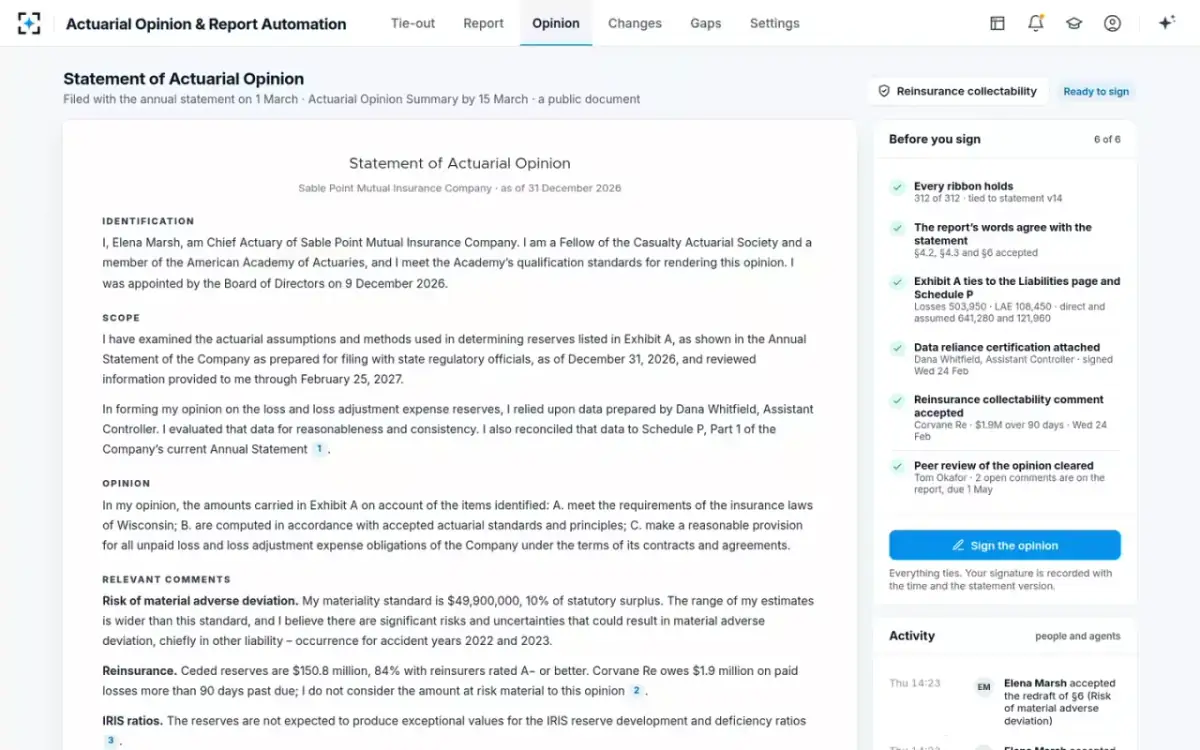
What the solution does not do is as important to an appointed actuary as what it does. It does not perform the reserve analysis or change a selection, method or assumption; the report drafter never writes the opinion paragraph. It does not prepare the board's qualification file, send the commissioner's notices, or file anything. It never edits the annual statement, which stays with statutory reporting. And it does not replace the peer reviewer: in the sample year-end, the reviewer's nine comments went to the appointed actuary to answer, not to an agent.
Questions people ask
What are the appointed actuary requirements?
The appointed actuary must be a qualified actuary under the NAIC definition: meet the Academy's specific qualification standard for P&C opinions, hold an Accepted Actuarial Designation, and belong to an association that adheres to the Code of Professional Conduct and participates in the ABCD. The board must appoint the actuary by 31 December, and the company must notify the commissioner within five business days of an initial appointment.
Does every property and casualty insurer need an appointed actuary?
Nearly every one filing on the P&C blank does. The instructions allow exemptions on application by 1 December: for small companies with under $1,000,000 of direct plus assumed written premium and under $1,000,000 of reserves, which file an officer's affidavit instead; for insurers under supervision or conservatorship; for the nature of the business; and for financial hardship, presumed when the opinion's projected cost would exceed the lesser of 1% of capital and surplus or 3% of direct plus assumed written premium.
Can the board delegate the appointment to a committee?
Yes. The instructions define the board to include "an appropriate committee directly reporting to the Board of Directors," and the Academy's practice note gives the audit committee as an example. Within a holding company or pool, a subsidiary's board can satisfy the qualification review by acknowledging the parent board's review in its minutes.
Does the appointed actuary have to present to the board in person?
Not by rule. The minutes must record the manner of presentation, which may be an executive summary or slides, but the NAIC working group strongly encourages an in-person presentation so the risks and uncertainties can be discussed. Whatever the format, the Actuarial Report must be made available to the board.
Can an appointed actuary use another actuary's work?
Yes, if the appointed actuary judges it reasonable to do so under ASOP No. 36. For a material portion of the reserves, the opinion must name the other person, their affiliation and credential, and from the 2026 instructions the report must also give the dollar amount and share of reserves covered and how far the appointed actuary reviewed that work.
How long must the actuarial report be kept?
Seven years. The opinion must assure regulators that the report and the underlying workpapers will be kept at the company and available for examination for seven years, and the report must be available by 1 May or within two weeks of a commissioner's request.