Case reserve adequacy is the degree to which an insurer's case reserves, the claim department's estimates on known claims, reflect what those claims will actually cost on the facts already in the file. Actuaries care most about relative adequacy: whether reserves are as strong this year as they were in the years their methods learn from. They test it in aggregate, by comparing trends in average case reserves with trends in paid claims, and they usually see a shift only after several quarters. A claim desk can test it sooner and more precisely on files that have already closed: replay each file at its past review dates, find the facts that were in the file before the reserve moved, and measure how long they sat. That replay is what Botminds' Case Reserve Adequacy Review produces for bodily-injury files, alongside a recommended reserve on every open one.
The replay figures below come from a fictional insurer, Western Casualty Claims, as its bodily-injury files run through the solution; the method figures come from the Casualty Actuarial Society's literature, linked where used.
What a shift in case reserve adequacy does, in the CAS's worked example
+25%
stronger case reserves on the latest diagonal, +6% the year before
20%
overstatement of total unpaid claims by the reported development method
16pts
added to the calendar-year claim ratio if booked in one year
What is case reserve adequacy?
It is how close case reserves come to the claim's eventual cost, judged on what was knowable when each reserve was set. A reserve can be wrong because the future surprised everyone, and that is not inadequacy. It is inadequate when the file already held the reason it should have been higher: a recommended surgery, a demand, a suit. The CAS study text puts the standard fairly: a case reserve "can turn out to be too high or too low, although it is reasonable in light of the information available at the time when the claims professional sets the estimate" (Friedland, CAS).
A plain operational test comes from an unlikely regulator. In a 2010 bulletin to the insurers that write flood policies for the National Flood Insurance Program, FEMA described the goal of case reserving this way: knowledge of the claim and any partial payments should "result in a case loss reserve that closely reflects the value of future payments. For example, when the final payment is made it should be in an amount close to the outstanding case reserve just before payment" (FEMA, NFIP bulletin W-10008). The bulletin is archived and written for flood claims, but its test travels: a file whose final payment lands far above its last reserve was not adequately reserved, whatever the line.
For actuaries the more important idea is consistency. Projections from incurred development assume the claim desk reserves the same way over time; Berquist and Sherman's 1977 paper calls this the assumption of consistent relative adequacy, and notes that "The sensitivity of projections of ultimate losses based on incurred loss development factors to changes in the adequacy level of case reserves increases significantly for the long-tail lines" (Proceedings of the CAS). Bodily injury is a long-tail line.
How do actuaries detect changes in case reserve adequacy?
By looking for a change in average case reserves that paid claims do not explain. Berquist and Sherman's test compares severity trends in "case reserves per open claim" with severity trends in "paid losses per closed claim", by development year and across calendar years; if case reserves are rising much faster than payments, reserving has probably strengthened, and if slower, it has probably weakened. They then restate past case reserves to today's level of adequacy before projecting (Proceedings of the CAS).
The CAS study text calls the average case outstanding triangle "one of the most important diagnostic tools for testing changes in case outstanding adequacy": reading down a column, "a decreasing pattern down the column is an indicator of potential weakening in the case outstanding, and an increasing pattern down the column is an indicator of possible strengthening in the case outstanding" (Friedland, CAS). The same text warns that the average can also move because the mix of claims changed, which is why actuaries go back to the claims department to ask what happened.
Both tests share a limit that matters to a claim executive. They see a shift only after enough development has accumulated to show in a triangle, and they see it for a whole accident year, not for a file. They answer whether reserving changed; they cannot say which adjuster, which trigger or which document. That is the question a file-level replay answers.
What a shift in adequacy does to the reserve estimate
It distorts the projection in the direction of the shift, and the distortion is large. The CAS study text works a clean example. A private passenger auto book's true ultimate claims stay at 70% of premium; only case reserving changes, strengthening by 6% and then 25% on the two latest diagonals. The reported claim development method, applied without adjustment, multiplies higher reported claims by higher development factors and overstates total unpaid claims by 20%: an estimate of $1,478,573 against a true $1,230,997. Booked in one year, the $247,596 difference "adds 16 points to the 2008 calendar year claim ratio" (Friedland, CAS).
The example runs in the comfortable direction: stronger case reserves make the estimate too high. The uncomfortable direction is the one injury desks tend to live in. If case reserves weaken because reviews thin out, the same methods understate the liability, the understatement is booked as profit, and it returns later as adverse development, which is the subject of adverse reserve development, traced to the file. The paid method is the usual cross-check, but paid patterns on litigated injury claims move with settlement speed, which is rarely constant either.
How do you test reserve adequacy file by file?
Replay closed files. Take every bodily-injury file that has closed, and for each past reserve change ask two questions: what was the reserve, and what was in the file at that moment? Then mark every fact that should have moved the reserve, and when it arrived, against the date the reserve actually moved. A closed file is the right test bed because its final cost is known, so the replay can say both how early a fact arrived and how much it was eventually worth.
The replay needs four things from the claim system: the reserve history with dates, amounts and who set each change; the documents with their arrival dates; the final paid amount; and the reserving guideline that applied at the time. It does not need a model of the future. That makes it a fair test of any reserving method, including the insurer's current one, and of any tool a buyer is evaluating: run the tool over the same closed files at their review dates and count the facts it would have priced earlier.
Four measures a closed-file replay produces
| Measure | What it shows | How it is computed | On the sample book |
|---|---|---|---|
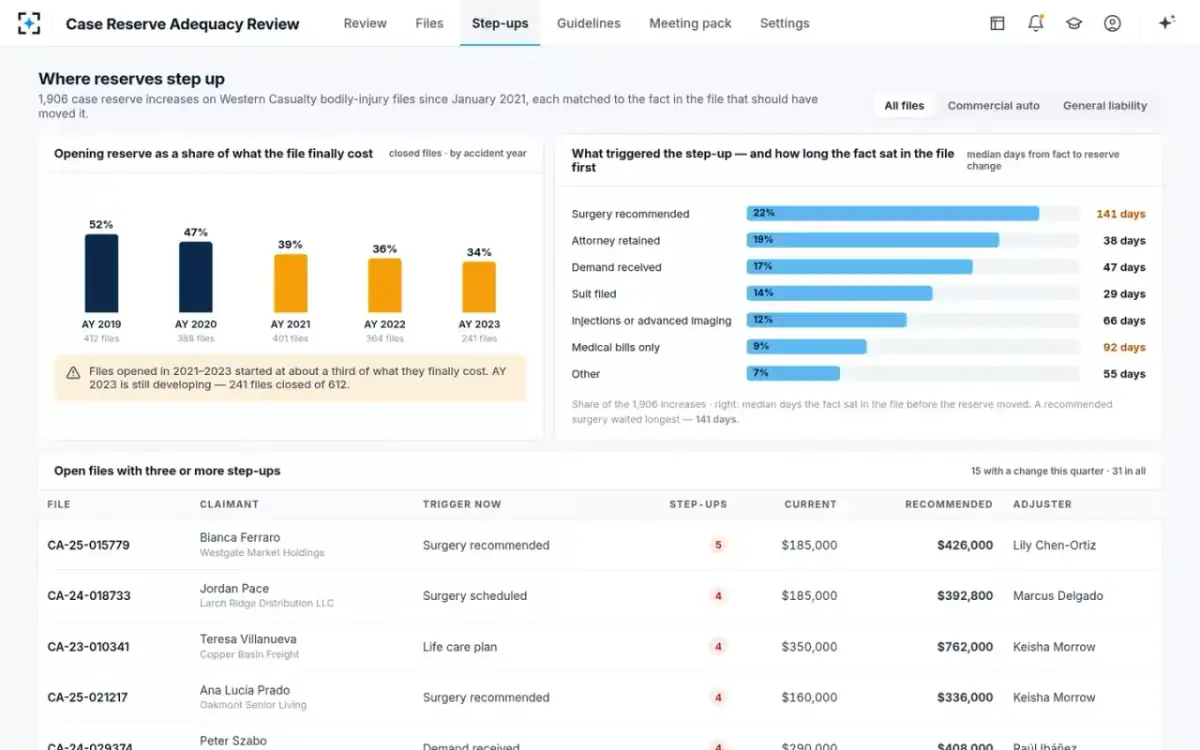
| Opening reserve as a share of final cost | How thin the first reserve is, by accident year | First case reserve ÷ total paid at closing, closed files only | 52% for AY 2019; 34% for AY 2023 (still developing) |
| Days a fact sat before the reserve moved | How long known information waited to be priced | Date of the reserve change minus the date the triggering document arrived | Median 141 days for a recommended surgery |
| Step-ups by trigger | Which events force reserves up | Each increase matched to the fact that should have moved it | 1,906 increases since January 2021 |
| Last reserve against final payment | Whether the reserve was right when it mattered | Final payment minus the case reserve just before it | A test FEMA described for flood claims in 2010 |
What a replay of 1,906 step-ups showed
On the sample book, a replay matched 1,906 case reserve increases on bodily-injury files since January 2021 to the fact in the file that should have moved each one. Three triggers account for more than half: a recommended surgery, an attorney's letter of representation, and a demand. The first is the one that matters most, because it is the most expensive and the slowest to be priced.
What triggered the sample book's 1,906 case reserve step-ups
The time a fact waited is the sharper measure. An attorney's letter moved the reserve in a median of 38 days and a suit in 29, because both are unmistakable events that someone diaries. A recommended surgery waited a median of 141 days, and bills alone 92. The pattern is what you would expect from reviews by exception: the facts that announce themselves get priced, and the facts buried in a pain-management note or an orthopedic consult wait for the demand that quotes them back to the insurer.
How long the fact sat in the file before the reserve moved
The accident-year view confirms it from the other end. On closed files the opening reserve covered 52% of final cost for accident year 2019 and 47% for 2020, but only 39%, 36% and 34% for 2021 to 2023, and 2023 is still developing, with 241 of its 612 files closed. Files opened in those years started at about a third of what they finally cost. In aggregate that is the kind of weakening Berquist and Sherman's test would eventually show; in the replay it comes with a file list and a trigger for every step.
Where reserves step up: the replay on the sample book
What causes inadequate case reserves?
Usually information that arrived and was not priced, more often than judgment that was wrong. The replay's longest waits are for facts written in medical language in documents nobody reread: a note that says "refer for surgical consultation", a consult that calls the claimant a candidate for fusion. A desk that reviews by exception will reliably price the letter of representation and reliably miss these.
Other causes are well documented. Reserving philosophy can change without anyone telling the actuaries, as the CAS study text's case example of a new claims executive shows. Caseloads grow. Severity moves faster than the cost tables: the Casualty Actuarial Society and Triple-I, an insurer-funded association, put the decade's cost of litigation trends and inflation in liability losses and defense at between $231.6 billion and $281.2 billion, and found severity, not frequency, behind the loss growth in every line (CAS and Triple-I). And there is motive. Grace and Leverty, studying property-liability reserve error, "find strong evidence that financially weak insurers underreserve to a greater extent than other insurers" (Journal of Risk and Insurance, CAS abstract).
The causes call for different fixes. Unpriced information needs reading. Philosophy and practice changes need written guidelines and a dated history of their changes. Severity needs current cost tables and closed-file values. Motive needs governance above the desk. A file-level replay distinguishes them, because it shows whether the fact was in the file and how long it waited.
What examiners find when they sample claim files
State examiners test reserving the way a replay does: by sampling claim files and reading them. In a 2009 limited-scope examination of a Florida commercial auto and workers' compensation insurer, the Office of Insurance Regulation reported that 27% of the sampled claim files showed a reserving problem, either reserves adjusted immediately before a payment or inadequate reserving; the insurer disputed the finding and submitted evidence for its reserves (Florida OIR). The finding names a pattern any claim leader would recognise, and stair-stepping reserves covers it in detail.
The lesson for a reserving test is to adopt the examiner's unit of analysis. An examiner does not ask whether an accident year developed adversely; it asks whether this file's reserve reflected this file's facts on this date. A replay that answers that question for every closed file, before an examiner samples them, is cheaper than the finding.
How do you measure reserve accuracy on open files?
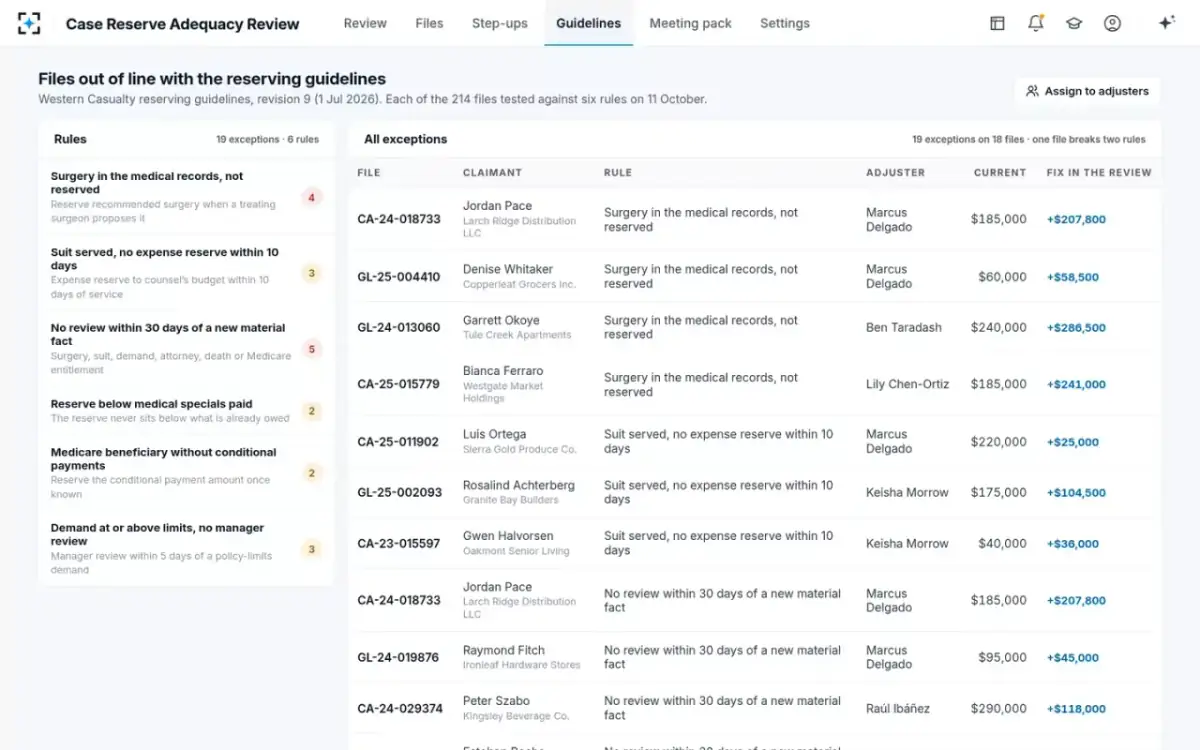
Against the rules a reserve should satisfy now, because open files have no final cost yet. The sample insurer tests every open bodily-injury file against six reserving rules: surgery in the medical records but not reserved, suit served with no expense reserve within 10 days, no review within 30 days of a new material fact, a reserve below the medical specials already paid, a Medicare beneficiary without conditional payments reserved, and a demand at or above limits without manager review. In the fourth-quarter review the solution found 19 exceptions on 18 of the 214 files.
The rules are the forward-looking half of the replay. The replay shows which facts waited longest on closed files; the rules turn those facts into tests on open ones. Surgery heads both lists for the same reason, and four open files carried it at the time of the review, each with the recommended fix.
Open files out of line with the reserving guidelines
Where Case Reserve Adequacy Review fits in an adequacy test
The solution does both halves on bodily-injury files. It replays closed files to show where reserves stepped up, what triggered each step and how long the fact sat first, and it rereads every open file before each reserving meeting to recommend a reserve that prices the facts already there. Its agents recommend; adjusters accept each step and managers approve above authority. It does not adjust triangles or select actuarial methods: its output is a better input for those methods, with a record of what moved and why.
A buyer can use the replay as the acceptance test. Before any open file is touched, run the agents over a year of closed files at their old review dates and compare their recommendations with what the insurer actually carried. If the agents would not have priced the surgery earlier on files you already know, they will not on files you do not. The calculation behind each recommendation is open to the same scrutiny, step by step.
Questions people ask
What is case reserve adequacy?
It is how well case reserves reflect what claims will cost on the facts already known. Actuaries focus on relative adequacy, whether reserving strength is consistent over time, because incurred development methods assume it; a reserve is inadequate in the claim desk's sense when the file already held the reason it should have been higher.
How do you test reserve adequacy?
In aggregate, by comparing trends in average case reserves per open claim with paid severity per closed claim, as Berquist and Sherman set out in 1977. At file level, by replaying closed files at their past review dates and measuring how long the facts that moved each reserve had been in the file.
What causes inadequate case reserves?
Most often facts that arrived but were not priced, such as a recommended surgery in a medical note. Changes in reserving practice, caseload, rising severity and, in Grace and Leverty's findings, an insurer's financial weakness also play a part.
How do actuaries detect changes in case reserve adequacy?
Mainly through the average case outstanding triangle and by comparing reserve and payment severity trends; a falling pattern down a column suggests weakening and a rising one strengthening. They then confirm with the claims department, because a change in the mix of claims can produce the same pattern.
What is a reserve step-up?
An increase in a claim's case reserve. One step-up is normal as facts emerge; repeated step-ups on the same file, each following an event, are the pattern called stair-stepping, and a replay shows whether each step's fact had been in the file long before.
How do you measure reserve accuracy?
On closed files, compare the final payment with the reserve just before it and the opening reserve with final cost. On open files, test each reserve against written rules, such as whether a recommended surgery or a suit has been reserved within the required number of days.