A case reserve review is the check of each open claim's case reserve against everything now in the file, so that the reserve is the claim department's best estimate of what the claim will still cost. On long-tail bodily-injury files it is done at least every quarter, before the reserving meeting, and it matters more than its routine reputation suggests: the actuaries who set the company's total reserve take the claim desk's case reserves as their starting point, so a quarter of thin reviews becomes next year's adverse development. The hard part is reading. An adjuster with a hundred open injury files cannot reread them all before the meeting, so most are reviewed by exception. Botminds' Case Reserve Adequacy Review exists for that gap: its agents reread every open injury file in full, recommend a reserve step by step with the page behind each step, and leave the decision with the adjuster and the manager.
The examples come from a fictional insurer, Western Casualty Claims, as its fourth-quarter 2026 review runs through the solution: 214 open bodily-injury files, $41.2 million of case reserves, and a reserving meeting on Tuesday 20 October. The research comes from the Casualty Actuarial Society, the Actuarial Standards Board and the NAIC, linked where it is used.
One quarter's case reserve review, on a sample book
214
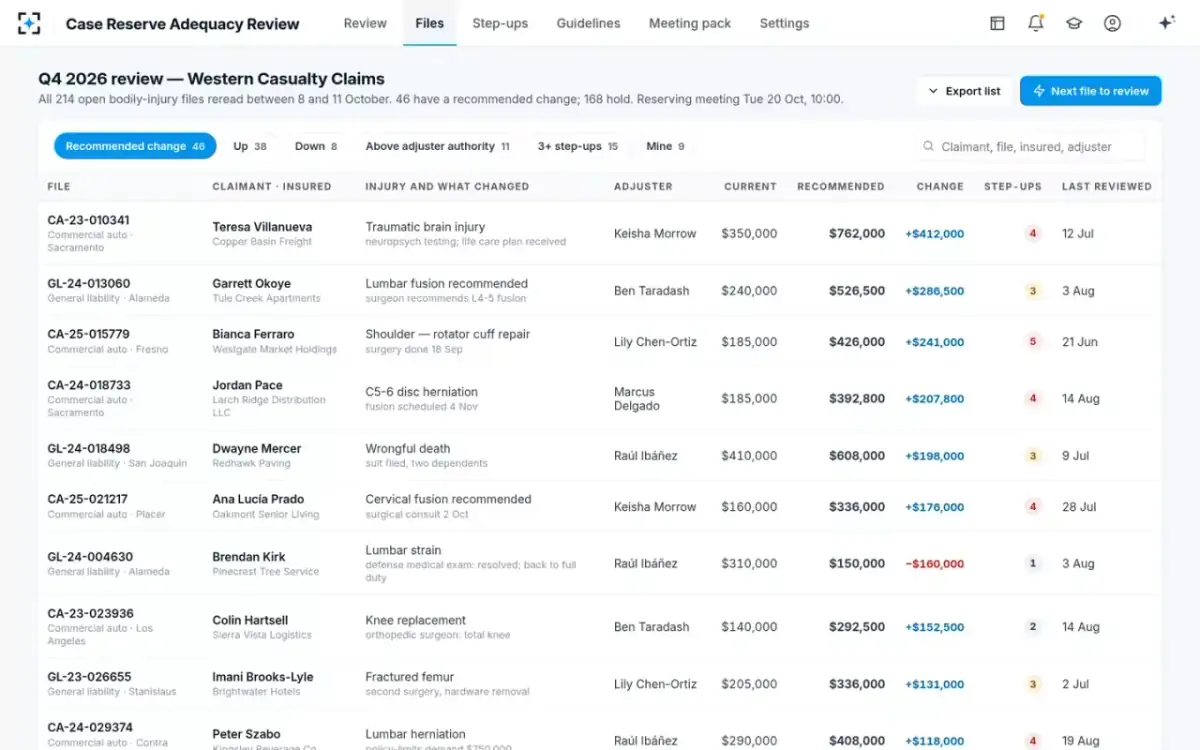
open bodily-injury files reread between 8 and 11 October
46
with a recommended change: 38 up, 8 down
168
held, each with the reason it holds
+6.9%
net change on $41.2 million carried: +$2,860,000
What is a case reserve review?
It is the scheduled reread of an open claim to decide whether its case reserve still matches the facts. A case reserve is the claim department's estimate for one known, reported claim, and the Casualty Actuarial Society's study text is blunt about why it moves (Friedland, CAS): "claims professionals generally estimate case outstanding based on the information known at that time. As additional information about a claim becomes available, the estimated value of the claim will likely change."
A review therefore has three questions to answer for every file. What is new since the last review? Does any of it change the expected cost: a surgery recommended, a lawyer retained, a demand, a suit, wage loss, Medicare entitlement? And if it does, by how much, on which documents, and who has to approve the new number? A review that answers only the third question, by adjusting a figure without rereading, is a reserve change, not a review.
Insurers differ in what the reserve is meant to represent, which a review has to respect. The same CAS text describes insurers that reserve to their best estimate of what the claim will finally settle for, inflation included, others that reserve to the policy limit, and others that use the most likely outcome or a probability-weighted expected value. Whatever the philosophy, the review applies it consistently, file by file and quarter by quarter. Consistency is what the actuaries downstream depend on.
Why the claim desk's quarter decides what actuaries project
Because actuarial reserving methods are built on the claim desk's numbers. Claims professionals estimate case reserves, the CAS text explains, and actuaries "rely on the historical variations in the case outstanding generated by claims professionals as a base for determining the remaining components of total unpaid claims" (Friedland, CAS). The incurred development methods project the future from the way case reserves have moved in the past.
That only works if the claim desk reserves the same way over time. Berquist and Sherman's 1977 paper, still taught in the CAS syllabus, names the assumption: reserving methods rely on "the consistent relative adequacy of case reserves" for incurred projections, and "To the extent that the underlying assumptions of a method are violated in a systematic and non-random manner, the projections of that method will likewise be systematically distorted" (Proceedings of the CAS). A quarter in which reviews were thinner than usual, because the desk was short-staffed or the caseload grew, is exactly such a systematic violation.
The professional standard puts the same duty on the actuary from the other side. ASOP No. 43 tells the actuary to take account of any change in how the claims staff work when it is likely to move the estimate materially. The statutory accounting rule then asks management to "record its best estimate of its liabilities for unpaid claims, unpaid losses, and loss/claim adjustment expenses" for each line of business (NAIC SSAP No. 55). The case reserve review is where the claims part of that best estimate is made.
How often should case reserves be reviewed?
On developing injury files, at least once a quarter, and also within a set number of days of any new material fact. The quarterly review catches drift; the event clock catches the surgeon's note that arrives the week after a review and would otherwise wait three months. Neither alone is enough. A quarter-only rule leaves a known fact unpriced for up to ninety days; an event-only rule depends on someone noticing that a document is an event.
The sample insurer writes both into its reserving guidelines as settings: every open bodily-injury file reread each quarter, finished five business days before the meeting, and a review within 30 days of a new material fact, which the guideline defines as surgery recommended, suit, demand, attorney, death or Medicare entitlement. A change is recommended when it moves the reserve by more than $10,000 or 10%; smaller moves are listed as holds, with the reason. Other insurers choose monthly or half-yearly cycles and 14- or 45-day clocks; the best practices for writing these rules down matter more than the particular numbers.
The quarter's review window, and one file's wait inside it
- Close1–7 Oct
- Reread, accept, approve8–19 Oct
- From the last review to the surgeon’s note14 Aug–22 Sep
- Note waits for the reread22 Sep–8 Oct
- Reread, priced, approved8–20 Oct
The second lane is the reason for the event clock. On the sample file the surgeon's note of 22 September moved a planned cervical fusion from recommended to scheduled. Under a quarter-only rule it waited 16 days for the reread; had it arrived on 12 October, it would have waited for January. The solution's design target is one night from a surgeon's note to a recommended reserve, so that the clock runs from the document rather than from the calendar.
How many files can one adjuster reread before the meeting?
Far fewer than the desk carries, which is why reviews by exception exist. The sample insurer's own estimate for one developing injury file at the quarterly review is about seven hours by hand: three to reread what is new, one to total specials and price future care, one to check value against closed files, half an hour on the expense reserve, an hour on the guideline check and the reserve note, and half an hour for approval above authority.
Where one file's review hours go, by hand and with Case Reserve Adequacy Review
- Reread what is new3 h
- Specials1 h
- Value1 h
- Expense0.5 h
- Note1 h
- Approval0.5 h
- Read0.5 h
- Check, approve1.1 h
Multiply it out and the problem is plain. Seven hours across 214 files would be about 1,500 hours a quarter, if every file were developing. Many hold quietly, but nobody knows which ones until they have been read, and the files that look quiet are where a pain-management note saying "refer for surgical consultation" sits unread. Berquist and Sherman's list of questions for a claims executive includes one that goes straight to this: "Has the size of the caseload of the average claims adjuster changed significantly in the past several years?" (Proceedings of the CAS). They asked because caseload changes how thoroughly files are reserved.
With the agents doing the reading, the estimate for the same file falls to about an hour and a half of the adjuster's time, most of it spent reading what changed and accepting or adjusting each recommended step. The reread itself runs overnight, which is why rereading all 214 files before each meeting is a realistic target rather than an aspiration.
The quarter's review list: 214 files, 46 recommended changes
Who attends a reserving meeting, and what each person needs
A quarterly reserving meeting usually brings together the adjusters who carry the files, the claim managers who approve above adjuster authority, a claims reserving analyst who reconciles case reserves with the actuaries, and the claims executive who chairs it and often also chairs the large-loss committee. Each comes with a different question about the same file.
Four people carry the same file into the reserving meeting
Today
Knows some of the hundred-plus open files moved, but has had no day to read them end to end.
With agents
Starts the quarter from a recommended reserve on every file, with the page behind each step.
Still theirs: Accepts, adjusts or rejects each step, with a reason.
Today
Receives a new number and a short note, and has to ask what changed.
With agents
Sees each step, who built it and who accepted it, and the reserve history of the file.
Still theirs: Approves above the adjuster’s authority, or returns it with a question.
Today
Builds the quarterly pack by hand and reconciles case reserves with actuarial.
With agents
Opens a pack with totals by line, every large move with its trigger, and the file pages behind them.
Still theirs: Explains movements to actuarial and the auditors.
Today
Learns where reserves were set too thin when the step-ups arrive as adverse development.
With agents
Sees where reserves step up, what triggered them and how long the fact sat in the file first.
Still theirs: Chairs the meeting and the large-loss committee.
The analyst's question is the one most often left unanswered. An actuary reviewing the quarter wants to know whether movement in case reserves reflects claims getting worse or reserving getting stronger, and those look identical in a triangle. The CAS study text warns that "it is quite common for an insurer’s management to report significant changes in both the claims settlement area and the strength (i.e., adequacy) of its case outstanding", and that sometimes "the best intentions of senior claims management may not have worked through the organization as planned" (Friedland, CAS). A pack that shows the trigger behind every move lets the analyst answer from evidence.
What goes in a reserve review pack?
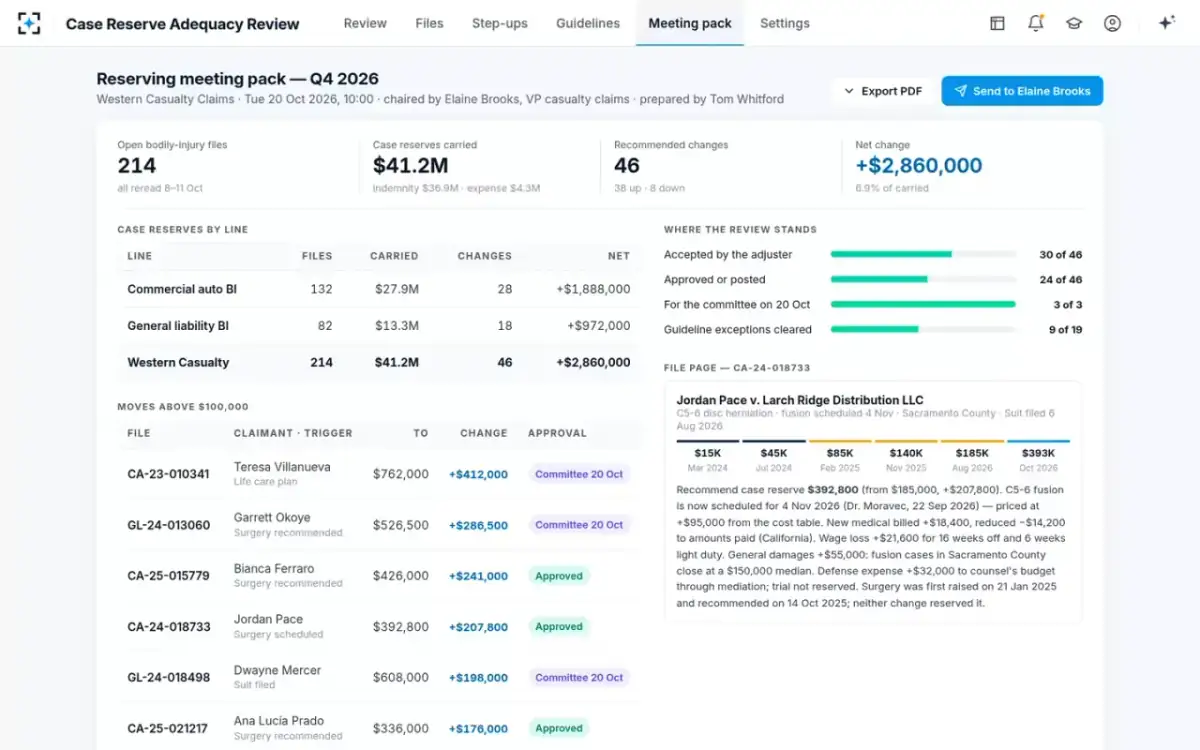
Enough for the meeting to approve the quarter's movement and for the actuaries to interpret it: totals by line, the carried reserve and the net change, every large move with its trigger and approval, the state of the review, and a page per significant file. At the sample insurer the pack shows commercial auto bodily injury, 132 files carrying $27.9 million with 28 changes netting +$1,888,000, and general liability bodily injury, 82 files carrying $13.3 million with 18 changes netting +$972,000.
What a reserve review pack should hold for the meeting
- Carried case reserves by line, indemnity and expense separately
The sample quarter carries $36.9 million of indemnity and $4.3 million of expense; the meeting approves both.
- Recommended changes, up and down, and the net
Downward moves belong in the pack too: on one sample file a resolved strain brings a recommended cut of $160,000.
- Every move above a threshold, with its trigger and its approval
The sample pack lists every move above $100,000: life care plan, surgery recommended, suit filed.
- Where the review stands
Steps accepted by adjusters, changes approved, files for the committee, guideline exceptions cleared.
- Files with repeated step-ups
Three or more step-ups on one file is a reserving question, not only a claim question.
- A file page for each large or contested move
The reserve history, what was known at each change and the reserve note, so the meeting debates facts.
- Changes to the reserving guidelines since last quarter
The actuaries need to know when the rules moved, not only the reserves.
The reserving meeting pack, built from every file
What is a large-loss reserve committee for?
It approves the reserves too large, or too close to the policy limit, for any single manager to carry alone, and it is where the insurer's most uncertain files get a second, senior look. Berquist and Sherman's questions for a claims executive include whether "any special procedures or guidelines" apply "in the reserving of large or catastrophic claims" (Proceedings of the CAS), because a separate route for large files changes how their reserves develop.
The sample insurer's authority settings make the route explicit: a casualty adjuster up to $250,000, a casualty claim manager up to $500,000, and the large-loss committee above $500,000 or above half of the policy limit, whichever comes first. In the fourth-quarter review three files go to the committee: a traumatic brain injury file rising to $762,000 after a life care plan, a lumbar fusion file rising to $526,500, and a wrongful death file rising to $608,000 after suit. Each arrives with its waterfall of steps and the documents behind them, which is what lets a committee of senior people spend its hour on judgment rather than on reconstruction.
The questions actuaries put to the claims department
Reserving actuaries ask the claims department about practice, not just about files, and a review process should be able to answer in writing. Berquist and Sherman's appendix of sample questions for a claims executive, written for reserve adequacy testing, opens with these: "What specific objectives and guidelines does your department have in setting case reserves?" and "Have there been any significant changes in the guidelines for setting and reviewing case reserves during the last five years?" (Proceedings of the CAS).
Most claim departments answer those questions from memory. A department that keeps its review cadence, event clock, thresholds, authority limits and state rules as versioned settings can answer from the dated history of what the rules were on any date, and so can show the actuary whether a jump in average case reserves in one quarter came from the claims or from a rule change. The same history answers the auditor's question about who approved a large move and when.
Between quarters, the desk also needs to see which reserves have stepped up repeatedly, because stair-stepping reserves are the visible symptom of reviews that waited for an event. At the sample insurer 31 open files have three or more step-ups, 15 of them with a change this quarter.
Where Case Reserve Adequacy Review fits, and where it stops
The solution covers the claim desk's half of the reserving process on bodily-injury files: it rereads every note, diary, letter, medical record, bill and suit paper added since the last review, recommends a case reserve as a waterfall of steps, checks each file against the insurer's reserving rules, drafts the reserve note and routes anything above authority. Seven agents divide the work, from the file rereader to the reserve recommender, and how each step of the calculation is built and checked is set out separately.
It stops at three lines. Its agents never post a reserve, change a payment, or contact claimants or counsel; the adjuster accepts or adjusts each step and a manager approves above authority. It does not estimate IBNR or project development triangles, which remain the actuaries' work. And it does not replace the meeting: it brings every file to the meeting already read, with the reason behind every move.
Questions people ask
What is a case reserve review?
It is the scheduled reread of an open claim to check that its case reserve still reflects what the file shows, and to change it if it does not. On injury files it covers new medical records, bills, wage information, demands and suit papers since the last review, and it ends with a reserve note explaining any change.
How often should case reserves be reviewed?
Developing injury files are commonly reviewed at least quarterly, before the reserving meeting, and also within a set period of a new material fact such as a recommended surgery, a demand or a suit. The sample insurer in this guide uses a quarterly reread and a 30-day clock; the right numbers are the insurer's own, written into its guidelines.
Who attends a reserving meeting?
Typically the adjusters or their managers for the files under discussion, the claim managers who approve above adjuster authority, a claims reserving analyst who reconciles case reserves with the actuaries, and a claims executive who chairs. Large or limit-threatening files usually go on to a separate large-loss committee.
How many files can an adjuster review per quarter?
It depends on caseload and on how many files are developing, but a full reread of a developing injury file takes hours, not minutes: the sample insurer estimates about seven by hand. That is why most desks review by exception, and why Berquist and Sherman list caseload among the questions actuaries ask the claims department.
What goes in a reserve review pack?
Carried reserves by line with indemnity and expense separately, the recommended changes and the net, every move above a threshold with its trigger and approval, files with repeated step-ups, and a file page for each large move. Changes to the reserving guidelines since the last quarter belong in it too, because they change how the numbers should be read.
Does a case reserve review include IBNR?
No. A case reserve review covers known, reported claims; IBNR, in its broad sense, is the actuaries' provision for claims not yet reported and for further development on known claims. The two meet in the reserving meeting, where the line between case reserves and IBNR is drawn.