A claim reserve calculation on a bodily-injury file is the sum of what the claim is still expected to cost: medical specials not yet paid, priced future treatment that a provider has recommended or scheduled, wage loss, a general damages amount for pain and suffering, and the defense expense if the claim is in suit, less what has already been paid. The arithmetic is easy; the inputs are not, because each one lives in a different part of a file that can run to hundreds of pages. Botminds' Case Reserve Adequacy Review is built around that calculation. Its agents reread the file, draft each component as a step with the page it came from, and show the result as a waterfall from today's reserve to a recommended one. The adjuster accepts or adjusts each step, and a claim manager approves anything above the adjuster's authority.
The worked example is a fictional sample file in the solution, Jordan Pace v. Larch Ridge Distribution LLC: a commercial auto rear-end collision in Sacramento in March 2024, a C5-6 disc herniation, suit filed in August 2026 and a $1,000,000 limit. Every name and figure on the file is sample data.
One file's calculation, before and after the reread
$185,000
case reserve carried after the August 2026 change
6
steps, each with the documents behind it
$392,800
recommended: indemnity $335,800 and expense $57,000
39.3%
of the $1,000,000 limit, below the committee threshold
How is a claim reserve calculated on a bodily-injury file?
Component by component, each priced from evidence and added to what the reserve already carries. A bodily-injury case reserve is the estimate of future payments on the claim; it excludes what has already been paid, so as payments go out the reserve comes down unless the expected total has changed. The statutory definition behind it is broad: reported losses are "Expected payments for losses relating to insured events that have occurred and have been reported to, but not paid by, the reporting entity as of the statement date" (NAIC SSAP No. 55).
For an injury claim the expected payment breaks into parts that can be priced separately. Past medical specials come from the bills, reduced where state law or practice limits them to amounts paid. Future medical care is priced from a cost table for the venue, and only for treatment a provider has named. Wage loss comes from wage statements and the providers' work restrictions. General damages come from what similar claims closed for. Defense expense, if the claim is litigated, comes from counsel's budget. Each part has its own evidence, and that is the point of calculating it in parts: a manager can see which part moved and why.
What goes into a bodily-injury case reserve
Medical specials
billed since last review
From itemised bills and bill review, new since the last change.
Medical and future care analyst
Billed vs paid
paid − billed, where the rule applies
Past medicals reduced to amounts paid in states that limit them.
Medical and future care analyst
Future care
cost table × named treatment
Only care a treating provider recommends or schedules, priced for the venue.
Medical and future care analyst
Wage loss
weeks off × weekly wage
From wage statements and the providers’ work restrictions, to date and expected.
Wage loss estimator
General damages
closed-file range, same injury and county
From the insurer’s own closed files; not priced on fewer than ten.
Value and venue reviewer
Defense expense
counsel budget − expense carried
Through the next phase counsel has budgeted; trial only when it is budgeted.
Litigation expense reviewer
Four ways insurers set the same case reserve
Before any arithmetic, an insurer has to decide what its case reserve is supposed to estimate, and the choice changes the number on the same file. The Casualty Actuarial Society's study text gives the example of a medical malpractice claim with a $1 million limit. One of the most common approaches, it says, is "to establish the case outstanding based on the best estimate of the ultimate settlement value of such a claim including consideration of future inflationary forces" (Friedland, CAS).
Other insurers reserve to the policy limit. Others take counsel's view of the odds: if counsel sees an 80% chance of no payment and a 20% chance of a limits loss, some insurers "set the case outstanding based on the mode, which would be $0; and others may set the case outstanding based on the expected value calculation or $200,000". The same file can therefore carry $0, $200,000, a best estimate somewhere else, or $1,000,000, and each is a defensible policy.
What is not defensible is mixing them, file by file or year by year. A calculation method that writes each component down, with its basis, makes the philosophy visible, and lets the reserving analyst tell the actuaries when it changed. The sample insurer reserves to its best estimate of ultimate cost on the known facts, which is why a scheduled surgery is priced in full the day it is scheduled, and an unscheduled possibility is not priced at all.
The calculation on one file, step by step
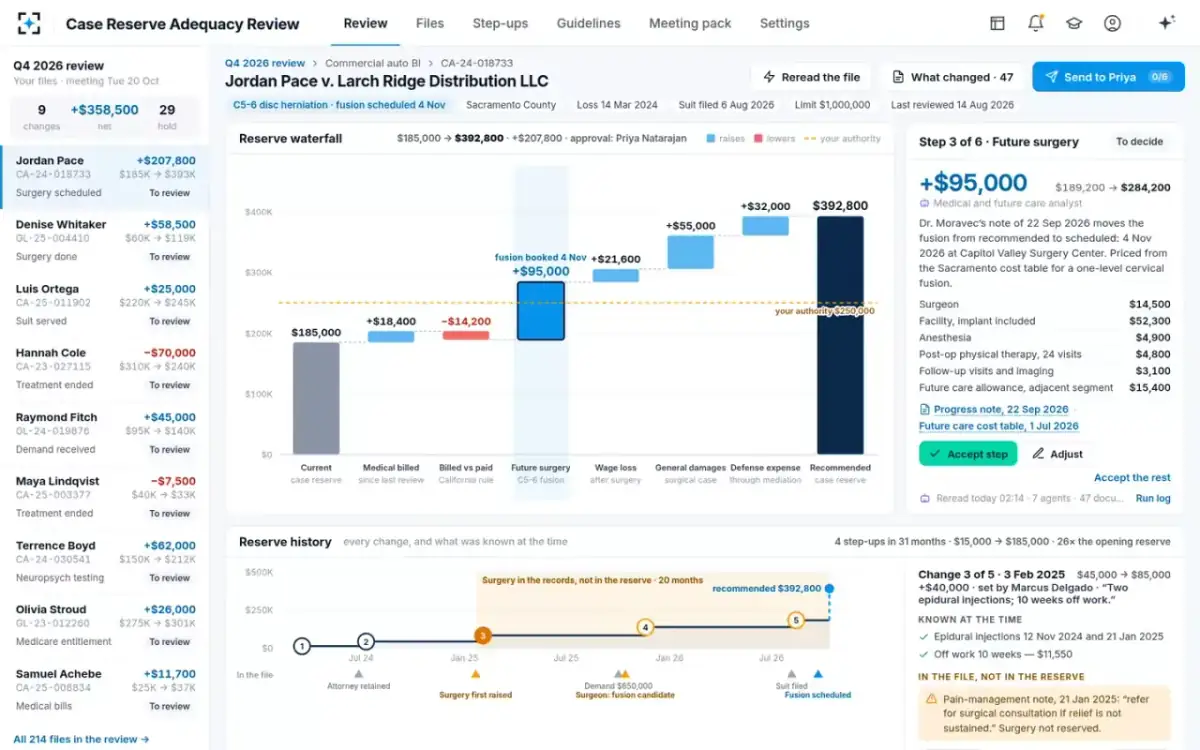
On the sample file the reserve stood at $185,000 after a change on 14 August 2026. Between then and the fourth-quarter reread, 47 documents arrived, 312 pages in all: 21 medical records, 14 bills, 6 letters and 6 litigation papers. Among them was a surgeon's progress note of 22 September scheduling a C5-6 anterior cervical discectomy and fusion for 4 November. The calculation runs from the current reserve, one step per change the agents found.
The sample file's reserve calculation, from $185,000 to $392,800
| Step | Amount | Running reserve | Evidence the step cites |
|---|---|---|---|
| Current case reserve | $185,000 | $185,000 | Change of 14 Aug 2026 |
| Medical billed since the last review | +$18,400 | $203,400 | 14 itemised provider statements, 14 Aug to 30 Sep 2026 |
| Billed vs paid, California rule | −$14,200 | $189,200 | Bill review: specials billed $71,850, paid $57,650 |
| Future surgery, C5-6 fusion | +$95,000 | $284,200 | Surgeon’s progress note, 22 Sep 2026; Sacramento cost table, 1 Jul 2026 |
| Wage loss after surgery | +$21,600 | $305,800 | 16 weeks off and 6 weeks light duty at $1,155 a week; employer wage statement |
| General damages, surgical case | +$55,000 | $360,800 | 23 closed fusion files in Sacramento County, median $150,000 |
| Defense expense through mediation | +$32,000 | $392,800 | Defense counsel’s budget of $57,000 through mediation, $25,000 already carried |
The future surgery step is the one that moves the file, and it is priced line by line from the venue's cost table: surgeon $14,500, facility with implant $52,300, anesthesia $4,900, 24 post-operative therapy visits $4,800, follow-up visits and imaging $3,100, and a $15,400 allowance for adjacent-segment care, because the surgeon's note records that the patient was counselled on adjacent-segment disease. The step cites the note and the table, and both are one click away from the number.
Two steps reduce or limit the reserve rather than raise it, and they matter as much. The billed-versus-paid step takes $14,200 out because the sample insurer's settings apply California's rule for past medicals at the amounts paid; in a state where juries hear billed amounts, the setting would be off and the step would not appear (which states use paid or billed amounts is covered in a sibling series). And the defense expense step stops at mediation: counsel's budget runs that far, so trial is not reserved until it is budgeted.
The reserve waterfall, with the surgery step open
Maker, checker, approver: who does what in the calculation
The calculation is safe to delegate only if the one who drafts a step is never the one who decides it. In the solution, agents draft and people decide. Seven agents divide the drafting: a file rereader, a medical and future care analyst, a wage loss estimator, a value and venue reviewer, a litigation expense reviewer, a guideline checker and a reserve recommender. The adjuster accepts or adjusts every step. A claim manager approves anything above the adjuster's authority.
From the reread to an approved reserve: what each agent may draft, and what it may never do
Agent
File rereaderReads every note, letter, record and bill added since the last review and lists each material fact with its date and page.
Never: summarises away a treatment recommendation
Agent
Medical and future care analystTotals specials billed and paid, applies the state rule for past medicals and prices treatment a provider recommends or schedules.
Never: prices care no treating provider has named, or second-guesses a provider
Agent
Wage loss estimatorWorks out lost earnings to date and expected, from wage statements and work restrictions.
Never: assumes time off a provider has not given
Agent
Value and venue reviewerSets the general damages range from the insurer’s closed files with the same injury group and county.
Never: prices on fewer than ten closed files, or predicts a verdict
Agent
Litigation expense reviewerReads the suit papers and counsel’s budget and sets the expense step.
Never: approves counsel’s budget
Agent
Guideline checker and reserve recommenderTest the file against the reserving rules, build the waterfall, draft the reserve note and route by authority.
Never: waives a rule, posts a reserve, or contacts claimants or counsel
A person decides
Casualty adjusterAccepts, adjusts or rejects each step; an adjusted step keeps the adjuster’s reason in the reserve note.
A person decides
Claim managerApproves a reserve above the adjuster’s authority, or returns it with a question; only then does it post to the claim file.
Adjusting is a normal outcome, not an override. On the sample file the adjuster could decide the closed files overstate value in this venue and set general damages at $45,000 instead of $55,000. The step changes, the recommended reserve becomes $382,800, and the reserve note records the reason and that the figure sits below the 23-file median of $150,000. A manager reading the note sees both the agents' range and the adjuster's judgment, which is the evidence an auditor or a settlement authority request later needs.
Who approves a reserve change?
Whoever holds authority for the new amount, under the insurer's own authority matrix. Most insurers give adjusters a reserve authority, managers a higher one, and route the largest or most limit-threatening reserves to a committee. The sample insurer's settings: a casualty adjuster up to $250,000, a casualty claim manager up to $500,000, and the large-loss committee above $500,000 or above half of the policy limit.
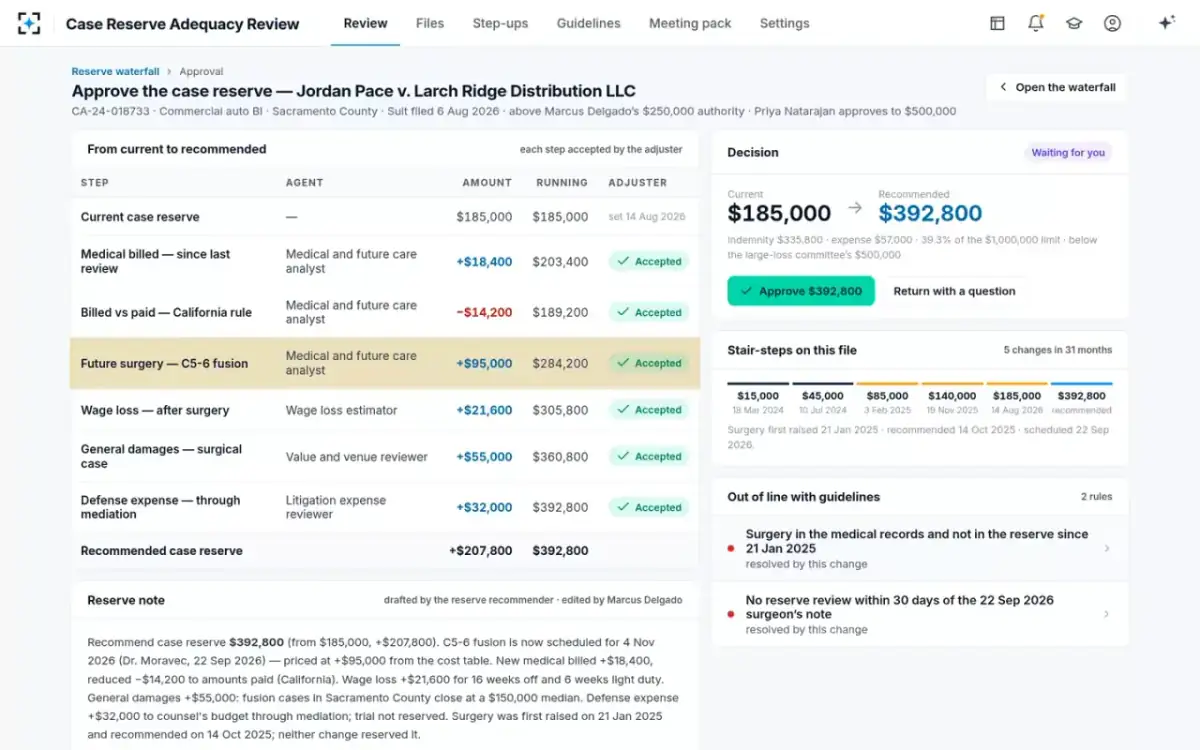
The sample file's recommended $392,800 is above the adjuster's authority, so once every step is accepted it goes to the claim manager with the waterfall and the drafted reserve note. She sees each step with the agent that built it and the adjuster's acceptance, the file's history of five reserve changes in 31 months, and the two guideline exceptions the change resolves, including surgery in the medical records but not in the reserve since 21 January 2025. She approves; the reserve posts to the claim file and the file moves to the reserving meeting pack.
The manager's approval: steps, acceptances and the file's history
Can AI recommend claim reserves?
It can draft them, and in most states it then falls under the insurer's governance of AI systems. The NAIC model bulletin on insurers' use of artificial intelligence lists claim management among the stages of the insurance life cycle where AI is used, alongside pricing, underwriting and fraud detection. The NAIC's map lists 29 jurisdictions as having adopted the bulletin as of 8 October 2026 (NAIC).
The bulletin asks insurers to scale their controls to, among other things, how far a person takes part in the final decision. A reserve recommendation that a person accepts step by step, with every step tied to a document, sits at the governed end of that scale. A model that posts a number into the claim system does not. The design question for a buyer is not whether AI touches the reserve but who decides it and what evidence they decide on.
There is also a plainer test: whether the recommendation can be checked against history. Run on files that have already closed, a calculation method shows whether it would have priced the surgery when the note arrived or when the demand did, and testing case reserve adequacy on closed files is how a buyer should judge any tool before trusting it with open ones.
What to look for in claim reserve calculation software
Look for evidence, control and fit with the insurer's own rules, in that order. A claim reserve tool that produces a better-looking number without showing where each part came from moves the risk rather than reducing it: the adjuster cannot defend it, the manager cannot check it, and the actuary cannot tell whether a change in average reserves is real.
Questions to ask any claim reserve calculation tool
- Does every component cite the page it came from?
A future surgery step should open the surgeon’s note and the cost table it was priced from.
- Can the adjuster accept, adjust or reject each step separately?
And is the reason for an adjustment kept with the reserve note and on the audit trail?
- Does it price only treatment a treating provider has named?
A tool that prices likely surgeries on its own is making a medical judgment the file does not support.
- Does the value step show the closed files behind its range?
And does it refuse to price when there are too few comparable files in the venue?
- Are state rules settings, with the date they took effect?
Billed or paid medicals, letters of protection and similar rules change by state and by year.
- Does it route by your authority matrix and never post on its own?
Above authority, the reserve should reach the claim file only after the approval.
- Does it keep indemnity and expense apart?
They are reported separately and set from different evidence.
- Can you test it on your own closed files before go-live?
Replay files at their review dates and count the facts it would have priced earlier.
Where the solution stops
Case Reserve Adequacy Review calculates case reserves on bodily-injury files: commercial auto and general liability injury claims in the sample book. It does not set workers' compensation benefit reserves, property reserves or IBNR, and it does not value a claim for settlement negotiation; a valuation and a reserve use some of the same evidence for different decisions. It reads the claim file the insurer already keeps, from notes and diaries to medical records, bill review, demands, suit papers, the reserve and payment history and closed files, and it never edits that file. Its agents never post a reserve, change a payment, or contact claimants or counsel.
What it adds is the discipline of the calculation: the same components on every file, every component tied to a page, every decision made by a named person, and a reserve history that shows what was known at each change. How the review cadence, thresholds and state rules become settings the insurer controls is the subject of claims reserving best practices written as rules.
Questions people ask
How is a claim reserve calculated?
On an injury claim, by pricing each expected future payment separately and adding them: unpaid medical specials, future treatment a provider has named, wage loss, general damages and, in litigation, defense expense, net of what has already been paid. The insurer's reserving philosophy decides whether the total is a best estimate of ultimate cost, an expected value or the limit.
What goes into a bodily injury reserve?
Past medical specials, reduced to amounts paid where state rules require it, priced future care, past and future wage loss, general damages for pain and suffering, and an expense reserve for defense costs if the claim is litigated. Reported losses are, in NAIC terms, expected payments on reported insured events not yet paid at the statement date.
Who approves a reserve change?
The person whose authority covers the new amount. The sample insurer in this guide gives adjusters $250,000, claim managers $500,000 and sends anything above $500,000 or above half the limit to a large-loss committee; each insurer sets its own matrix.
Can AI recommend claim reserves?
Yes, as a draft for a person to decide on, and in states that have adopted the NAIC AI model bulletin the insurer is expected to govern that use, including how far humans are involved in the final decision. A recommendation that cites its documents and is accepted step by step is far easier to govern than a model that posts a number.
What is a reserve waterfall?
A chart that runs from the current reserve to the recommended one through a bar for each change: up for new specials, surgery, wage loss or expense, down for amounts paid below billed or a resolved injury. It lets a manager see which component moved the reserve and open the evidence for each.
What is reserve authority?
The maximum reserve a person may set without a higher approval. It protects against a single person carrying a large exposure alone, and it decides where a recommendation goes: on the sample file, a $392,800 recommendation went from an adjuster with $250,000 authority to a manager with $500,000.