Claims reserving best practices, for the claim department that sets case reserves, are a short list of decisions an insurer makes once and then applies to every file: what a case reserve is meant to estimate, how often each open file is reread, which new facts force a review and how quickly, how large a change must be before it is recommended, who may approve what, which state rules apply to the medical numbers, and what every reserve change must record. Most insurers hold some version of these in a manual and many more in habit. The practice that separates a defensible reserving process from a merely conscientious one is writing them as rules with effective dates, so that they can be applied the same way on every file, tested on every file, and shown to actuaries, auditors and examiners as they stood on any day. Botminds' Case Reserve Adequacy Review keeps the rules of a bodily-injury reserving guideline as settings, applies them on every reread, and saves each change as a new rule version with who made it and when.
The settings shown come from a fictional insurer, Western Casualty Claims, as set up in the solution; the reasons behind them come from the actuarial and regulatory sources linked in the text.
The same practice as a habit and as a written rule
As a habit: Files reviewed when time allows before the quarter-end.
As a written rule, with a date: Every open bodily-injury file reread each quarter, finished five business days before the meeting.
As a habit: Reserve looked at when a letter arrives.
As a written rule, with a date: Review within 30 days of surgery recommended, suit, demand, attorney, death or Medicare entitlement.
As a habit: Small moves made or skipped by feel.
As a written rule, with a date: Recommend when the move exceeds $10,000 or 10%; smaller moves listed as holds.
As a habit: Billed or paid, depending on the adjuster.
As a written rule, with a date: Paid amounts where the state rule applies, as a setting with its legal basis.
As a habit: Added when bills arrive.
As a written rule, with a date: Set to counsel’s budget within 10 days of service of suit.
As a habit: Remembered settlements and comparables.
As a written rule, with a date: Closed files from the last five years, same injury group and county, at least ten.
As a habit: The manual is updated; nobody knows when.
As a written rule, with a date: Each change saved as a new version with who and when.
What are claims reserving best practices?
They are the rules that make case reserves consistent, timely and explainable, which is what everyone downstream of the claim desk depends on. Consistency matters because actuarial methods assume it: Berquist and Sherman's paper builds incurred projections on case reserves that are equally adequate from year to year. Timeliness matters because a fact that sits in the file unpriced becomes a late step-up. Explainability matters because statutory accounting asks management to record its best estimate, and an estimate nobody can explain cannot be shown to be one.
The best evidence of what good practice covers is what reviewers ask about. Berquist and Sherman's appendix of questions for a claims executive, written to support reserve adequacy testing, reads like a checklist of the rules a claim department should have written down: the objectives and guidelines for setting case reserves, whether they changed, how bulk or formula reserves are set, special procedures for large claims, caseload, and when claims are closed. It ends with a request every claim department should be able to meet on demand.
"Could you provide copies of all bulletins to the field issued in the last five years in which details of the changes in claims procedures are provided?"
Berquist & Sherman, questions for a claims executive, 1977
What is a reserving philosophy, and why write it down?
It is the insurer's answer to what a case reserve is supposed to estimate. The CAS study text sets out the options on one example: a best estimate of the ultimate settlement value including future inflation, the policy limit, the most likely outcome, or a probability-weighted expected value. On a $1 million claim that counsel gives a 20% chance of a limits loss, the mode is $0 and the expected value $200,000 (Friedland, CAS). Each is a philosophy; each produces different reserves on the same files.
Statutory accounting narrows the target for the total. Management records its best estimate; where it develops a range, "management’s best estimate of the liability within that range shall be recorded", the range "shall be realistic", and "there is not a specific requirement to include a provision for adverse deviation in claims" (NAIC SSAP No. 55). For the claim desk that argues against both habits that distort case reserves: padding every reserve as a margin, and reserving only the most likely outcome until an event forces a step.
The sample insurer's written philosophy is a best estimate of ultimate cost on the known facts. In practice that means a treatment a provider has scheduled is priced in full the day it is scheduled, a treatment nobody has named is not priced at all, and a value range from closed files is used only when there are enough of them. The philosophy is short. Writing it down is what lets the next three rules be applied the same way by every adjuster.
How often should reserves be reviewed?
Every open file on a fixed cycle, and every file again within a set period of a new material fact. On long-tail injury files the common cycle is quarterly, before the reserving meeting; some insurers choose monthly or half-yearly. The event clock matters more than the cycle, because the facts that drive injury reserves, a recommended surgery above all, arrive between cycles and otherwise wait for the next one.
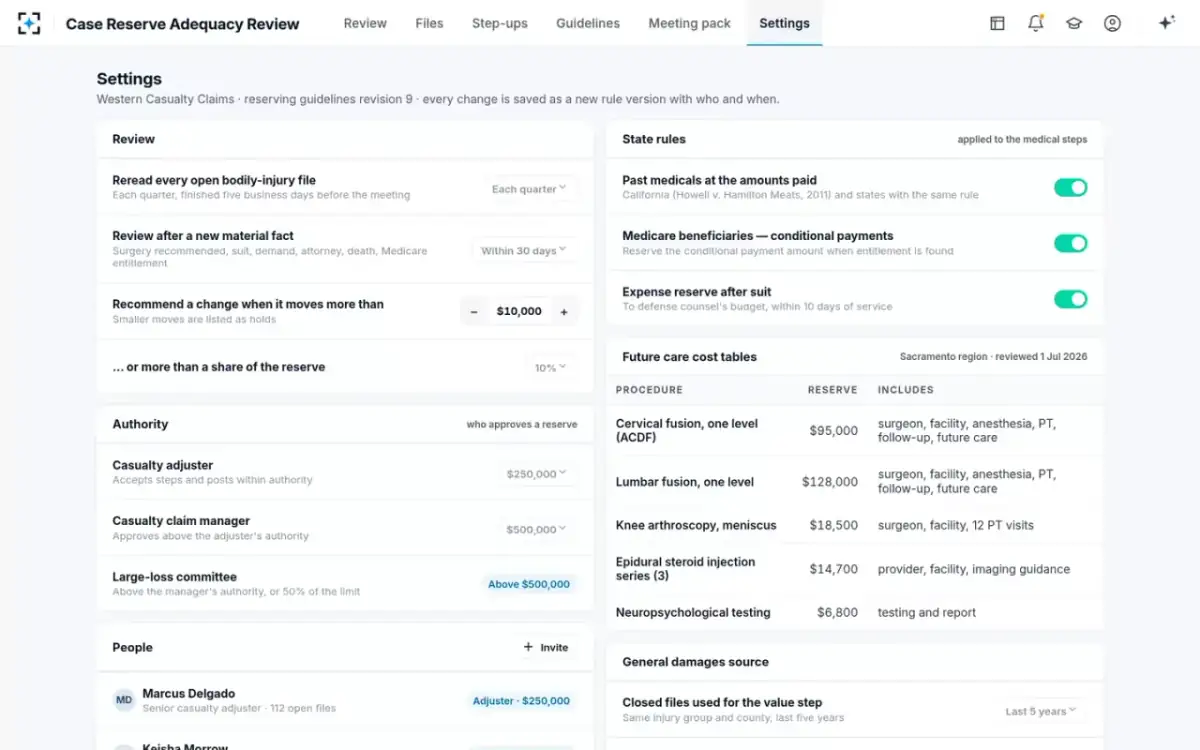
The sample insurer rereads every open bodily-injury file each quarter and requires a review within 30 days of a material fact, a choice among 14, 30 and 45 days in its settings. A replay of its closed and open files found that a recommended surgery waited a median of 141 days before the reserve moved, against 29 days for a suit; the event list therefore starts with surgery. The quarterly case reserve review shows how the cycle and the clock fit together in one quarter.
A bodily-injury reserving guideline as settings
| Rule | Sample insurer’s setting | Options the insurer can choose |
|---|---|---|
| Reread every open bodily-injury file | Each quarter | Each month · each quarter · each half-year |
| Review after a new material fact | Within 30 days | Within 14, 30 or 45 days |
| Recommend a change when it moves more than | $10,000 or 10% | A dollar amount, or 5, 10, 15 or 20% |
| Casualty adjuster authority | $250,000 | $150,000 · $250,000 · $350,000 |
| Casualty claim manager authority | $500,000 | $400,000 · $500,000 · $750,000 |
| Past medicals at the amounts paid | On | On · off, by state rule |
| Closed files used for the value step | Last 5 years | Last 3, 5 or 7 years |
| Fewest closed files to show a range | 10 files | 10, 15 or 20 files |
What threshold should trigger a reserve change?
One large enough to ignore noise and small enough that the reserve never drifts far from the facts. A threshold too low makes the reserve twitch with every bill and buries the meaningful changes in the meeting pack; one too high lets real movements accumulate unrecorded until they arrive as a step. A combined rule, a dollar amount or a percentage of the current reserve, handles small and large files alike.
The sample insurer recommends a change when the move exceeds $10,000 or 10% and lists smaller moves as holds with their reasons, so a hold is a written decision rather than an absence. In its fourth-quarter review that rule produced 46 recommended changes and 168 holds across 214 files. The threshold applies to recommendations, not to judgment: an adjuster can still adjust any step, and the reason is kept.
What should a claim reserve worksheet include?
Each component of the reserve, its amount, its evidence and who decided it. The traditional reserve worksheet on an injury file lists specials, future medical, wage loss, general damages and expense, often with a sentence of justification. Its weakness is that the evidence lives elsewhere and the worksheet records the conclusion, not the reasoning. A best-practice worksheet records the reasoning line by line.
What a claim reserve worksheet on an injury file should record
- The current reserve and the date it was set
Every recommendation starts from what is carried now.
- Each component as a separate line
Specials billed and paid, future care, wage loss, general damages, defense expense, each with its own amount.
- The document behind every line
The bill, the surgeon’s note, the wage statement, the closed files, counsel’s budget: by date and page.
- The rule applied, where a rule applies
Billed or paid medicals, Medicare, expense after suit, with the guideline version.
- What was known and not priced, and why
A possibility a provider has not named is left out on purpose; say so.
- Who accepted or adjusted each line, and the reason
An adjusted line keeps the adjuster’s reason in the reserve note.
- Indemnity and expense totals, and the share of the limit
The sample file: $335,800 and $57,000, 39.3% of a $1,000,000 limit.
- Where it goes for approval
Above authority, the name of the approver and the outcome.
How do you document reserving decisions?
With a reserve note that a stranger could check: what changed in the file, how each part was priced, which rule applied, and when anything relevant first appeared. Examiners read files this way. A 2009 Florida examination of a commercial auto and workers' compensation insurer reported that 27% of sampled claim files showed a reserving problem, including reserves adjusted immediately before a payment (Florida OIR); a reserve note that records why each change was made, and when the fact behind it arrived, is the evidence that answers such a finding.
The sample file's note shows the standard. It recommends $392,800 from $185,000; states that the C5-6 fusion is now scheduled, with the surgeon and date, priced at $95,000 from the cost table; records the billed amount reduced to amounts paid under the California setting, the weeks of wage loss, the closed-file median behind general damages, and defense expense to counsel's budget through mediation with trial not reserved. It closes with when surgery was first raised and that neither earlier change reserved it. A manager, an actuary and an examiner can each test it against the file.
Where AI drafts any part of that record, the documentation duty grows rather than shrinks. The NAIC's model bulletin on insurers' use of AI, adopted in 29 jurisdictions as of 8 October 2026, according to the NAIC's own map, tells insurers it sets out "the type of information and documentation that the Department may request during an investigation or examination" (NAIC). A recommendation tied step by step to documents, and accepted step by step by a named adjuster, is documentation of that kind by construction.
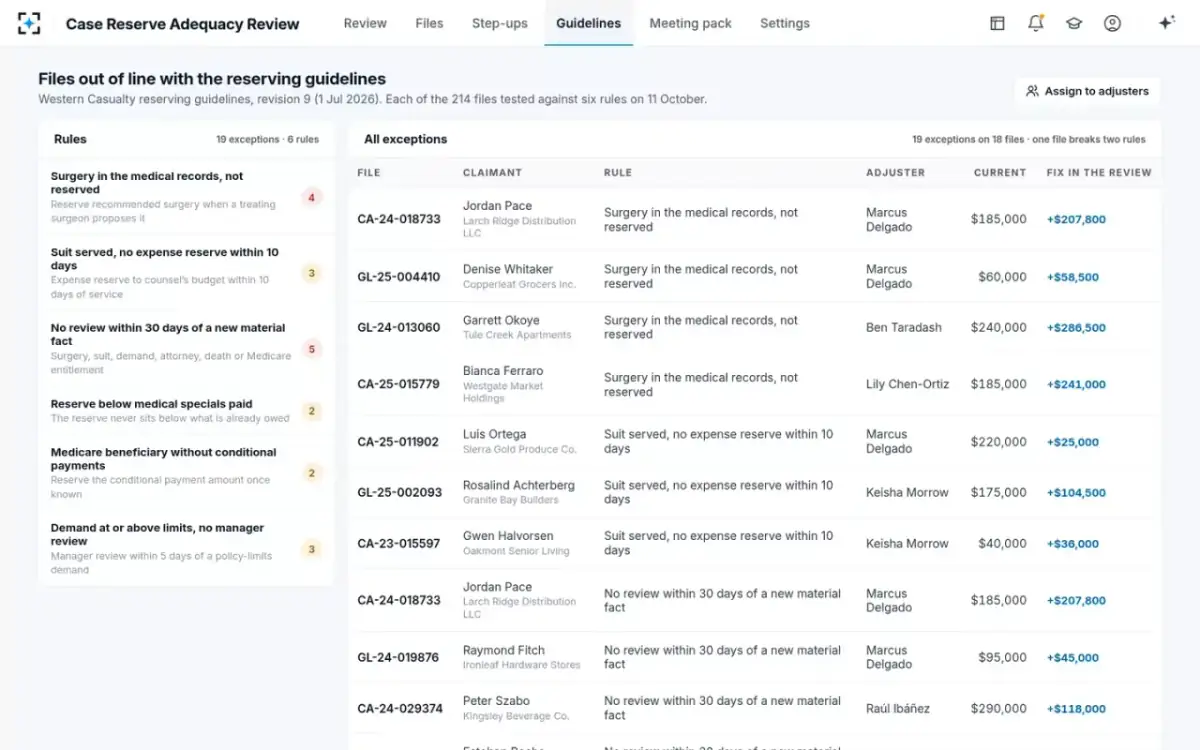
Files out of line with the written rules, tested every quarter
Authority, escalation and the large-loss committee
Write the authority matrix down as part of the reserving guideline, with the escalation for limit-threatening files. Authority decides who may set which reserve, and it also shapes reserves: a reserve set just below a threshold to avoid escalation is a reserving decision driven by the matrix, not the file. Berquist and Sherman's questions for a claims executive include whether large or catastrophic claims are reserved under special procedures (Proceedings of the CAS), because a separate route changes how large files develop.
The sample insurer's matrix gives casualty adjusters $250,000, claim managers $500,000, and sends reserves above $500,000 or above half the policy limit to a large-loss committee. Its guideline adds a rule for demands at or above the limit: manager review within five days. Settlement authority is a related but separate ladder, and what settlement authority is and who signs it is covered in a sibling series.
Tell the actuaries when reserving practice changes
Every change to a reserving rule is information the actuaries need, with its effective date. ASOP No. 43 asks the actuary to consider "changes in the practices used by the entity’s claims personnel" and, in determining whether conditions have changed, to "consider obtaining supporting information from the principal or the principal’s duly authorized representative" (Actuarial Standards Board). The claim department is that source. If it cannot say when its review cadence, event clock or authority limits changed, the actuary cannot adjust for it.
The CAS study text describes the opposite case: management reporting stronger case reserves that the data does not show, because the change had not worked through the organisation (Friedland, CAS). A versioned rule set removes the guesswork in both directions. It says what the rule was on each date; the reserve histories say whether files followed it.
The reserving guideline as settings, each change a new version
What to look for in reserving software for the claim desk
Software that applies the insurer's rules rather than its own, shows its evidence, and leaves decisions with named people. For the claim desk, as opposed to the actuarial department's reserving systems, the buying questions are about case reserves on files, and they are concrete.
Questions to ask any case reserving tool
- Are our reserving rules settings we control, with versions and dates?
Cadence, event clock, thresholds, authority, state rules, cost tables and the closed-file window.
- Does it reread every open file, or only flagged ones?
Reviews by exception are the source of stair-stepped reserves.
- Does each recommended change come in parts, each with its document?
A total without components cannot be checked or defended.
- Can adjusters accept, adjust or reject each part, with reasons kept?
And can a manager see who accepted what before approving?
- Does it route by our authority matrix and never post on its own?
Above authority, the reserve should reach the claim file only after approval.
- Does it test every open file against our guidelines each cycle?
Exceptions with the recommended fix, not a report to read later.
- Can it replay our closed files at their review dates?
The fairest test of any tool before it touches an open file.
- Does it produce the reserving meeting pack from the same work?
Totals by line, large moves with triggers and approvals, file pages with the reserve history.
How Case Reserve Adequacy Review applies the rules
It turns a bodily-injury reserving guideline into rules that run on every open file. The reread happens on the insurer's cycle and clock; the medical, wage, value and expense steps follow the insurer's state rules, cost tables and closed-file window; the guideline checker tests six rules on every file; the reserve recommender drafts the note and routes by the authority matrix. Review cadence, authority limits, state rules and cost tables are all settings, and each change is saved as a new rule version. Adjusters accept each step; managers approve above authority; the agents never post a reserve, change a payment, or contact claimants or counsel.
It does not write the insurer's philosophy for it, set IBNR, or replace the actuarial reserving system. It covers bodily-injury case reserves, not property, workers' compensation benefits or aggregate reserving. How the insurer's guideline becomes a recommended number on one file is shown in the claim reserve calculation, step by step.
Questions people ask
What are claims reserving best practices?
A written reserving philosophy, a fixed review cycle plus a clock after new material facts, a change threshold, an authority matrix, state rules for medical amounts, a reason and evidence for every change, and a dated history of when any of these rules changed. Together they make case reserves consistent, timely and explainable.
What is a reserving philosophy?
The insurer's statement of what a case reserve is meant to estimate: a best estimate of ultimate cost, the most likely outcome, an expected value or the policy limit. The CAS study text shows the same claim can be reserved at $0, $200,000 or $1,000,000 depending on which is chosen.
How often should reserves be reviewed?
Long-tail injury files are commonly reread at least quarterly, before the reserving meeting, with a review also required within a set period of any new material fact. The sample insurer in this guide uses a quarterly reread and a 30-day clock.
What threshold should trigger a reserve change?
A combined dollar and percentage threshold that filters noise without letting real movements accumulate; the sample insurer uses $10,000 or 10%. Moves below it should be recorded as holds with their reasons, so the decision not to change is also on the record.
What should a claim reserve worksheet include?
The current reserve, each component as a separate line with its amount and document, the rule applied, what was deliberately not priced, who accepted each line, the indemnity and expense totals with the share of the limit, and the approval route.
What are reserving guidelines?
The insurer's written rules for setting and reviewing case reserves: philosophy, review cycle, triggers, thresholds, authority and state rules. Actuaries and examiners ask for them, and for their changes over time, because they explain how the reserves were set.