Settlement authority is the amount an insurer allows a named person to agree to pay to resolve a claim without asking anyone above them. On a bodily injury claim it is the moment a valuation becomes a commitment: the adjuster proposes a number, and someone holding enough authority signs it. The hard part is not the signature but what it rests on. A claim manager who signs thirty requests a week rarely has time to check what the same injury paid in the same county, while the law treats an unreasonable refusal of a demand within the policy limit as the insurer's risk. Botminds' Bodily Injury Claim Valuation is built for that moment: six agents read the injury file, find comparable closed files and published verdicts in every county where the suit could be filed, and put a cited range in front of the person who signs.
The file on this page is fictional sample data, run through the solution: a neck injury claim at an invented carrier, Harborline, with invented people, firms and cases. It shows the ladder at work on an ordinary Monday: a $95,000 offer that sat below most of the evidence, and a $165,000 grant signed eleven minutes after it was asked for.
The authority ladder in the sample casualty unit
$100k
each adjuster, Tomás Rivera and eleven others
$250k
the casualty claim manager
$500k
the VP of casualty claims
Abovelimit
the home office, with a written excess letter to the insured
What is settlement authority in insurance?
In insurance, settlement authority is a delegated limit: the carrier, which controls the defence and settlement of a liability claim, lets each person settle up to a stated amount and sends anything larger to someone with a higher limit. It exists because the insurer, not the policyholder, decides whether to pay. The Supreme Court of Illinois put the reason plainly in 2001: a liability policy typically gives the insurer the right to "make such investigation, negotiation, and settlement of any claim or suit as it deems expedient", and that "exclusive control" is the basis of the duty to settle.
The limit is personal, not positional. Two adjusters with the same title can hold different amounts, and a manager may grant authority on one file and decline it on the next. What makes it authority rather than opinion is that it is written down: the unit's rules name each level, and each grant names the person and the time. In the sample unit, Tomás Rivera holds $100,000 and carries 140 open injury files. The one that matters this week needs more than he holds.
Authority also has a direction. A manager can grant more than an adjuster asked for, or less. In both cases the grant is the carrier's answer to the claimant, and whatever reasons sit behind it are the reasons a regulator, a court or a policyholder may later ask to see.
Who has settlement authority at an insurance company?
The people who can bind the insurer are the adjuster, up to their own limit, and the managers above them, each to theirs; above the policy limit the decision leaves the claim unit altogether. Around them sit people who hold no authority but shape every grant: the litigation specialist who takes a file once suit is filed, and the defence counsel liaison who knows which plaintiff firms try cases and where. The sample unit has all five.
Five people carry one injury value, and three of them can sign it
Today
Values six to ten files a week from memory and an injury score; proposes a number and writes the authority request.
With agents
Proposes from a cited range of what the same injury paid, in every county where suit could be filed.
Still theirs: Up to $100,000 of authority, and the decision to save the note
Today
Signs about thirty authority requests a week, many resting on an adjective rather than a case.
With agents
Reads the comparable cases pinned to the request and grants or pushes back in minutes.
Still theirs: Up to $250,000 of authority
Today
Owns severity and consistency: "Two desks, same injury, a $90,000 difference."
With agents
Sees the first authority set on the same injury, desk by desk, against the range for that venue.
Still theirs: Up to $500,000 of authority
Today
Takes the file once suit is filed: "By the time I get it, the venue fight is already lost."
With agents
Sees the venue risk on the file while the demand is still open.
Still theirs: Trial strategy with counsel, no authority of their own
Today
Knows which plaintiff firms file where, but the desks rarely hear it.
With agents
Keeps the firm profile every valuation now reads.
Still theirs: The firm history, no authority of their own
The ladder in your own unit may have more rungs, a committee at the top or a separate limit for files in suit. The question this page asks is the same at every rung: when a person signs, what are they signing on?
Why authority exists: the duty to settle within the limit
Authority exists because an insurer that controls settlement owes its policyholder a duty to use that control in good faith, and the unfair claims laws make poor settlement practice a regulatory matter as well. The NAIC's Unfair Claims Settlement Practices Act, a model that states adopt in their own versions, treats it as an unfair practice to fail to try in good faith to settle promptly and fairly once liability is reasonably clear, and to force people to sue by offering far less than they later recover in court. The model act reaches these as a general business practice or a flagrant one, which is why a unit's pattern of first offers matters as much as any single file.
The sharper risk is the excess judgment. In Illinois the duty to settle "arises when a claim has been made against the insured and there is a reasonable probability of recovery in excess of policy limits and a reasonable probability of a finding of liability against the insured", and it does not arise until the claimant demands settlement within the limits. In Texas, as the Fifth Circuit summarised the Stowers doctrine in March 2025, an insurer that fails to accept a covered demand within limits that an ordinarily prudent insurer would accept, and then faces a verdict above the limit, can be liable for the whole judgment, including the part above the limit.
Each of those tests turns on a value: whether recovery above the limit is reasonably probable, whether a prudent insurer would accept. That is why an authority request that cites nothing is weak twice over. It is weak as a decision, and it is weak later, as evidence of how the decision was made. On the sample file, liability was clear (the insured was cited for failing to reduce speed) and a $250,000 policy-limits demand was open. In Cook County, where the insured lives and suit could be filed, 11 of the 15 comparable cases paid more than $250,000.
What is a settlement authority request, and what should it carry?
A settlement authority request is the adjuster's written ask for permission to offer or accept an amount above their own limit; it should carry the injury and specials, what comparable cases paid, the venue risk and a recommendation, each amount traceable to a source. In most units it is a note on the claim and a message to the person above. The request is where a valuation is either shown or merely asserted.
In Bodily Injury Claim Valuation the note writer drafts that request from the range, in four parts, and every amount links to the case it came from. On the sample file the request read, in substance: a C5-C6 herniation with two injections and fusion recommended but not done; specials of $77,660; seventeen comparable DuPage County cases with a median of $142,000 and a middle half of $118,000 to $165,000; a Cook County median of $322,000 if suit is filed where the insured lives; and a recommendation to raise the $95,000 offer to $165,000 and settle inside the demand, which expired on Friday 30 October 2026.
An authority request with every amount cited to its case
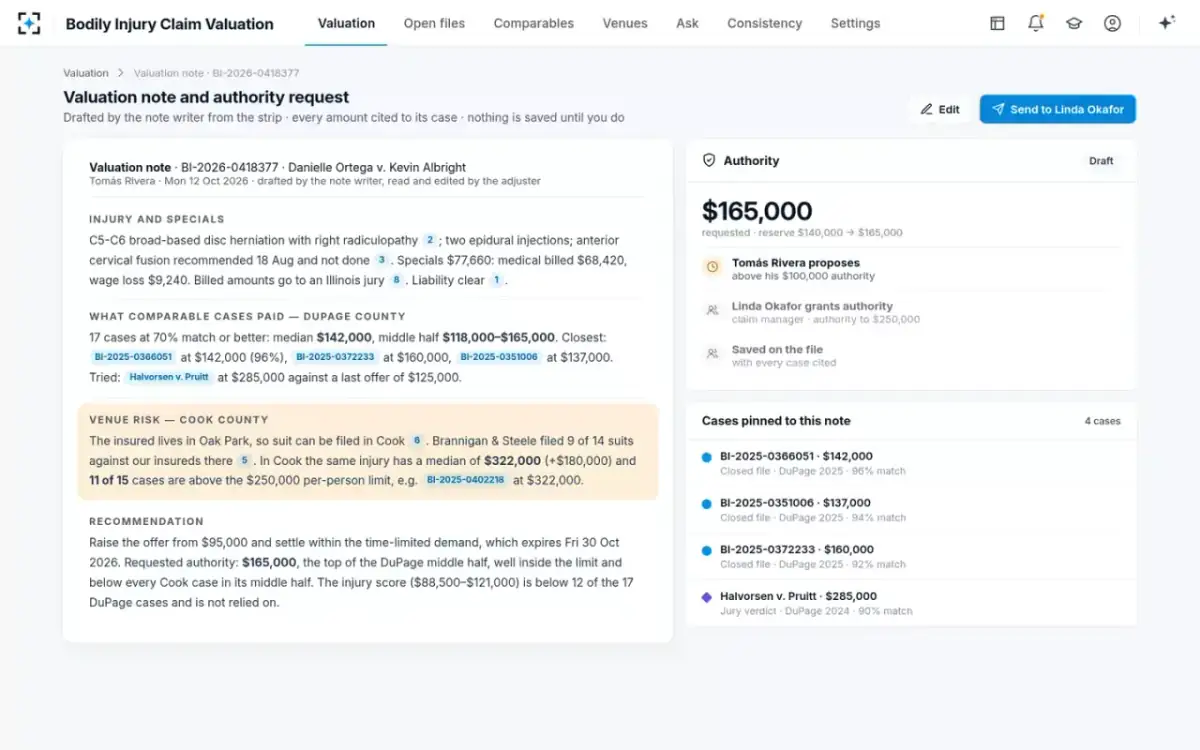
Linda Okafor, the sample unit's claim manager, has a line for requests that cite nothing: "Show me the cases, not the adjective." Set a request built from memory beside the one this file produced.
Two authority requests for the same file
A request built from memory: Neck injury, ongoing treatment, surgery possible.
The request on the sample file: C5-C6 broad-based herniation, two epidural injections, fusion recommended 18 Aug and deferred; each item cited to its page in a 412-page file.
A request built from memory: Medicals about $68k.
The request on the sample file: $68,420 billed and $31,870 paid, plus $9,240 of wage loss; billed is the figure an Illinois jury hears.
A request built from memory: In my experience, low six figures.
The request on the sample file: DuPage: 17 cases, median $142,000, middle half $118,000–$165,000, each case one click away.
A request built from memory: Not mentioned.
The request on the sample file: Suit can be filed in Cook, where the insured lives: median $322,000, 11 of 15 cases above the limit.
A request built from memory: Request $150,000 authority.
The request on the sample file: $165,000, the top of the DuPage middle half, inside the limit and the demand window.
What happens when a claim exceeds the adjuster's authority?
When the value a file needs is above the adjuster's limit, the adjuster cannot offer it; the request goes to the next person with enough authority, who grants it, grants less or sends it back, and the grant is written down with a name and a time. If the amount needed is above the policy limit, the question is no longer the claim unit's alone, because the excess is the policyholder's exposure.
On the sample file the agents' part took 5 minutes 48 seconds. Tomás Rivera sent the $165,000 request at 15:31 on Monday 12 October. Linda Okafor read the four pinned cases and granted it at 15:42, eleven minutes later. The reserve moved from $140,000 to $165,000, and Tomás saved the note to the file with its cases attached.
From a range to a grant: who does what on the sample file
Agent
Range builderPlaces 17 DuPage and 15 Cook comparables on one dollar axis and computes each venue’s median and middle half.
Never: sets authority
Agent
Note writerDrafts the four-part note and authority request, every amount cited to its case.
Never: saves to the file without the adjuster
A person decides
Adjuster, to $100,000Edits the note and proposes $165,000 at 15:31, above his own limit.
A person decides
Claim manager, to $250,000Reads the pinned cases and grants $165,000 at 15:42.
A person decides
AdjusterSaves the note to the claim with its four cases; the reserve moves to $165,000.
The interesting case is the one where the manager declines. The grant and the refusal both stay on the claim with the cases they rested on, so a later reader can see that the manager saw a Cook median of $322,000 and chose to hold at a lower number, and why. A refusal that cites the same evidence as the request is a decision. A refusal with no evidence is just a lower number.
Authority and the clock on a policy-limits demand
A demand within limits with a deadline turns authority into a timing question: every day a request waits for a signature is a day off the window in which the insurer can answer. On the sample file the claimant's lawyers sent a $250,000 demand, the per-person limit, received on 30 September with 30 days to accept. The $95,000 offer went out on 2 October and the reserve was set on 4 October. By the morning the file was valued, Monday 12 October, 18 days were left.
The demand clock is not a reason to pay the limit. It is a reason to know, early, whether the limit is where the evidence points. In DuPage County, where the crash happened, it was not: the middle half of comparable cases ran from $118,000 to $165,000. In Cook County it was, and the plaintiff firm on this file had filed 9 of its 14 suits against the carrier's insureds there. The firm's pattern on files like this one, kept by the unit's defence counsel liaison, was to let the demand lapse and file in Cook within about 40 days. That is the kind of knowledge that should reach the person signing before the deadline, not the litigation specialist after it.
The order of work matters as much as the speed. A unit that values the file first and then decides who must sign can use the whole window. A unit that waits for the adjuster to feel the file has outgrown his limit may learn it from the complaint.
Full settlement authority at mediation and settlement conferences
Courts ask for someone with authority to be reachable when settlement is discussed, but they accept that the person in the room may only be able to recommend. Federal Rule of Civil Procedure 16 lets a judge require "that a party or its representative be present or reasonably available by other means to consider possible settlement". The 1993 committee note names "a representative from an insurance carrier" as one such person, and adds a realistic caution: where large sums are involved "there may be no one with on-the-spot settlement authority", and the most a court should expect is access to a person with "a major role in submitting a recommendation".
State courts and mediators set their own attendance rules. The practical lesson is the same wherever the session is held. The adjuster who attends carries a number granted in advance, and the case for moving off it has to reach the person who can grant more within the hour. A request that already cites the comparable cases can travel that fast. One built from memory cannot.
Settlement authority is not the reserve
The reserve is the insurer's estimate of what a claim will cost, held on its books; authority is permission to pay a specific amount now. The two often move together but answer different questions, and a file can be reserved above the authority granted or the reverse. On the sample file four numbers were in play at once, and only one of them was a signature.
Four numbers on one file, and only one is a grant
$95k
the offer made on 2 October
$140k
the reserve, set on 4 October
$165k
authority granted at 15:42 on 12 October
$250k
the demand, equal to the per-person limit
The gap between the offer and the evidence was the real finding. The $95,000 offer sat below 14 of the 17 DuPage comparables and $23,000 under their middle half. The offer sat inside the file's injury-score band of $88,500 to $121,000, a band that on this file is the same in every county. An adjuster who sees that gap before the demand expires can fix it inside his own authority or ask for more. One who sees it after suit is filed is explaining it.
Where the agents stop, and the signature stays human
The agents compute and draft; people propose, grant and save. In Bodily Injury Claim Valuation no agent can set authority, contact the claimant or counsel, or write to the claim on its own. The range builder is a calculation, not a model, and every mark on its strip is a case with a source. Any comparable can be taken off the strip, but only with a reason that stays with the file.
Authority granted, by name and by minute
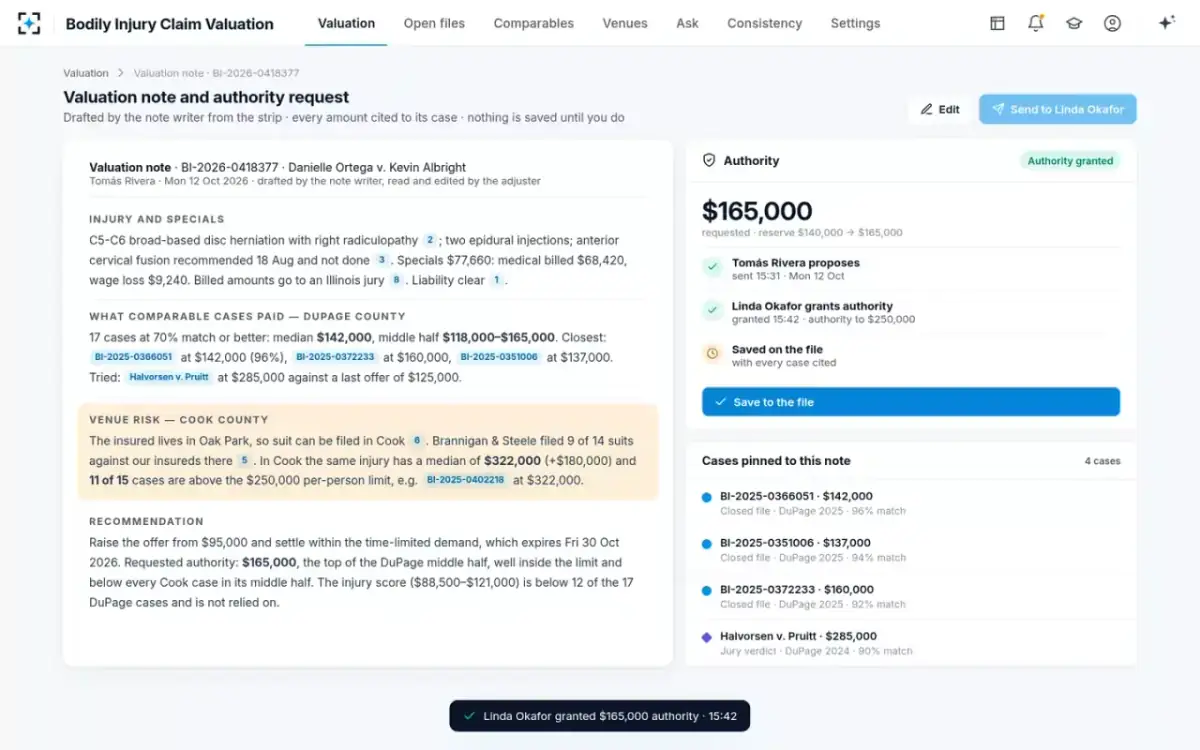
That division is also what makes the grant defensible. If a regulator's market conduct examiner or a court later asks how the $165,000 was reached, the answer is on the claim: which cases, which venue, who proposed and who granted. How those agents read the file and what each one may never do is covered in what valuation agents may not do, and the same file is valued twice, by hand and with the solution, in one C5-C6 herniated disc file, valued two ways.
What to ask of every authority request
A claim manager can raise the quality of every grant without new software by asking the same six questions of each request. They work whatever tool the adjuster used, and they make inconsistency between desks visible, which is the subject of why nine desks give nine numbers.
Six questions before signing any injury value
- Which comparable cases, and how close?
Named files or verdicts with the injury, treatment and surgery status that make them comparable, and what differs.
- Which venues can the suit be filed in?
The crash county and every defendant’s county under the state’s venue statute, with the range in each.
- Where does the current offer sit?
Against the median and middle half of the comparables, not against the demand.
- Is there a demand within limits, and when does it lapse?
The date, and whether the value in the likeliest venue could exceed the limit.
- What was left out, and why?
Excluded cases with the reason for each; a range that drops its highest cases without saying so is not a range.
- What would change the number?
Surgery done or declined, a second defendant, a firm known to try cases. A request should say what would move it.
Questions people ask
What does settlement authority mean in insurance?
It means permission, held by a named person, to commit the insurer to pay up to a stated amount to resolve a claim. Above that amount the person must ask someone with a higher limit. In the sample unit on this page, adjusters hold $100,000, the claim manager $250,000 and the VP of casualty claims $500,000.
Why do adjusters need authority to settle?
Because the insurer controls settlement and owes its policyholder good faith in using that control. The Supreme Court of Illinois called that control the source of "a conflict of interest between the insurance provider and its insured", and authority levels are how a carrier makes sure larger decisions get a second look.
Can an adjuster settle a claim above their authority?
No. The adjuster asks for more, and the person holding enough authority grants it, grants less or declines. In the sample file the request went from the adjuster to the claim manager at 15:31 and was granted at 15:42.
Does a lawsuit change the duty to settle?
Not in Illinois. The state's Supreme Court held in 2001 that the duty to settle neither begins with the policy nor waits for a lawsuit; it arises with a demand within limits, a reasonable probability of liability and a reasonable probability of recovery above the limits.
Who decides on a value above the policy limit?
A value above the limit exceeds what the policy pays, so the excess is the policyholder's own exposure and the decision is bigger than one desk's. In the sample unit such files go to the home office, and the insured receives a written excess letter.
How long should an authority request take?
As long as it takes to read the evidence behind it. On the sample file the manager granted $165,000 eleven minutes after the request arrived, because the four comparable cases were pinned to it and the venue risk was set out; in the sample unit a cited range built by hand takes one to two days before any request is written.