Personal injury software for case evaluation is software that helps put a value on an injury claim, and for an insurer it comes in three kinds: injury scores that turn coded medical inputs into a value band, verdict and settlement research that finds published outcomes, and comparable-case valuation that reads the open file and lays it beside what similar injuries actually paid. The buying question is not only what the software can compute but what it may decide, because the insurer answers for every settlement whatever tool produced the number. Botminds' Bodily Injury Claim Valuation is the third kind, built as six agents that read the file, search closed files and published verdicts in every county where the suit could be filed, and draft a cited note, while the adjuster proposes and a named manager grants authority.
This guide is written for the insurer's side: claims leaders and claims technology teams choosing a tool for bodily injury desks. Plaintiff firms search for the same words, and the case-management and intake software they buy is a different category with a different job. The examples come from a fictional sample file run through the solution, with invented people, carrier, firms and cases.
Six agents, and the line none of them crosses
| Agent | What it does | What it may never do |
|---|---|---|
| File reader | Reads every page of the open injury file and writes the injury, spinal level and ICD-10 codes, each treatment with its date and provider, surgery status, and specials billed and paid. | Estimate a value. Every item it writes cites its page. |
| Comparable finder | Searches the carrier’s closed injury files and published verdicts and settlements, scores each on level, herniation, treatment, surgery, liability, age and specials, and says why it matches and how it differs. | Use a file that is still open, show a claimant’s full name, or include a case below the match threshold without marking it. |
| Verdict reader | Reads verdict and settlement reports for court, case number, injury, award and last offer before trial, and moves amounts to current dollars. | Use an amount without its report, or drop the amount actually awarded. |
| Venue analyst | Works out every county where suit can be filed, with comparables, verdicts and time to trial in each, and profiles the plaintiff firm. | Predict a particular jury or judge. Venue rules are cited by section. |
| Range builder | Places the comparables on one dollar axis and computes the median and middle half per venue, with the offer, demand, limit and injury score marked. | Set authority. It is a calculation, not a model. |
| Note writer | Drafts the valuation note and authority request in four parts, every amount cited to its case. | Save to the claim without the adjuster, or send a request above the adjuster’s limit anywhere but to the claim manager. |
What is personal injury case evaluation software?
It is any software an adjuster, supervisor or litigation specialist uses to estimate what an injury claim is worth; the three kinds differ in what evidence they look at. A score knows the injury as codes. Verdict research knows the small set of cases that reached a reported outcome. Comparable-case valuation knows the carrier's own closed files as well, because those are where most of the evidence about what an injury pays actually lives.
Three kinds of case evaluation software, and the question each one answers
| Kind | Works from | Answers well | Cannot tell you |
|---|---|---|---|
| Injury evaluation score | Coded medical inputs entered by the adjuster, run through the tool’s rules | A consistent starting band for routine injuries | What this injury paid in this county; how far it reflects venue depends on how it is configured |
| Verdict and settlement research | Published jury verdicts and reported settlements, searched by injury, court and date | What juries awarded in cases that went to trial or were reported | What the carrier itself paid on the same injury, which is most of the evidence |
| Comparable-case valuation | The open file, the carrier’s closed files, published reports and the venue rules | Where this claim sits among cases like it, venue by venue, each one cited | What a particular jury will do; it shows the range, it does not predict a verdict |
The categories are not rivals. A score is cheap to run on every file. Verdict research is indispensable once a file is in suit. Comparable-case valuation earns its keep on the files where the value is contested and the venue is in play, which is also where the gap between desks is widest. A buyer who knows which files cause the reserve surprises can tell which kind of tool those files need.
How do insurers evaluate injury claims with software today?
Mostly in pieces: the adjuster reads the medical records and bills, codes the injury into a score, recalls a few files, perhaps searches verdicts, and writes a note asking for authority. Each step is reasonable, and the joins between them are where time goes. In the sample unit the whole sequence, done carefully by hand on one file, is estimated at about thirteen hours: three reading the records and demand, four pulling comparable closed files, three reading verdict and settlement reports, one working out where suit can be filed, an hour and a half writing the note, and half an hour of review.
The time explains the habit. Few desks carrying 140 open files can spend a day and a half per valuation, and in the sample unit's own account the comparable files and the verdict reports are the steps that get skipped, so the score carries more weight than it was built to. In the solution the agents' part of the same work took 5 minutes 48 seconds on the sample file. What remains for people, the estimate says, is about two hours of reading, judging and review, which is the part that should never have been squeezed.
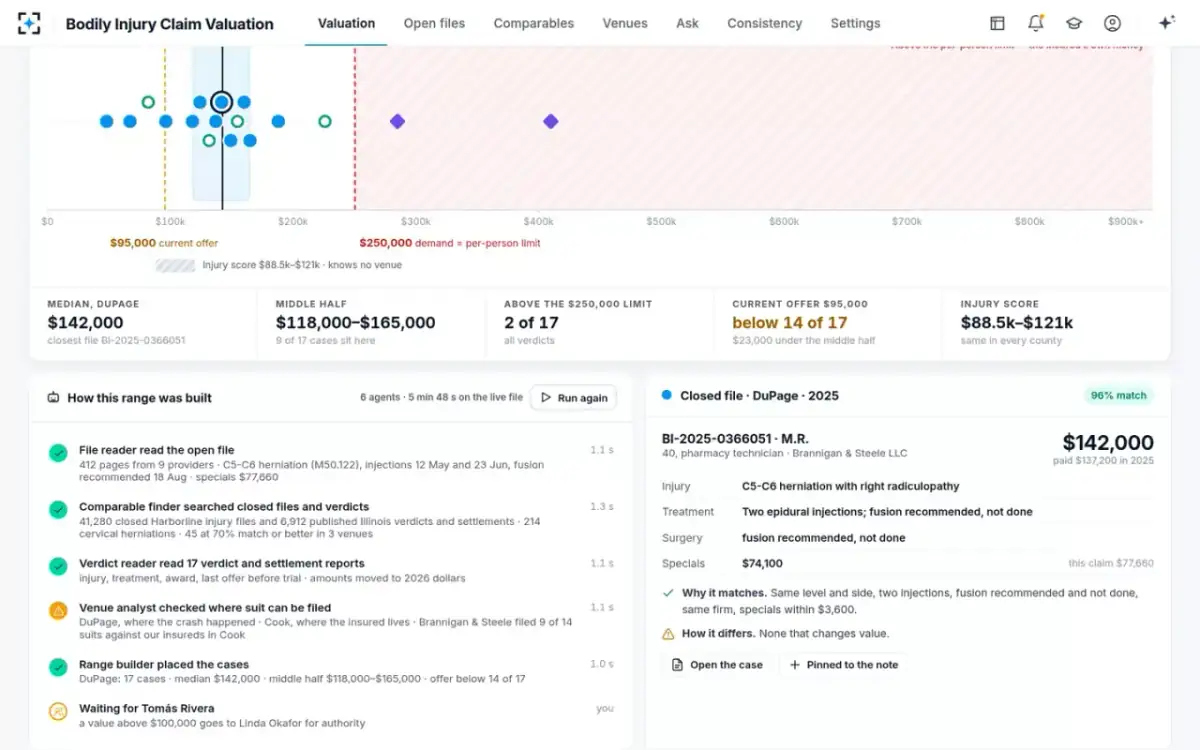
How the range was built: each agent's step, and what it found
What data does injury valuation software use?
Valuation software can only be as good as four sources: the open file, the carrier's closed files with what was actually paid, published verdict and settlement reports, and the rules for where suit can be filed. A fifth, the plaintiff firm's history with the carrier, is what turns a range into a venue risk. Each has a condition a buyer should test before signing.
The open file must be readable as documents, not only as codes, because the facts that move value hide in narrative: a surgical consult that recommends fusion and a patient who defers it, an emergency visit the same evening, a wage loss of six weeks. Closed files must carry the injury, treatment, venue, firm and the amount paid, with dates of loss; a closed file with a payment and nothing else is a number without a reason. Verdict reports must carry the court and case number so an award can be checked, and the last offer before trial where it was reported. Venue rules must be the statute, cited by section: in the sample file, Illinois's general venue section. And firm history must come from the carrier's own litigation files, kept by someone who knows them.
On the sample file those sources produced 214 cervical herniation cases from 41,280 closed files and 6,912 published Illinois verdicts and settlements, of which 45 matched at 70% or better across three counties. The 70% threshold, the 2021–2026 window of closed cases and the twelve-case minimum per venue are the unit's own settings. Below the minimum, the strip says so and widens to neighbouring venues rather than pretending to precision.
Can AI value a personal injury claim? It can compute; people decide
AI can read an injury file, find comparable cases and compute a range faster and more completely than a person working by hand; it cannot decide what the insurer pays, and regulators judge the decision, not the method. The NAIC's model bulletin on insurers' use of AI, which names claim management among the uses it covers, is direct about this: an insurer's actions must comply with the state's unfair trade practices and unfair claims settlement laws whatever method produced them. The UCSPA is the state version of the NAIC's unfair claims settlement practices model, which treats failing to settle in good faith once liability is reasonably clear as an unfair practice.
The bulletin is not a distant model. Illinois, the state in the sample file, is listed as adopting it by Company Bulletin 2024-08 on 13 March 2024, one of 29 jurisdictions on the NAIC's adoption map as of 8 October 2026. Among the factors the bulletin says should scale an insurer's controls is how far people are involved in the final decision (the bulletin's proportionality test). A valuation tool that leaves the final number to a named person is not a workaround. It is the design a regulator expects to see. What the AI bulletin requires of an insurer's governance programme as a whole is a compliance subject of its own; this page stays with the claim desk.
The labour data point the same way. The Bureau of Labor Statistics' outlook has jobs for adjusters, examiners and investigators falling by about 6% between 2025 and 2035, and lists technology among the causes. Some tasks, not the judgement. The tasks that move to agents are the reading, searching and arithmetic. The ones that stay are deciding what a case is worth and answering for it.
Does valuation software set settlement authority?
It should not, and in Bodily Injury Claim Valuation it cannot: the range builder computes the range, the note writer drafts the request, and only people propose and grant amounts. The run on the sample file ended with a line that makes the boundary visible: "Waiting for Tomás Rivera — a value above $100,000 goes to Linda Okafor for authority." How the authority ladder itself works, rung by rung, is the subject of what settlement authority is and who signs.
Agents compute and draft; people propose, grant and save
Agent
File readerReads 412 pages from 9 providers and writes the injury, treatment and specials, each cited to its page.
Never: estimates a value
Agent
Three search agentsComparable finder, verdict reader and venue analyst find 45 matches across three counties and the venues where suit can be filed.
Never: predict a jury or judge
Agent
Range builder and note writerCompute the median and middle half per venue and draft the cited note.
Never: set authority or save
A person decides
AdjusterReads, edits and proposes $165,000, above his $100,000 limit.
A person decides
Claim managerGrants $165,000 eleven minutes later; the adjuster saves the note.
What is the difference between an injury score and comparable cases?
An injury score turns the coded injury into a value band from rules; comparable cases show what injuries like this one actually paid, case by case, in the county where the suit would be heard. The first is a model of value, the second is evidence of it. On the sample file they disagreed in a way that mattered.
The same neck injury, seen by a score and by its comparables
Injury evaluation score: A band of $88,500 to $121,000.
Comparable cases: DuPage: median $142,000, middle half $118,000–$165,000 across 17 cases.
Injury evaluation score: On this file, the same band in every county.
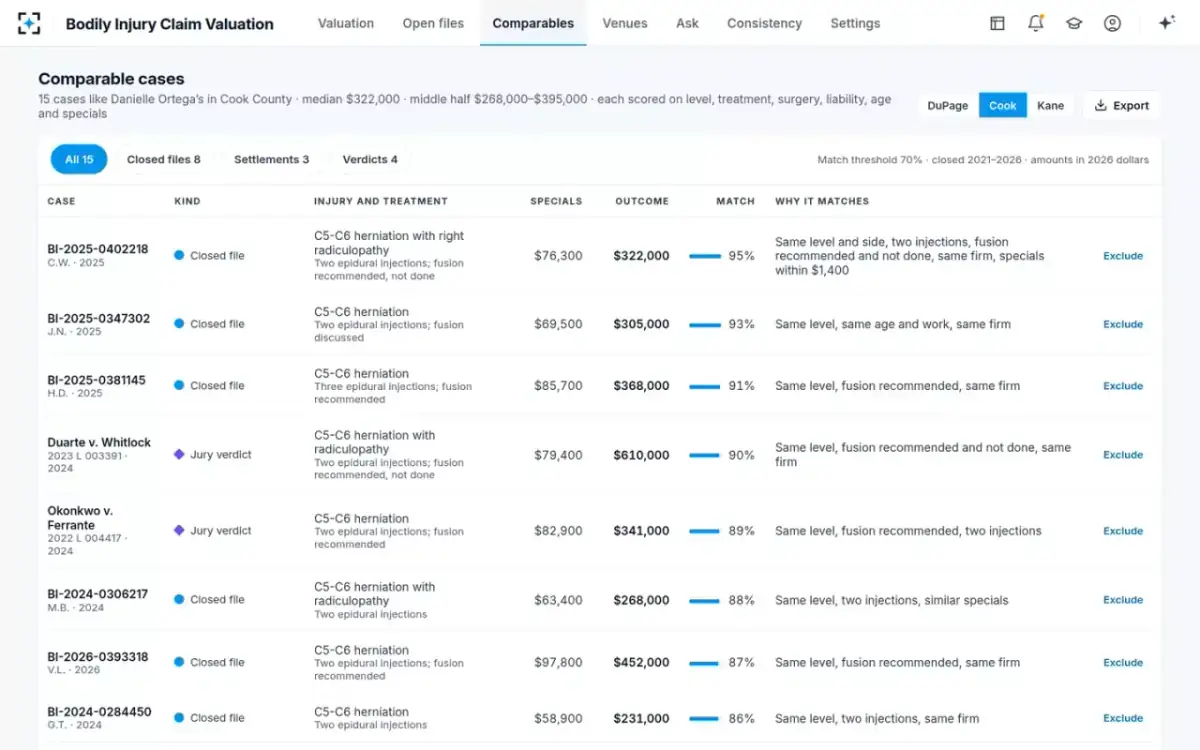
Comparable cases: Cook: median $322,000 across 15 cases, 11 of them above the $250,000 limit.
Injury evaluation score: The inputs and rules that produced it.
Comparable cases: Each case named, with why it matches and how it differs.
Injury evaluation score: $95,000, inside the band.
Comparable cases: $95,000, below 14 of the 17 DuPage cases.
Injury evaluation score: A consistent first look at routine files.
Comparable cases: An authority request a manager can check in minutes.
Buying from a vendor: the insurer keeps the legal standard
When an insurer buys valuation software, it keeps responsibility for what the software helps decide. The NAIC bulletin asks insurers to assess third-party AI systems and data so that the decisions they make or support meet the same legal standards as the insurer's own, and, where appropriate, to write contract terms that make the vendor cooperate with regulatory inquiries and allow audits. A vendor that cannot show what its tool read, which cases it used and why, leaves the insurer unable to answer for its own settlements.
Some states go further. Colorado's SB21-169 bars insurers from using external consumer data, algorithms or predictive models in a way that unfairly discriminates by race, sex, disability and other protected traits, in claims as in every other insurance practice, and requires them to keep a framework for testing, as far as practicable, whether their use of external data does so. A comparable-case tool should therefore be able to show which characteristics drive a match. In the sample configuration they are clinical and legal (spinal level, herniation, treatment, surgery status, liability, age and specials) and the reason for each match is written beside it.
Questions to ask any case evaluation software vendor
The questions below separate tools that will survive an examiner's sample from tools that only look good in a demonstration. Each has a short, checkable answer. A good vendor will show it on your files; a pilot built around them is set out in testing a bodily injury evaluation tool on your own closed files.
Eight questions for a case evaluation software vendor
- Does every number open to its source?
Each comparable to its closed file or report, each item from the open file to its page.
- Can it read the file, or only the codes someone enters?
Surgery recommended and deferred is a sentence in a consult note, not a code.
- Does it use your own closed files, with amounts paid?
Published verdicts are the trial tail; your files are the body of the range.
- Does it handle every county where suit could be filed?
Under the state venue statute, cited by section, with the range in each.
- How are old amounts brought to today’s dollars?
Which index, the factor shown on each case, and the original amount kept beside it.
- What can an agent do without a person?
Ask for the list of actions it can never take: set authority, save to the claim, contact the claimant.
- Can a case be excluded, and is the reason kept?
A range that silently drops its highest cases is the most expensive bug a valuation tool can have.
- What does it show when there are too few cases?
A tool should say so and widen, not produce a confident range from four files.
Two questions deserve a follow-up on your own data. Ask the vendor to replay twenty closed files you choose, including some that went to suit, and show where the amount actually paid fell in the range it would have given. Then ask how it treats verdicts, since the trial cases it can find are a small and unusual slice of all claims, as the guide to jury verdict search for claim valuation explains.
Where Bodily Injury Claim Valuation fits, and where it does not
The solution fits contested bodily injury files where comparable closed files exist and venue is in play: neck and back injuries with injections or surgery in question, files with a demand within limits, files where the insured lives in a different county from the crash. On those, it reads the file, builds the range in each county where suit could be filed and drafts the note. Comparable cases appear on the strip with match scores and reasons, and any one can be excluded with a reason that stays on the file.
Every comparable with its match score and the reason it matches
It is not a plaintiff's case evaluation tool, not a medical bill review or coding tool, and not a jury forecaster: the venue analyst describes each county's history and never predicts a particular jury or judge. It needs history to work. A carrier entering a new state or a new line has few closed files there, and the strip will say it has too few cases rather than invent a range. The venue logic is a setting per state, written from that state's statute. Botminds builds the solution from your authority levels, note standards and a sample of your own closed and open injury files, and the first step is to see it run on them.
Questions people ask
What is personal injury case evaluation software?
Software that estimates what an injury claim is worth. For insurers it means injury scores, verdict and settlement research, and comparable-case valuation; plaintiff firms use the same words for case intake and management tools, which do a different job.
Can AI value a personal injury claim?
It can compute a range from the evidence, quickly and with every case cited. The decision stays with people: the NAIC's AI bulletin holds insurers to the unfair claims standards whatever method they used, and in the sample solution no agent can set or grant authority.
What data does injury valuation software need?
The open injury file, closed files with injury, treatment, venue, firm and amount paid, published verdict and settlement reports with court and case number, and the state's venue statute. On the sample file that meant 41,280 closed files and 6,912 published Illinois verdicts and settlements.
Does valuation software replace claims adjusters?
Federal labour projections have the claims adjusting occupation shrinking over the decade to 2035, partly because software is taking over pieces of the job. In valuation, the reading and searching move to software; judging the case and answering for the number do not.
How is comparable-case valuation different from an injury score?
A score turns coded inputs into a value band; comparable cases show what similar injuries paid, one case at a time. On the sample file the score band was $88,500 to $121,000 in every county, while comparable cases put the median at $142,000 in DuPage and $322,000 in Cook.
What should a vendor show before you buy?
A replay on your own closed files, with each range traced to its cases and the amount actually paid marked. Ask also for the list of actions its agents can never take, and for what it shows when fewer than a dozen comparable cases exist.