A herniated disc settlement is worth what comparable injuries have paid in the county where the case would be tried, and four facts move it: whether surgery was done, recommended or never raised; the injections and therapy; the medical specials and which figure the state's jury hears; and liability. There is no national price for a herniated disc, and a file valued without those four facts is valued on habit. This case study follows one fictional claim, a C5-C6 herniation from a rear-end collision in Naperville, Illinois, through Botminds' Bodily Injury Claim Valuation twice: once as many desks value it, from memory and an injury score, and once from cited comparable cases in every county where the suit could be filed. The people, carrier, firms and cases are invented; the law and the court data are real.
The same file valued twice: about thirteen hours by hand, about two with the agents
- Reading records, bills, demand3 h
- Pulling comparable closed files4 h
- Reading verdict reports3 h
- Where suit can be filed1 h
- Note and authority request1.5 h
- Review
- Reading the cited chronology, checking comparables, verdicts and venue, editing the note, authority review≈ 2 h
How much is a herniated disc settlement worth? Four facts decide it
On this file, the honest answer was a range: $118,000 to $165,000 in DuPage County, where the crash happened, with a median of $142,000 across 17 comparable cases, and a median of $322,000 in Cook County, where the insured lives. Those numbers belong to this injury, this treatment and these counties. They are a long way from the average auto bodily injury payment, which the Insurance Research Council, an insurer-supported non-profit, put at more than $20,000 in 2022, because a herniation with injections and a surgical recommendation is far from the average injury claim.
The four facts that put a herniated disc file where it sits are worth naming, because each one can move the value by more than an adjuster's instinct allows for. Surgery status: done, recommended and deferred, or never raised. Treatment: the number of injections and the length of therapy. Specials: billed and paid, and which the jury hears. Liability: clear, disputed or shared. Venue then decides which set of comparables applies.
The file: a C5-C6 herniation, read page by page
Danielle Ortega, a 41-year-old dental hygienist, was rear-ended at a red light on Ogden Avenue in Naperville on Saturday 14 March 2026. The insured driver, Kevin Albright of Oak Park, was cited for failing to reduce speed; liability was clear. The policy limits were $250,000 per person and $500,000 per accident. By October her lawyers had sent a demand for the $250,000 limit, open for 30 days from its receipt on 30 September. The file was 412 pages from nine providers.
The treatment, as the file reader found it, with the page for each line
| Date | Provider and what happened | Page | Billed |
|---|---|---|---|
| 14 Mar | Emergency department: neck pain radiating to the right arm; CT negative for fracture | p. 9 | $3,840 |
| 19 Mar – 22 Jul | Physical therapy, 24 visits: range of motion improved 30%; right C6 numbness persists | p. 31 | $7,680 |
| 9 Apr | MRI: C5-C6 broad-based disc herniation, right foraminal narrowing, contact with the exiting C6 root | p. 118 | $2,950 |
| 12 May | Epidural steroid injection 1: 50% relief for three weeks | p. 204 | $6,420 |
| 23 Jun | Epidural steroid injection 2: relief two weeks | p. 231 | $6,420 |
| 18 Aug | Surgical consult: anterior cervical discectomy and fusion recommended, deferred by the patient; estimated $92,000–$118,000 | p. 377 | $1,450 |
| Mar – Sep | Medications, pharmacy and other providers, four primary-care follow-ups | p. 389 | $39,660 |
Read that way, the file says more than its diagnosis. Two injections with diminishing relief, persistent numbness at the level of the herniation, and a fusion recommended but deferred: this is the in-between case, worse than a strain that resolves with therapy and short of a fusion already done. Its value turns on how comparable files with the same in-between status were resolved, which is exactly what memory is least reliable about.
Valued from memory and a score: $95,000
The first valuation is the one many desks would make, and on this file it was made: an offer of $95,000 on 2 October and a reserve of $140,000 on 4 October. The offer sat inside the injury score's band of $88,500 to $121,000. The adjuster, carrying 140 open injury files, knew DuPage County well, and the offer was a reasonable reading of a DuPage herniation without surgery.
It had three blind spots, none of them a failure of effort. It did not know what the carrier itself had paid on the same injury in the same county; the closest closed file, a 40-year-old with the same level, two injections and fusion recommended and not done, against the same plaintiff firm, had settled for $142,000 in current dollars. It did not see the second county. And it treated the demand as a negotiating position rather than a deadline with a limit attached.
Valued from comparables: $142,000 in DuPage, $322,000 in Cook
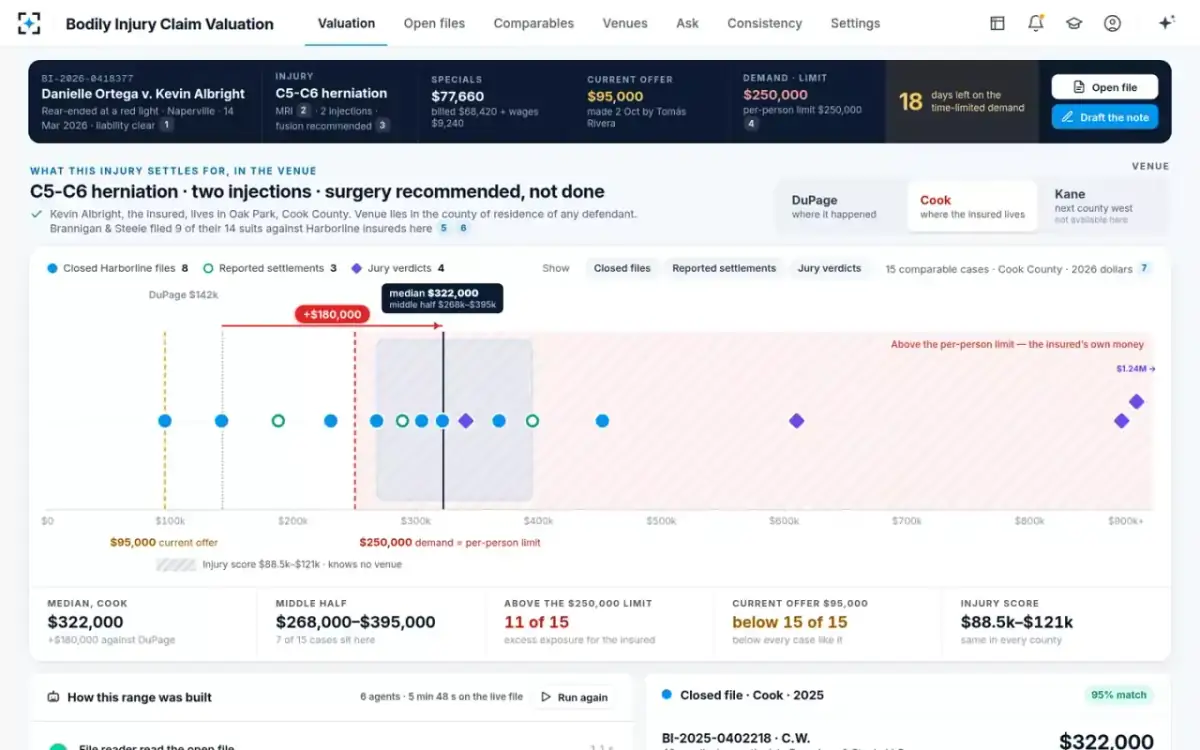
The second valuation took the agents 5 minutes 48 seconds. They searched 41,280 closed injury files and 6,912 published Illinois verdicts and settlements, found 214 cervical herniations and 45 that matched at 70% or better across three counties. In DuPage the strip held 17 cases: 11 closed files, 4 reported settlements and 2 jury verdicts, with a median of $142,000 and a middle half of $118,000 to $165,000. The $95,000 offer sat below 14 of the 17, and $23,000 under the middle half.
Eight open files, each checked for every county where the suit could be filed
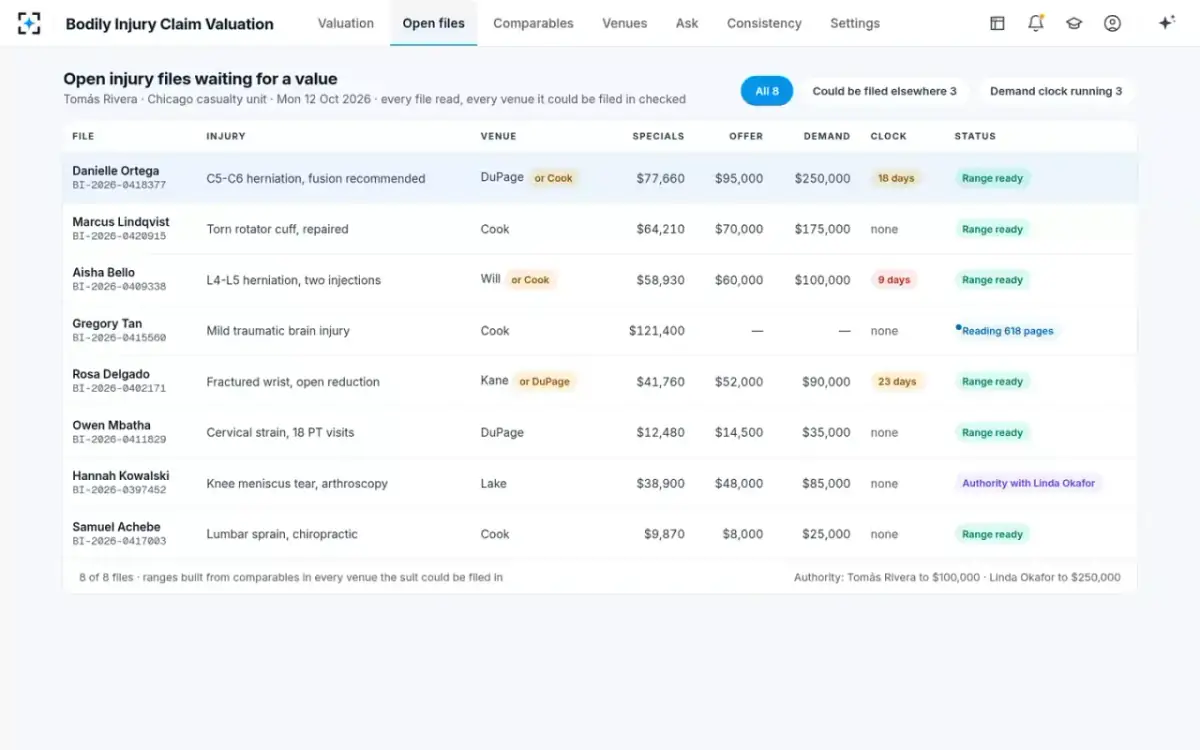
The Cook strip told a different story. Fifteen cases, a median of $322,000, a middle half of $268,000 to $395,000, and 11 of the 15 above the $250,000 limit. The closest Cook file, a 42-year-old with the same level and side, two injections, fusion recommended and not done and the same plaintiff firm, had settled for $311,100 in 2025, $322,000 in current dollars, at mediation after suit was filed in Cook.
Does venue change settlement value? On this file, by $180,000
Yes, and on this file venue was the largest single factor. Illinois lets a plaintiff sue in more than one county: an action must be commenced "(1) in the county of residence of any defendant who is joined in good faith and with probable cause for the purpose of obtaining a judgment against him or her and not solely for the purpose of fixing venue in that county, or (2) in the county in which the transaction or some part thereof occurred out of which the cause of action arose". The crash was in DuPage; the insured lives in Cook.
The same injury's median, county by county
Whether the plaintiff would use that choice was not a guess. The defence counsel liaison's profile of the firm showed 31 injury files against the carrier since January 2023, 14 of them to suit, 9 of those filed in Cook; Cook was chosen on 7 of the 9 files where it was open. Both of the firm's trials to verdict were in Cook, at $610,000 and $1,240,000. On files like this one the firm let the demand lapse and filed in Cook within about 40 days. The venue analyst cites the statute and the history; it never predicts what a particular jury or judge will do.
The venue toggle: Cook County, the same injury, $180,000 higher
Does surgery increase a herniated disc settlement?
Surgery done usually brings its own bills and recovery into the claim, and surgery recommended but not done is the hardest status to value, because the future cost is real but uncertain. On this file the consult priced the fusion at $92,000 to $118,000, more than the whole of the billed medical to date. A valuation that ignores the recommendation undervalues the file; one that prices it as certain overvalues it.
Comparable cases resolve the dilemma better than any rule, because they can be matched on the same status. Two of the four cases pinned to the final note, the closest DuPage closed file and the Halvorsen v. Pruitt verdict, share this file's status exactly: two injections, fusion recommended and not done. Among the Cook comparables, a file with fusion recommended and higher specials of $97,800 paid $452,000, which shows how far the same status runs when the specials and the venue are higher. For a herniated disc settlement without surgery, the useful question is not "how much less than with surgery?" but "what did files with the same deferred recommendation pay here?"
Why the billed figure counts on an Illinois herniated disc file
In Illinois the plaintiff may place the entire billed amount in evidence once its reasonableness is shown, and the jury does not hear what insurance paid. The rule comes from the Illinois Supreme Court's 2008 decision in Wills v. Foster, as an Illinois appellate court applied it in 2016. On this file that means $68,420, not $31,870, is the medical figure a DuPage or Cook jury would hear, and the note says so. In a state that limits paid bills to the amount paid the same file would be argued from the smaller number, which is why a comparable from Florida or, for recent injuries, from Georgia cannot be dropped into an Illinois range; the details are in Georgia tort reform 2025 and medical bills.
The limit and the demand: when the duty to settle arises
A demand for the limit on a file whose likeliest venue values the injury above that limit is the moment Illinois law says the insurer's duty to settle in good faith can arise. The state's Supreme Court held in 2001 that the duty arises when a claim has been made, there is a reasonable probability of a finding of liability, and a reasonable probability of recovery above the limits, and that "The duty does not arise at the time the parties enter into the insurance contract, nor does it depend on whether or not a lawsuit has been filed." Nor does it arise before a demand within limits.
On this file all three elements were in view on 12 October, eighteen days before the demand expired: clear liability, a demand at the limit, and a county where 11 of 15 comparable cases had paid more than $250,000. That is not a reason to pay the limit; the DuPage evidence pointed well below it. It is a reason to settle at a number the evidence supports while the demand is open, and to record why.
The decision: $165,000, and why not $95,000 or $250,000
The recommendation was to raise the offer from $95,000 to $165,000 and settle inside the demand. Tomás Rivera, the adjuster, proposed it at 15:31 on Monday 12 October; at $165,000 it was above his $100,000 authority, so it went to Linda Okafor, the claim manager, who holds authority to $250,000. She read the four pinned cases and granted it at 15:42. The reserve moved from $140,000 to $165,000. How the authority ladder itself works is the subject of what settlement authority is and who signs.
The same herniated disc file, valued two ways
From memory and an injury score: $95,000 offered on 2 October.
From cited comparables in every venue: $165,000 requested and granted on 12 October.
From memory and an injury score: Inside the score band of $88,500–$121,000.
From cited comparables in every venue: The top of the DuPage middle half; below every Cook case in its middle half.
From memory and an injury score: DuPage only.
From cited comparables in every venue: DuPage and Cook, with the firm’s filing pattern and both counties’ verdicts.
From memory and an injury score: Weighed by feel.
From cited comparables in every venue: Matched on status: the closest DuPage file and the pinned verdict share the deferred fusion.
From memory and an injury score: Demand read as a position.
From cited comparables in every venue: Demand read as a deadline, with Cook values above the limit set out.
From memory and an injury score: The adjuster’s judgement.
From cited comparables in every venue: Four cases pinned: three DuPage closed files at $137,000–$160,000 and the $285,000 Halvorsen v. Pruitt verdict.
$165,000 was not a split of the difference. It was the top of the range for the county where the crash happened, high enough to be a serious answer to the demand and still below what any Cook case in the middle half had paid. If the claimant's lawyers declined it and filed in Cook, the file would carry a cited note showing the insurer had offered the top of the DuPage middle half before the demand lapsed.
How long does a herniated disc claim take to settle?
Months before suit, years after it. In the IRC's national data, represented auto bodily injury claimants waited a median of nearly 440 days for closure, more than twice as long as those without lawyers. On this file the demand arrived on day 200 after the crash; had it lapsed, the sample unit's venue history put the median time to trial at 38 months in Cook and 31 in DuPage. The cheapest month to settle a herniated disc file is the one in which a demand within limits is still open and the evidence is in front of the person who signs.
Questions people ask
How much is a herniated disc settlement worth?
What comparable injuries paid in the county where the case would be tried. In the sample file in this guide, a C5-C6 herniation with two injections and a deferred fusion had a median of $142,000 in the crash county and $322,000 in the county where the insured lived.
What is a herniated disc settlement without surgery worth?
Less than with surgery done, but a recommendation that was deferred still carries value because the future cost is real. The best evidence is files with the same status; in the sample, the closest such file in the crash county settled for $142,000 in current dollars.
Does a herniated disc from a car accident settle for more in some counties?
Yes. Where suit can be filed in more than one county, values can differ sharply. Illinois allows suit where any defendant resides or where the events occurred, and in the sample file the same injury's median was $128,000 to $142,000 in three counties and $322,000 in Cook.
How do insurers value a herniated disc claim?
By totalling the specials, establishing liability and judging general damages, often with an injury score. A comparable-case valuation adds what the same injury, treatment and surgery status paid in each county where suit could be filed, with every case cited.
Is the billed or the paid medical amount used for a herniated disc claim?
It depends on the state. Illinois lets the jury hear the full billed amount once its reasonableness is shown; Florida limits paid bills to the amount paid; Georgia, for injuries after April 2025, lets the jury hear both. On the sample file the difference was $68,420 against $31,870.
How long does a herniated disc claim take to settle?
Before suit, it can settle within the window of a demand. After representation and suit it takes far longer: in the IRC's data the typical represented auto injury claim stayed open well over a year, close to 440 days at the median.