Georgia's 2025 tort reform changed how medical bills are proved in injury cases: under SB 68, signed on 21 April 2025, special damages for medical care are limited to the reasonable value of medically necessary care, and where the plaintiff has health insurance the jury may hear both the amounts charged and the amounts actually needed to satisfy the charges. That part of the act applies only to causes of action arising on or after its effective date, so a 2024 crash still goes to trial under the old rules and a 2026 crash under the new. For anyone valuing injury claims the consequence is practical: every set of closed Georgia files is now two sets, and a value built from the wrong one is wrong. Botminds' Bodily Injury Claim Valuation builds injury values from comparable closed files and published verdicts in every county where a suit could be filed, so which cases count as comparable is the first thing a law change touches.
The examples on this page that show the solution come from a fictional sample file in Illinois, with invented people and cases; Illinois is useful here precisely because its rule on medical bills did not change.
Inside a 2021–2026 window of closed files, each state's line falls in a different place
- Prior law on medical damagesJan 2021 – Apr 2025
- SB 68 section 7Apr 2025 –
- Prior lawJan 2021 – Mar 2023
- HB 837Mar 2023 –
- Billed amounts, with foundationJan 2021 – Oct 2026
What did Georgia tort reform 2025 change for medical bills?
It replaced the question "what did the providers bill?" with "what was the reasonable value of medically necessary care?", and it widened the evidence a jury may use to answer it. The Governor's office summarised the medical-damages section plainly: at trial, counsel may now put in evidence both what providers charged and what an insurer actually paid to satisfy those charges. Jurors then decide the reasonable value of past medical care "with full transparency into the billed and paid value".
The Georgia Senate Research Office's analysis of the bill as passed sets out the mechanics. Special damages for medical and healthcare expenses are limited to "the reasonable value of medically necessary care, treatment, or services", and the amount is for the trier of fact. Where the plaintiff has any form of public or private health insurance, the relevant evidence includes the amounts charged and "the amounts actually necessary to satisfy the charges, regardless of whether insurance has or will be used to satisfy the charges". Treatment under a letter of protection, where a provider is paid from the recovery, is made discoverable: the bill lists what is relevant and must be produced.
The phrase "regardless of whether insurance has or will be used" is the heart of it for a valuation. Read plainly, a plaintiff's choice not to use health insurance no longer decides which figures the jury sees. On a file treated under a letter of protection, the gap between the billed figure and the amount needed to satisfy the charges becomes something both sides can argue about in front of the jury.
When did Georgia tort reform take effect, and which claims does it reach?
SB 68 took effect when the Governor signed it on 21 April 2025, but its medical-damages section reaches only causes of action that arose on or after that date. The Senate Research Office states the rule without qualification: "Section 6 (Negligent Security Actions) and Section 7 (Special Damages for Medical and Healthcare Expenses) only apply to causes of action arising on or after the effective date of this bill, and any prior causes of action are governed by prior law."
For an injury claim the cause of action ordinarily arises with the injury, so the practical line is the date of loss. A crash on 20 April 2025 is valued under the old medical-damages law however late it is tried; a crash on 22 April 2025 under the new. Claims from before the line will keep reaching verdict and settlement for years, which is why a comparables search that sorts Georgia files only by when they closed will mix the two regimes well into the next decade.
Other parts of the act are not limited in the same way in the Senate Research Office's summary, including the rule on arguing noneconomic damages, the option to bifurcate, the admissibility of seat belt evidence and the changes to voluntary dismissal. A unit valuing Georgia files should take its own counsel's view on which of those apply to cases already pending.
Georgia tort reform 2025 and the collateral source rule: billed, paid, insured or not
For medical expenses, the act lets the jury see what insurance paid or would pay, which is exactly the evidence a collateral source rule exists to keep out. Illinois, the state in the sample file, shows the traditional rule in its strong form. In the words of the Illinois Supreme Court's 2008 decision in Wills v. Foster, as quoted by an appellate court in 2016, the collateral source rule "prevents defendants from introducing any evidence that all or part of a plaintiff's losses have been covered by insurance", and the plaintiff may place the entire billed amount into evidence once its reasonableness is established.
Georgia's act cuts through that for medical bills on new claims. The official summaries say nothing about other kinds of benefit, and the act does not cap damages, a point the Governor's office made emphatically.
“This bill does NOT place a cap on the amount of money a jury may award.”
Office of the Governor of Georgia, on SB 68, 21 April 2025
That matters for valuation because it means the reform moves the medical part of a verdict, and the arguments about the rest, without putting a ceiling on general damages. A comparables search should therefore allow for post-reform Georgia verdicts showing smaller medical specials on insured plaintiffs who treated outside their coverage, and should not expect the general damages on serious injuries to shrink by statute.
What is the anchoring rule in Georgia?
Georgia now limits when and how a lawyer may put a number to pain and suffering in front of a jury. Under SB 68, as the Senate Research Office summarises it, counsel may argue the monetary value of noneconomic damages, or elicit testimony about amounts, only after the close of evidence, at the first opportunity to argue damages; if counsel mentions amounts earlier, the court must take remedial measures. The Governor's office describes the aim as tying closing arguments to "actual evidence" of pain and suffering rather than to an artificial benchmark.
Two procedural changes travel with it. Any party in a bodily injury or wrongful death case may elect a trial in stages, liability first, then the apportionment of fault, then damages, though a court may reject the election where the amount in controversy is under $150,000. And evidence that the plaintiff was not wearing a seat belt is now admissible, including on negligence, comparative negligence and causation. Each of these changes what a Georgia verdict means as a comparable. A pre-reform verdict won with an unanswered anchor, in a single-stage trial with seat belt evidence excluded, is weaker evidence for a 2026 file than its dollar figure suggests.
How did Florida tort reform 2023 change injury claims?
Florida's 2023 reform, HB 837, took effect on 24 March 2023 and changed both the medical evidence and the fault rule, and most of it is tied to the filing date. Its applicability section, section 30, makes the act govern cases filed after its effective date unless another section says otherwise. The shorter, two-year limitation period for negligence actions applies instead to causes of action accruing after that date.
The substance is a mirror image of Illinois. Florida now limits proof of past medical bills that have been paid to the amount actually paid, and for unpaid bills of a claimant with health coverage it admits what that coverage would have paid. A claimant who treats under a letter of protection must disclose the letter before claiming those medical expenses, along with other details of the arrangement. And Florida moved to modified comparative negligence: in most negligence actions "any party found to be greater than 50 percent at fault for his or her own harm may not recover any damages", medical negligence excepted.
Because Florida's line follows the filing date, its comparables split differently from Georgia's. A 2022 Florida crash that was not filed by 24 March 2023 is governed by the new act if suit came later, so even a claim settled before suit in 2024 was negotiated in the shadow of the new rules. A 2024 Georgia crash tried in 2027 is governed by the old medical-damages rule. Sorting by close date alone gets both wrong.
Billed, paid or both: three states, three answers
Illinois lets the jury hear the billed amount, Florida limits paid bills to what was paid, and Georgia, for new claims, lets the jury hear both. The same specials therefore mean different things in each state, and a comparable from one regime overstates or understates a file in another.
Which medical figure reaches the jury, and from when
| State | Rule on past medical expenses | Applies to | What it does to a comparable |
|---|---|---|---|
| Illinois | Plaintiff may put the entire billed amount in evidence, with foundation for its reasonableness; insurance payments stay out under the collateral source rule | Since Wills v. Foster (2008), throughout the 2021–2026 window | One regime: billed-amount comparables compare like with like |
| Florida | Satisfied bills proved by the amount actually paid; unpaid bills with evidence of what coverage would pay; letters of protection disclosed | Causes of action filed after 24 Mar 2023 | Comparables filed before the line carry billed-amount verdicts and settlements |
| Georgia | Reasonable value of necessary care; for insured plaintiffs, amounts charged and amounts necessary to satisfy them, whether or not insurance was used | Causes of action arising on or after 21 Apr 2025 | Comparables from earlier injuries carry the prior rule, even if tried later |
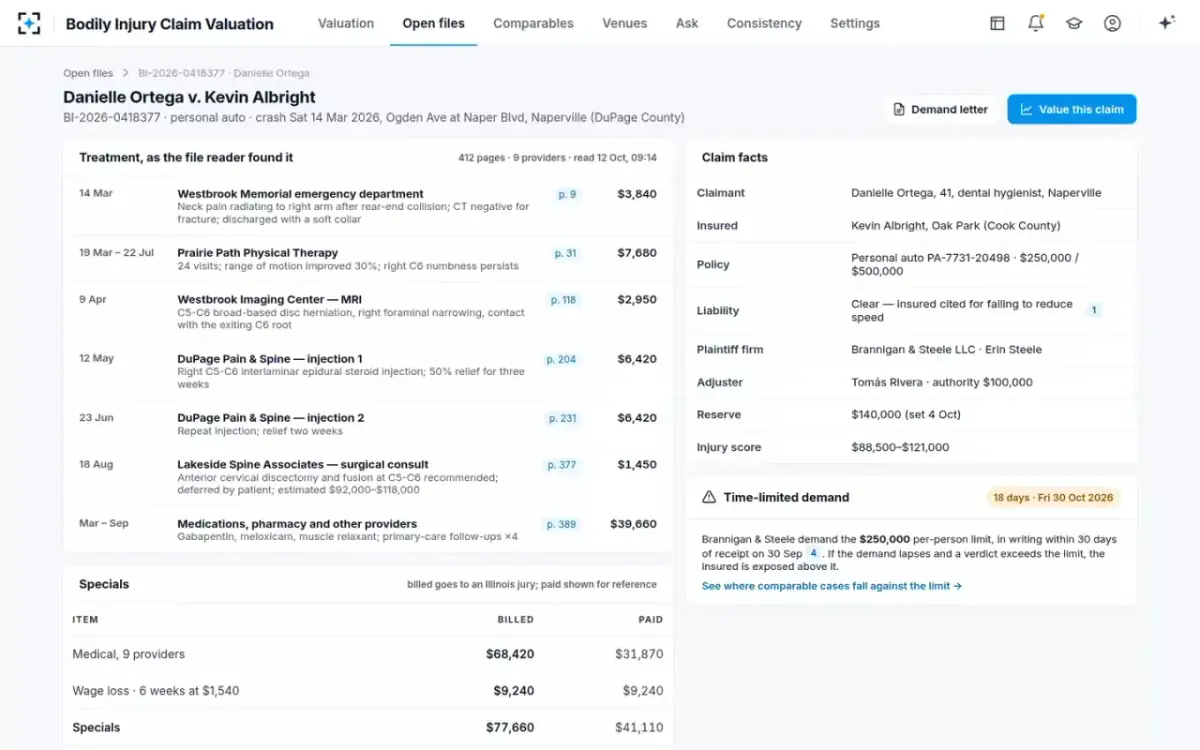
On the sample file the difference is concrete: $68,420 billed against $31,870 paid. In Illinois the billed figure goes to the jury, and the note the solution drafts says so. The same file in Florida after March 2023 would be argued from the paid figure. In Georgia, for an injury after April 2025, a jury could see both. The file reader keeps both numbers for that reason, page by page.
Specials billed and paid, kept side by side on the file
Do old settlements still predict values after tort reform?
Some do, and the useful question is which. A comparable from before a reform still predicts the general damages for a similar injury in the same venue; it does not predict the medical specials, the fault reduction or the effect of arguments the new law forbids. The answer is to sort comparables by the legal regime that governed them, not to throw the old ones away.
Comparables after a reform: close-date sorting and regime sorting
Sorted by close date: Everything closed in the last five or six years.
Sorted by governing regime: Files governed by the same rule as the open file: date of loss in Georgia, filing date in Florida.
Sorted by close date: Billed-amount verdicts mixed with paid-amount ones.
Sorted by governing regime: Specials compared on the basis the jury will hear.
Sorted by close date: Florida verdicts under pure comparative fault mixed with the 50% bar.
Sorted by governing regime: Matched on the fault rule, and on liability.
Sorted by close date: Hidden: the range looks full.
Sorted by governing regime: Visible: too few cases under the new rule, so the range says so and widens.
Sorted by close date: A median that drifts as old files age out.
Sorted by governing regime: Which side of the line each comparable sits on.
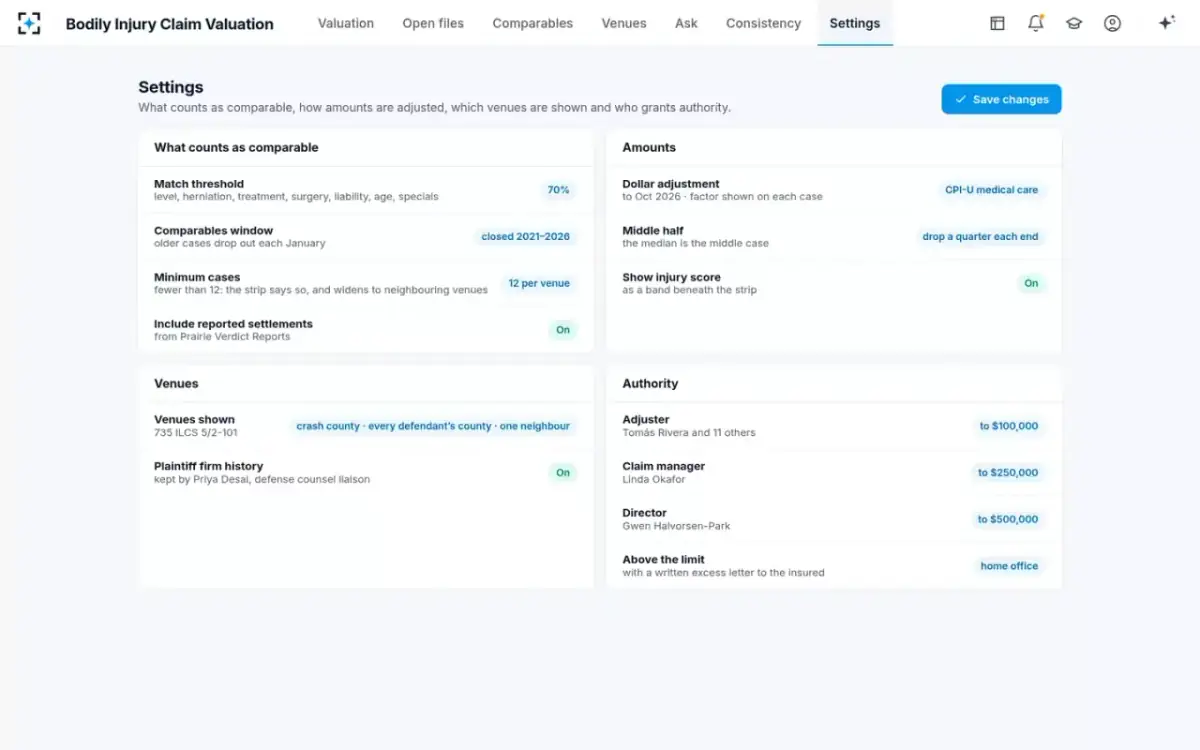
The thin-regime row is the one most likely to be missed. For a year or two after a reform, few cases will have closed under the new rules, especially verdicts. A tool that silently fills the range with old cases produces a confident number from the wrong law. In the sample settings the solution requires twelve comparable cases per venue and, below that, says so on the strip and widens to neighbouring venues; a unit valuing Georgia files should make the date-of-loss line one of its comparability rules and check that its tool respects it. Testing that a tool respects these lines, with closed files on both sides of each, is one of the checks in a pilot on your own closed files.
Comparability rules a unit sets for itself
What a claim unit should change in its comparables after a reform
Five changes keep a valuation honest across a cutover, and each can be made whether the comparables are pulled by hand or by software. They also make the reform measurable: a unit that sorts its files by regime will know within a year whether post-reform Georgia files are settling for less, and by how much.
Five changes to comparables after a damages reform
- Add the governing regime to every closed file
Date of loss for Georgia’s medical-damages rule; filing date for Florida’s act; the limitation period by accrual date.
- Match the open file to its own regime
A 2026 Georgia crash is compared with post-April 2025 injuries first; earlier ones are marked as such, not mixed in silently.
- Compare specials on the jury’s basis
Billed, paid or both, as the state’s rule for that regime allows; keep both figures on every file.
- Flag thin ranges
Where the new regime has fewer than your minimum cases, say so and widen deliberately rather than borrow from the old law.
- Re-read old verdicts for what no longer applies
An unanswered anchor, excluded seat belt evidence or pure comparative fault: note it beside the verdict.
None of this needs a prediction about how juries will react to the new rules. It needs the discipline to compare each claim with cases decided under the same law, and to show which those are. Why that matters for the person who signs, and how one Illinois file was valued twice, by hand and from evidence, is shown in the herniated disc settlement case study.
Questions people ask
What did Georgia tort reform 2025 change?
SB 68 limited medical special damages to the reasonable value of necessary care and let juries hear amounts billed and amounts paid; restricted when counsel may argue a number for pain and suffering; allowed staged trials and seat belt evidence; changed voluntary dismissal and discovery timing; and created a negligent security cause of action. It does not cap awards.
When did Georgia tort reform take effect?
On signature, 21 April 2025. Its medical-damages section and its negligent security section apply only to causes of action arising on or after that date, according to the Georgia Senate Research Office; earlier causes of action are governed by prior law.
Does Georgia tort reform affect medical bills for people with health insurance?
Yes. For a plaintiff with public or private health insurance, the evidence of reasonable value includes the amounts charged and the amounts actually necessary to satisfy them, whether or not the insurance was used, so treating outside coverage no longer keeps the lower figure from the jury.
Is Georgia now a paid-amount state like Florida?
Not exactly. Florida limits proof of satisfied past bills to the amount actually paid; Georgia lets the jury hear both what was charged and what was paid or necessary to satisfy the charges, and decide reasonable value from both.
How did Florida tort reform 2023 change injury claims?
HB 837 limited proof of paid medical bills to the amount paid, required disclosure of letters of protection, barred recovery by a plaintiff more than 50% at fault in most negligence cases, and cut the negligence limitation period to two years. Most of it applies to cases filed after 24 March 2023; the limitation change applies to causes of action accruing after that date.
Should insurers stop using pre-reform settlements as comparables?
No, but they should label them. A pre-reform comparable still says something about general damages for a similar injury in the same venue; it says little about the medical specials or the fault reduction a new-law case will see.