A bodily injury evaluation template is the worksheet an adjuster completes to value an injury claim: the injury and treatment, the specials, liability, the general damages judgement and a recommended range, in the same order on every file. It does its first job well, because files become comparable at a glance. It does not do the second job people expect of it, which is to make adjusters agree, because the part of the value that varies most is the general damages, and a template has nothing to fill that box with except the adjuster's experience. Botminds' Bodily Injury Claim Valuation fills that box with evidence instead: six agents read the file, find what comparable closed files and published verdicts paid in every county where the suit could be filed, and lay them on one range that every desk sees the same way.
The numbers below come from a fictional sample casualty unit run through the solution, with invented people, carrier and cases. In 2025 its nine desks set first authority on the same kind of file, a C5-C6 herniation with injections and no surgery, anywhere from $61,000 to $208,000.
Nine desks, one injury: first authority ran wider than the evidence
What is a bodily injury evaluation template?
It is a structured valuation note: a fixed set of sections an adjuster fills in so that every injury claim is valued against the same headings and every reviewer knows where to look. A template of this kind usually opens with the claim and the policy, sets out liability, lists the injuries and treatment, totals the specials, then asks for the general damages and a range. The authority request follows from the bottom line.
The structure is worth having. It forces the adjuster to state liability before value, to separate billed from paid medical amounts, and to name the injury precisely rather than as "neck pain". What it cannot supply is the one number every heading feeds into. A template turns valuation into a list of questions; the answer to the last question, what the injury is worth, still comes from wherever the adjuster's experience happens to sit.
What goes in a bodily injury evaluation worksheet?
A useful worksheet holds six things, each with the evidence beside it: the injury and its level, the treatment and surgery status, the specials billed and paid, liability, the venues where suit could be filed, and the comparable cases that set the range. The first four are what templates are built around. The last two are the ones a template cannot fill on its own, and they are where the disagreement lives.
A bodily injury evaluation worksheet, field by field
| Field | What it should hold | Where the evidence comes from | What goes wrong without it |
|---|---|---|---|
| Injury | Diagnosis, spinal level and side, with the imaging that shows it | MRI report, consult notes, cited by page | “Neck injury” covers a strain and a herniation alike |
| Treatment and surgery | Every visit, injection and procedure with dates; surgery done, recommended or deferred | Provider records in date order | A deferred fusion recommendation is missed and the future medical goes unpriced |
| Specials | Medical billed and paid, wage loss, by provider | Bills and payment statements, employer wage records | The wrong number for the venue: billed and paid are treated differently by state |
| Liability | Fault, comparative fault, citations, witness accounts | Police report, statements | Value set before liability is settled in the note |
| Venue | Every county where suit can be filed, under the state statute | Crash location, every defendant’s residence | The file is valued for one county and sued in another |
| Comparable cases | What the same injury paid in each venue, case by case | Closed files with amounts paid; published verdicts and settlements | General damages filled in from memory, differently at every desk |
Why do different adjusters value the same claim differently?
Because the specials can be added up and the general damages cannot. Two adjusters will total the same bills to the dollar and still disagree by tens of thousands on the rest, since pain, impairment and loss of enjoyment have no market price and each person prices them from the files they happen to remember. The legal research on juries describes the same problem from the other side of the courtroom. Non-economic damages, one experimental study put it, "are the most significant and variable components of liability".
Juries are given almost nothing to calibrate with. Reviewing the instructions courts give, Roselle Wissler, Michael Saks and colleagues found that "The most noteworthy feature of current instructions regarding damages is the lack of guidance they provide", and that the consequence "appears to be awards that have considerable variability". An adjuster without a comparables search is in the jury's position, with one difference: the adjuster's number is a first offer, and the claimant's lawyer sees it.
Three things widen the spread on a desk. The first is memory: each adjuster remembers a different handful of files, from different years and counties. The second is the demand: a large number in a lawyer's letter is the first figure in the file, and the same study found that large lump-sum demands drive larger jury verdicts. The third is venue: a desk that knows DuPage County values a DuPage crash for DuPage, even when the insured lives in Cook and the plaintiff firm files there whenever it can.
“Two desks, same injury, a $90,000 difference. That’s what plaintiffs’ firms exploit.”
Gwen Halvorsen-Park, VP of casualty claims in the fictional sample unit
Nine desks, one injury: what the spread looks like
The spread is easiest to see as dots: one row per desk, one dot per file, and the comparable cases' middle half shaded across them all. In the sample unit's 2025 files the dots run from $61,000 to $208,000, and only 9 of the 27 sit inside the shaded band of $118,000 to $165,000. Some desks sit wholly below the band; others straddle it or run above it.
Same injury, valued by desk: first authority against today's middle half
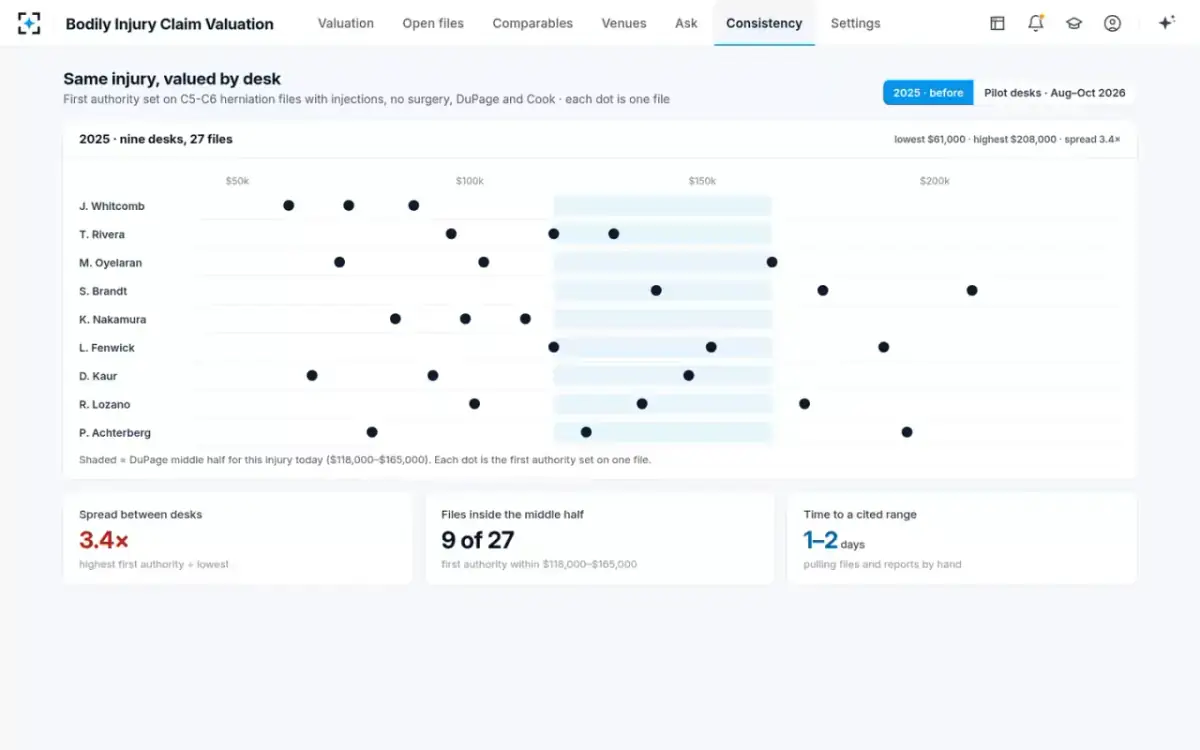
Two details matter for anyone who manages these desks. The low dots are not the safe ones. A first offer far below the range leaves the next move to the claimant's lawyer, including where to sue: the plaintiff firm on the sample unit's Ortega file filed 9 of its 14 suits against the carrier's insureds in Cook County, and both its trials to verdict there ended at $610,000 and $1,240,000. And the dots are first authorities, not final payments. The spread a VP sees here is the spread a claimant's lawyer sees, because the first number is the one that goes out.
What reduces the spread: showing the comparable awards
The research that tested remedies found that showing decision-makers how comparable cases were valued beats capping the answer. In a 1997 experiment, Wissler, Saks and colleagues gave mock jurors one of four kinds of information about awards for similar injuries in similar cases: the average award, the range within which 80% of awards fell, both the average and the range, or four example awards. They compared these with no guidance and with a cap. The findings, they wrote, "suggest several alternative solutions that are better able than caps to solve the problem of unwanted variability in awards".
The study was about jurors, not adjusters, but the mechanism carries over directly: give every decision-maker the same distribution of comparable outcomes and the answers draw together. The range strip in Bodily Injury Claim Valuation shows close cousins of those forms at once: the median, the middle half, and every individual case as a dot that can be opened. Unlike a mock jury's, the adjuster's guidance is specific to the venue and current to this year's dollars. Unlike a cap, it does not stop a desk from going above the band when a file's facts justify it. It asks the desk to say why.
The general damages field, filled from memory and from evidence
General damages from memory: The adjuster’s recollection of similar files.
General damages from comparables: Named closed files and published cases that match on level, treatment, surgery, liability, age and specials.
General damages from memory: The county the adjuster knows best.
General damages from comparables: Every county where suit can be filed, each with its own range.
General damages from memory: Old settlements remembered at their old amounts.
General damages from comparables: Each amount moved to current dollars with the medical care index, the original kept beside it.
General damages from memory: The manager judges the adjective: fair, reasonable, conservative.
General damages from comparables: The manager opens the cases and checks the match.
General damages from memory: Invisible until someone compares desks.
General damages from comparables: Visible on every file as a position against the same band.
How do you measure consistency in claim valuation?
Measure it on the first authority, file by file, against the range the comparable cases give for the same injury and venue: the ratio of highest to lowest, the share of files inside the middle half, and the spread within each desk. Those three numbers turn a vague worry about consistency into something a VP can track by quarter, and they need no new technology to start.
In the sample unit the starting point is a 3.4× ratio and 9 of 27 files inside the middle half. The solution's design target is a ratio of 1.4× once desks value from the range. That is a target, not a measured result, and a unit adopting any tool should measure its own before and after in the same way. If the comparable range is right, about half of first authorities should fall inside the middle half, by construction, and the rest should be explained by facts the note records.
Five measures of agreement between valuation desks
- Spread ratio, highest to lowest
First authority on the same injury and venue, across desks. A falling ratio is the simplest sign of convergence.
- Share inside the middle half
Of first authorities on matched files, how many sit between the comparables’ lower and upper quartiles. Near half is the expectation.
- Spread within each desk
A desk with three files at $61,000, $80,000 and $95,000 is consistent with itself and far from the evidence; that is a different conversation.
- Blind agreement test
Give the same closed file to three adjusters without the outcome and compare their numbers before and after they see the comparables.
- First authority against final payment
Files that settle far above their first authority are where an early range would have mattered most.
How much do noneconomic damages vary, and what drives it?
Enough that the experimental literature treats variability as the central problem of damages, and much of it is driven by the numbers people hear. The 2017 study of 732 people found that large lump-sum demands drive larger verdicts, and found no effect of similarly sized per diem figures, though per diem arguments did affect whether plaintiffs won at all. Its survey of 51 U.S. jurisdictions also found wide differences in whether lawyers may quantify pain and suffering as a per diem figure or demand a lump sum.
States are now changing those rules, and that changes which old cases are comparable. Georgia's 2025 tort reform, for instance, restricts when counsel may argue the value of noneconomic damages and lets juries hear both billed and paid medical amounts; how that splits a set of closed Georgia files in two is set out in Georgia tort reform 2025 and medical bills. For the anchoring research itself, and what it says about the popular multiplier, see how insurance companies calculate pain and suffering.
Running a blind agreement test in your own unit
A blind test measures agreement directly, and it takes a week, not a project. Choose twenty closed files on two or three common injuries, from venues your desks handle, and strip each to what the adjuster knew at the first valuation: the records, bills, demand and liability evidence, without the outcome. Give each file to three adjusters from different desks and ask for the number they would request authority for, with one line on why.
Three readings come out of it. The spread across adjusters on the same file is the unit's real inconsistency, free of the excuse that files differ. The gap between their average and what the file eventually paid shows whether the unit runs low or high as a whole, which is a different problem from inconsistency. And the reasons they write show which facts each desk weighs: one adjuster cites surgery status, another the plaintiff firm, a third nothing at all.
Then repeat the round with the comparable cases for each file in front of the same adjusters. If the spread does not narrow, the problem is not information but judgement or incentives, and no tool will fix it. If it narrows and the reasons converge on the same facts, the evidence is doing what a template alone could not. Either answer is worth knowing before buying anything, and the test needs nothing more than closed files and a spreadsheet.
One comparable, checked line by line against the file
Agreement between desks depends on agreement about what counts as comparable, so the matching itself has to be open to inspection. Each comparable case in the solution is checked against the open file on eight points: spinal level, herniation, injections, surgery, liability, age, specials and plaintiff firm, beside the closing note it came from.
One comparable case, checked against the open file on eight points
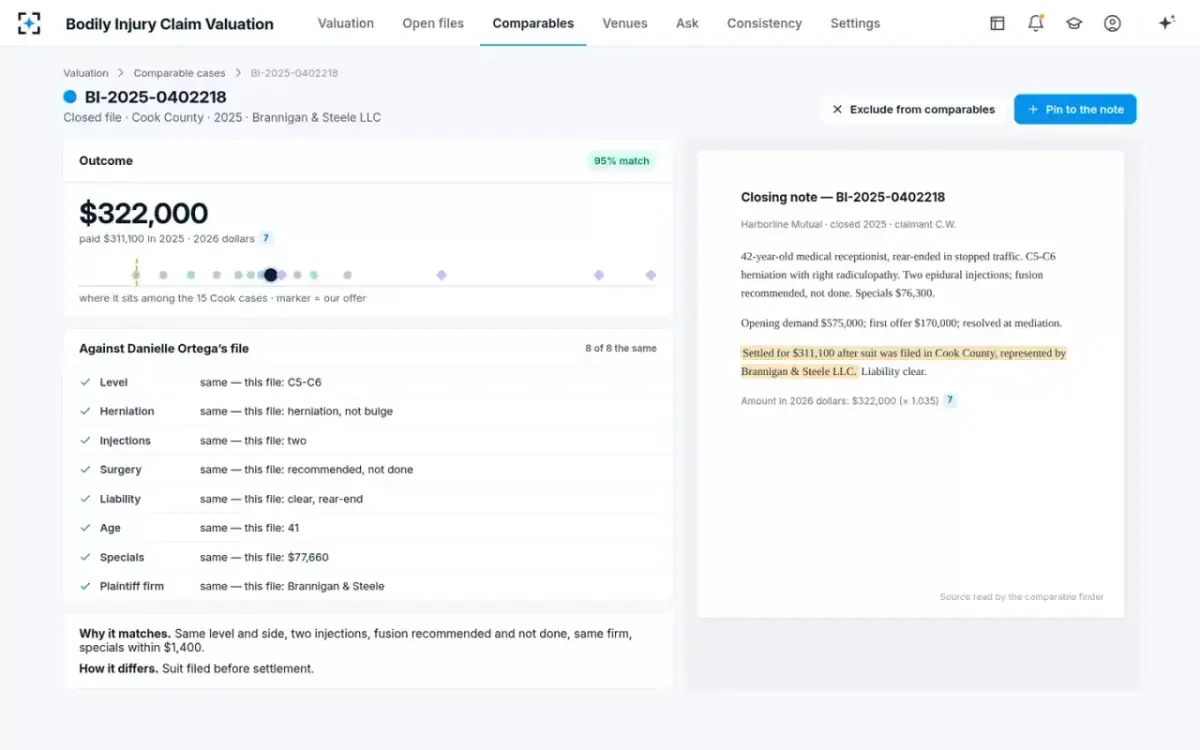
That is also where a template earns back its place. The headings stay; the evidence fills them. When the comparables, the venue and the dollar adjustment are shown the same way at every desk, the remaining disagreement is about facts a manager can discuss, and every grant can be checked against the same evidence, which is what settlement authority is supposed to rest on.
Questions people ask
How do adjusters evaluate bodily injury claims?
They establish liability, read the medical records and bills, total the specials, and then judge the general damages, increasingly with an injury score and sometimes with a search of comparable cases. The general damages judgement is where desks diverge; in the sample unit the first authority on one injury ranged from $61,000 to $208,000.
What is the difference between special and general damages?
Special damages are the economic losses that can be added up from bills and pay records, such as medical expenses and lost wages. General damages compensate pain, suffering, impairment and loss of enjoyment of life, which have no price list, and are where most valuation disagreement comes from.
Should a bodily injury template include venue?
Yes. In Illinois, for example, suit may be filed where any defendant lives as well as where the crash happened; in the sample file the same injury had a median of $142,000 in DuPage County and $322,000 in Cook County, where the insured lived.
How do you measure consistency between adjusters?
Compare first authority on matched files against the comparable range: the ratio of highest to lowest, the share inside the middle half and the spread within each desk. A blind test, in which several adjusters value the same closed file, shows agreement directly.
Do caps or guidelines reduce variation in injury awards?
In a 1997 mock-jury experiment, jurors were given information about awards in comparable cases (an average, a range, or example awards) or a cap, and the authors concluded that several of the alternatives were better able than caps to reduce unwanted variability. The same logic applies to a claim desk: a shared distribution of comparable outcomes, not a ceiling.
What is a good level of agreement between adjusters?
We found no published benchmark from a regulator or research body. A practical test is the share of first authorities that fall inside the middle half of comparable cases for the same injury and venue: if the range is right, about half should, and the rest should be explained by facts in the note. The sample unit started at 9 of 27.