A jury verdict search finds published awards in cases like the one being valued, by injury, court, county and year, from court records, commercial verdict reporters and an insurer's own litigation files. For claim valuation it answers one question well: what juries did when cases like this were tried. It cannot answer the broader question of what this claim is worth, because trials are rare and the cases that reach them are unusual. Of 355,243 civil cases closed in the federal district courts in the year to September 2025, 1,462 ended during trial, about 0.4%. Botminds' Bodily Injury Claim Valuation treats verdicts accordingly: its verdict reader reads published verdict and settlement reports and sets them at the tail of a range whose body comes from the carrier's own closed files, in every county where the suit could be filed.
Where the page shows the solution, the file, carrier, firms and cases are fictional sample data. The court statistics are real.
How rare a trial is, drawn to scale: each square is one case in 500
Federal civil cases, 2025
0.4% ended during trial
State general civil cases, 2005
3.4% disposed of by trial
What is jury verdict research?
Jury verdict research is the practice of finding and reading the outcomes of tried cases that resemble the one being valued, so that a valuation can account for what happens if the case is not settled. It draws on three kinds of source. Court dockets and judgments are public and authoritative but scattered across thousands of courts. Verdict reporters, most of them commercial, collect and summarise outcomes, often with reported settlements beside the verdicts. And an insurer's own litigation files hold its own tried and settled suits, with details no reporter has: the last offer, the defence costs, the firm on the other side.
The research has always had a place in claims work, because a jury is what a claimant's lawyer threatens. Its weakness is the one in its name: it is research about juries, and very few claims see one.
Are jury verdicts public record? Verdicts yes, settlements often not
Verdicts and judgments are entered in court files and are public in principle; settlement terms often are not, which is why verdicts dominate the published picture of what injuries are worth. The Bureau of Justice Statistics, introducing its last national survey of state civil trials, put the problem precisely: "Civil bench and jury trials are rare but important events. Records from civil trials are the primary source of information on civil cases in general. The terms of settlement agreements and other key information for civil cases resolved prior to trial may not be reported to the court or may not be publicly available."
That leaves anyone valuing an injury with an inverted evidence base. The cases that are easiest to find are the ones least like the claim on the desk, and the cases most like it, the ones that settled, are the hardest to see. An insurer is the exception. It holds the closing note, the amount paid and the reasons for every claim it settled, so for the body of the distribution its own closed files are better evidence than any public source.
How many personal injury cases go to trial?
Very few. In the federal courts, 0.4% of civil cases closed in the year to 30 September 2025 ended during trial, at a median of 30.7 months from filing; most ended before pretrial or with no court action at all. In the state courts, which hear most injury cases, the 2005 national survey found that trials of any kind accounted for 3.4% of general civil dispositions in the jurisdictions that could report them, and 3.5% of tort dispositions. Motor vehicle cases were the most common type of case tried, at 35% of state civil trials.
Those shares are of cases filed in court. Most injury claims never become a lawsuit at all, so as a share of claims the trial rate is lower still. The verdict that a demand letter invokes is, statistically, the least likely way the claim will end.
Why are verdicts higher than settlements, or lower?
Verdicts are not a sample of claims; they are a sample of disagreements, and that cuts both ways. Cases go to trial when the parties' valuations are far apart, so trials over-represent cases where one side misjudged, and the published awards include both the misjudgments that ran high and those that ran low. The national data show how ordinary most verdicts are.
Motor vehicle trials in state courts: ordinary amounts, frequent wins
$15,000
median award to a winning motor vehicle plaintiff, 2005
40%
of winning motor vehicle plaintiffs awarded $10,000 or less
64%
of motor vehicle trials won by the plaintiff
−60%
fall in the median automobile jury award, 1992–2005, after inflation, in the 75 largest counties
The same survey shows why a reported award is not always what was paid. Awards were adjusted before the end of trial in about 16% of trials, more than half of them for the plaintiff's contributory negligence, and appeals were filed in 17% of trials. A verdict report that gives the jury's figure without what followed can overstate the case's value as a comparable.
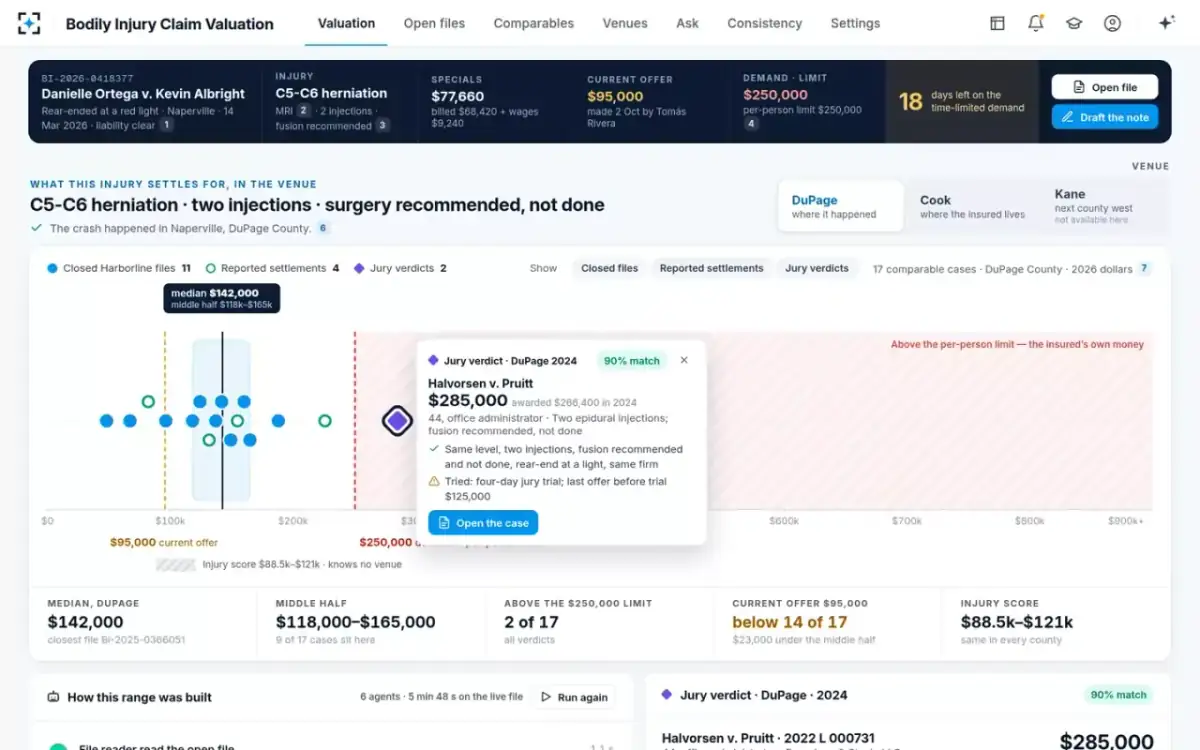
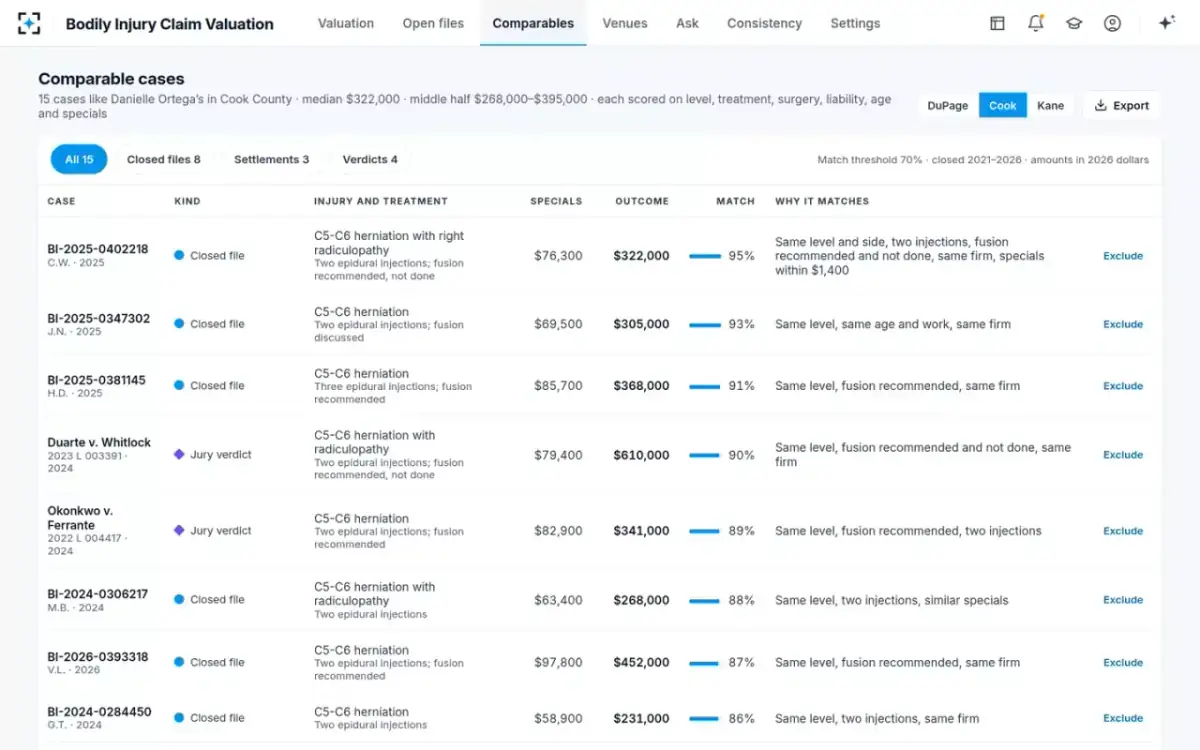
The sample file in this series shows the gap from the other side. One of the two DuPage County verdicts on its range, Halvorsen v. Pruitt, was tried after a last offer of $125,000 and returned $266,400. In neighbouring Cook County four verdicts on the same injury since 2022 ran from $341,000 to $1,240,000, and plaintiffs won four of five trials there. A desk that knew those verdicts would not have offered $95,000; a desk that knew only those verdicts would have offered too much.
How do you search jury verdicts for one claim?
Search by the facts that move value, not by the headline: the injury and spinal level, the treatment and surgery status, liability, the plaintiff's age and specials, the county and the date. Then read each report for what a valuation needs, which is more than the award. A verdict found by injury alone, "herniated disc, $1.2 million", tells an adjuster almost nothing until it is clear whether the plaintiff had surgery, what the specials were and where it was tried.
What a verdict report must carry to be usable as a comparable
- Court, county and case number
So the award can be checked against the docket and the venue matched.
- Injury, level and treatment
Herniation or bulge, the spinal level, injections, surgery done, recommended or neither.
- Specials, and on what basis
Billed or paid, since states differ on which a jury hears.
- The award and what followed
Reductions for comparative fault, post-trial changes and appeals, where known.
- The last offer before trial
The gap between offer and verdict is the risk the defence took.
- The date, and a dollar factor
An index, the factor applied and the original amount kept beside the restated one.
- The plaintiff firm
Firms that try cases and firms that settle them produce different verdict histories in the same county.
A good report also shows its absences. Where the last offer or the specials basis is unknown, the comparable is weaker, and a valuation that leans on it should say so. That is why the verdict reader in Bodily Injury Claim Valuation uses no amount without its report and keeps the amount actually awarded beside the adjusted one.
How do you find comparable verdicts in personal injury, and how many?
Match on the same factors as any comparable and accept that verdicts will be few. On the sample file the comparable finder searched 6,912 published Illinois verdicts and settlements alongside 41,280 closed files, and of 45 cases at a 70% match or better across three counties, the DuPage strip carried 2 verdicts among 17 cases and the Cook strip 4 among 15. That is far more verdicts than the trial statistics alone would produce, because published verdicts are searched as a pool of their own; it is also why each kind of case is marked on the strip and can be switched off.
A verdict on the strip, with its award, its last offer and why it matches
Anchors deserve a note here. Verdicts are the numbers claimants' lawyers quote, and mock-jury experiments show how strongly a large number pulls a later judgement on damages, and how hard a high anchor is to counter. A valuation that lets the most extreme verdict in a county set its number has been anchored by the other side's research. Placing every verdict on the same axis as the settled cases, at its true position, is the antidote.
Three ways a verdict misleads a valuation
A verdict misleads when it is read as a price rather than as an outcome with a history. Three patterns account for most of the damage, and each can be caught by reading the report rather than the award alone.
The award is not the payment. Comparative fault reductions, set-offs and appeals change what a verdict is worth; in the 2005 state survey more than half of the adjustments made before the end of trial were for the plaintiff's own negligence. In a state with a fault bar, such as Florida's rule that a plaintiff more than 50% at fault recovers nothing, the same jury figure can mean full payment or none.
The law has moved. A verdict won under rules that no longer apply describes a trial that cannot happen again in the same form. Georgia's 2025 reform changed which medical figures reach the jury and when counsel may name a number for pain and suffering, for injuries after its effective date; a 2023 Georgia verdict is evidence about a different trial. How to sort comparables across such a line is set out in Georgia tort reform 2025 and medical bills.
The case was tried for a reason. Trials happen when parties disagree, sometimes about liability rather than value. A defence verdict on a disputed rear-end collision says little about a file where the insured was cited for failing to reduce speed. Matching on liability, as the comparable finder does, keeps such cases from passing as comparables for clear-liability files.
Verdicts from different years: restate them and show the factor
A verdict from 2022 is not comparable to a 2026 claim until it is restated, and the restatement must be visible. The solution uses the BLS medical care index, shows the factor on each case and keeps the award as returned: Halvorsen v. Pruitt's $266,400 award in 2024 appears at $285,000. Old data need more care still. The national survey's medians above are in 2005 dollars, and the medical care index rose about 26% between January 2017 and September 2026 alone; it is the shape of those numbers that carries over, not their level. How to test a tool's restatement, including the month it restates to, is part of testing a bodily injury evaluation tool on your own closed files.
Jury verdict search tools, and a valuation that uses them
Verdict research tools and comparable-case valuation are complements, and a buyer should judge each by the job it does. A verdict database is the right tool for a litigation specialist preparing for trial in a known court. A valuation tool is the right one for the desk deciding, before suit, what the claim is worth in each county where it could be tried. The difference shows in what each returns for the same file.
A verdict search and a comparable-case valuation, on the same neck injury
Jury verdict search: Tried cases and reported settlements matching the search terms.
Comparable-case valuation with verdicts at the tail: The carrier’s closed files plus published verdicts and settlements, scored on seven factors.
Jury verdict search: Whatever county the search names.
Comparable-case valuation with verdicts at the tail: Every county where suit can be filed, under the state statute, with a range in each.
Jury verdict search: Not included.
Comparable-case valuation with verdicts at the tail: The body of the range: 11 of 17 DuPage cases were the carrier’s own closed files.
Jury verdict search: As reported, sometimes restated.
Comparable-case valuation with verdicts at the tail: Restated with the medical care index, factor shown, original kept.
Jury verdict search: A list to read.
Comparable-case valuation with verdicts at the tail: A median, a middle half and a cited note for the authority request.
When choosing either, ask how the source collects reported settlements, since reported settlements are self-selected too: they appear because someone chose to report them. A comparable-case tool should mark reported settlements separately from closed files and verdicts, as the strip in the solution does with three symbols, so a reviewer can switch each kind off and see how the range moves. The other buying questions that apply to any valuation software are in personal injury software for case evaluation.
Where Bodily Injury Claim Valuation uses verdicts, and where it stops
The solution fits the decision before suit: valuing a contested injury file with the trial risk in view, in the county of the crash and every county where the suit could be filed. Its verdict reader reads the reports, the comparable finder places verdicts among closed files and reported settlements, and the venue analyst sets out each county's verdict history and time to trial. On the sample file that meant seeing, before a $250,000 demand lapsed, that Cook juries had returned four verdicts on this injury since 2022 and that the plaintiff firm on the file had chosen Cook on seven of the nine files where it could.
Every comparable by kind: closed files, settlements and verdicts, each with a reason
It does not replace verdict research for trial. Once a file is in suit, the litigation specialist and defence counsel need the full reports, the judge's history and the expert testimony, which are beyond a valuation strip. It does not predict a jury: the venue analyst describes each county and never forecasts a particular jury or judge. And it depends on published reports being available for the state; where they are thin, the strip will show fewer verdicts and say so, rather than borrow from elsewhere.
Questions people ask
How do you search jury verdicts?
By the facts that move value: injury and level, treatment and surgery status, liability, specials, county and date. Sources are court dockets, verdict reporters and an insurer's own litigation files; read each report for the last offer, any reduction or appeal, and the specials basis, not only the award.
Are jury verdicts public record?
Verdicts and judgments are entered in public court files. Settlement terms often are not: the Bureau of Justice Statistics notes that for cases resolved before trial, settlement terms "may not be reported to the court or may not be publicly available".
How many personal injury cases go to trial?
A small fraction of those filed, and fewer still of all claims. In the federal courts 0.4% of civil cases closed in the year to September 2025 ended during trial; in the 2005 state court survey, trials were about 3.5% of tort dispositions.
Why are verdicts sometimes lower than settlements?
Because tried cases include those where the claimant overvalued the claim. In the 2005 state survey the median award to a winning motor vehicle plaintiff was $15,000, and 40% of them received $10,000 or less; plaintiffs lost about a third of motor vehicle trials outright.
Should insurers base settlement values on jury verdicts?
On verdicts as the tail, not the body. Verdicts show the trial risk in a venue; the insurer's own closed files show what similar claims actually settled for, and together they give a range a claim manager can sign.
How do you adjust old jury verdicts for inflation?
With a named index, the factor shown and the original kept. Restated with the BLS medical care index, a 2024 award of $266,400 in the sample file becomes $285,000 in current dollars.