Nuclear verdicts and insurance are linked through severity: a jury award far beyond what an injury usually brings, generally defined by the state insurance regulators' association as a verdict above $10 million, pushes up what liability claims cost and what insurers reserve and charge for them. For a casualty claim unit the more useful question is narrower. Nuclear verdicts are a thin tail of a very small share of cases that reach trial; what an ordinary injury file costs is decided earlier, by whether it was valued before the claimant's demand lapsed and before suit was filed in the county the plaintiff preferred. Botminds' Bodily Injury Claim Valuation exists for that earlier moment: six agents value the open file against comparable closed files and published verdicts in every county where suit could be filed, in minutes rather than days, so the person who signs authority sees the venue risk while it can still be settled.
The tail and the body of liability severity
$10M+
a nuclear verdict, as the NAIC’s topic page generally defines it
0.4%
of federal civil cases closed in the year to Sept 2025 ended during trial
7.8%
a year: rise in average auto bodily injury payments, 2017–2022, per the insurer-funded IRC
~440days
median wait to closure for represented auto BI claimants, per the IRC
What is a nuclear verdict? Two thresholds in the regulators' own literature
A nuclear verdict is a jury award far larger than the facts of a case would ordinarily support; the threshold is a convention, not a legal term, and even the regulators' own publications draw it in different places. The NAIC's consumer topic page describes "Nuclear verdicts, generally defined as jury verdicts exceeding $10 million in punitive and compensatory awards". An article in the NAIC's Journal of Insurance Regulation by two Florida State University researchers sets the bar ten times higher: a nuclear verdict is "a large or exorbitant award based on the specifics of a case, or an award larger than expected", and "The dollar amount of damages to qualify as a nuclear verdict is generally $100 million or more."
The second definition is the more useful one for a claim desk, because of its middle clause: an award larger than expected. A $1.24 million verdict on a neck injury like the sample file's, fusion recommended and not done, is not nuclear by either dollar test. It is still nearly nine times the median for the same injury in the next county, and on a $250,000 policy it is a judgement mostly above the limit. The same article lists the reasons such awards happen, and one is plain geography: “the venue of where cases are being heard”.
How do nuclear verdicts affect insurance?
They raise severity, the average cost per claim, rather than the number of claims, and they do it through settlements as much as through the verdicts themselves, because every file in a venue settles in the shadow of what its juries have done. An analysis by the Casualty Actuarial Society with Triple-I, an insurer-funded association, found across liability lines that the cost per claim, not the number of claims, is what has been pushing losses up. For personal auto liability it estimated that litigation trends and inflation together added $91.6 billion to $102.3 billion to losses and defence costs over the decade to 2024, 8.7% to 9.7% of booked losses; those are the sponsors' estimates and their framing.
The Federal Insurance Office lists "high jury verdicts" among the factors insurers cite as driving litigation costs, with class actions, litigation funding and one-way attorney fee laws, and notes that at least 21 states now regulate third-party litigation funding. The NAIC's topic page names commercial auto, especially trucking, professional liability, product liability and directors' and officers' cover as the lines most affected. With an average bodily injury payment of a little over $20,000 in 2022 by the IRC's count, personal auto files rarely come near those thresholds. They produce thousands of files that settle a little higher each year, which is where the next section looks.
What a month of waiting costs one injury file
On an ordinary injury file a month of delay costs a few hundred to a few thousand dollars of drift, and then, on the day an open demand lapses, it can cost a step change of six figures. The table prices both on the fictional sample file used throughout this series: a C5-C6 herniation, rear-ended in Naperville, a $250,000 policy-limits demand open until Friday 30 October 2026, and an insured who lives in Cook County.
What waiting costs the sample file: small drift, then a cliff
| Cost line | How it moves while the file waits | On the sample file | Rate behind it |
|---|---|---|---|
| Medical prices | Comparable amounts are restated in current dollars each month | About $180 a month on a $142,000 median | CPI-U medical care rose 1.5% from Sept 2025 to Sept 2026 (BLS) |
| Claim severity trend | Settlement values for the same injury rise faster than prices | About $890 a month on $142,000 | Average auto BI payments rose 7.8% a year, 2017–2022 (IRC) |
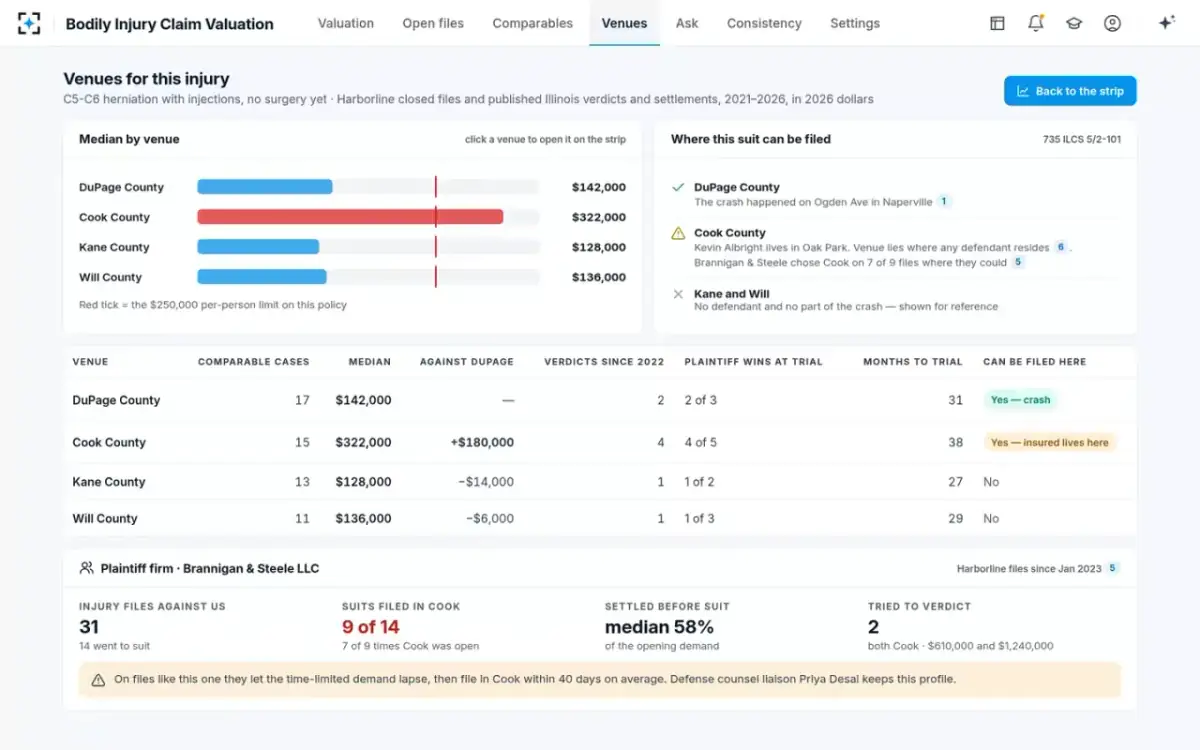
| Venue, if the demand lapses | The firm can file where the insured lives | +$180,000 on the median, from $142,000 in DuPage to $322,000 in Cook | The firm chose Cook on 7 of the 9 files where it could (sample) |
| Expected venue step | The venue change weighted by how often the firm takes it | About $140,000, once, when suit is filed (about 40 days after a lapse, on the firm’s average) | 7 of 9 × $180,000 (our arithmetic) |
| Excess above the limit | Cook values sit mostly above the $250,000 limit | 11 of 15 Cook cases above the limit; the median is $72,000 over it | The insured’s own exposure, and the insurer’s if it refused a reasonable demand |
| Time in suit | A filed case runs to trial or a late settlement | Median 38 months to trial in Cook, 31 in DuPage (sample) | Federal cases that end during trial: median 30.7 months from filing (U.S. Courts) |
Read the rows in order and the shape is plain. The first two lines are what most cost-of-delay arguments describe: a file that waits a month is worth a little more when it is finally valued. On this file that is under $1,100 a month, real but small against the $47,000 gap between the $95,000 offer and the DuPage median. The third and fourth lines are different in kind. They do not accrue; they happen. A month of drift costs hundreds. The day the demand lapses can cost the median for a different county.
The cliff on the calendar: when an open demand lapses
The cliff has a date. On the sample file the crash was on 14 March 2026, the claimant's lawyers' $250,000 demand was received on day 200, and it gave 30 days. The file was valued on Monday 12 October with 18 of them left. The plaintiff firm's pattern on files like this, kept by the unit's defence counsel liaison, was to let the demand lapse and file in Cook within about 40 days.
One file's calendar: seven months to a demand, eighteen days to decide
- Crash to demand received200 d
- Demand open, not yet valued12 d
- Valued, authority granted, inside the window18 d
- Lapse to suit filed in Cook≈ 40 d
- In suit in Cook, trial still years away190 d and on
Twelve of the thirty days had passed before the file was valued against comparable cases. In the sample unit a cited range built by hand takes one to two days of an adjuster's time, and on a desk of 140 open files that is the step most often skipped. The solution's design target is six minutes from open file to cited range, and on this file the agents took 5 minutes 48 seconds. The point of the speed is not the minutes saved. It is that the valuation happens on day one of the demand window rather than day twelve.
The venue toggle: the same injury in Cook County, where the insured lives
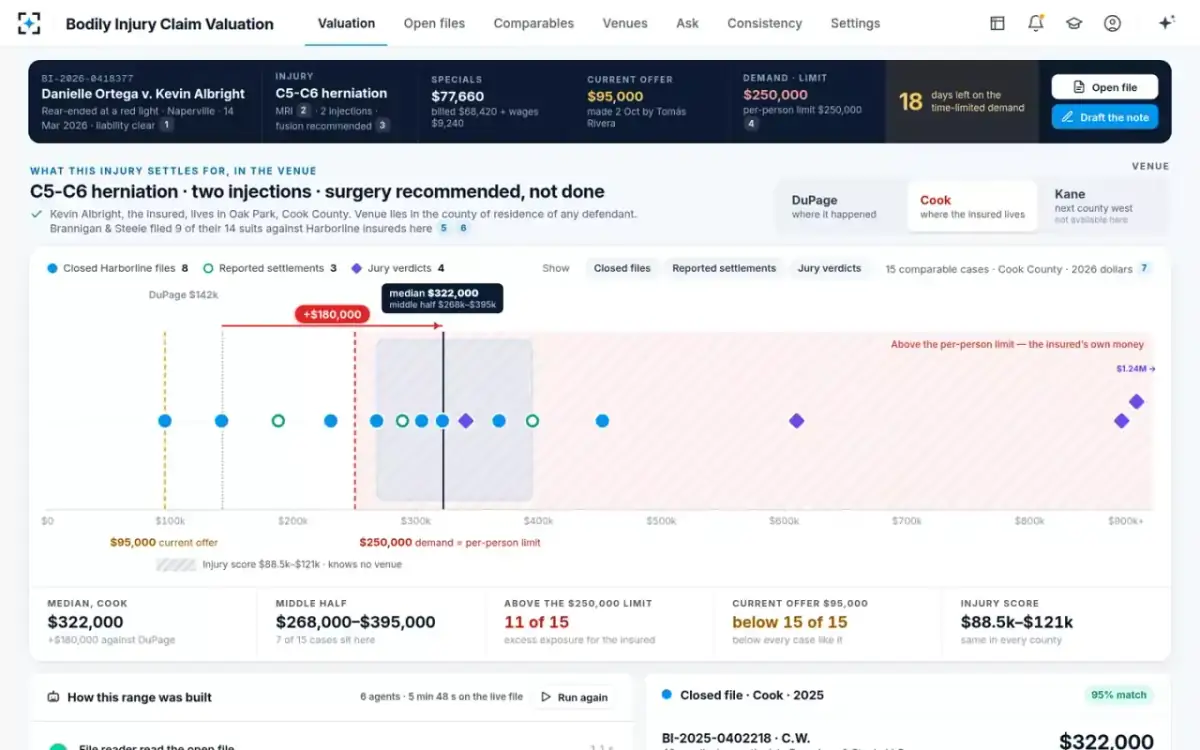
For the insurer the cliff is also a legal one. In Illinois the duty to settle arises once there is a demand within limits and a reasonable probability both of liability and of a recovery above the limits, a test the state's Supreme Court set out in 2001. A Cook range with 11 of 15 comparables above the limit is the kind of evidence that test is about, and how the duty, the limit and the authority ladder fit together is set out in the herniated disc settlement case study.
What is social inflation, and how is it different from economic inflation?
Social inflation is the part of liability claim cost growth that general price inflation does not explain: larger awards and settlements, more attorney involvement and longer litigation. Economic inflation is the rise in prices, medical prices included. The NAIC's definition begins "Social inflation is a term that describes how insurers' liability claims costs are increasing" above general economic inflation, and the two can be set side by side for auto injury claims.
The medical care index the Bureau of Labor Statistics publishes rose about 13% from January 2017 to January 2022, roughly 2.5% a year. Over almost the same window, the Insurance Research Council, a non-profit research body supported by insurers, found average bodily injury payments rising 7.8% a year, "more than double the rate of medical care inflation", from about $14,000 to more than $20,000. The gap between those two rates is the social part. On one file it shows up as the difference between restating an old settlement for medical prices and finding that the same injury now settles higher still.
Why are injury claim costs rising? Representation, litigation and time
Injury claim costs are rising because more claimants are represented, more represented claims are litigated, and litigated claims take longer, and each step raises what a file settles for. The IRC's 2026 study, from 7.4 million auto injury claims closed with payment by nine insurers writing about 43% of the private passenger market, found attorney involvement across all coverages rising from 40% in 2017 to nearly 50% in 2022, and 57% among bodily injury claimants in 2022. Litigation nearly doubled, from 10% to 18% of claimants, and represented bodily injury claimants waited a median of nearly 440 days for closure, more than twice as long as those without lawyers.
None of that is a nuclear verdict. All of it is time, and time is what a late valuation gives away. A file valued after representation, after the demand has lapsed and after suit is filed is valued in a different market from the one it started in: a different county, a lawyer's fee to recover and a trial date to price.
How often do injury cases go to trial?
Rarely: of 355,243 civil cases terminated in the federal district courts in the year to 30 September 2025, 1,462 ended during trial, about 0.4%, at a median of 30.7 months from filing. Most of the rest ended with no court action or before pretrial. Verdicts are the rarest outcome in the system and the most influential, since every settlement in a venue is priced against them. That is why verdict research belongs at the tail of a valuation and closed files at its body, the argument of jury verdict search for claim valuation.
Does settling early reduce claim costs?
On the evidence available, settling a file at a well-supported number before suit costs less than settling it after, though the published studies measure association rather than cause. The IRC found that represented auto bodily injury claimants waited more than twice as long and netted less per dollar of medical expense after fees ($1.40 against $1.80), which suggests the later, represented settlement costs more in total without leaving the claimant better off. In the sample unit the pattern is starker: the plaintiff firm on the sample file settled files before suit at a median of 58% of its opening demand, and in Halvorsen v. Pruitt, one of the two DuPage verdicts on the strip, the jury awarded more than twice the last offer made before trial: $266,400 against $125,000.
Early is not the same as high. The sample file's recommendation was $165,000, the top of the DuPage middle half and well inside the limit, not the $250,000 demanded. Settling early at a number the evidence supports, with authority granted before the demand lapses, is what removes the cliff. Paying the limit on every demand would merely move it.
What a casualty VP can measure
The cost of delay becomes manageable once it is counted at the moment that matters: the demand window. Five measures do it, and all of them can be read from claim files a unit already keeps.
Five measures of valuation timing for a casualty unit
- Days from demand received to first cited valuation
Against the days the demand allows. On the sample file it was 12 of 30.
- Share of demands within limits valued before they lapse
Every lapse on a file whose likeliest venue exceeds the limit is a decision someone should have signed.
- Files with a second possible venue, flagged before the demand lapses
Where the insured or another defendant lives in a different county from the crash.
- First offer against the comparable range
An offer below the middle half is the hardest position to defend if the file goes to suit; the sample offer was below 14 of 17.
- Final payment against first authority, by venue
The step-ups that came after suit show what late valuation cost the unit last year.
Venue risk set out before the suit: medians, verdicts and the plaintiff firm's record
Questions people ask
What is a nuclear verdict?
A jury award far larger than the facts of a case would ordinarily support. The NAIC's topic page generally defines it as a verdict above $10 million in punitive and compensatory awards; an article in the NAIC's Journal of Insurance Regulation puts the usual threshold at $100 million and adds "an award larger than expected".
How do nuclear verdicts affect insurance premiums?
They raise expected severity, which flows into reserves and rates, and they move settlement values for every file tried in the same venue. The CAS and Triple-I analysis attributes liability loss growth to severity rather than frequency; the NAIC names commercial auto, professional liability, product liability and D&O as the lines most affected.
What is social inflation in insurance?
Growth in liability claim costs beyond what general price inflation explains, through larger awards and settlements, more representation and longer litigation. On auto injury claims, IRC data show average bodily injury payments rising 7.8% a year from 2017 to 2022, more than double medical care inflation.
Are nuclear verdicts common in auto injury claims?
Verdicts of any size are rare: about 0.4% of federal civil cases closed in the year to September 2025 ended during trial. The cost of auto bodily injury is driven far more by ordinary files settling higher and later than by a handful of extreme awards.
How do insurers reduce nuclear verdict risk on injury claims?
By valuing contested files early against comparable cases in every county where suit could be filed, and settling the ones where the likeliest venue's values exceed the limit before a demand lapses. Defence tactics and appeals matter at trial; the cheaper lever is not reaching trial in the worst venue.
Does a demand deadline change the cost of delay?
Yes, it turns drift into a step. On the sample file, a month of waiting added an estimated $1,100 of drift, while a lapsed demand followed by suit in Cook County would move the median by $180,000.