Insurance companies do not calculate pain and suffering with a single formula. They total the special damages, the medical bills and lost wages that can be added up, and then put a value on the general damages, the pain, impairment and loss of enjoyment that cannot, using injury scores, the adjuster's experience, comparable cases and what juries in the venue have awarded. The "multiplier" quoted online, specials times a number, is a description of where settlements tend to land, not a rule anyone applies, and the closest published measure of it comes from a study of 7.4 million auto injury claims. Botminds' Bodily Injury Claim Valuation takes the evidence route: six agents read the injury file, find what comparable closed files and published verdicts paid in every county where suit could be filed, and show the adjuster where the claim sits among them.
To see why the multiplier cannot do that job, this page applies it to a fictional sample file: a C5-C6 disc herniation from a rear-end collision in Naperville, Illinois, with invented claimant, carrier and cases. The research and law it cites are real.
Settlement per $1 of medical bills paid: the multiplier, measured
How do insurance companies calculate pain and suffering? Specials first, then judgement
They start from what can be counted and then judge what cannot: specials are summed from bills and wage records, and general damages are valued by comparison with what similar injuries have paid. The arithmetic part is exact. On the sample file, nine providers billed $68,420 and were paid $31,870, and six weeks off work at $1,540 a week came to $9,240. Specials were $77,660 on the billed figure.
The judgement part is where a value is really set, and adjusters use several tools for it at once. An injury score turns coded diagnoses and treatment into a band; on the sample file the band was $88,500 to $121,000. The adjuster's memory of earlier files adds a sense of what "a herniation with injections" usually brings. Comparable cases and verdicts, where anyone has time to pull them, show what the same injury actually paid. And the venue decides which of those comparables count, because the same injury is worth more in some counties than in others.
What is the pain and suffering multiplier?
It is a rule of thumb that values pain and suffering, or a whole claim, as the special damages multiplied by a factor that rises with the severity of the injury. It is widely repeated, usually with a range of factors attached. We found no regulator, court or academic source that sets such a range, so this page does not print one. What exists is a measured cousin. The Insurance Research Council, a non-profit supported by property and casualty insurers, found that bodily injury claimants were paid about $2.00 in total, before legal fees, for each $1 of medical bills paid, with the ratio rising from $1.80 to more than $2.30 by mid-2022.
Three features of that ratio matter before anyone uses it as a multiplier. It is an average across millions of claims, most of them small, so it says little about a contested file with injections and a surgical recommendation. It divides total settlement, wage loss included, by medical bills paid, so it is not a pain-and-suffering factor on its own. And it moved by half a dollar in five years, which means a multiplier remembered from 2017 is already more than a fifth too low.
One file, four multipliers: the test
Apply the measured ratio to the sample file and it gives a value between $63,740 and $157,366, depending on which ratio and which medical figure are used, a spread wider than the gap between a lowball offer and a fair one. Set beside what comparable cases actually paid in the two counties where the suit could be filed, the multiplier is not even close in one of them.
The sample file valued four ways by multiplier, and by its comparables
| Method | Calculation | Value | Against comparable cases |
|---|---|---|---|
| $2.00 × medical paid | $2.00 × $31,870 | $63,740 | Below every DuPage middle-half case |
| $2.30 × medical paid | $2.30 × $31,870 | $73,301 | Still below the DuPage middle half |
| $2.00 × medical billed | $2.00 × $68,420 | $136,840 | Inside the DuPage middle half, under its $142,000 median |
| $2.30 × medical billed | $2.30 × $68,420 | $157,366 | Near the top of the DuPage middle half |
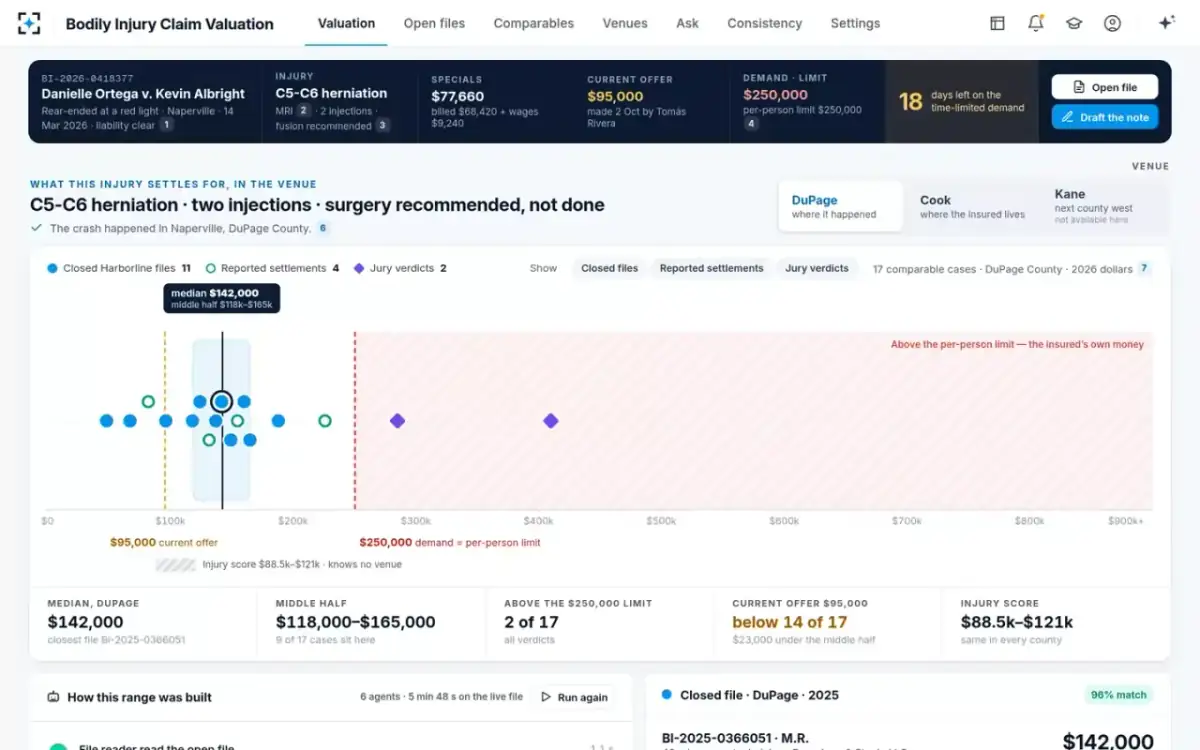
| Comparables, DuPage County | 17 cases, crash county | Median $142,000 | Middle half $118,000–$165,000 |
| Comparables, Cook County | 15 cases, where the insured lives | Median $322,000 | 11 of 15 above the $250,000 limit |
The test teaches three things. The base matters as much as the factor: the same ratio more than doubles the value when applied to billed rather than paid medical bills, and states disagree about which figure a jury hears. The factor is national and the file is local: no multiplier knows that this claimant's lawyers file in Cook County whenever the venue lets them. And the multiplier has no way to see the facts that set this file apart, a fusion recommended on 18 August and deferred by the patient, which the comparable cases capture because they were matched on surgery status.
Is there a formula for pain and suffering? What juries are told
No. Juries are told in so many words that no standard exists, and courts describe the task as subjective. California's civil jury instruction on pain and suffering, written by the state's Judicial Council, tells jurors: "No fixed standard exists for deciding the amount of these noneconomic damages. You must use your judgment to decide a reasonable amount based on the evidence and your common sense." The items it lists for jurors to value include physical pain, mental suffering, loss of enjoyment of life, disfigurement, physical impairment, inconvenience, grief, anxiety, humiliation and emotional distress.
“One of the most difficult tasks imposed on a fact finder is to determine the amount of money the plaintiff is to be awarded as compensation for pain and suffering. The inquiry is inherently subjective and not easily amenable to concrete measurement.”
California Court of Appeal, Pearl v. City of Los Angeles (2019), as quoted in the CACI authorities
An insurer's valuation is a forecast of that subjective judgement, made long before any jury exists. That is why the best evidence for it is what juries and settling parties in the same venue have done with injuries like this one, rather than a factor that averages every injury in every county together.
What is anchoring in damages, and why does it move pain and suffering?
Anchoring is the pull a number exerts on a later judgement: when a lawyer asks a jury for a specific sum, the award tends to move toward it, whatever the evidence. A randomized experiment in which mock jurors heard a shortened medical malpractice trial, published in the Iowa Law Review, confirmed "that anchoring has a powerful effect on damages, and a small negative effect on liability determination", and found that high anchors are difficult to counter: "none of these strategies were an effective antidote to the plaintiffs' high anchor." A later study of 732 people found that large lump-sum demands drive larger verdicts, while per diem figures of similar size did not.
States are now legislating against it. Georgia's 2025 tort reform, as the Governor's office summarised it, requires closing arguments about pain and suffering to relate to the evidence, which "prevents counsel from using an artificial benchmark--like a professional athlete's salary, the cost of fighter jets, or the number of miles driven by a truck". An insurer valuing Georgia files has to ask which of its comparable verdicts were won under the old rules, the subject of Georgia tort reform 2025 and medical bills.
Anchoring can work on adjusters too. On the sample file the first number in the file was the demand: $250,000, the per-person limit. An adjuster who values from memory may start from the demand and the score and split the difference; one who values from comparables starts from what the same injury paid, and treats the demand as one more number on the strip.
Do insurers use the multiplier method? What a valuation weighs instead
A multiplier can serve as a rough sense check; a defensible valuation weighs comparable cases, adjusted for venue and date, beside the facts that set the file apart. The difference is what each method can explain to a claim manager, a claimant's lawyer or, later, a court.
The multiplier and a comparable-case valuation, side by side
Specials × a multiplier: Medical bills, billed or paid depending on habit.
Comparable cases in each venue: Closed files and published cases matched on level, treatment, surgery, liability, age and specials.
Specials × a multiplier: None; one factor for every county.
Comparable cases in each venue: A range for each county where suit could be filed, under the state venue statute.
Specials × a multiplier: Invisible unless the factor is raised by feel.
Comparable cases in each venue: Matched directly: comparables with the same status.
Specials × a multiplier: A factor remembered from earlier years.
Comparable cases in each venue: Each amount restated with the medical care index, the original kept.
Specials × a multiplier: The factor chosen, and the adjuster’s reason for it.
Comparable cases in each venue: Every case, opened to its closing note or report.
Where this claim sits among the cases like it, and where the score sits
Future pain and suffering: the problem of a deferred surgery
Future pain and suffering is valued only if it is reasonably certain, which makes a surgery that has been recommended but not done the hardest kind of file to price. California's instruction states the test directly: to recover for future pain and suffering, the plaintiff "must prove that [he/she/nonbinary pronoun] is reasonably certain to suffer that harm", and the jury awards an amount in current dollars at the time of judgement. A multiplier has nowhere to put that uncertainty; it either ignores the surgery or prices it as if it had happened.
On the sample file the surgical consult on 18 August recommended an anterior cervical discectomy and fusion at C5-C6, estimated at $92,000 to $118,000, and the patient deferred it. That single sentence in a 412-page file moves the value in two directions. If the surgery is reasonably certain, its cost belongs in future specials and the pain of surgery and recovery in future general damages. If it is not, a claimant's lawyer will still present it, and a jury may weigh it. The honest way to value the file is to match it with closed cases in the same state: fusion recommended and not done, rather than fusion done or never mentioned.
That is what the comparable finder scores, among other things: surgery status is one of the seven matching factors, alongside spinal level, herniation, treatment, liability, age and specials. The closest DuPage file on the sample strip, a 40-year-old with two injections and fusion recommended and not done, settled at $142,000 in current dollars, exactly the county median. A Cook file with fusion recommended, at a different specials level, paid $452,000. Neither number is a multiplier; both are evidence of what a deferred surgery has actually been worth.
How much do insurance companies pay for pain and suffering?
No national statistic separates the pain-and-suffering part of injury settlements from the rest, so the honest answer comes in two pieces: what whole settlements look like, and what this injury pays in this venue. On the first, the IRC study found average auto bodily injury payments rising from about $14,000 in 2017 to more than $20,000 in 2022, at about $2.00 of total settlement per dollar of medical bills paid. The differences behind that average are set out in what each published average bodily injury settlement measures.
Representation changes the arithmetic for the claimant more than the headline suggests. After medical costs and legal fees, which the IRC estimated at a third of the settlement, a represented claimant ended up with $1.40 for each dollar of medical expense, against $1.80 without a lawyer, and waited more than twice as long for the claim to close. Those are averages across a national book. On a single file the venue still dominates. The sample file's comparables put the same injury at a median of $142,000 in one county and $322,000 in the next.
Billed or paid: the base under any multiplier changes by state
Any method that starts from medical specials depends on which medical figure the state's law puts in front of a jury, and states answer differently. Illinois lets the plaintiff place the full billed amount in evidence once its reasonableness is established. Florida's 2023 reform limits the proof of past medical bills that have been satisfied to what was actually paid, whoever paid it. Georgia's 2025 act lets juries hear both.
Specials billed and paid, on the file the agents read
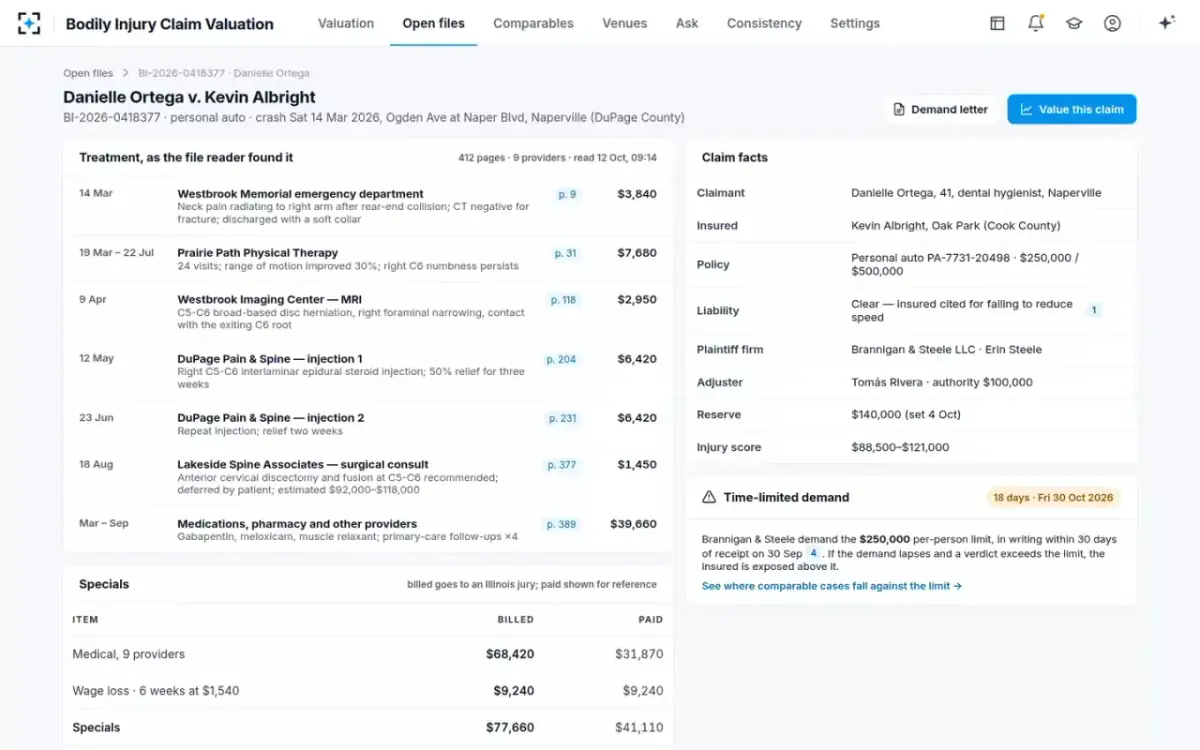
A multiplier applied to the wrong base is wrong before it starts. The sample file shows how far: $68,420 billed against $31,870 paid, a ratio of more than two to one before any factor is applied. In Bodily Injury Claim Valuation the file reader keeps both figures, and the note states which one goes to the jury in the file's state.
Questions people ask
What is the pain and suffering multiplier?
A rule of thumb that values pain and suffering as medical specials times a factor that rises with severity. It has no official source; the closest measured figure is the IRC's finding that auto bodily injury claimants received about $2.00 in total settlement per $1 of medical bills paid, 2017–2022.
How is pain and suffering calculated by a jury?
Without a formula. California's jury instruction tells jurors that "No fixed standard exists" and that they must use their judgement and common sense to reach a reasonable amount based on the evidence.
Do insurance companies use pain and suffering calculators?
Insurers can use injury evaluation scores, which turn coded injuries and treatment into a value band. A score is consistent but not local: on the sample file in this guide its band was the same in every county, while comparable cases put the median at $142,000 in one county and $322,000 in another.
What counts as pain and suffering in an injury claim?
The noneconomic losses an injury causes. California's instruction lists physical pain, mental suffering, loss of enjoyment of life, disfigurement, physical impairment, inconvenience, grief, anxiety, humiliation and emotional distress.
Does a lawyer increase a pain and suffering settlement?
The published data do not show that it raises what the claimant keeps. In IRC data, represented auto bodily injury claimants netted $1.40 per dollar of medical expense after medical costs and legal fees, against $1.80 for those without lawyers, and waited more than twice as long for closure.
Why does the same injury get different pain and suffering values?
Because noneconomic damages have no market price, and each adjuster or jury prices them from different evidence. Venue adds to it: in the sample file the same neck injury had a median of $142,000 in DuPage County and $322,000 in Cook County.