Stair stepping reserves is the practice of raising a claim's case reserve in a series of increments, each made when something forces it, such as a lawyer's letter, a demand, a suit or a payment about to go out, rather than setting the reserve to the best estimate of what the facts already in the file imply. Drawn as a chart, the reserve history looks like a staircase. Each step can look reasonable on the day it is taken; together they mean the reserve was always behind the file, the claim's cost reached the books quarters late, and the insurer's reserving history taught its actuaries the wrong pattern. On bodily-injury claims the fact behind the next step is usually already sitting in a medical record. Botminds' Case Reserve Adequacy Review rereads every open injury file before each reserving meeting, shows the reserve history with what was known at every change, and marks any fact that was in the file but not in the reserve.
The file used throughout is a fictional sample in the solution; the regulatory examples come from a Florida examination report and a FEMA bulletin, linked where they appear.
Four step-ups on one file, and the fact beneath each
| Change | Reserve | Reason recorded at the time | In the file, not in the reserve |
|---|---|---|---|
| 1 · 18 Mar 2024 | $15,000 | Opening reserve | — |
| 2 · 10 Jul 2024 | $45,000 | First step-up | — |
| 3 · 3 Feb 2025 | $85,000 | “Two epidural injections; 10 weeks off work.” | Pain-management note, 21 Jan 2025: “refer for surgical consultation if relief is not sustained” |
| 4 · 19 Nov 2025 | $140,000 | “Demand $650,000 received.” | Surgical consult, 14 Oct 2025: “candidate for C5-6 fusion; patient wishes to defer” |
| 5 · 14 Aug 2026 | $185,000 | Set eight days after suit was filed | Surgery still unreserved |
| Recommended, Oct 2026 | $392,800 | Fusion scheduled for 4 Nov 2026, priced at $95,000 with five other steps | Resolved |
What is stair stepping reserves?
It is a reserve history in which every increase follows an event rather than the facts that predicted the event. The demand arrives, the reserve rises to meet it; the suit is filed, the reserve rises again; a payment is about to exceed the reserve, so the reserve is raised just enough to cover it. Each change has a reason. The pattern's defining feature is that the reason was foreseeable from documents already in the file when the previous change was made.
The sample file shows the pattern cleanly. Its reserve opened at $15,000 in March 2024 and stepped up four times in 31 months, to $185,000. At the third change, in February 2025, the adjuster priced two epidural injections and ten weeks off work; a pain-management note in the file, 13 days old, already recommended a surgical consultation if relief did not last. At the fourth change, in November 2025, the adjuster priced a $650,000 demand; a surgeon's consult five weeks earlier had called the claimant a candidate for fusion. Neither change reserved the surgery. The recommendation that finally did, in October 2026, more than doubled the reserve.
Why do insurers stair-step reserves?
Mostly because of how reviews are triggered, not because anyone sets out to under-reserve. A desk that reviews by exception rereads files when an event announces itself, and events that announce themselves are letters: representation, demand, suit, a bill that would exceed the reserve. Medical facts announce themselves to nobody. A recommendation for a surgical consult arrives as one line in a pain-management note, among dozens of pages a busy adjuster will read properly only when a demand quotes it back.
Reserving philosophy contributes. The CAS study text describes insurers that reserve to the best estimate of ultimate settlement value and others that reserve to the most likely outcome, the mode (Friedland, CAS). A desk that reserves only to what has been documented, or to the most likely outcome when surgery is merely possible, will step up every time the possible becomes documented. Authority thresholds can add a nudge: a reserve that would cross an adjuster's limit needs a manager, and an increment that stays under it does not.
None of these is a reason to call each step wrong. The same CAS text is explicit that a reserve can prove too high or too low and still have been reasonable on what the adjuster knew when setting it, the standard applied in case reserve adequacy. Stair-stepping is the case where the information was available and the reserve did not reflect it.
Is stair stepping reserves bad?
Yes, for three reasons that reach beyond the file. It delays recognition: every step on a prior accident year lands as adverse development in a later calendar year. It distorts projections: actuarial methods assume consistent relative adequacy of case reserves, and Berquist and Sherman warned that when those assumptions break in a consistent direction rather than at random, the projections bend with them. And it is visible to examiners, who sample files and read the reserve history against the documents.
"Based on analysis of the statistical sample of claims files we found that 27% of claims files sampled indicated a problem with claims reserving due to adjusting reserves immediately prior to making a claims payment or due to inadequate reserving."
Florida Office of Insurance Regulation, examination report, 2009
That finding, from a limited-scope examination of a commercial auto and workers' compensation insurer, names both forms of the pattern: reserves raised only when a payment needs room, and reserves that were simply too low. The insurer disputed it and submitted evidence for its reserves (Florida OIR). The point for any claim leader is how an examiner tests: by reading sampled files, one by one, against their reserve histories.
There is a cost inside the claim too. A file whose reserve tracks only events gives the manager no warning: the first time a $185,000 file shows its true cost is the day a $392,800 recommendation arrives, and if a limits demand comes first, the authority to answer it is sized to the old number. How a late step-up reaches the accounts is set out in adverse reserve development, traced to the file.
The next step is usually already in the file
On injury files the fact behind a step-up tends to precede it by months, and the delay depends on what kind of fact it is. A replay of the sample insurer's closed and open files matched 1,906 step-ups since 2021 to the fact that should have moved each one: a recommended surgery waited a median of 141 days before the reserve moved, against 29 days for a suit, because a suit arrives as a summons and a surgery arrives as a sentence in a progress note. The open files with the most steps show what is still waiting.
Open sample files with four or more step-ups, and the increase their next step needs
Three of the five carry a surgery as the trigger now. That is the replay's lesson turned forward: on a desk that stair-steps, the files with the most steps are the files most likely to have an unpriced medical fact, and they are the ones to reread first.
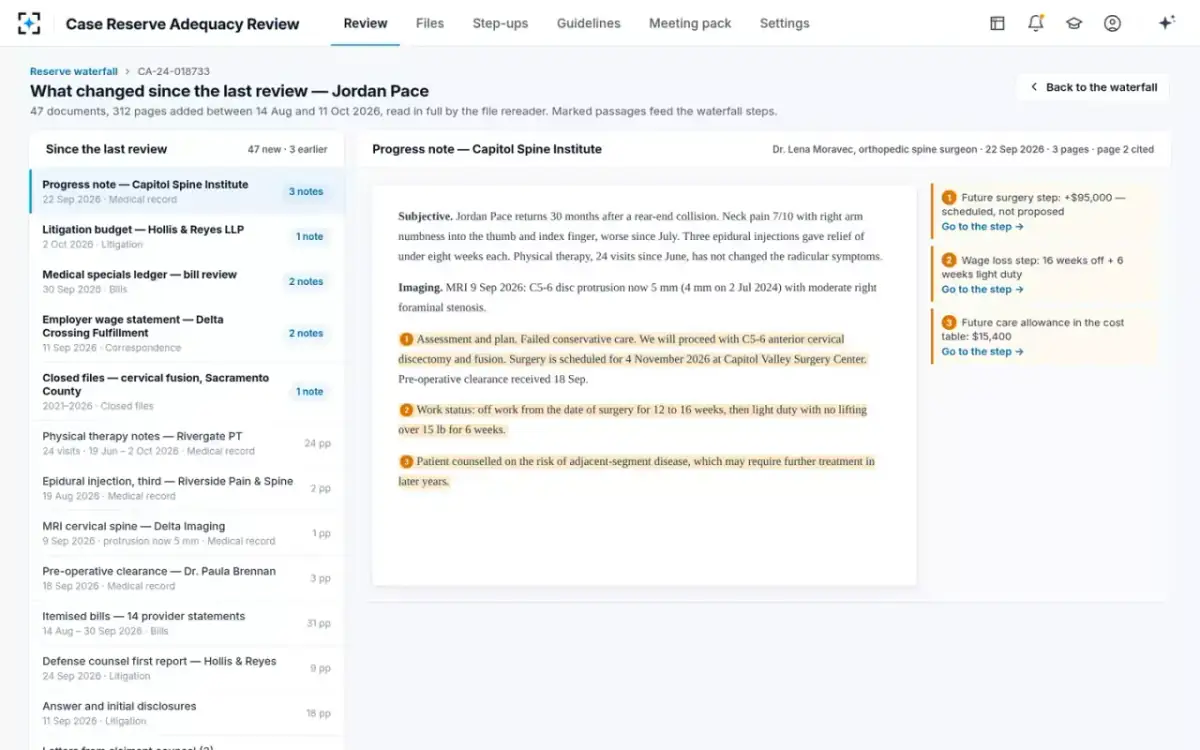
What changed since the last review: the surgeon's note, marked
What events should trigger a reserve review?
Every fact that changes the expected cost, including the medical ones, and every payment. The sample insurer's guideline defines a new material fact as a surgery recommended, a suit, a demand, an attorney, a death or Medicare entitlement, and requires a review within 30 days of any of them, on top of the quarterly reread of every open file. Putting surgery recommended at the top of that list is the single most effective change against stair-stepping on injury files.
Payments belong on the list as well. FEMA's 2010 bulletin on case reserving for flood insurers said that when a partial payment is made, "the company’s estimate of the value of future payments should be reevaluated and the case reserve revised", and that "Subsequent adjuster reports should refine the case reserve amount (increase or decrease) as the company becomes aware of additional facts, inspections, and estimates of damage" (FEMA, NFIP bulletin W-10008). The bulletin is archived and written for flood claims, but its distinction is exactly right: a payment is a moment to re-estimate the claim, not to top up the reserve by the amount about to go out.
Events that should open a reserve review on an injury file
- Surgery recommended, scheduled or performed
Price the procedure from the venue’s cost table when a treating provider names it, not when a demand quotes it.
- Injections, advanced imaging or a specialist referral
Often the step before surgery; the sample replay found these waited a median of 66 days.
- Attorney retained
Changes expected value and duration; review the reserve and the expense line.
- Demand received, and especially a demand at or above limits
The sample guideline sends limits demands to a manager within five days.
- Suit served
Set an expense reserve to counsel’s budget; the sample guideline allows 10 days.
- Work restrictions or wage statements
Time off a provider gives is wage loss the reserve should carry.
- Medicare entitlement
Conditional payments and their recovery clock become part of the cost.
- A payment that would approach or exceed the reserve
Re-estimate the whole claim, not just the headroom for the payment.
How do auditors and examiners spot stair stepping?
By reading the reserve history against the documents, and by looking for shapes in the numbers that only stair-stepping produces. On a sample of files, the questions are simple: how many times has the reserve moved, did each move follow a document that arrived long before, and was the reserve raised just before payments. In aggregate, actuaries look for case reserves weakening relative to payments, which shows in the average case outstanding triangle as a falling pattern down a column.
A stair-stepped file and a file priced on arrival, as an examiner would read them
Stair-stepped: Many small increases over the life of the claim.
Priced on arrival: Fewer changes, each sized to a new fact.
Stair-stepped: Clustered at demands, suits and payments.
Priced on arrival: Within days of the medical or wage document that changed the cost.
Stair-stepped: “Demand received.” “Suit filed.”
Priced on arrival: What the fact is, where it is in the file, and how it was priced.
Stair-stepped: Final payment well above the reserve just before it.
Priced on arrival: Final payment close to the last reserve.
Stair-stepped: Most of the cost recognised in later calendar years.
Priced on arrival: Cost recognised as the facts arrive.
The solution keeps the evidence an examiner asks for in one place. The reserve history shows every past change with who set it, the note, what was known at the time and any fact that was in the file but not in the reserve. The guideline check runs the same tests on every open file each quarter; in the sample insurer's fourth-quarter review, four files had surgery in the medical records but not in the reserve, and five had no review within 30 days of a new material fact.
How to stop reserve creep without padding reserves
Price each fact when it arrives, at its documented value, and nothing that has not happened in the file. The cure for stair-stepping is not a larger opening reserve or a blanket margin, which trades one distortion for another and is just as visible to an actuary. It is a rule that every named treatment, every work restriction and every litigation phase is priced within days of the document that names it, and that possibilities are left out until a provider names them.
Case Reserve Adequacy Review builds that rule into its agents. The medical and future care analyst prices only care a treating provider recommends or schedules. The wage loss estimator never assumes time off a provider has not given. The value and venue reviewer will not price general damages on fewer than ten closed files. The change threshold, $10,000 or 10% at the sample insurer, keeps the reserve from twitching on every bill. The result is a reserve that moves when the file moves, by the amount the file supports. How each step of that calculation is drafted and accepted is covered separately.
The reserve note says when surgery was first raised

What Case Reserve Adequacy Review changes
It removes the reason most stair-steps happen: files not reread until an event forces it. Every open bodily-injury file is reread before each reserving meeting, and the target is one night from a surgeon's note to a recommended reserve, so the medical fact is priced when it arrives rather than when a demand quotes it. The reserve history makes past steps visible, with the fact beneath each, and the meeting pack lists files with three or more step-ups so the reserving meeting sees the pattern as well as the numbers.
What it does not do is change a reserve on its own. Agents recommend; the adjuster accepts or adjusts each step, with reasons kept; a manager approves above authority. The staircase is replaced by a trail of decisions, each tied to a document, which is what an examiner, an actuary and the quarterly case reserve review all need.
Questions people ask
What is stair stepping reserves?
It is raising a claim's case reserve in repeated increments, each made when an event such as a demand, a suit or a pending payment forces it, instead of pricing the facts already in the file. The reserve history looks like a staircase, and each step usually follows a fact that arrived well before it.
Why do insurers stair step reserves?
Mainly because files are reviewed when events announce themselves, and medical facts rarely do. Reserving only to documented or most-likely outcomes, heavy caseloads and authority thresholds that a small increment avoids crossing all add to it.
Is stair stepping reserves bad?
Yes: it recognises cost late, turns into adverse development on prior accident years, distorts the actuarial projections that assume consistent case reserving, and is visible to examiners. A Florida examination in 2009 reported reserving problems in 27% of sampled files, including reserves adjusted just before payments.
How do you prevent reserve creep?
Price each fact within days of the document that reveals it, at its documented value, and review on medical events as well as legal ones. Padding the opening reserve is not a cure; it replaces one distortion with another.
What events should trigger a reserve review?
A recommended or scheduled surgery, injections or advanced imaging, an attorney, a demand, a suit, work restrictions, Medicare entitlement, a death, and any payment that would approach the reserve. The sample insurer in this guide requires a review within 30 days of any material fact as well as a quarterly reread.
How do auditors spot stair stepping?
They sample files and read each reserve change against the documents and payments around it, looking for many small increases clustered at demands, suits and payments. Actuaries see it in aggregate as case reserves weakening relative to paid claims.