Case reserves and IBNR are the two halves of an insurer's reserve for unpaid claims. A case reserve is the estimate, set by the claim department on each reported claim, of what that claim will still cost. IBNR, incurred but not reported, is the actuaries' estimate for everything the case reserves do not capture: claims that have happened but not yet been reported and, in the broad sense most actuaries use, the further development of claims that are reported but not yet fully reserved. The adjuster's number ends at what the known file shows; IBNR picks up the rest. The two are not independent, because actuaries project IBNR from the history of case reserves, so a change in how adjusters reserve moves the IBNR too. Botminds' Case Reserve Adequacy Review works on the case side, rereading every open bodily-injury file and recommending a case reserve on its facts, so that the part the claim desk owns is right and consistent before the actuaries build on it.
Case reserves and IBNR, side by side
Case reserve: Future payments on one known, reported claim.
IBNR: Claims not yet reported, plus further development on reported claims, reopened claims and claims in transit.
Case reserve: The claim department: adjusters, managers within authority, sometimes formulas.
IBNR: Actuaries, approved by management.
Case reserve: The individual claim file.
IBNR: A line of business and accident period, in aggregate.
Case reserve: Documents in the file: medical records, bills, wage loss, demands, suit papers.
IBNR: Development patterns, exposure, expected loss ratios, and the history of case reserves.
Case reserve: When the file changes, at reviews, and as payments are made.
IBNR: At each actuarial valuation, usually quarterly or yearly.
Case reserve: A fact sits in the file unpriced; reserving practice drifts.
IBNR: The methods assume case reserving is consistent; when it is not, the projection is distorted.
What is the difference between case reserves and IBNR?
Who sets them, on what, and for which claims. Case reserves are the claim department's estimates for claims it knows about; IBNR is the actuarial estimate for the rest of the liability. The CAS study text draws the line by role: "Claims professionals are responsible for estimating case outstanding on claims that are reported to the insurer", and "While claims professionals typically estimate case outstanding, actuaries are responsible for estimating the remaining components of total unpaid claims" (Friedland, CAS).
The total reserve for unpaid claims is the sum. The same text lists five components: case outstanding on known claims, a provision for future development on known claims, an estimate for reopened claims, a provision for claims incurred but not reported, and a provision for claims in transit. Actuaries call the last four together the broad definition of IBNR.
The five parts of an unpaid claim estimate, and who owns each
Case outstanding
Σ case reserves on known claims
Set file by file on reported claims.
Claim department
Development on known claims
IBNER
Incurred but not enough reported: what known claims will add beyond their case reserves.
Actuaries
Reopened claims
expected reopenings
Closed claims expected to come back.
Actuaries
Pure IBNR
claims not yet reported
Incurred but not yet reported at all.
Actuaries
Claims in transit
reported, not recorded
Reported but not yet entered in the claim system.
Actuaries
What is a case reserve?
It is the estimate of future payments on a specific reported claim, made by whoever handles it. The CAS study text uses the terms case outstanding or unpaid case "to refer to the estimates of unpaid claims established by the claims department, third-party adjusters, or independent adjusters for known and reported claims only; case outstanding do not include future development on reported claims" (Friedland, CAS). For some lines the first case reserve comes from a formula or a table; on injury liability files it is usually set by an adjuster and revised as the file develops.
Two words in that definition carry the boundary. "Known and reported" means the claim exists in the insurer's system. "Do not include future development" means the case reserve is the claim department's estimate today, not a forecast of how that estimate will change. The insurer's reserving philosophy decides what today's estimate aims at; among the most common, the CAS text notes, is a best estimate of the claim's ultimate settlement value, including future inflation.
What does IBNR stand for, and what does it include?
Incurred but not reported. In its narrow sense it means claims that have occurred but have not been reported to the insurer as of the valuation date. In the broad sense actuaries usually mean, it also includes the development still to come on reported claims, often called IBNER, incurred but not enough reported. The NAIC's statutory definition is close to the narrow sense but acknowledges the overlap: IBNR is "Expected payments for losses relating to insured events that have occurred but have not been reported to the reporting entity as of the statement date" and, as a practical matter, "may include losses that have been reported to the reporting entity but have not yet been entered to the claims system or bulk provisions" (NAIC SSAP No. 55).
The split matters because the two parts respond to different things. Pure IBNR depends on reporting lags and exposure. IBNER depends on how adequate case reserves are. The CAS text is explicit about why actuaries separate them: "One of the most important reasons for separating IBNR into its components is to test the adequacy of case outstanding over time" (Friedland, CAS).
Who sets case reserves, and who sets IBNR?
Adjusters and claim managers set case reserves within their authority; actuaries estimate IBNR; management records the total. At the sample insurer used throughout this series, a fictional company called Western Casualty Claims, casualty adjusters set case reserves up to $250,000, claim managers approve up to $500,000, and a large-loss committee approves anything larger or above half the policy limit. The claims reserving analyst reconciles the claim department's carried case reserves with the actuaries' work each quarter.
Statutory accounting puts the final responsibility on management for both halves together: for each line and in aggregate, management "shall record its best estimate of its liabilities for unpaid claims, unpaid losses, and loss/claim adjustment expenses" (NAIC SSAP No. 55). The reserving meeting is where the two halves meet, and where the claim department's quarter is explained to the people who will project from it, as described in the quarterly case reserve review.
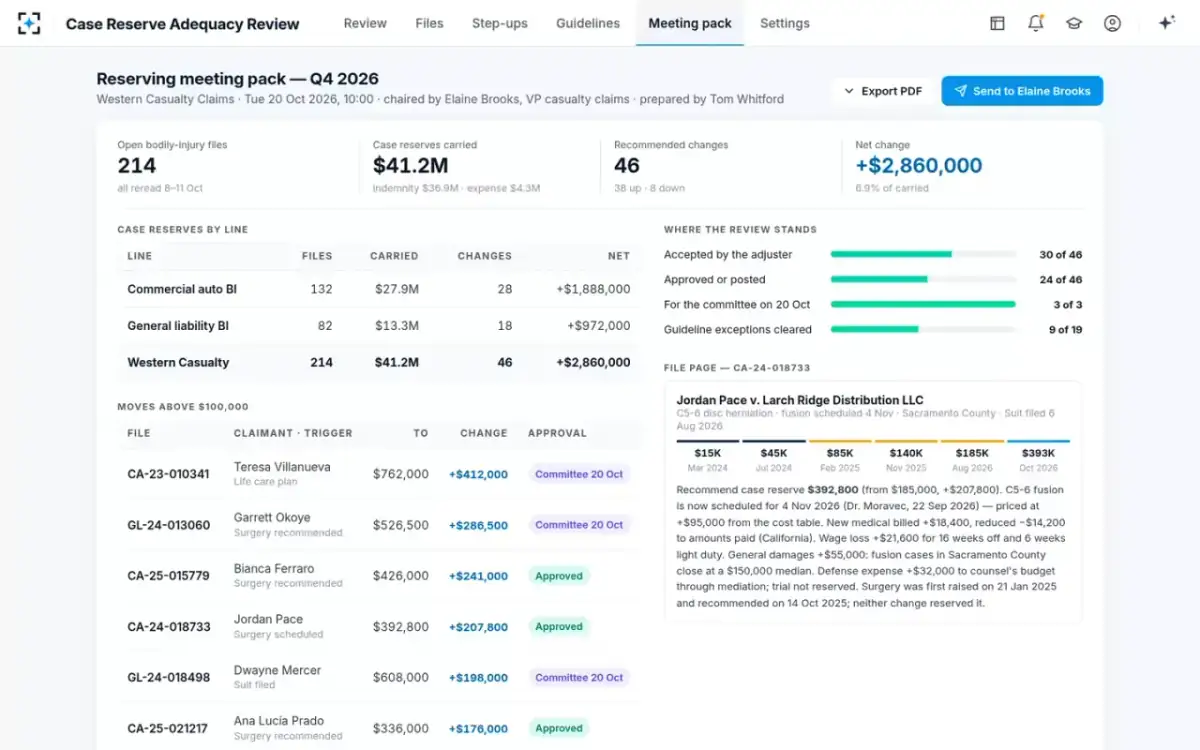
Carried case reserves, by line, for the reserving meeting
Bulk reserves: the line in between
A bulk reserve is a provision added on top of case reserves, in aggregate, for known claims as a group, and statutory accounting files it with IBNR. The NAIC's definition, in the same paragraph that defines IBNR, is unusually candid about what it is for (NAIC SSAP No. 55).
"Bulk provisions are reserves included with other IBNR reserves to reflect deficiencies in known case reserves."
NAIC, SSAP No. 55, paragraph 6.b
That sentence is the clearest statement of how case reserves and IBNR interact. When the claim department's case reserves are known to be short, the shortfall is not fixed file by file; it is carried in bulk, in the IBNR line, by people who do not read the files. Every dollar of bulk reserve on known claims is a dollar the case reserves are understood not to hold. A claim department that brings its case reserves up to the facts reduces the need for it; one whose reserves drift leaves the actuaries to estimate the drift.
Are case reserves part of loss reserves?
Yes. Loss reserves, in statutory terms the liability for unpaid losses, are case reserves plus IBNR, and loss adjustment expense reserves sit alongside them. The NAIC reports that the US property and casualty industry's total loss and loss adjustment expense reserves rose 5.1% in 2025 to $1.03 trillion, made up of $869.2 billion of unpaid losses and $162.9 billion of unpaid loss adjustment expense (NAIC).
The reserve the case reserves are part of
$1.03T
total loss and LAE reserves, US P&C industry, end of 2025
$869.2B
of it unpaid losses: case reserves plus IBNR
$162.9B
unpaid loss adjustment expense
<50%
unpaid case share of total unpaid claims and expenses, net, in the industry data the CAS text uses (2008 edition)
The last figure surprises people outside reserving. In the consolidated industry data the CAS text cites, unpaid case, net of reinsurance, "represent less than 50% of total unpaid claims and claim expenses", and the text adds that the proportion "varies tremendously by line of business and from insurer to insurer" (Friedland, CAS). On long-tail liability lines IBNR is a large part of the balance sheet, and it is estimated from case reserve history.
How do case reserves affect IBNR?
Through the projection. Actuaries use the development of reported claims, paid plus case reserves, to project ultimate losses, and IBNR is ultimate minus reported. Berquist and Sherman's paper names the assumption this rests on: that case reserves stay equally adequate, relative to each other, from one year to the next. The CAS text shows what happens to IBNR when they do not.
In the CAS text's worked example, a private passenger auto book strengthens its case reserves while its true ultimate losses do not change. Case outstanding for the latest accident year rises from $380,075 to $475,094, and the IBNR actually needed falls from $438,638 to $253,336, because more of the liability now sits in case reserves. The text notes in passing that "The actual pure IBNR remains the same regardless of changes in the adequacy of case outstanding": everything that moves is development on known claims (Friedland, CAS).
When case reserves strengthen, the IBNR actually needed falls
The trap is that the standard method responds in the wrong direction. Stronger case reserves raise reported claims and development factors together, so the unadjusted projection rises when the true IBNR need has fallen. Weaker case reserves do the reverse and understate the liability. Either way, a change in case reserving that nobody reported to the actuaries ends up mispricing IBNR, which is why testing case reserve adequacy is part of every reserve analysis.
What the claim file can tell the actuary
Whether a movement in case reserves is the claims getting worse or the reserving getting better. Triangles cannot tell the two apart; the files can. When a quarter's case reserves rise, the actuary wants to know how much came from new facts, a recommended surgery, a suit, a life care plan, and how much from a change in practice, such as a new review cadence or an effort to clear files that were stair-stepped. The first is real development; the second should be adjusted for.
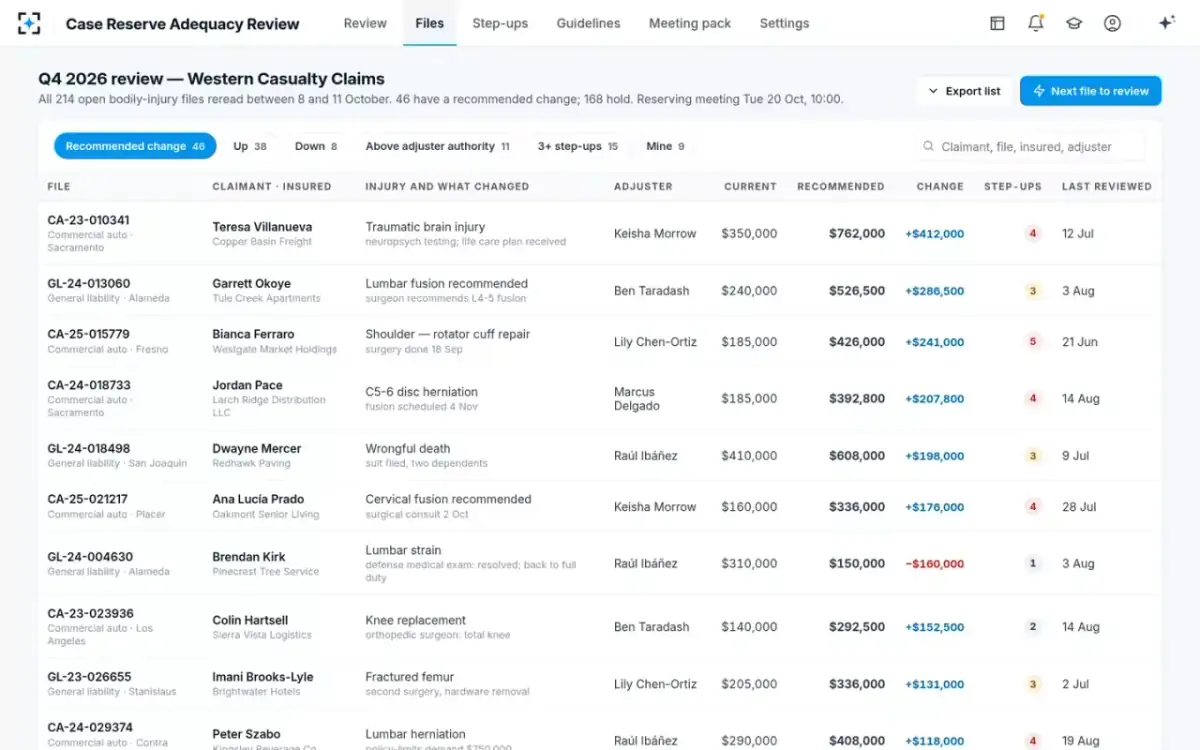
The sample insurer's fourth-quarter review shows what such evidence looks like. Of 214 open bodily-injury files carrying $41.2 million, 46 have a recommended change, 38 up and 8 down, for a net +$2,860,000, and every move above $100,000 goes to the meeting with its trigger: a life care plan, a recommended fusion, a wrongful death suit. The reserve history on each file shows when a fact entered the file and when the reserve priced it. That is information the actuary can use to separate new development from catch-up, and to decide whether bulk reserves on known claims are still needed.
Every file's recommended change, with what changed in the file
Where Case Reserve Adequacy Review sits: the case side only
On the case reserve side of the line, and only there. Its agents reread every open bodily-injury file before the reserving meeting and recommend a case reserve as a waterfall of steps, each tied to its page; adjusters accept each step and managers approve above authority; the agents never post a reserve. The output for the reserving meeting is the carried case reserves by line, every recommended change with its trigger, and the reserve history of each file.
It does not estimate IBNR, IBNER, bulk reserves or reopened claims, and it does not select development factors; those remain the actuaries' work, on their own systems. What it changes for them is the input: case reserves set on the facts, consistently, with a dated account of when and why reserving practice moved. The rules that keep that consistency, from review cadence to authority limits, are set out in claims reserving best practices.
Questions people ask
What is the difference between case reserves and IBNR?
Case reserves are set by the claim department on each reported claim; IBNR is set by actuaries, in aggregate, for claims not yet reported and, in the broad sense, for further development on reported claims. Together they make up the reserve for unpaid losses.
What is a case reserve?
The claim department's estimate of the future payments on a specific known claim. It reflects what is known at the time and excludes future development, which the actuaries provide for in IBNR.
Who sets case reserves?
Adjusters, claim managers within their authority, and for some lines formulas or tables; third-party administrators and independent adjusters set them on the claims they handle. Large reserves usually need a manager's or a committee's approval.
What does IBNR stand for?
Incurred but not reported: losses from events that have happened but have not yet been reported to the insurer. Actuaries often use it broadly to include development on reported claims, reopened claims and claims reported but not yet recorded.
How do case reserves affect IBNR?
IBNR is projected from the development of reported claims, which includes case reserves, on the assumption that case reserving is consistent. If case reserves strengthen or weaken, the IBNR actually needed moves the other way, while unadjusted projections can move in the wrong direction.
What is a bulk reserve?
An aggregate provision on known claims, carried with IBNR, for deficiencies in case reserves. The NAIC's SSAP No. 55 defines bulk provisions as reserves included with other IBNR reserves to reflect deficiencies in known case reserves.