Machine learning in individual claims reserving means estimating the outstanding cost of each claim from that claim's own history, its payments, case estimates, documents and characteristics, using flexible models such as regression trees, gradient boosting or neural networks, instead of projecting aggregated development triangles. Mario Wüthrich's 2018 paper of that title showed the approach is workable; the research since has shown, again and again, that the data decides how well it works, and that the single most useful input is one claim departments already produce: the adjuster's case estimate and its history of revisions. For a claims or reserving leader the practical question is therefore less "which model?" than "what must we have ready?" Botminds' Case Reserve Adequacy Review is not a statistical model of the ultimate; it is a set of agents that reread each injury file and build its case reserve step by step from cited evidence. That makes it a source of the clean, dated, explained case reserves these models depend on, and this guide is plain about both.
The research figures come from peer-reviewed actuarial journals and recent working papers, linked where they appear. Product examples are sample data from a fictional insurer.
What recent research found about individual claims reserving
6
neural networks in one published architecture for individual claims reserving
2
static features in its data: line of business and claim code
~30,000
simulated claims per dataset, modelled on a motor bodily-injury book
~80%
of outstanding liability in the 15 most recent accident periods, in one simulated book
What is individual claims reserving?
It is reserving from claim-level data rather than from triangles that sum claims by accident and development period. Traditional methods such as the chain ladder work on aggregates and are robust and well understood; they also discard what is known about each claim. Wüthrich's abstract states the premise in one line: "Machine learning techniques make it feasible to calculate claims reserves on individual claims data" (Scandinavian Actuarial Journal, 2018).
The term covers two different tasks that buyers often merge. One is predicting the remaining cost of reported claims, which the literature calls RBNS (reported but not settled); the other is predicting claims not yet reported, IBNR. The first overlaps squarely with what an adjuster's case reserve estimates. The second does not, because a claim nobody has reported has no file to read. That distinction is the line between this solution and the actuaries' work, and where the case reserve ends and IBNR begins is covered in its own guide.
What the research has shown so far
That individual models can match or beat aggregate methods, that the hard part is data, and that case estimates carry real information. Delong, Lindholm and Wüthrich set out "to operationalize claims reserving based on individual claims data", built an architecture of six neural networks, and benchmarked its reserves against the chain ladder (Scandinavian Actuarial Journal, 2022). They also offered a pointed observation about their own field: "Surprisingly, many of these approaches pay little attention to the data itself, but they describe the methods used in much detail."
Their data shows why. The features available for each claim were static: a line of business and a claim code. The authors note that "Dynamic information like number of injured people, which can change over time, would require more complex dynamic modeling." On a bodily-injury file, almost everything that moves the cost is dynamic: a surgeon's recommendation, a lawyer's letter, a demand, a suit.
Avanzi, Lambrianidis, Taylor and Wong tested the dynamic information claim departments do keep, the case estimate history, on simulated data designed to mimic a motor bodily-injury portfolio. Asked whether a neural network trained with case estimate data performs better than the same model without them, their answer is "Yes, resoundingly." They found "evidence that case estimates will improve predictions significantly, but that equipping the neural network with memory only leads to meagre improvements", and they caution that "the case estimation process and quality will vary significantly between insurers" (arXiv, 2025).
A 2026 paper by Avanzi, Richman, Wong, Wüthrich and Xie adds two practical points. Most models, it notes, "are trained as one-shot predictors and typically learn only from settled claims", which biases them towards claims that settle quickly; and on immature claims, which hold most of the liability, "case estimates of immature claims are less likely to be accurate" (arXiv, 2026). The claims that matter most are the ones where the adjuster's estimate is weakest and the model has least to learn from.
Can machine learning set case reserves?
It can estimate them; whether it should set them is a governance question, and on injury files the research points to a partnership rather than a replacement. The 2025 study found that a network trained without case estimates outperformed the case estimates overall, but "the relative merits vary significantly by quarter since notification" (arXiv, 2025). And the same study found case estimates improved the model. The best results come from models that use the adjuster's judgment, not ones that ignore it.
That makes the quality of the case estimate a shared asset. If adjusters price a recommended surgery when it is recommended, the model learns from an informative signal. If surgery waits 141 days for a demand, as it did on the median file in a replay of the sample book, the case estimate history teaches the model that reserves move on demands. A model trained on stair-stepped reserves learns stair-stepping.
A model that predicts the ultimate, and agents that reread the file
Statistical model of the ultimate: Payment and case estimate histories and coded claim features, across many claims.
Case Reserve Adequacy Review: The documents in one file since its last review: notes, medical records, bills, demands, suit papers.
Statistical model of the ultimate: An expected remaining cost per claim and, summed, a reserve estimate.
Case Reserve Adequacy Review: A recommended case reserve as a waterfall of steps, each tied to a page.
Statistical model of the ultimate: Many similar claims with long, consistent histories.
Case Reserve Adequacy Review: A single file where a new fact, such as a scheduled surgery, changes the cost.
Statistical model of the ultimate: Quietly, when claim practice changes and history no longer describes the present.
Case Reserve Adequacy Review: Visibly: a step without a document cannot be drafted, and a value range on fewer than ten closed files is left for the adjuster.
Statistical model of the ultimate: Depends on the insurer’s governance; often the actuary reviews the output in aggregate.
Case Reserve Adequacy Review: The adjuster accepts or adjusts each step; a manager approves above authority.
What data is needed for AI reserving?
Claim-level histories with dates, the documents that explain the changes, outcomes on closed claims, and the rules in force when each reserve was set. Most insurers hold all of it somewhere; few hold it joined up, dated and explained. The table below is the readiness list we would work through with any insurer, whatever model or tool it chooses.
Machine learning in individual claims reserving: the data to have ready
| Input | What it must contain | Why models and reviewers need it | Common gap |
|---|---|---|---|
| Case reserve history | Every change with date, amount, who set it and why | The case estimate series is the most predictive dynamic input; reasons show practice changes | Reasons in free text or missing; changes overwritten |
| Payment history | Every payment with date, type and indemnity or expense split | Paid development and settlement speed | Expense and indemnity mixed |
| Documents with arrival dates | Medical records, bills, demands, suit papers, wage statements | What was known at each review: the basis of any replay | Scans without reliable received dates |
| Closed-file outcomes | Final paid by injury group and venue, several years back | Value ranges and the final cost every model is tested against | Injury coding too coarse to compare like with like |
| Reserving guidelines, versioned | Review cadence, triggers, thresholds, philosophy, with effective dates | Separates a change in claims from a change in reserving practice | Guidelines kept as documents, not dated rules |
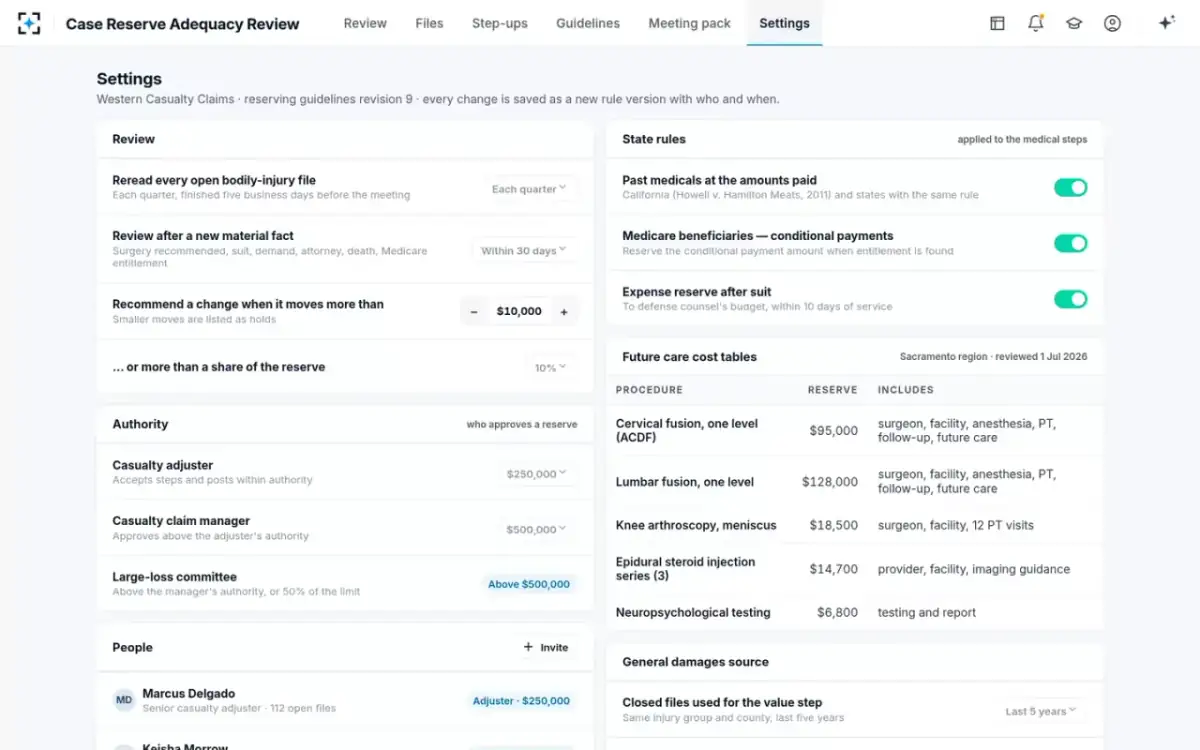
| Authority matrix | Who may set or approve which amount | Routes recommendations; explains jumps at authority thresholds | Exceptions granted informally |
| Cost tables and state rules | Future care costs by venue; billed-or-paid and similar rules by state and date | Prices the facts a file reveals; keeps law changes out of the noise | Tables out of date; state rules applied by habit |
The guidelines row is the one most often skipped and the one actuaries most need. Berquist and Sherman's classic paper made consistent relative adequacy of case reserves the assumption behind incurred projections (Proceedings of the CAS), and ASOP No. 43 asks actuaries to consider changes in the practices of claims personnel (Actuarial Standards Board). A model inherits the same assumption silently. If the date the review cadence or authority limits changed is not in the data, neither the model nor the actuary can see the break.
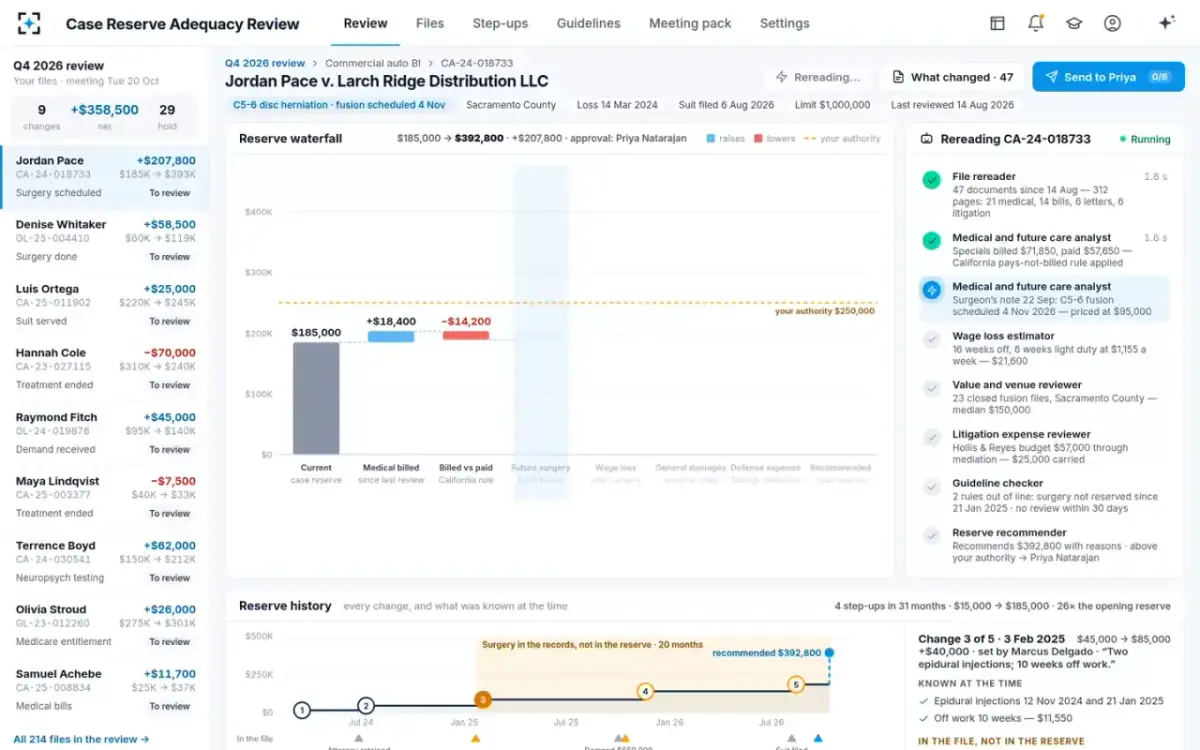
Seven agents reread one file, step by step
How is case-level reserving different from IBNR methods?
Case-level reserving estimates the remaining cost of claims the insurer knows about, one file at a time; IBNR methods estimate the claims not yet reported and the further development on known claims, usually from aggregate patterns. Individual models can do both, but they treat them differently: Delong, Lindholm and Wüthrich model reported claims by completing each claim's settlement path and estimate IBNR claim counts and amounts separately, because for unreported claims "we do not have partially observed histories" (Scandinavian Actuarial Journal, 2022).
For a claim department the useful boundary is ownership. Case reserves are the claim desk's numbers, set by adjusters and approved within authority; IBNR is the actuaries'. A machine-learning reserve for reported claims sits between them, and an insurer has to decide whose number it is before it decides which model to use.
How do you validate a reserving model?
On claims whose outcome you already know, at the dates you would have used it. A reserving model, or a reserving tool like this one, should be replayed on closed files at their historical review dates, using only what was in the file at each date, and its estimates compared with what the files finally cost and with what the insurer actually carried. A model that only looks good on settled claims at the end of their lives has not been tested where reserving is hard.
The NAIC's model bulletin on AI, which the NAIC lists as adopted in 29 jurisdictions as of 8 October 2026, encourages exactly this kind of discipline: insurers are expected to build and use methods that test their predictive models and AI systems for errors and bias. For reserving, the errors that matter are systematic: a model that under-reserves immature litigated claims, or a tool that prices surgery only when a demand quotes it. Replaying closed files to test case reserve adequacy sets out the measures, from days a fact sat in the file to final payment against the last reserve.
Who owns the reserve when AI recommends it?
The person whose authority covers it, as before. Statutory accounting asks management to record its best estimate; adjusters and managers set case reserves within authority; actuaries set the rest. A recommendation from a model or an agent changes the evidence, not the ownership. The design question is how a person can own a number they did not calculate, and the answer is that they must be able to check every part of it.
In Case Reserve Adequacy Review the recommendation is broken into steps, each drafted by a named agent and tied to the document it rests on. The adjuster accepts or adjusts each step, with any adjustment's reason kept in the reserve note. A manager approves above the adjuster's authority, and above authority the reserve reaches the claim file only after that approval. The agents never post a reserve. That is ownership a regulator can examine and an adjuster can defend.
The insurer's reserving rules, as settings with versions
What to have ready, in order
Start with the history and the rules, then the documents, then the model. Insurers that start with the model discover in month three that the reserve history has no reasons, the documents have no dates and the guideline changed twice with no trace of when. The order below front-loads the work that every approach needs, so that the choice of model, or of agents that read the file, is made on evidence.
A readiness checklist for case-level reserving on injury files
- Extract the full case reserve history for open and closed files
Every change with date, amount, who and why, not just the current reserve.
- Date the documents
Received dates for medical records, bills, demands and suit papers; without them no replay is possible.
- Write the reserving guideline as dated rules
Cadence, triggers, thresholds and philosophy, with the date each took effect.
- Code closed outcomes by injury group and venue
Enough files per group to show a range; the sample insurer will not price a value step on fewer than ten.
- Bring cost tables and state rules up to date
Future care costs by venue and billed-or-paid rules by state and date.
- Set the authority matrix and the approval route
So a recommendation goes to the right person and the record shows who decided.
- Hold out a year of closed files for the replay
Test any model or tool at historical review dates before it touches an open file.
- Agree who owns the output
Case reserve, actuarial estimate or management overlay: decide before the first number appears.
Where Case Reserve Adequacy Review fits, and where it does not
It fits at the front of the chain. Its seven agents reread every open bodily-injury file before each reserving meeting and build the reserve waterfall: specials, future care, wage loss, general damages from the insurer's own closed files, and defense expense, each step tied to the page it came from. Adjusters accept each step; managers approve above authority. The result is a case reserve history in which every change has a date, a reason and evidence, which is the input individual reserving research values most, and a closed-file replay that measures how adequate past reserves were.
It does not fit where a statistical model does. It does not predict a portfolio's ultimate loss, estimate IBNR, fit development patterns or forecast verdicts, and it will not price a step without a document behind it. An insurer building a machine-learning reserving model can use it to clean and explain the case estimate series the model learns from; an insurer that is not can use it to make case reserves right on the facts. Claims reserving best practices as written rules shows the settings that make either use auditable.
Questions people ask
What is individual claims reserving?
Estimating outstanding claim costs from data on each individual claim, such as its payments, case estimates and characteristics, rather than from aggregated development triangles. Machine-learning methods such as trees, boosting and neural networks have made it practical, as Wüthrich showed in 2018.
Can machine learning set case reserves?
It can estimate them, but research finds models do best when they use the adjuster's case estimates as an input. Who sets the reserve remains a governance decision: in most insurers an adjuster or manager within authority, with the model or agent providing evidence.
What data is needed for AI reserving?
A complete case reserve history with dates and reasons, payment histories split by indemnity and expense, documents with received dates, closed-file outcomes by injury group and venue, and the reserving guidelines and authority limits as dated rules. Gaps in dates and reasons are the most common obstacle.
How is case-level reserving different from IBNR methods?
Case-level reserving estimates the remaining cost of known claims file by file; IBNR methods estimate unreported claims and further development, usually from aggregate patterns. Individual models handle unreported claims separately because there is no claim history to complete.
How do you validate a reserving model?
Replay it on closed claims at their historical review dates, using only what was known at each date, and compare its estimates with final costs and with the reserves actually carried. Testing only on settled claims at the end of their lives misses the immature claims that hold most of the liability.
Who owns the reserve when AI recommends it?
The adjuster, manager or committee whose authority covers the amount, exactly as without AI. The recommendation should be broken into checkable parts with their evidence, so the person who owns the number can defend each part of it.