Adverse reserve development is the increase, recognised in the current period, in an insurer's estimate of what it owes for losses from earlier accident years: the prior reserve proved too low, and the shortfall is charged against this year's earnings. In 2025 the US property and casualty industry as a whole developed favorably, by more than in any year of the past decade, yet the commercial liability lines still developed adversely, which is where long-tail injury claims sit. On those files adverse development is rarely one big surprise. It is the sum of late case reserve step-ups, each made quarters after the surgery, demand or suit that justified it was already in the file. Botminds' Case Reserve Adequacy Review rereads every open bodily-injury file before the reserving meeting so that those facts are priced when they arrive, and it shows, file by file, how long each one waited.
The industry figures come from the Federal Insurance Office and the NAIC. The file-level example is a fictional sample file in the solution, at a fictional insurer, Western Casualty Claims.
A favorable year with adverse liability lines
$20.0B
one-year reserve redundancy, US P&C industry, 2025
$7,278M
adverse prior-year development in other liability (occurrence), 2025
$1,837M
adverse prior-year development in commercial auto liability, 2025
What is adverse reserve development?
It is the amount by which estimates for past accident years rise from one valuation to the next. The Federal Insurance Office defines the opposite case precisely: favorable development "occurs when current estimates of losses and loss-adjustment expenses attributable to prior accident years are lower than the reserves previously established for those losses, allowing excess reserves to be released, resulting in a corresponding increase in current-period underwriting income" (FIO, 2026). Adverse development is the same mechanism in reverse: the estimate rises, more reserve is added, and current-period underwriting income falls by that amount.
Two features make it hard to manage. It is recognised in the calendar year the estimate changes, not the year the accident happened, so this year's results carry the corrections of earlier years. And it arrives through two channels: the claim desk's case reserves on known claims, and the actuaries' provision for development and for claims not yet reported. On long-tail injury lines the first channel matters more than its share of the balance sheet suggests, because the actuaries' projections are built from the history of case reserves. A late case step-up shows up twice, once on the file and again in the development factors that learn from it.
2025: the best year in a decade, with two liability lines still adverse
The aggregate and the lines tell different stories. The FIO reports that "P&C sector reserve development was significantly favorable in 2025, much greater than in 2024 and greater than in any year over the past 10 years" (FIO, 2026), a turn from a year earlier, when it described 2024 development as favorable "but still to a much lesser degree compared to the experience over the past 10 years" (FIO, 2025). The NAIC puts 2025 at a one-year redundancy of $20.0 billion and a two-year redundancy of $13.5 billion (NAIC).
The NAIC also explains where the releases came from and where they did not. Personal lines "together accounted for $15.9 billion in favorable development", and the turnaround "followed several years of diminishing prior year reserve releases which stemmed primarily from adverse development in the commercial liability lines, driven by economic and social inflation" (NAIC). Its by-line chart shows other liability on an occurrence basis and commercial auto liability still adverse in 2025, the two lines that carry most commercial bodily-injury claims.
Prior-year reserve development by line, 2025: liability adverse, personal lines favorable
For a casualty claim executive the aggregate is the wrong comfort. Workers' compensation and personal auto released reserves; the lines where commercial injury claims live strengthened them. The NAIC's own outlook says that "challenges with social inflation continue to impact reserve adequacy within commercial liability lines" (NAIC).
What causes adverse development in casualty lines?
Two kinds of cause, and they call for different responses. The first is genuinely new information: severity rising faster than anyone assumed, a venue turning, a law changing what juries hear. The Insurance Research Council, an insurer-supported research body, reports that the average auto bodily-injury payment rose from about $14,000 in 2017 to more than $20,000 in 2022, about 7.8% a year, while the share of claimants who sued rose from 10% to 18% (IRC, 2026). Trends like these raise ultimate costs on files that were reserved correctly on what was then known.
The second is information the insurer had but had not priced. A pain-management note recommending a surgical consult, a surgeon calling the claimant a candidate for fusion, a wage statement showing months off work: each is in the file, none is a headline event, and on a desk that reviews by exception each tends to wait until a demand or a suit forces a reserve change. The reserve then rises in a step that looks like development, because by the time it is booked the accident year has closed. On the sample book, a replay of 1,906 step-ups found that a recommended surgery waited a median of 141 days before the reserve moved, against 29 days for a suit.
The first kind belongs to actuaries and pricing; it cannot be reread out of a file. The second belongs to the claim desk and can be. Separating them is the point of testing case reserve adequacy on closed files: a step-up whose fact sat in the file for months is a reserving lag, not an unforeseeable development.
How do case reserves drive reserve development?
Directly, as the claim desk's changes on known claims, and indirectly, through the methods actuaries use for everything else. On known claims, every case reserve increase on a prior accident year is development in the year it is booked. Indirectly, Berquist and Sherman's paper explains that incurred projections assume the claim desk reserves equally well from year to year, and that a systematic change in that adequacy carries straight into the projections; the paper's own wording is quoted in case reserve review.
The indirect effect is the larger risk. If case reserves are weaker than they used to be because reviews have thinned, development factors learned from older, stronger years understate what the weaker reserves still have to develop. The incurred estimate comes out too low, the shortfall is booked as earnings, and it returns as adverse development in later calendar years. The CAS study text shows the mirror image in its worked example, where stronger case reserves made the same method overstate unpaid claims by 20% (Friedland, CAS); the arithmetic is symmetrical.
One file's development, change by change
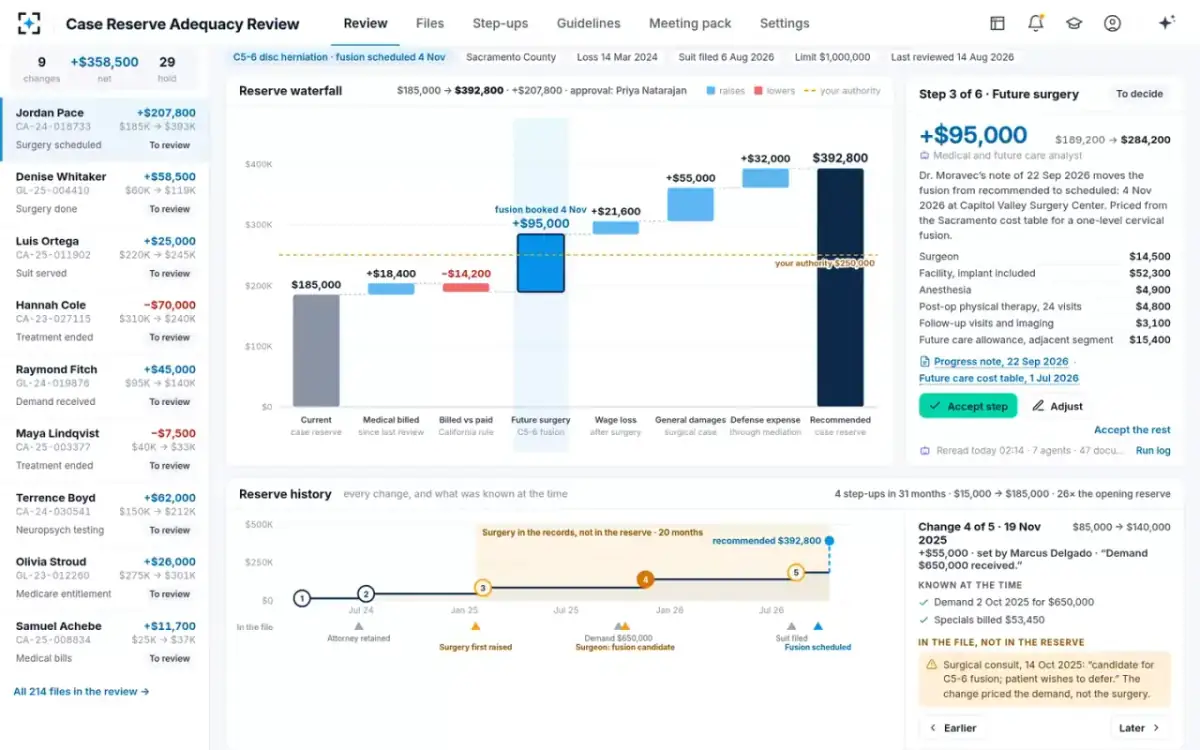
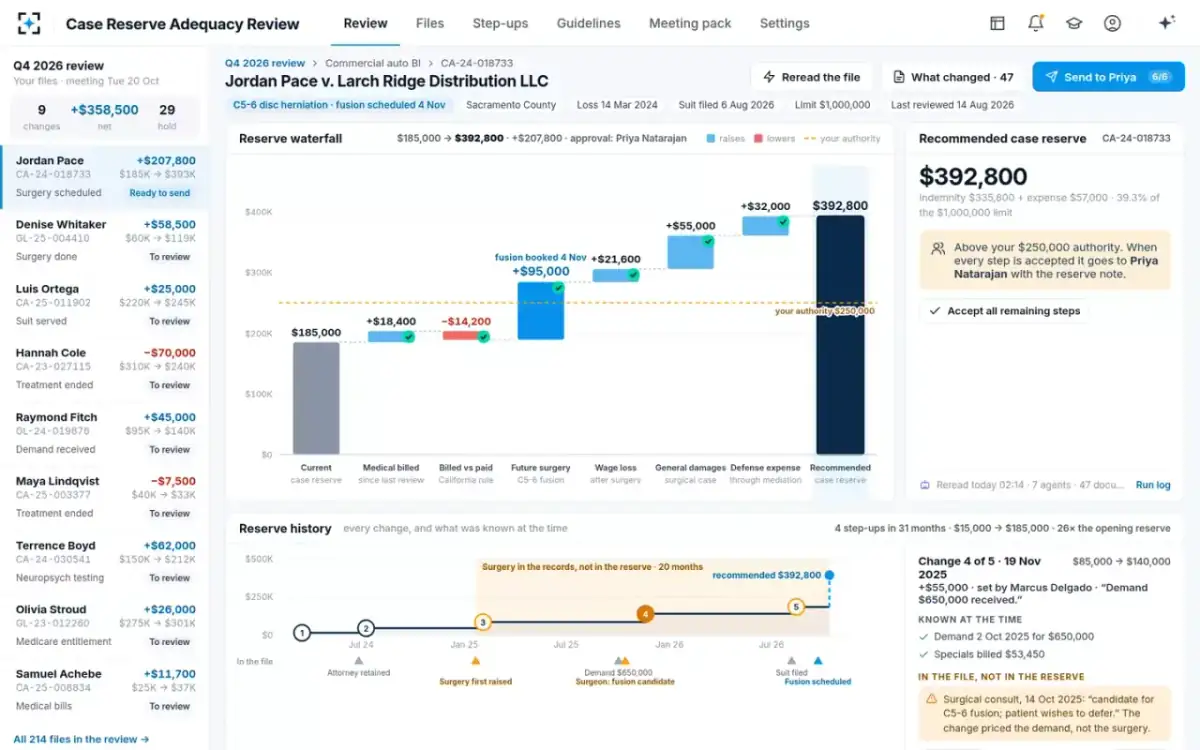
A single sample file shows how the steps accumulate. Jordan Pace was rear-ended by a commercial box truck in Sacramento on 14 March 2024. The case reserve opened at $15,000 four days later, rose to $45,000 in July 2024, to $85,000 in February 2025 for two epidural injections and ten weeks off work, to $140,000 in November 2025 when a $650,000 demand arrived, and to $185,000 in August 2026, the month suit was filed. In October 2026 the solution recommended $392,800, and the claim manager approved it.
One sample file's reserve history, against the surgery that sat in the file
- $15,000Mar–Jul 2024
- $45,000Jul 2024–Feb 2025
- $85,000Feb–Nov 2025
- $140,000Nov 2025–Aug 2026
- $185,000Aug–Oct
- Not yet raisedto 21 Jan 2025
- In the file, not in the reserve21 Jan 2025–22 Sep 2026
- Priced, Oct 2026
The second lane is the uncomfortable one. On 21 January 2025 a pain-management physician wrote "refer for surgical consultation if relief is not sustained". The reserve rose 13 days later, to $85,000, without it. On 14 October 2025 a surgeon called Jordan Pace a candidate for C5-6 fusion who wished to defer; the November change priced the demand instead. Surgery was in the file for 20 months before any reserve included it, and the fusion, once scheduled, was priced at $95,000 from the venue's cost table.
For the insurer's accident-year results the shape matters as much as the total. At the end of 2024 the file carried $45,000. Every increase after that, $95,000 in calendar 2025 and $252,800 in calendar 2026 including the approved recommendation, is development on accident year 2024: $347,800 of reserve increases on one file, our arithmetic from the sample history. The stair-stepping pattern behind those steps is examined separately.
The reserve history: every change, and what was known at the time
How does adverse development affect earnings?
Dollar for dollar, in the year it is recognised. An increase in prior-year reserves is a charge to current-period losses, so it reduces underwriting income, raises the calendar-year loss ratio and, through net income, reduces surplus. In the FIO's own words, favorable development frees reserves "to contribute to the insurer’s profitability" (FIO, 2025); adverse development takes the same amount away.
It also moves the measures regulators and analysts watch. The FIO reports the ratio of loss and loss adjustment reserves to policyholder surplus at 0.82 at year-end 2025, down from 0.87 (FIO, 2026). At that leverage, a 5% strengthening of reserves costs roughly 4% of surplus before tax, our arithmetic: a reserving problem becomes a capital problem quickly. Development is also a credibility measure, because it is the market's evidence of whether last year's reserves can be believed.
Where one late step-up lands, by who reads the numbers
| Reader | What they see | Why it matters |
|---|---|---|
| Claims executive | A reserve increase on an old file at the quarterly meeting | The step is approved after the fact that justified it |
| Reserving actuary | Higher incurred development on a prior accident year | Development factors learned from it change future projections |
| Finance | A charge to current-period underwriting income | The prior year looked better than it was; this year looks worse |
| Regulator or rating analyst | One-year development relative to surplus | Repeated adverse development questions the credibility of reserves |
Is adverse development a sign of under-reserving?
Sometimes, not always. Adverse development means the earlier estimate proved low; whether it was under-reserved depends on whether the earlier estimate ignored information it had. A step-up driven by a verdict trend that nobody could see is an estimation error in the honest sense. A step-up driven by a surgical consult that sat in the file for a year is under-reserving, whatever the intent.
The research on intent is a reminder that motives exist. Grace and Leverty, examining property-liability reserve error, found that financially weak insurers under-reserve more than others, and that insurers also over-reserve for tax purposes and to reduce the effect of rate suppression (Journal of Risk and Insurance, CAS abstract). A claim desk cannot settle that question from the files. It can settle the narrower one: for each step-up, was the fact already there, and for how long? That is evidence a board, an auditor and an actuary can all use.
What earlier rereading is worth
It moves development from later years into the year the information arrives, which is where it belongs, and it makes the remaining development honest. Rereading does not reduce what a claim will cost; Jordan Pace's fusion costs the same whether it is reserved in January 2025 or October 2026. What changes is when the cost is recognised, how much of it lands as a surprise on a prior year, and how much the actuaries' factors are distorted by a desk that priced facts late.
The value can be measured on the insurer's own book. The sample insurer's quarterly review recommends 46 changes on 214 files, a net +$2,860,000 or 6.9% of $41.2 million carried, and every move above $100,000 goes to the meeting with its trigger. If the replay on closed files shows that most step-ups followed facts already in the file, the late part of each step is the amount earlier rereading would have pulled forward. The quarterly case reserve review is where that happens, before the numbers go to the actuaries.
Every step accepted: the recommended reserve and where it goes
What Case Reserve Adequacy Review does about adverse development
The solution works on the claim desk's channel of adverse development: case reserves on bodily-injury files. It replays closed files to show which step-ups followed facts already in the file and how long they waited, and it rereads every open file before each reserving meeting to recommend a reserve that prices those facts now. Each recommendation is a waterfall of steps with their documents; adjusters accept each step and managers approve above authority. The agents never post a reserve.
It does not estimate IBNR, select development factors or forecast industry trends, and it cannot make a verdict trend appear earlier than it does. What it gives the actuaries is a cleaner input, with a dated history of when reserving practice changed and why each large move was made, so that the next projection is built on case reserves whose adequacy is known rather than assumed.
Questions people ask
What is adverse reserve development?
It is an increase in the estimated cost of losses from earlier accident years, recognised in the current period as a charge to earnings. It means the earlier reserve proved too low, whether because of new information or because information already in the files was not priced.
What causes adverse development?
Rising severity, litigation and legal changes that raise ultimate costs, and case reserves that lag the facts in their files. The NAIC attributes several years of diminishing releases before 2025 mainly to adverse development in commercial liability lines, driven by economic and social inflation.
How does adverse development affect earnings?
Directly: each dollar of prior-year reserve strengthening reduces current-period underwriting income by a dollar and raises the calendar-year loss ratio. Through net income it also reduces surplus, which at the industry's 0.82 ratio of reserves to surplus makes reserving a capital question.
Is adverse development a sign of under-reserving?
Not necessarily. It is under-reserving when the information that drove the increase was already in the file when the earlier reserve was set; replaying closed files at their review dates is how to tell the two apart.
How do case reserves drive reserve development?
Case reserve increases on prior accident years are development in the year they are booked, and actuarial incurred methods project from the history of case reserves. If case reserving weakens, those methods understate the liability and the difference emerges later as adverse development.
What is favorable reserve development?
The opposite movement: current estimates for prior accident years come in below the reserves set earlier, so reserves are released and current-period underwriting income rises. The FIO reports that 2025 was the most favorable year for the P&C sector in the past ten.