An expense reserve in insurance is the part of a claim's reserve set aside for the costs of resolving the claim rather than for paying the claimant: on a litigated bodily-injury file, chiefly defense counsel's fees, experts, and other litigation and medical cost containment costs. It sits beside the indemnity reserve, which covers the damages, and in US statutory accounting the claim-specific part of it is called defense and cost containment, DCC, what many still call ALAE. On a file in suit, the most defensible way to set it is from defense counsel's budget, phase by phase, through the phases counsel has actually budgeted. Botminds' Case Reserve Adequacy Review drafts the expense step that way on every litigated bodily-injury file it rereads, and flags any file served with a suit that has no expense reserve within the insurer's deadline.
The worked example is a fictional sample file in the solution, at a fictional insurer, Western Casualty Claims; the definitions come from the NAIC's statutory accounting rules and the Casualty Actuarial Society.
How much of a reserve is expense: one litigated file and the industry
One litigated sample file, recommended
- Indemnity $335,800 · 85.5%
- Expense $57,000 · 14.5%
US P&C industry reserves, end of 2025
- Unpaid losses $869.2B · 84.2%
- Unpaid LAE $162.9B · 15.8%
What is an expense reserve in insurance?
It is the estimate, carried on the claim, of the loss adjustment expense still to be paid to resolve it. The NAIC defines loss adjustment expenses as "Expected payments for costs to be incurred in connection with the adjustment and recording of losses" (NAIC SSAP No. 55). Those costs run from an adjuster's time to a trial lawyer's fees, and they are reserved separately from the losses themselves because they behave differently: indemnity tracks the injury, expense tracks the fight.
Insurers do not all case-reserve expense the same way. The CAS study text records that "some insurers establish case outstanding for the estimated claim amount only; others establish case outstanding for the estimated claim amount and all claim-related expenses", and that some reserve the claim-specific part only, others the general part only (Friedland, CAS). On a litigated injury file, where defense costs can be a large share of the total, a case-level expense reserve is the only way the claim department's view of the defense reaches the reserve.
What is the difference between indemnity and expense reserves?
The indemnity reserve is for what the insurer will pay the claimant or on the insured's behalf: medical specials, wage loss, general damages, a settlement or a judgment. The expense reserve is for what the insurer will pay to get there: defense counsel, experts, record retrieval, surveillance, independent medical examinations and the other costs of resolving the claim. They are set from different evidence, by different reasoning, and reported in different lines.
The distinction matters for the decisions as well as the accounts. An indemnity reserve answers what the claim is worth; an expense reserve answers how far the insurer expects to litigate it. A file whose expense reserve assumes trial, when counsel's plan is to mediate, is making a strategic statement the litigation team did not make. On the sample file, the recommended reserve of $392,800 splits into $335,800 indemnity and $57,000 expense, 14.5% of the total.
LAE, ALAE, DCC and AO: which expense is which
Loss adjustment expense, LAE, is the whole category. The older split, still widely used, is allocated LAE, which the CAS text describes as "those costs the insurer is able to assign to a particular claim, such as legal and expert witness expenses", against unallocated LAE such as "the payroll, rent, and computer expenses for the claims department" (Friedland, CAS). US statutory reporting has used a different split since 1998: defense and cost containment, DCC, and adjusting and other, AO.
Which expense goes where under SSAP No. 55
| Category | What it includes | Examples the NAIC lists |
|---|---|---|
| Defense and cost containment (DCC) | Defense, litigation and medical cost containment, internal or external | Surveillance; litigation management; attorney fees incurred owing to a duty to defend; the cost of engaging experts; fixed amounts for medical cost containment |
| Adjusting and other (AO) | All other loss adjustment expense | Fees and expenses of adjusters and settling agents; attorney fees incurred in the determination of coverage, including litigation with the policyholder |
| Losses, not LAE | Legal costs where legal costs are the insured peril itself | Legal defense costs paid as covered damages under a policy whose only insured peril is legal cost |
The DCC definition is the one that matters for a litigated injury file. SSAP No. 55 puts defense, litigation and medical cost containment there, whether the work is done in-house or outside, and names defense attorneys' fees under a duty to defend and the cost of experts; coverage disputes are a different line, and fees spent deciding coverage are AO. The full list, item by item, is in the defense and cost containment definition. A case expense reserve on a bodily-injury suit is, in statutory terms, almost entirely DCC.
How do you set an expense reserve on a litigated file?
From the defense budget, by phase, for the phases counsel expects to work, less what has already been reserved. Litigation work is organised in phases that the Uniform Task-Based Management System codes for billing: L100 case assessment, development and administration; L200 pre-trial pleadings and motions; L300 discovery; L400 trial preparation and trial; and L500 appeal (UTBMS phases, as adapted by a Maine state agency). A budget written in those phases maps directly onto an expense reserve.
An expense reserve built from the defense budget, phase by phase
| Phase | When to reserve it | Evidence the step should cite |
|---|---|---|
| L100 Case assessment and administration | On service of suit, within the insurer’s deadline | Summons and complaint; counsel’s assignment and first report |
| L200 Pleadings and motions | With the first budget | Answer; motion practice counsel expects |
| L300 Discovery | With the first budget, revised as depositions and experts are scheduled | Budget by task; expert retention letters |
| Mediation or settlement conference | When ordered or agreed | Order or agreement; counsel’s estimate |
| L400 Trial preparation and trial | Only when counsel budgets trial, usually after a trial date or a failed mediation | Trial date; revised budget |
| L500 Appeal | Only after a judgment and a decision to appeal | Notice of appeal; appellate budget |
Two disciplines keep the result honest. Reserve what is budgeted, not what is possible: an expense reserve that assumes trial on every suit overstates expense, because most cases end before trial. And revise when the budget is revised: a new expert, a trial date or a failed mediation changes the phase plan and therefore the reserve. Federal data show how long the plan can run. Of civil cases terminated in the year to September 2025, the median time from filing to disposition was 15.6 months, and 30.7 months for the small number that ended during trial (U.S. Courts, Table C-5).
Should the expense reserve follow the defense budget?
Yes, as its evidence, but not as an approval of it. The budget is the best available estimate of what the defense will cost because it is written by the lawyer who will do the work, phase by phase. It is not a promise and it is not a decision the claim department has made about the budget's reasonableness. That review belongs to the litigation management process.
The solution keeps those two things apart by design. Its litigation expense reviewer reads the suit papers and defense counsel's budget and sets the expense step from them; it never approves counsel's budget. If the budget looks high, that is a conversation for the litigation manager with counsel, and the reserve follows the budget the insurer accepts. The adjuster accepts or adjusts the step like any other, with the reason kept in the reserve note.
A worked expense reserve, on one sample file
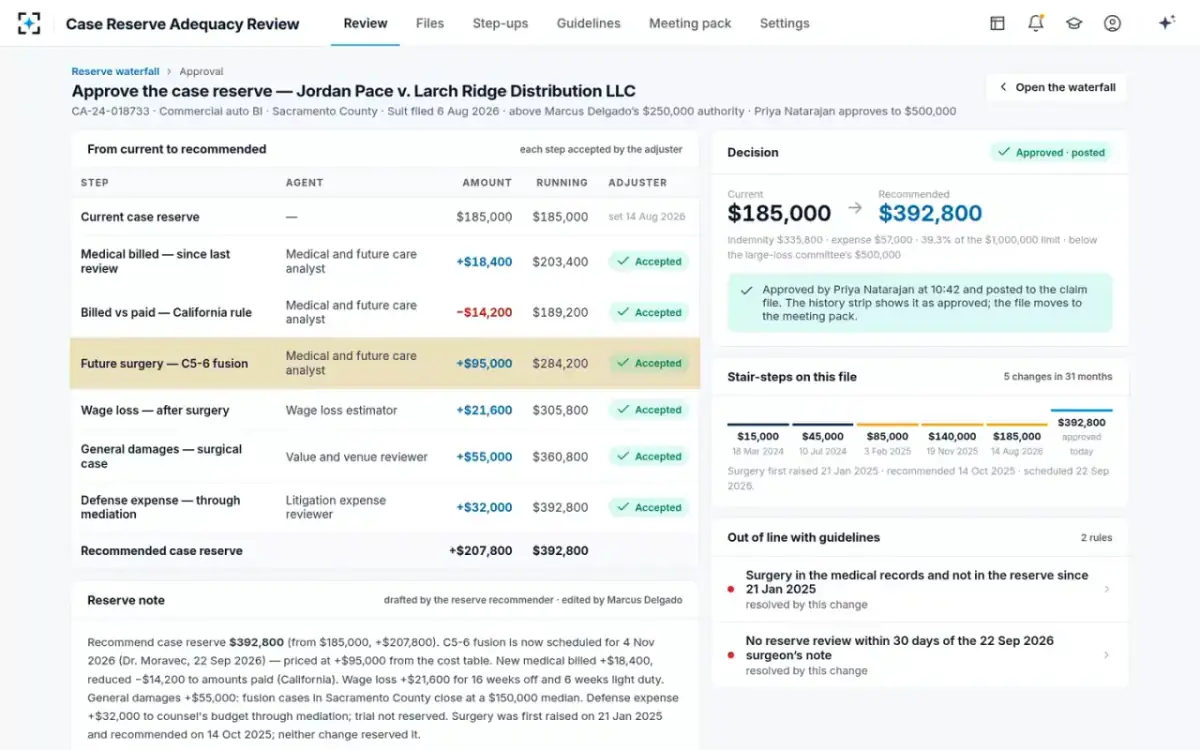
On the sample file, Jordan Pace v. Larch Ridge Distribution LLC, suit was filed on 6 August 2026 and before the fourth-quarter reread the file carried a $25,000 expense reserve. Defense counsel's budget, received on 2 October 2026, runs to $57,000 through mediation. The litigation expense reviewer drafts a step of +$32,000, bringing the expense reserve to the budgeted $57,000, and notes that trial is not reserved because counsel has not budgeted it.
The sample file's expense step
$25,000
expense reserve carried before the reread
$57,000
defense counsel’s budget through mediation
+$32,000
the expense step the adjuster accepted
$0
reserved for trial: not yet in counsel’s budget
The reserve note states the basis in one line: "Defense expense +$32,000 to counsel’s budget through mediation; trial not reserved." If mediation fails and counsel budgets trial, that is a new material fact; the next reread drafts a new expense step for the trial phase, with the revised budget as its evidence. The expense reserve then moves for a reason anyone can see, rather than creeping up invoice by invoice as defense bills arrive.
Approved and posted, with the expense step on the record
What share of a litigated file is expense?
It varies with how far the case goes, which is why it is reserved from the budget rather than as a fixed percentage. On the sample file the recommended expense is 14.5% of the reserve; across the sample insurer's 214 open injury files it is 10.4% of what is carried. Industry-wide, the NAIC reports $162.9 billion of unpaid loss adjustment expense against $869.2 billion of unpaid losses at the end of 2025, a ratio that includes adjusting costs as well as defense (NAIC).
The Federal Insurance Office tracks the defense part relative to premium. It reports that US property and casualty insurers' defense and cost containment expenses incurred fell to 3.9% of direct premiums earned in 2023 and 2024, after holding near 4.5% from 2015 to 2020, and that Florida's rose to 6.6% in 2022 before falling to 5.1% in 2024 after its reforms (FIO, 2025). The national line is flat-to-falling; the state lines show how much law and venue move it.
Defense and cost containment as a share of direct premiums earned
Why a suit with no expense reserve is a known error
Because the suit itself is the evidence that expense will be incurred. Once a summons is served, defense counsel will be assigned and will bill, so a litigated file whose expense reserve is zero is not uncertain; it is wrong by at least the cost of the first phases. Unlike most reserving judgments, this one can be tested mechanically on every open file.
The sample insurer writes the test into its guidelines: an expense reserve to defense counsel's budget within 10 days of service. In the fourth-quarter review the solution found three files served with a suit and no expense reserve within 10 days, each with the change the review recommends. The rule turns an easily missed step into an exception the adjuster sees, and it is one of the rules described in claims reserving best practices written as rules.
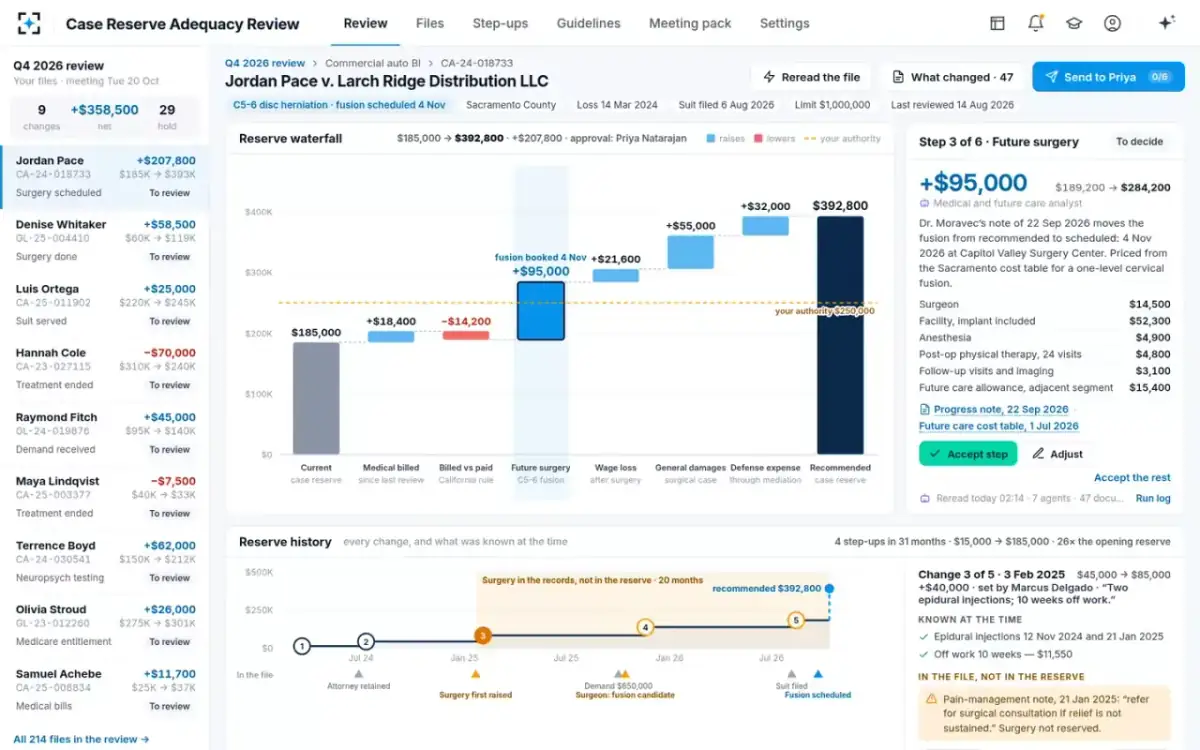
The expense step in the waterfall, beside the indemnity steps
Where Case Reserve Adequacy Review fits on the expense line
The solution sets the case-level expense step on litigated bodily-injury files and checks that every suit has one. Its litigation expense reviewer reads the suit papers and counsel's budget and drafts the step through the budgeted phases; the guideline checker flags suits without an expense reserve within the insurer's deadline; the reserve recommender puts the step in the waterfall with indemnity and expense shown separately. The adjuster accepts the step; a manager approves above authority. The full reserve calculation shows where the expense step sits among the others.
It does not review or approve legal bills, negotiate budgets with counsel, or estimate unallocated or AO reserves, which actuaries set in aggregate. Its agents never contact counsel. It reads the budget the insurer has and turns it into a reserve the reserving meeting can read: so much through mediation, trial not reserved, and why.
Questions people ask
What is an expense reserve in insurance?
It is the amount carried on a claim for the costs of resolving it, such as defense counsel and experts, separate from the indemnity reserve for damages. In US statutory accounting the claim-specific part is defense and cost containment expense.
How do you set an expense reserve?
On a litigated file, from defense counsel's budget by phase, for the phases counsel expects to work, less what is already reserved. It is revised when the budget changes, for example when a trial date is set or mediation fails.
What is the difference between indemnity and expense reserves?
Indemnity is what the insurer expects to pay for the claim itself, such as specials, wage loss, general damages and settlement. Expense is what it expects to pay to handle and defend the claim; the two are set from different evidence and reported separately.
What is an LAE reserve?
The reserve for loss adjustment expense, which the NAIC defines as expected payments for costs incurred in adjusting and recording losses. It includes both defense and cost containment and adjusting and other expense; the US industry carried $162.9 billion of unpaid LAE at the end of 2025.
Should an expense reserve follow the defense budget?
Yes, as its evidence: the budget is the best estimate of defense cost because it comes from the lawyer doing the work. Approving the budget is a separate litigation management decision, which is why the solution's expense agent sets the step from the budget but never approves it.
What is ALAE?
Allocated loss adjustment expense: costs that can be assigned to a particular claim, such as legal and expert witness fees. US statutory reporting has replaced the ALAE/ULAE split with defense and cost containment and adjusting and other, though many insurers still use the older terms.