Defense and cost containment (DCC) is the category of an insurer's loss adjustment expense that covers defending, litigating and containing the cost of claims: defense counsel's fees, experts, surveillance, litigation management and medical cost containment, whether the work is done by the insurer's own staff or by outside firms. Everything else spent on handling claims, chiefly the cost of adjusters, falls in the other category, adjusting and other (A&O). The definition dates from changes the NAIC made to annual statement reporting in 1998, and it matters to a claims legal team because DCC is the line on which its work is reported. The Federal Insurance Office puts U.S. property and casualty DCC at 3.9% of direct premiums earned in 2023 and 2024; in Florida it fell from 6.6% in 2022 to 5.1% in 2024 after the state's legal reforms. Botminds' Claims Litigation Management works on the spending behind that line, suit by suit.
Defense and cost containment as a share of direct premiums earned
What does DCC mean in insurance?
DCC stands for defense and cost containment. It is one of the two parts into which statutory accounting divides loss adjustment expense (LAE), the cost of settling claims as distinct from the claim payments themselves. The other part is adjusting and other (A&O). Insurers report both in their annual statements, by line and accident year, so DCC is a regulated, comparable number, not an internal label.
The defining feature is the nature of the work, not who does it. The definition the NAIC adopted, effective 1 January 1998, as the Texas Department of Insurance reproduced it for insurers that month, reads:
"Allocated loss adjustment expenses include defense, litigation and medical cost containment expenses, whether internal or external."
NAIC annual statement instructions, as reproduced in Texas Commissioner's Bulletin B-0002-98
The words "allocated loss adjustment expenses" in that sentence are the old name for the same category. The NAIC later changed the annual statement titles, and the category has been reported as defense and cost containment since.
What counts as DCC expense?
Defense lawyers and everything that supports a defense. The NAIC's list, as Texas reproduced it, names seven items and says it is not exhaustive: surveillance; fixed amounts for medical cost containment; "Litigation management expenses"; pool expenses reported by accident year; appraisers, investigators and similar staff "if working in defense of a claim", and rehabilitation nurses where their cost is not in losses; "Attorney fees incurred owing to a duty to defend, even when other coverage does not exist"; and "The cost of engaging experts."
DCC or A&O? Where common claim costs fall
| Cost | Category | Why |
|---|---|---|
| Panel defense counsel’s fees on a suit against the insured | DCC | Attorney fees owing to a duty to defend |
| Expert witnesses and independent medical examinations for the defense | DCC | The cost of engaging experts; medical examination fees |
| In-house defense lawyers and litigation managers | DCC | Defense and litigation expenses count whether internal or external |
| Surveillance and investigators working in defense of a claim | DCC | Named in the list; investigators count only when working in defense |
| Court costs, stenographers, copies of records | DCC | Specific case-related expenses in Washington’s current rule |
| Adjusters’ salaries and independent adjusters’ fees | A&O | Fees of adjusters and settling agents |
| Investigators working in the capacity of an adjuster | A&O | Same people, different role |
| Lawyers deciding whether the policy covers the claim, including suits with the policyholder | A&O | Attorney fees incurred in the determination of coverage |
A current state rule shows the definition is still live. Washington's regulation for medical malpractice closed-claim reports defines allocated loss adjustment expense as "defense and cost containment expenses paid or incurred for defense, litigation and medical cost containment expenses and services", lists among them case evaluation, risk assessment, "Case preparation and management", medical record review and "Settlement negotiations" by experts, and excludes the costs of claims adjusting staff.
ALAE vs DCC, and ALAE vs ULAE
They are close but not identical, and the difference is the basis of classification. Under the older terms, allocated loss adjustment expense (ALAE) was expense that could be assigned to a particular claim, and unallocated (ULAE) was everything else. The 1998 change replaced that test. A paper in the Casualty Actuarial Society's Forum explained it at the time: "Under the revised rules, the ability of an insurer to assign expenses to a specific claim no longer determines how it is classified."
Two ways of splitting claim expense
ALAE and ULAE (traditional): Can the expense be assigned to a specific claim?
DCC and A&O (annual statement since the late 1990s): Is the expense for defense, litigation or medical cost containment?
ALAE and ULAE (traditional): Often unallocated, because salaries are not billed to files.
DCC and A&O (annual statement since the late 1990s): DCC, whether internal or external.
ALAE and ULAE (traditional): Allocated, because it is billed to that claim.
DCC and A&O (annual statement since the late 1990s): A&O: fees of adjusters and settling agents.
ALAE and ULAE (traditional): Allocated if billed to the claim.
DCC and A&O (annual statement since the late 1990s): A&O: attorney fees in the determination of coverage.
ALAE and ULAE (traditional): Still common in actuarial and claims speech, often as loose synonyms.
DCC and A&O (annual statement since the late 1990s): The categories insurers report in statutory statements.
In everyday use the terms blur, and that is mostly harmless inside a claims department. It matters when numbers are compared across companies or over time, or when a litigation programme's cost is being measured: an in-house litigation team's salaries are DCC under the current definition but would have been ULAE under the old test, and an independent adjuster billed to a file went the other way. Reserving for these expenses belongs to the actuarial team; the claims side's job is to make sure the spending behind them is visible suit by suit.
Coverage fights are not DCC
One exclusion surprises people. Legal fees spent deciding whether the policy covers a claim, including litigation between the insurer and its own policyholder, are classified as adjusting and other, not DCC. The NAIC list puts "Attorney fees incurred in the determination of coverage, including litigation between the insurer and the policyholder" on the A&O side, and Washington's current rule excludes "Expenses incurred to determine whether coverage is available" from its defense category.
The logic follows the tripartite relationship. DCC is the cost of defending the insured and containing the claim's cost; a coverage dispute is the insurer contesting its own obligation. Keeping them apart means the DCC line measures the defense, and it is one more reason a carrier's litigation records should keep defense matters and coverage matters separate.
What share of premium is defense cost?
About 3.9% across all U.S. property and casualty lines in 2023 and 2024, according to the Federal Insurance Office, which drew the series from S&P Global. The figure varies widely by line. Read from FIO's chart, commercial auto ran at roughly 6.5% of premium in 2024, private auto near 2% and homeowners multiperil around 1.5%; liability-heavy books carry far more defense cost than property books.
Defense cost in three numbers
3.9%
U.S. P&C DCC as a share of direct premiums earned, 2024
Federal Insurance Office
≈6.5%
commercial auto, U.S., 2024, read from FIO’s chart
approximate
$231.6–281.2B
added to liability losses and DCC over a decade by litigation trends and inflation, as CAS and Triple-I estimate
CAS with Triple-I
A share of premium is the right denominator for comparing companies and states, but a litigation team works in dollars. At the industry ratio, a book of $500 million in commercial auto premium would carry about $32 million of defense and cost containment a year at 6.5%; each tenth of a point is half a million dollars. That is an illustration, not a benchmark: a carrier's own ratio depends on its lines, states and claim mix.
How did Florida's reforms change defense costs?
Florida's DCC ratio rose from 4.5% of premium in 2015 to 6.6% in 2022 and then fell to 5.1% in 2024, after reforms the Federal Insurance Office describes as "focused on eliminating one-way attorney’s fees, restricting assignment of benefits, and reducing the time periods for claims and benefits." FIO links the national decline to reductions in Florida, "particularly in multiperil homeowners insurance and private auto lines of business."
The causal language is careful for a reason. FIO says the reforms "may have had a direct impact" on litigation costs, and its own chart shows the decline was not uniform: Florida's homeowners ratio fell sharply after 2022, while its commercial auto ratio, read from the same chart, stayed near 9% in 2023 and 2024. Reforms aimed at first-party property litigation and fee shifting moved the lines they targeted. Commercial auto bodily injury, the business that fills casualty litigation desks, remained the most defense-intensive line in FIO's Florida figures.
Are defense costs included in insurance limits?
It depends on the policy wording and, increasingly, on state law. Some liability policies pay defense costs in addition to the limit; others let defense costs erode it. Nevada went furthest in 2023: its Division of Insurance described the regulation implementing Assembly Bill 398 as clarifying "how insurers shall make defense costs, outside of the limits of liability, available in policies of liability insurance", after the bill ended the ability to buy liability insurance with defense costs inside the limit.
Either way, the accounting is the same: defense fees owed under a duty to defend are DCC. What the limit question changes is who bears the cost at the margin. Where defense sits outside the limit, every dollar of defense is the insurer's on top of indemnity; where it sits inside, every dollar of defense is a dollar less for the claimant and more exposure for the insured. That is one reason budgets and the trial calendar belong on the same page as the policy limit.
Where a litigation programme shows up on the DCC line
On both sides of it. The benefits of managing litigation well, cheaper defenses and earlier resolutions, reduce DCC; the cost of managing it is DCC too, because the NAIC list includes "Litigation management expenses", internal or external. A programme has to reduce the line by more than it adds. The argument for spending the money where decisions are made is set out in litigation management software for insurers.
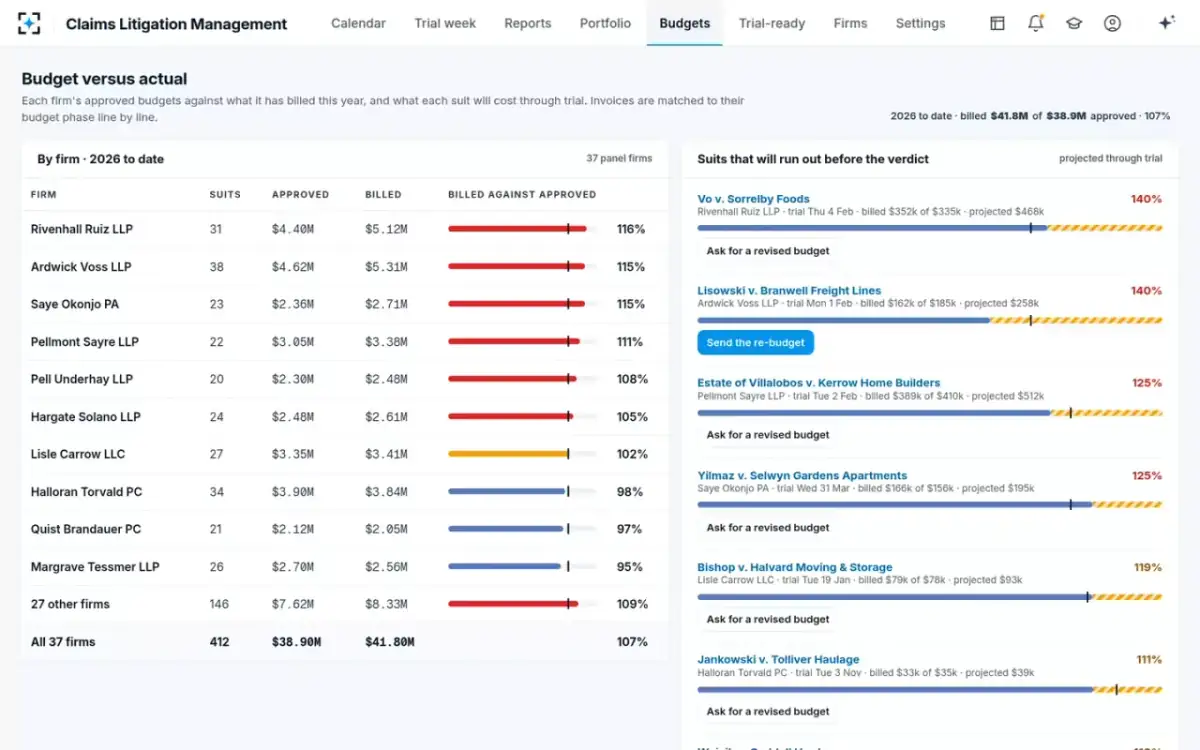
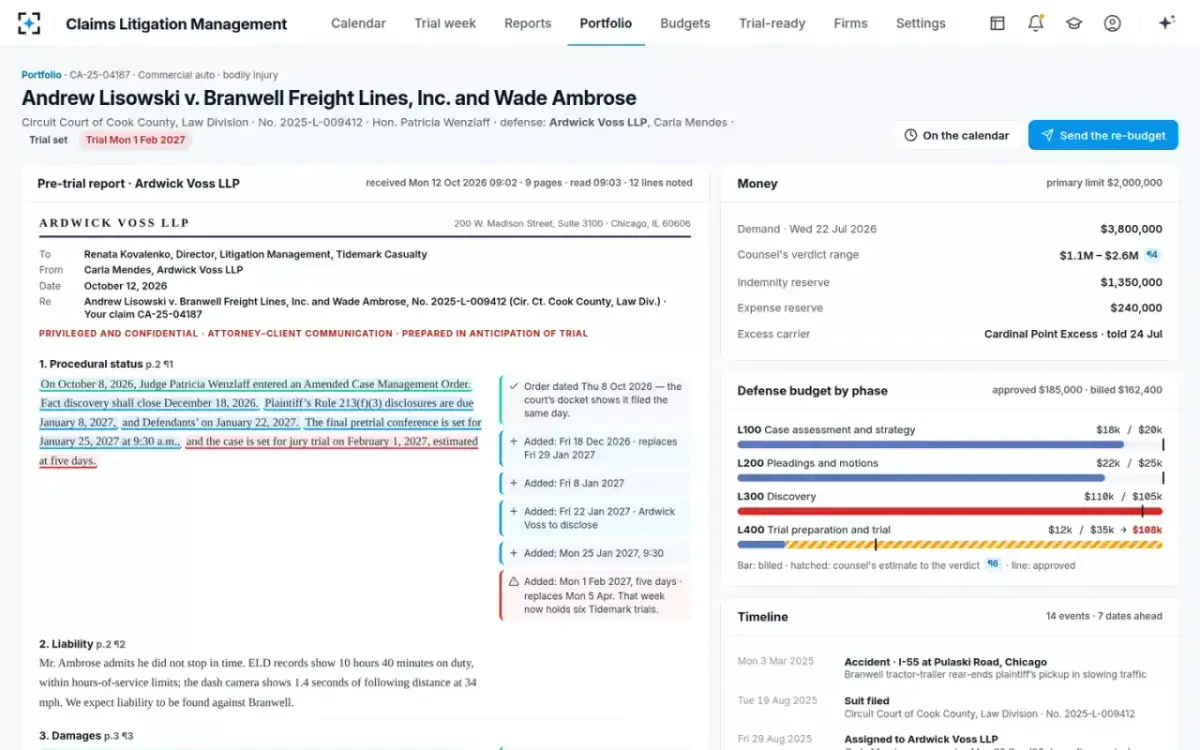
Suit by suit, the line is built from budgets and invoices. On the fictional sample portfolio in these guides, panel firms had billed $41.8M against $38.9M of approved budgets in 2026, or 107%. On one suit, Lisowski v. Branwell Freight Lines, the firm had billed $162,400 of an approved $185,000 when its pre-trial report put the remaining trial cost at about $96,000, for a projected $258,400, against an expense reserve of $240,000. The projection reached the claim supervisor the hour the report arrived, with a proposed re-budget; the reserve decision stayed his. A budget is spent before trial prep starts, and nobody sees it until the invoice lands, unless something reads the report the day it comes in.
Where the DCC line is made: budgets against billing, firm by firm
One suit's defense cost beside its expense reserve
Guidelines decide how early that projection can be made, because it depends on counsel reporting its estimate on a clock; the clauses that make that possible are in litigation management guidelines.
Questions people ask
What does DCC mean in insurance?
Defense and cost containment: the loss adjustment expense spent on defense, litigation and medical cost containment, including lawyers, experts, surveillance and litigation management, whether in-house or outside. It is reported separately from adjusting and other (A&O) expense in statutory financial statements.
Is DCC the same as ALAE?
Close, but the test differs. ALAE traditionally meant expense assignable to a specific claim; DCC is defined by the type of activity, regardless of whether it can be assigned to a claim. Since 1998, in-house defense costs are DCC even if never billed to a file, and an independent adjuster's fee is A&O even if it is.
What is the difference between DCC and A&O?
DCC covers defending and containing the cost of claims; A&O covers the rest of claim handling, chiefly adjusters' fees and salaries. Coverage counsel's fees, including litigation with the policyholder, fall in A&O under the NAIC's definitions.
Are defense costs outside policy limits?
It depends on the policy: some pay defense in addition to the limit, others let defense costs erode it, and states regulate this differently. Nevada's 2023 law, Assembly Bill 398, requires defense costs to be made available outside the limits of liability, as the state's Division of Insurance describes it.
How much did Florida's defense costs fall?
From 6.6% of direct premiums earned in 2022 to 5.1% in 2024, across all property and casualty lines, according to the Federal Insurance Office. The decline was concentrated in homeowners and private auto, the lines Florida's fee and assignment-of-benefits reforms targeted.