A personal injury lawsuit usually takes between about a year and three years from filing to its end, and most of that time is discovery, not trial. The official numbers: federal civil cases that ended in the year to September 2025 took a median 15.6 months from filing, and the few that ended during trial took a median 30.7 months, according to the Administrative Office of the U.S. Courts. In the last national survey of state courts, for 2005, automobile accident cases tried to a verdict took a median 20.1 months from filing. Before any of that comes the claim itself, and after it the payment. This guide times each stage with the rule or statistic behind it, for anyone asking the question, claimant or claims professional. It is written from the defense side's vantage by Botminds, whose Claims Litigation Management software tracks every deadline in an insurer's lawsuits; it gives no advice on any particular case.
One injury suit against the official medians, in months
- Crash to suit filed5.5 mo
- Suit filed to trial: pleadings, discovery, experts17.5 mo
- Filing to verdict20.1 mo
- Filing to end during trial30.7 mo
- Filing to disposition15.6 mo
How long does a personal injury lawsuit take?
The honest answer is a distribution, not a number, and its shape is skewed: many suits end within months, most within two years, and the ones that reach a jury take the longest. The federal courts publish the cleanest figures. Of 355,243 civil cases terminated in the year to 30 September 2025, the median took 15.6 months from filing; cases closed with no court action took 5.1 months; and the 1,462 that ended during trial took 30.7 months.
Four medians that bracket an injury suit
15.6months
filing to end, all federal civil cases, year to Sept 2025
30.7months
filing to end, federal cases that ended during trial
33.7months
filing to trial, federal civil cases, year to June 2026
20.1months
filing to verdict, state automobile accident trials, 2005
State courts, where many injury suits are filed, publish no comparable national timing series today. The last national picture comes from the Bureau of Justice Statistics' 2005 survey: tort cases tried to a verdict took a median 22.3 months from filing, automobile accident cases 20.1 months, premises liability 24.5 and medical malpractice 30.0. Those are trial cases only; the same survey found that trials made up an estimated 4% of tort dispositions.
Before the suit: the limitation clock, and the claim that comes first
Most injury lawsuits begin as insurance claims, and many are filed only after negotiation fails, so the months before filing are often the longest single stage. The outer limit is the statute of limitations. California allows two years for an action for injury caused by the wrongful act or neglect of another; Florida's statute lists "An action founded on negligence" among the actions that must be brought within two years, a section amended by the state's 2023 tort reform law (chapter 2023-15) among other acts. Other states set their own periods, and exceptions are common.
For the claim stage itself, the Insurance Research Council, a non-profit supported by insurers, reports that represented bodily injury claimants in its auto injury study waited "a median of nearly 440 days for claim closure". That figure covers claims, most of which never become lawsuits, but it shows how much of the calendar can pass before a suit is filed. In the sample suit in these guides, the crash was on 3 March 2025 and the complaint was filed on 19 August, five and a half months later.
Filing to answer: weeks, set by rule
The first stage of the lawsuit is short and fixed. Once served, a federal defendant must answer "within 21 days after being served with the summons and complaint", or 60 days if it waived formal service; in California, a defendant has 30 days after the summons is served. Motions attacking the complaint can add a few months. The court then sets the schedule: a federal judge must issue the scheduling order within the earlier of 90 days after any defendant is served or 60 days after any defendant appears.
From the insurer's side this stage starts before the complaint arrives at the claim desk, because the answer clock runs from service on the policyholder. That is why the answer date is the first date a carrier dockets on a new suit, and why a policyholder who is served should pass the papers to the insurer at once. The rules that set these clocks, and how they are computed, are in court deadline calculator vs the court's order.
Discovery and experts: where most of the months go
Discovery is the exchange of evidence: written questions, documents, medical records, depositions of the parties and witnesses, and independent medical examinations. Its length is set by the court, not by rule: the federal scheduling order sets the time allowed for discovery, along with the limits for joining parties, amending pleadings and filing motions, as what to docket from a scheduling order lays out. Expert reports come late in the sequence; absent an order, federal expert disclosures are due at least 90 days before trial, with rebuttal experts 30 days after.
In injury cases the medical picture drives the pace. A claimant still treating cannot easily value the claim, and a defense cannot value it without the records and, often, an examination. In the sample suit, discovery runs from the August 2025 filing to a fact discovery cutoff on 18 December 2026, about sixteen months, with expert disclosures following in January. That proportion, most of the case spent in discovery, is typical of the federal data too: a large share of cases end during discovery, before any pretrial conference.
How long does a lawsuit take to settle?
Most suits settle or otherwise end before trial, at any point from a few months to the eve of trial, and the timing tracks the information. Cases end early when liability is clear and the injuries are fully treated; they end late when one side is waiting for an expert, a ruling or a trial date to force a decision. The federal courts' Table C-4 shows the pattern for motor vehicle injury suits brought under diversity jurisdiction: of 5,333 that ended in the year to September 2025, only 37 reached trial.
How 5,333 federal motor vehicle injury suits ended, year to September 2025
Motor vehicle personal injury, diversity jurisdiction
- No court action: 1,079 · 20.2%
- Court action, before pretrial: 2,840 · 53.3%
- During or after pretrial: 1,377 · 25.8%
- Reached trial: 37 · 0.7%
Timing figures by stage need care. In Table C-5, cases ended with court action before pretrial show a median of 18.8 months, longer than the all-case median of 15.6. That partly reflects composition: in the same year a single category, "other personal injury" cases under diversity jurisdiction, accounted for 162,125 terminations, 155,061 of them before pretrial. Very large consolidated dockets can move national medians, which is one more reason to read a venue's own numbers.
How long does it take to get to trial? Time to trial statistics in federal court
In federal court, a median of 33.7 months for civil cases tried in the year to June 2026, according to the courts' caseload profiles, and that figure has ranged from 28.3 to 35.7 months over six years. The spread by district is wide: a civil case tried in the Eastern District of Virginia reached trial in a median 18.8 months, one in the Northern District of Illinois in 48.4.
Median months from filing to trial, federal civil cases, by district, year to June 2026
The trial itself is short by comparison. In the 2005 state survey, general civil jury trials lasted 3.9 days on average and tort jury trials 3.7. Federal judges completed 15 trials per judgeship in the year to June 2026. The months are spent waiting for a trial slot and preparing for it, not in the courtroom. How a carrier prepares for those few days, and why trial weeks still surprise it, is set out in trial readiness.
Why do lawsuits take so long?
Three reasons dominate, and only one is the courts. First, court capacity: on 30 June 2026, 125,478 federal civil cases, 26.2% of those pending, were more than three years old. Second, the evidence: injury cases wait for treatment to end, records to arrive and experts to report, and each side's valuation depends on the other's disclosures. Third, the incentive to wait: settlement often comes when a deadline forces a decision, so cases drift toward the next fixed date, often the trial date itself.
Each stage also has a clock the parties can miss. The federal rules let a judge change a schedule only for good cause, and deadlines for experts, motions and pretrial disclosures follow from it, so a single amended order can move every later date. In the sample suit, one amended order in October 2026 moved trial up by nine weeks and the discovery cutoff by six. Delay is not always on one side: a defense that values a case late, or holds mediation late, adds months as surely as a plaintiff who waits for treatment to finish.
How long does a car accident lawsuit take?
On the available data, about as long as other injury suits, and slightly faster to verdict when tried. In the 2005 state survey, automobile accident trials were the most common kind of tort trial, nearly 60% of them, and faster to verdict than the other large categories, at a median of 20.1 months from filing, against 24.5 for premises liability and 30.0 for medical malpractice. In federal court, motor vehicle injury suits under diversity jurisdiction rarely reach trial: 0.7% in the year to September 2025.
Car accident and other injury suits: the timing data side by side
| Measure | Car accident suits | Other injury suits | Source |
|---|---|---|---|
| Filing to verdict, state tort trials (median, 2005) | 20.1 months (automobile accident) | 24.5 premises liability; 30.0 medical malpractice; 22.3 all torts | BJS, 2009 |
| Share reaching trial, federal diversity suits (year to Sept 2025) | 0.7% (37 of 5,333) | 0.1% other personal injury (115 of 162,125) | U.S. Courts, Table C-4 |
| Claim to closure, represented auto injury claimants | Median nearly 440 days | — | Insurance Research Council, 2026 |
Which months a defendant's insurer controls
A defendant's insurer cannot speed the court, but it controls more of the calendar than it often uses. It decides how quickly a suit is assigned to counsel, how soon a valuation is asked for, whether settlement authority is set before mediation or after, and whether a new trial date is seen the day it is ordered or at the next quarterly report. Once a settlement is agreed, payment clocks apply: the NAIC model claims regulation calls for payment within 30 days of accepting liability where the amount is settled and undisputed, and state versions vary, as prompt payment laws by state shows.
One suit's timeline, from the crash to the next deadline
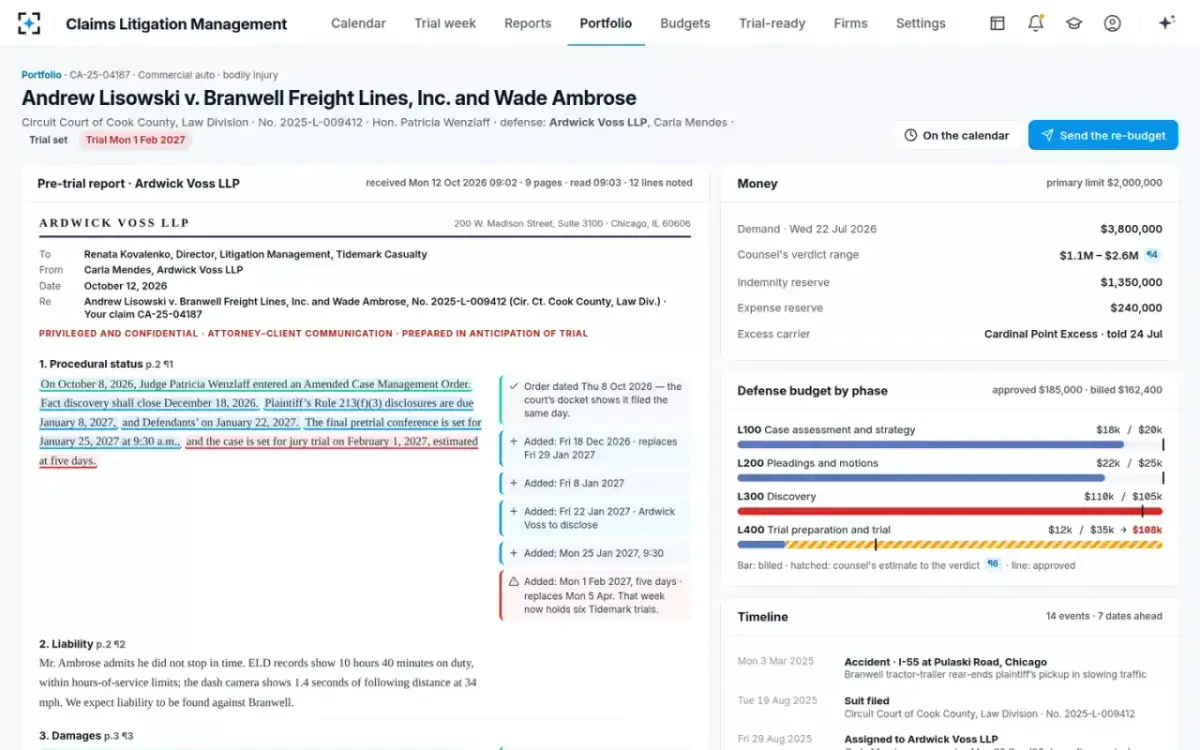
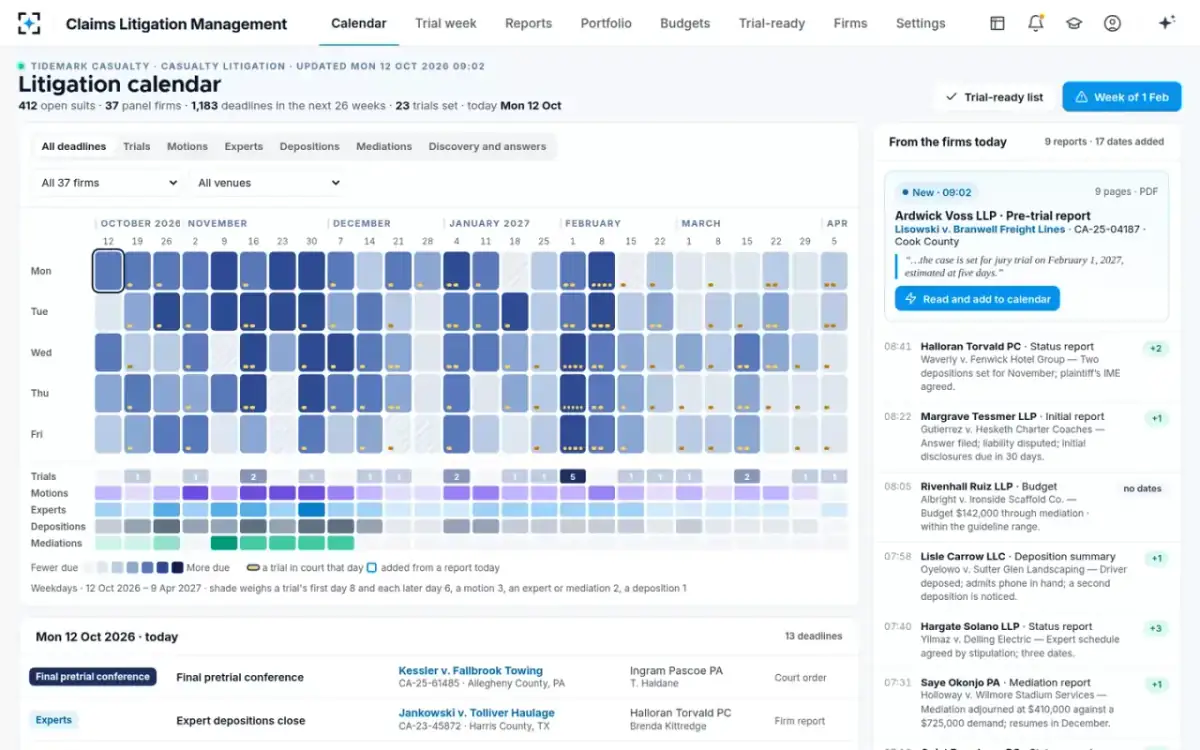
Measuring those months is the first step to shortening them. Claims Litigation Management puts every suit's dates on one calendar with each date's source, so a carrier can see, across hundreds of suits, how long each stage took and where its own steps added time. On the fictional sample portfolio, firms' average months to close ranged from 21 to 31 over twelve months, a spread a carrier can investigate firm by firm. The answer date and the other early clocks are covered in docket management software for claims.
Hundreds of suits, each at a different stage, on one calendar
Questions people ask
How long does a lawsuit take after filing?
In federal court, the median civil case ended 15.6 months after filing in the year to September 2025, and cases that ended during trial took a median 30.7 months. State courts publish no current national figure; in the 2005 national survey, tort cases tried to a verdict took a median 22.3 months.
What is the personal injury statute of limitations in Florida?
Florida's statute of limitations lists an action founded on negligence among those that must be brought within two years, under section 95.11. Other periods apply to other claims, such as medical malpractice, which has its own two-year rule with a four-year outer limit and exceptions. Anyone with a real deadline should check the current statute and get advice on their own facts.
Do most personal injury cases settle?
Most end without a trial. Of 5,333 federal motor vehicle injury suits under diversity jurisdiction that ended in the year to September 2025, 37 reached trial. In the 2005 state survey, trials accounted for an estimated 4% of tort dispositions. The data do not say how many of the rest settled rather than being dismissed.
Why do cases take so long to go to trial?
Mostly waiting for a trial slot and completing discovery and expert work first. Federal civil cases tried in the year to June 2026 took a median 33.7 months from filing to trial, with wide differences by district, from 18.8 months in the Eastern District of Virginia to 73.3 in the Eastern District of California.
How long does a jury trial for a personal injury case last?
Usually a few days. In the 2005 national survey of state courts, tort jury trials lasted 3.7 days on average. Complex cases take longer, and the trial date itself is often the main event that forces settlement in the weeks before it.