A court deadline calculator takes a trigger date, such as the day a complaint was served or the date set for trial, applies a rule, such as 21 days to answer or 90 days before trial for expert disclosures, and returns the deadline, rolled forward or back past weekends and legal holidays. That arithmetic is reliable. The trouble is that most of the deadlines that matter in a litigated injury claim are not set by rule at all: a scheduling order sets the discovery cutoff and the expert dates, and an amended order moves them. A calculator answers "what does the rule say?" when the question is "what did the court order?" Botminds' Claims Litigation Management computes rule-based dates with the rule shown beside them and replaces them the moment an order sets something else, and the carrier can measure the result with three numbers.
Three measures of a litigation calendar's accuracy
| Measure | What it counts | How to compute it | What a bad number means |
|---|---|---|---|
| Matched to the order | Court dates on the calendar that agree, date and event, with the order or notice currently governing them | Matched dates ÷ dates the governing orders set, for a sample of suits | The calendar disagrees with the court, usually because an amended order was not picked up |
| Missed or late | Dates in an order that never reached the calendar, or reached it after a set number of days | Missing dates ÷ ordered dates; and days from order entry to calendar, median and worst | The team learns of changes from the next report or the next phone call |
| Unconfirmed from correspondence | Dates on the calendar whose only source is an email or call, with no person’s confirmation recorded | Unconfirmed correspondence dates ÷ all dates on the calendar | Plans and guesses are mixed with orders, and nobody can tell which is which |
How do court deadline calculators work?
Every calculator encodes the same counting rule, which in federal court is Rule 6(a). For a period stated in days, the rule is to "(A) exclude the day of the event that triggers the period; (B) count every day, including intermediate Saturdays, Sundays, and legal holidays; and (C) include the last day of the period", and if that last day is a weekend or legal holiday, the period runs to the end of the next day that is not. For periods counted backward from an event, such as "90 days before trial", the "next day" is found by continuing to count backward.
A worked example shows why the edge cases matter. A complaint served on Friday 4 December 2026 starts a 21-day answer period on Saturday 5 December and ends on Friday 25 December, which is Christmas Day, a legal holiday under Rule 6(a)(6). The deadline therefore runs past the weekend to Monday 28 December. A calculator gets that right; a person counting on a desk calendar the week before the holidays may not. Mail adds its own wrinkle: Rule 6(d) adds three days after service by mail, but since 2016 not after electronic service through the court's system.
The federal clocks a calculator knows, in days
How long does a defendant have to answer a complaint? Four answers
It depends on the court and on how the defendant came to be served, which is exactly why answer dates are a classic calculator job and a classic source of error. In federal court the usual answer is 21 days after service, but a defendant who waives formal service gets 60 days from when the request was sent, and a removed case has its own rule. California gives 30 days. Each of those is the first date in a suit with a default behind it.
How long a defendant has to answer: four common situations
| Situation | Deadline | Source |
|---|---|---|
| Federal court, served with summons and complaint | Within 21 days after being served | Fed. R. Civ. P. 12(a)(1)(A)(i) |
| Federal court, service waived | 60 days after the waiver request was sent; 90 if sent outside any U.S. judicial district | Fed. R. Civ. P. 4(d)(3) |
| Removed from state to federal court, no answer yet | The longest of 21 days after receiving the initial pleading, 21 days after service of summons, or 7 days after the notice of removal is filed | Fed. R. Civ. P. 81(c)(2) |
| California superior court | Within 30 days after the summons is served | Cal. Code Civ. Proc. § 412.20(a)(3) |
For an insurer the answer date has a second edge. It is often the first deadline after the suit reaches the claim desk, and the carrier, not yet the firm, is holding it. In Claims Litigation Management the suit intake reader reads the complaint and summons, finds the court and the date of service, and dockets the answer date by the venue's rule, showing which rule it used so a person can check the trigger and the count. The removal window runs alongside it, and a carrier that wants a federal forum has 30 days from receipt of the pleading, under 28 U.S.C. § 1446(b), to make that choice.
When are expert disclosures due in federal court?
When the court orders, and only by default 90 days before trial. Rule 26(a)(2)(D) says a party "must make these disclosures at the times and in the sequence that the court orders"; only "absent a stipulation or a court order" do the defaults apply: at least 90 days before trial, and rebuttal experts within 30 days after the other side's disclosure. The committee note adds that "Normally the court should prescribe a time for these disclosures in a scheduling order", usually with the party carrying the burden of proof going first.
So the calculator's 90-day date is a fallback, and in practice it is often wrong. Take the fictional sample suit used across these guides, Lisowski v. Branwell Freight Lines, set for trial on Monday 1 February 2027. Had it been a federal case with a silent order, the 90-day default would have put defense experts on Tuesday 3 November 2026. The court's amended order, in a state court with its own rules, set the defense disclosure for Friday 22 January 2027 instead, 80 days later. A team relying on the calculator would have been early, which is harmless; on another suit, the order could just as easily be earlier than the rule, which is not.
If a party fails to identify a witness as required, "the party is not allowed to use that information or witness to supply evidence on a motion, at a hearing, or at a trial, unless the failure was substantially justified or is harmless."
Fed. R. Civ. P. 37(c)(1)
Discovery cutoff in federal court: set by order, not by rule
There is no default discovery cutoff in the federal rules for a calculator to compute. The scheduling order supplies it: under Rule 16(b)(3), the order has to set limits for joining parties, amending pleadings, finishing discovery and filing motions. The judge must issue that order within the earlier of 90 days after any defendant is served or 60 days after any defendant appears, so a carrier should expect it, and docket it, early in every federal suit.
The cutoff then drives other dates. Unless a local rule or order says otherwise, a party may move for summary judgment "at any time until 30 days after the close of all discovery", so the motion deadline is a calculation that depends on an ordered date. When an amended order moves the cutoff, every derived date has to move with it. That is the most common failure of a calendar built on calculations: the inputs change, and the outputs stay put.
The last 90 days before trial: the federal default, and what one order did
- Experts disclosed by day 90; rebuttal within 30 days30 d
- No rule date30 d
- Pretrial disclosures by day 30; objections within 1414 d
- Run-in to trial16 d
- Discovery still open, to Fri 18 Dec45 d
- To plaintiff’s experts, Fri 8 Jan21 d
- To defense experts, Fri 22 Jan14 d
- Pretrial 25 Jan, trial 1 Feb10 d
Why the order beats the calculator
Because the rules say so. Most of the clocks in the federal rules carry an exception for the court: "unless the court orders otherwise", "absent a stipulation or a court order", "unless a different time is set by local rule". Once a scheduling order exists, it "may be modified only for good cause and with the judge's consent", which means the order, not the arithmetic, is the authority on the dates it covers.
State practice adds variety on top. California gives 30 days to respond to a summons where federal court gives 21. Illinois requires sworn answers to interrogatories within 28 days of service, under the Illinois Supreme Court's Rule 213(d). Venue rules in other states use their own trigger events and counting conventions. A calculator that is right for one court is wrong for the next, and the sample carrier in these guides has suits in 37 courts. The only date that is right in every court is the one the court wrote down.
How do you check a litigation calendar is accurate? Three measures
By comparing it with the orders, not with another calculator. The three measures at the top of this page do that. The first, match rate, asks whether the calendar agrees with the order now governing each suit. The second, misses and lag, asks whether every ordered date arrived and how long it took. The third asks how much of the calendar rests on correspondence that no person has confirmed. A calendar can score well on one and badly on the others: a team that dockets every email will have few misses and a poor third measure.
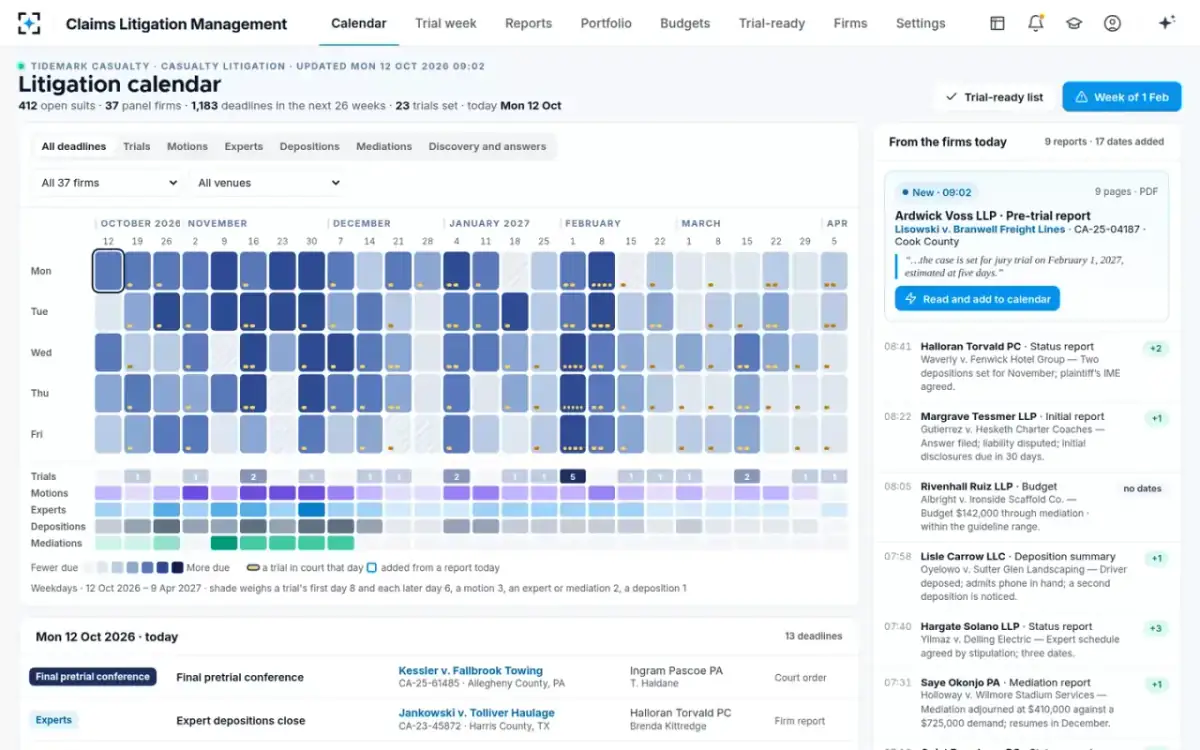
Lag deserves its own number because the cost of a late date is not the date itself but the decisions missed in between. In the sample case, the amended order was entered on Thursday 8 October and reached the carrier's calendar from the firm's report on Monday 12 October, one minute after the report arrived. Under a 90-day status report clock, the same order could have reached the carrier in January, after the new discovery cutoff had passed.
The calendar the three measures are run against
A test you can run on your own suits
The test takes a few days and needs no vendor. Its value is that it produces the carrier's own baseline, which no published study provides.
Measuring your calendar against the orders
- Draw a sample of suits
Thirty is enough to see a pattern: mix venues, firms and stages, and include at least five suits with a trial date in the next six months.
- Pull every order and notice of hearing for six months
From the court’s docket, not from firm reports. Note the entry date of each.
- List the dates each order sets
Event, date, and which earlier date it replaced, if any.
- Compare with your calendar on a fixed day
Count matches, misses and dates still showing a replaced value.
- Measure lag
For each date that did arrive, days from order entry to the day it reached your calendar.
- Label every calendar date by source
Order, notice, firm report, rule calculation or correspondence; count correspondence dates nobody confirmed.
- Repeat with any system you are considering
Same suits, same orders. A product that cannot show where each date came from cannot be measured this way.
Buying a court deadline calculator, or a reader of orders
Buy a calculator if the problem is counting; buy a reader of orders if the problem is knowing. Most litigation teams at insurers have the second problem. Rule calculators are widely available and they are rarely where a carrier's calendar goes wrong. Dates go wrong when an order changes them and the change does not reach the carrier, or when a plan in an email is treated as a date.
Claims Litigation Management therefore does both jobs and keeps them apart. Rule-based dates are computed and labelled with the rule, the trigger and the venue. Ordered dates come from the order or notice, or from a firm's report line that is then checked against the docket, and they replace rule dates when they differ. Dates from correspondence are held. What it does not do is decide anything that follows from a date: it never asks a court for a continuance and never contacts a court at all. Where the dates come from in the first place, and who confirms each one, is the subject of docket management software for claims; how the months add up across a whole injury suit is in how long a personal injury lawsuit takes.
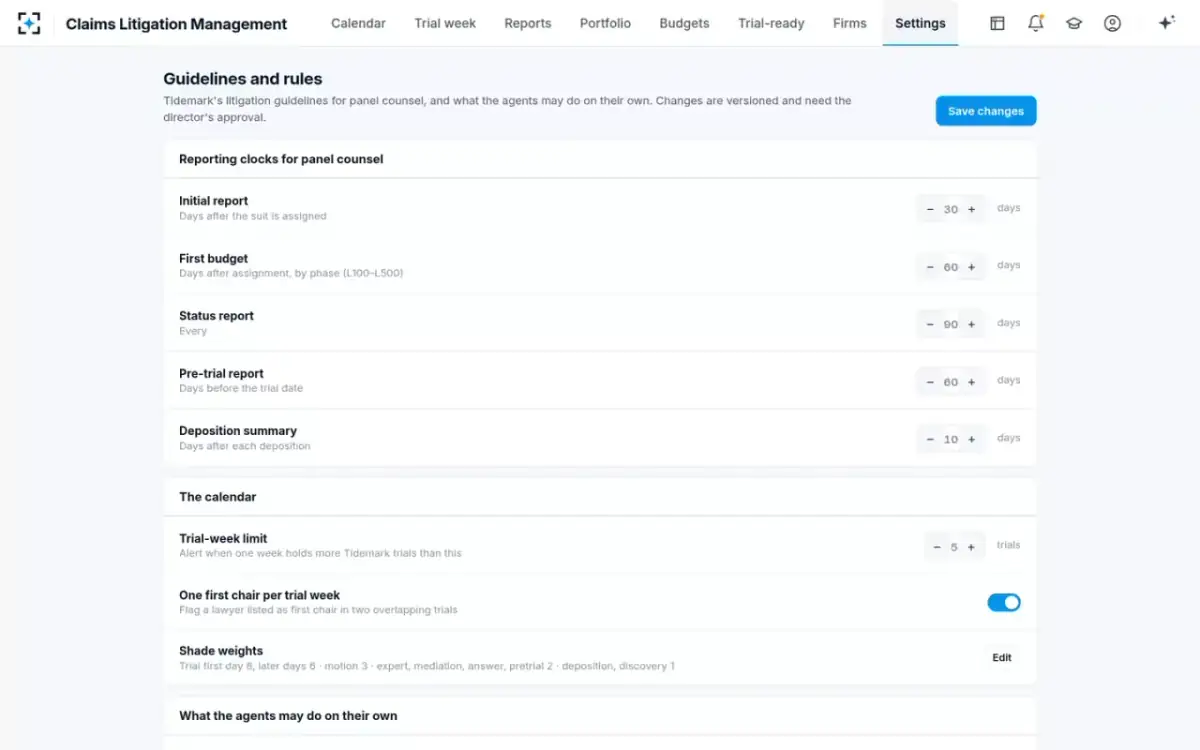
The carrier's own clocks sit beside the court's, as versioned settings
Questions people ask
How long does a defendant have to answer a complaint in federal court?
Twenty-one days after being served with the summons and complaint, under Rule 12(a)(1)(A)(i). A defendant who returns a waiver of service has 60 days from when the request was sent, or 90 if it was sent outside the United States. A court order or a pending motion can change the date.
Are weekends counted in court deadlines?
Yes, for periods stated in days: federal Rule 6(a) counts every day, including intermediate Saturdays, Sundays and legal holidays. Only the last day is special: if it falls on a weekend or legal holiday, the deadline moves to the next day that is not one. Many state courts follow a similar rule, but check each venue's own.
Does electronic service add three days to a deadline?
Not in federal court since the 2016 amendment to Rule 6(d). Three days are still added after service by mail, by leaving a paper with the clerk, or by other means the person consented to. Service through the court's electronic filing system is complete on filing.
What is the deadline to answer after removal to federal court?
A defendant that had not answered before removal must answer within the longest of 21 days after receiving the initial pleading, 21 days after service of the summons, or 7 days after the notice of removal is filed, under Rule 81(c)(2). The notice of removal itself is due within 30 days of receiving the initial pleading.
How do you calculate court deadlines in California?
Start from the triggering event and the statute or rule that sets the period: a defendant served with a summons, for example, has 30 days to respond under Code of Civil Procedure § 412.20. California's counting rules, its service extensions and any case management order then decide the final date, so the order controls where one exists.