Litigation management guidelines are the written terms an insurer sets for the outside law firms that defend its policyholders: how often and in what form counsel reports, how budgets and invoices work, how the firm coordinates with the claim staff, and what the insurer will and will not pay for. Good guidelines are short and checkable. Each rule names the event that starts it, the document that satisfies it, and the date by which it is due, so the firm can meet it and the carrier can see whether it was met. They also stop at a line that bar opinions have drawn for decades: an insurer may require information and set budgets, but it may not make defense counsel ask permission to exercise professional judgment. Botminds' Claims Litigation Management turns a carrier's reporting clocks into settings and checks every counsel report against them, which only works if the clocks were written to be checked.
Four guideline clauses, annotated: trigger, proof, and the line each must respect
§ 3.1
Counsel will send an initial report within 30 days after the suit is assigned, covering the facts, liability, damages and the next 90 days of deadlines.
- Trigger
- Assignment date, recorded on the suit
- Proof
- The report, dated as received
- The line
- Reporting deadline: allowed where it creates no disincentive to adequate representation (KBA E-416)
§ 4.2
Counsel will send a budget by phase (L100–L500) within 60 days after assignment, and a revised budget before any phase is exceeded.
- Trigger
- Assignment; a phase reaching its budget
- Proof
- Budget on file; invoices matched to phases
- The line
- A reasonable, tentative budget with a process for ongoing consultation: allowed (KBA E-416)
§ 5.3
Counsel will send a pre-trial report 60 days before the trial date, with a verdict range, the trial budget and a settlement recommendation.
- Trigger
- The trial date in the current order
- Proof
- The report; the order that set the date
- The line
- Reporting: allowed. The trigger must follow the order, not a typed date
§ 6.1
Counsel must obtain the insurer’s approval before scheduling any deposition.
- Trigger
- Each deposition
- Proof
- Approval on file
- The line
- Not allowed in several jurisdictions: prior approval of legal services interferes with counsel’s judgment (Rhode Island 99-18; Montana 2000)
What are litigation management guidelines?
They are the insurer's standing instructions to panel counsel, usually issued as a document every firm accepts when it joins the panel and applied to every suit it takes. Most cover four subjects: reporting (which reports, when, with what content), money (rates, budgets, what is and is not billable, invoice format), coordination (who at the insurer the firm deals with, when the insured and any excess carrier must be told of events), and, in some versions, approvals for particular tasks.
That fourth subject is where guidelines get into trouble. Oklahoma's bar described the pattern in 2000: billing guidelines "may also restrict a lawyer’s ability to perform certain legal services without prior approval which must be requested from the insurer." The other three subjects are management of a relationship the insurer pays for. The fourth reaches into the defense itself, and the lawyer's client in that defense is usually the insured.
Can litigation guidelines restrict defense counsel? What the bar opinions allow
They can govern money, reporting and coordination; they cannot direct counsel's professional judgment. The rule underneath is the same in every state that follows the ABA model: a lawyer "shall not permit a person who recommends, employs, or pays the lawyer to render legal services for another to direct or regulate the lawyer's professional judgment." The opinions below apply that rule to actual guideline clauses, and they agree more than they differ.
What bar opinions and courts have said about guideline clauses
| Kind of clause | Rhode Island 99-18 (1999) | Kentucky E-416 (2001) | Montana Supreme Court (2000) |
|---|---|---|---|
| Rates, billable items, detailed bills | No ethical concern where they merely define the financial relationship | Detailed billing and reporting procedures allowed if they create no material disincentive and protect confidentiality | Not the issue decided; the court addressed prior approval and audits |
| Reports and deadlines for them | Coordination with the insurer’s claim staff raises no concern | Allowed, if (and only if) no material disincentive to adequate representation | — |
| Budgets | — | A reasonable, tentative budget with ongoing consultation is allowed | Insurers may decline to pay for unnecessary services; that does not justify prior approval |
| Prior approval of depositions, research, motions, experts | Interferes with independent judgment; counsel may not agree | No, for approval before any discovery, research or motion | Counsel who submit to prior approval violate their duties |
| Limits on trial preparation time | — | Allowed if reasonable for the case and with ongoing consultation | — |
Prior approval: the one clause to leave out
Prior approval of legal services is the clause the authorities reject most consistently, and the one that adds least for the carrier. The Montana court described the clause it struck down in plain terms: the insurer's plan "expressly requires prior approval before a defense attorney may undertake to schedule depositions, conduct research, employ experts, or prepare motions." The insurers argued that they rarely withheld approval. The court answered that how often approval is refused does not decide whether requiring it is permitted, and went further, cautioning that a mere requirement of consultation may interfere with counsel's judgment in the same way. A carrier drafting guidelines in 2026 should read that warning as aimed at clauses that require consultation before counsel acts, not at reports after the fact.
"An attorney may agree to abide by an insurer's litigation management guidelines provided that the guidelines do not direct or regulate the attorney's independent professional judgment in the representation of an insured."
Rhode Island Supreme Court Ethics Advisory Panel, Opinion 99-18
What should insurance litigation guidelines include?
Everything the carrier needs to manage the relationship and decide its own questions, and nothing that decides counsel's. A useful test for each clause is whose decision it serves. A clause that tells the carrier when it will learn something, or what it will pay for, serves the carrier's decisions. A clause that tells counsel what it may do in the case serves nobody's, and courts and bar committees have said so.
What a set of litigation management guidelines should contain
- Report clocks with named triggers
Initial report, first budget, status interval, deposition summary, pre-trial report; each counted from a recorded event.
- Content for each report
What the initial evaluation covers, what a status report must update, what a pre-trial report must value and cost.
- Budgets by phase, with a re-budget rule
L100 to L500 phases, a tentative budget, and a revised budget before a phase is exceeded.
- Billing format and rates
Electronic invoices in an agreed format, task codes, rates by role, and what is not billable.
- Coordination points
Who the firm deals with, when the insured and any excess carrier are told of trial, mediation and settlement offers.
- Settlement communications
Every demand and offer reported promptly, with any deadline in it, so authority can be set in time.
- A consultation process, not an approval step
How the firm raises a budget or strategy question, and how fast the carrier answers.
- A statement of the boundary
That nothing in the guidelines limits counsel’s independent judgment on behalf of the insured, and that the guidelines are shared with the insured.
The last item has an ethics source. Kentucky's opinion conditions a lawyer's acceptance of insurer guidelines on, among other things, disclosing "the guidelines’ existence to the insured" with a practical explanation of their import, and on the insured's consent to any guideline that materially limits the representation. How information and bills may flow between the three parties is covered in the tripartite relationship in insurance defense.
How often should defense counsel report to the insurer?
At the events that change a decision, and on a fixed interval in between. The fictional sample carrier in these guides uses five clocks: an initial report 30 days after the suit is assigned, a first budget by phase at 60 days, a status report every 90 days, a deposition summary within 10 days of each deposition, and a pre-trial report 60 days before trial. Those are one carrier's choices, not a standard; Kentucky's opinion allows detailed reporting procedures with deadlines "if (and only if) such procedures and deadlines do not create material disincentives to adequate representation of the insured".
The sample guidelines' clocks across the life of one suit
- Initial report, 30 days30 d
- First budget, 60 days60 d
- Status reports every 90 days, plus deposition summaries within 10 days≈ 4 status reports
- Pre-trial report window: due 60 days before trial60 d
The trigger matters more than the number. "Sixty days before trial" means nothing until the clause says which trial date: the one typed into the claim system, or the one in the court's current order. In the sample suit, the amended order moved trial from 5 April to 1 February, which moved the pre-trial report deadline from early February to 3 December. A guideline clock counted from a stale date will mark a firm late when it is on time, or on time when it is late.
What is an initial case evaluation?
It is defense counsel's first report after taking the suit: the facts as counsel understands them, the claims and defenses, an early view of liability and damages, the plan for the first months and the deadlines ahead. It gives the adjuster what is needed to set or confirm reserves and to decide whether early resolution makes sense. In the sample portfolio, one initial report that arrived on Monday morning read, in summary: answer filed; liability disputed; initial disclosures due in 30 days. A good guideline names those elements, so a three-line report and a thirty-page one are judged against the same list.
What the initial evaluation should not contain is just as important. A guideline that asks defense counsel to report on coverage questions puts the lawyer between the client it defends and the party paying for that defense. Coverage questions belong to coverage counsel, a separate lawyer, as the guide on coverage counsel explains.
What is a litigation budget in insurance defense?
It is counsel's estimate of what the defense will cost, usually by phase, which the insurer approves as a planning figure. The common phase structure is the litigation code set of the Uniform Task-Based Management System, from L100 Case Assessment, Development and Administration to L500 Appeal. Kentucky's bar allowed guidelines "setting a reasonable, tentative budget and providing a process for ongoing consultation" in place of the approval rules it rejected, which is a good description of what a budget clause should be: a forecast and a conversation, not a cap on the defense.
The budget's job is to make overruns visible before the money is spent. In the sample portfolio, Ardwick Voss had billed $162,400 of a $185,000 budget on Lisowski when its pre-trial report put the remaining trial cost at about $96,000, a projected 140% of budget. The guideline that helps there is not a ban on overruns. It is a re-budget rule, triggered when a phase approaches its budget or when trial is set, with the carrier's answer due within days.
Measuring compliance without second-guessing counsel
Measure what the guidelines ask for, and only that: reports on time, budgets that held, billing against approved, requests answered. Those are facts about the relationship. They say nothing about whether counsel chose the right expert, and a carrier that starts scoring strategy is back across the line the opinions drew.
Every report checked against the clocks, and every late one named
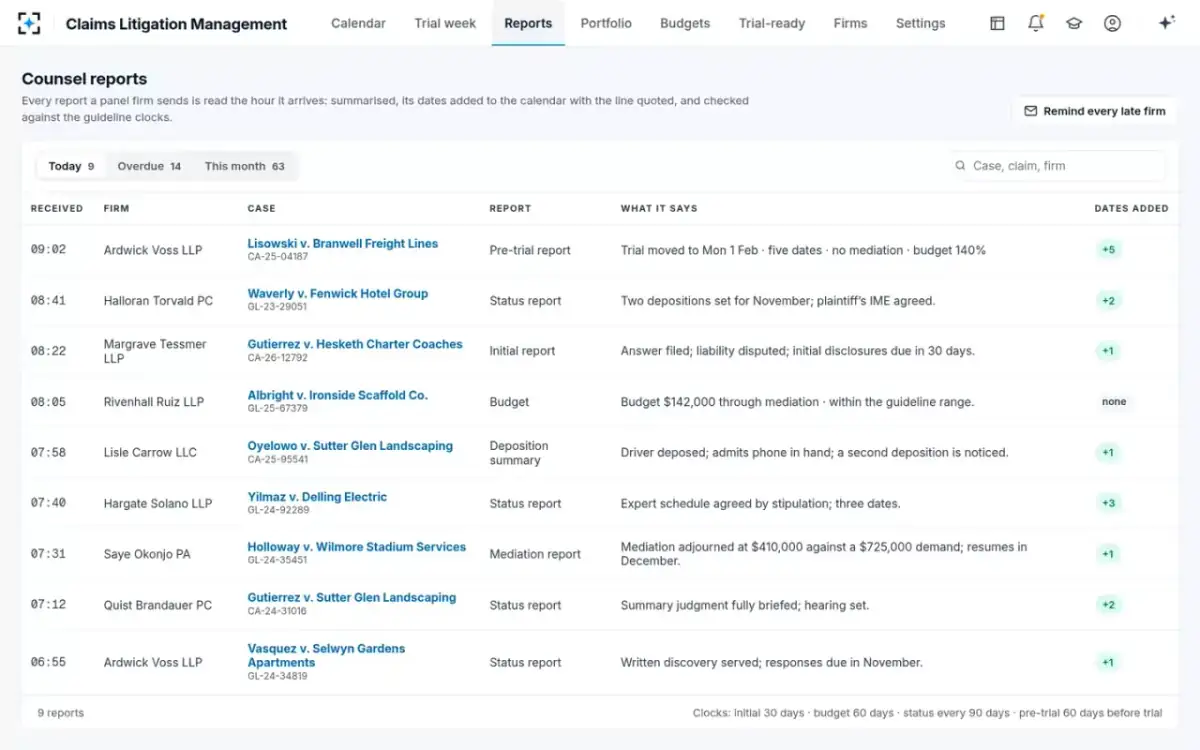
In the sample, fourteen reports were overdue across seven firms on Monday 12 October; two firms owed three each, and the oldest was an initial report 28 days late. Over twelve months, the ten largest firms ranged from 70% to 96% of reports on time. Numbers like those make panel reviews factual, and they are only possible because each clock had a recorded trigger. Claims Litigation Management keeps the clocks as versioned settings that the director approves, checks every counsel report against them, and drafts reminders; it never writes to a firm on its own. Where guideline clocks are kept by memory, the first sign of a late report is the file review. How each seat on a sued claim uses those reports is set out in what a litigation adjuster does.
The clocks as settings, versioned with the guidelines

Questions people ask
What are defense counsel guidelines?
Another name for an insurer's litigation management guidelines: the terms panel firms accept for reporting, budgets, billing and coordination on the suits they defend for the insurer's policyholders. They are binding on the business relationship, but they cannot override counsel's duties to the insured under the rules of professional conduct.
Do defense lawyers have to follow insurer guidelines?
Only where the guidelines are consistent with their ethical duties. Kentucky's bar, for example, lets a lawyer accept guidelines only if they will not interfere with independent judgment, are disclosed to the insured, and the lawyer performs every duty the rules require regardless of what the guidelines will pay for. A lawyer who cannot do that must decline the case.
Can an insurer require approval before a deposition?
Several authorities say no. Rhode Island's Ethics Advisory Panel held in 1999 that counsel may not agree to pre-approval of services such as scheduling depositions, and the Montana Supreme Court held in 2000 that counsel who submit to prior approval violate their duties. An insurer can ask to be told, and can question cost, without requiring permission.
How often should a status report be sent in insurance defense?
There is no single standard; it is set by each insurer's guidelines. The fictional sample carrier uses ninety days, with event-driven reports (deposition summaries, mediation results, new orders) in between. The interval matters less than counting it from a recorded event.
Should litigation guidelines be shared with the insured?
Kentucky's ethics opinion says the lawyer should disclose their existence and explain their practical effect to the insured at the outset, and obtain consent to any guideline that materially limits the representation. Writing the guidelines so they can be shared without embarrassment is a good discipline for the insurer too.