Coverage counsel means the lawyer who advises on insurance coverage: whether a policy covers a loss, what a disputed clause means, and how the insurer, or the policyholder, should act on that answer. On the insurer's side, coverage counsel may be an in-house lawyer or an outside firm; the policyholder can retain coverage counsel too. On a property claims desk the seat is often invisible until a file goes wrong, yet it decides the questions the forms leave open, approves reservations of rights and new form editions, and fields a steady stream of adjusters' questions about what an endorsement means. Many of those questions could be answered from the file if the right edition and the right passage were in front of the adjuster. Botminds' Claim Coverage Verification does that, quoting every step of a coverage position from the forms in force on the date of loss, so counsel's time goes to interpretation and judgement rather than looking things up.
The people and claim on this page are fictional: the sample carrier Ashgrove Mutual, its coverage counsel Hannah Pruett and the four people who carry one homeowners water claim. Research and rules are linked where they appear.
Coverage counsel and the three seats that wait on them
Today
“Half my calls are an adjuster asking what one endorsement means. Let them see the edition.”
With agents
Sees what changed between editions clause by clause, and approves the trees for a new edition after they are replayed on past claims.
Still theirs: Meaning of disputed wording, reservations of rights, new editions
Today
Before each first call back, opens the declarations and reads the form; the unclear endorsements go to counsel.
With agents
Starts from a drafted position with every step quoted, sees which fact would change it, and asks exactly those questions.
Still theirs: The coverage decision and the signature
Today
“Show me the wording and the fact. If I can’t see both, it comes back.”
With agents
Co-signs from a letter whose reasons are quoted from the policy, with the facts and editions alongside.
Still theirs: Every denial and every reduction over $10,000
Today
“Same form, same facts, same answer. That is the whole audit.”
With agents
Sees every fact pattern with the positions signed on it, opens the outliers and reopens a position.
Still theirs: Findings on closed files
What is coverage counsel?
Coverage counsel is a lawyer whose subject is the insurance contract itself. Defence lawyers argue about whether the insured is liable to someone; claims adjusters work out what happened and what it costs; coverage counsel answers the question between them: does this policy, in this edition, on these facts, pay?
The role exists because the answer can be worth more than the claim. Policy language is drafted once and read millions of times, and a word read one way across a book of claims is a large number. A 2024 New York University Law Review article opens with the Hurricane Katrina litigation, in which "advocates fighting over tens of billions of dollars of potential liability ultimately contested the meaning of a single word": flood. Most coverage questions are smaller, but they have the same shape: one passage, two readings, and money on each.
The federal description of the claims job shows where counsel sits. Among the duties the Bureau of Labor Statistics lists for claims adjusters, examiners and investigators are "Determine whether the insurance policy covers the loss claimed" and "Talk with legal counsel about claims when needed". The first is the adjuster's every day. The second is the escalation path when the first cannot be done alone.
The desk that coverage counsel supports
376,100
claims adjusters, examiners and investigators in U.S. jobs, 2025
$78,000
their median annual wage, May 2025
−6%
projected change in the occupation’s jobs, 2025–2035
Coverage counsel vs defense counsel: who each lawyer works for
In a liability claim the difference is sharp. Defense counsel is the lawyer the insurer provides to defend the insured against the injured party's suit; their client is the insured. Coverage counsel advises the insurer on whether the policy obliges it to defend and pay at all. The two can pull in opposite directions, which is why insurers keep them apart.
The conflict is most visible when the insurer reserves its rights. If the facts the defence lawyer develops could also decide coverage, the insured is entitled to worry about whose interest the lawyer serves. States handle it in different ways. Florida's claims administration statute, for liability insurers that assert a coverage defence, requires the insurer within set times either to refuse to defend, to obtain a non-waiver agreement "following full disclosure of the specific facts and policy provisions upon which the coverage defense is asserted", or to retain "independent counsel which is mutually agreeable to the parties", with fees set by the court if the parties cannot agree.
Two lawyers on one claim
Defense counsel: Is the insured liable to the claimant, and for how much?
Coverage counsel: Does the policy oblige the insurer to defend or pay, and for what?
Defense counsel: The insured, though the insurer usually pays.
Coverage counsel: The insurer, or the policyholder if retained by them.
Defense counsel: Liability claims in suit.
Coverage counsel: Liability and first-party property claims, before and after suit.
Defense counsel: Pleadings, discovery, settlement advice.
Coverage counsel: Coverage opinions, reservations of rights, denial letters, new form editions.
Defense counsel: Usually none: the claim is first-party.
Coverage counsel: The meaning of the seepage exclusion, the hidden-water conditions, the edition in force.
What does insurance coverage counsel do on a property claim?
On a first-party property claim there is no defence to run, so coverage counsel's work is the contract and the letters. Four tasks recur. Counsel interprets disputed wording: is a leak that ran "at least 3–4 weeks" over the 14-day line, and does a tenant's knowledge defeat a condition that says "unknown to all insureds"? Counsel decides when to reserve rights and signs or reviews the letter. Counsel reviews denials that rest on an exclusion, because the denial must name the provision and the reasoning has to survive a complaint or a suit. And counsel approves the carrier's own forms and editions, including how each change will be applied to open claims.
The stakes of the last two are written into the rules. The NAIC model act lists as an unfair claims practice "Knowingly misrepresenting to claimants and insureds relevant facts or policy provisions relating to coverages at issue", and Ohio's rule requires an insurer to disclose "all pertinent benefits, coverages or other provisions of an insurance contract under which a claim is presented". A letter that quotes the wrong edition, or omits an endorsement that gives coverage back, is the kind of error coverage counsel exists to prevent.
Sometimes counsel's opinion becomes the turning point of a case. In a 1989 California Supreme Court decision on a homeowners claim, the insurer wrote to the homeowners "after receiving from its counsel an opinion that the loss was not covered". The resulting litigation, over whether excluded earth movement or covered negligent construction caused the loss, settled how California courts treat first-party losses with more than one cause. That doctrine is explained in what an ensuing loss provision is.
Why so many calls to coverage counsel are edition and endorsement questions
Because the wording varies more than adjusters expect, and the right document is hard to find. The 2011 University of Chicago Law Review study of homeowners policies concluded that "carriers’ homeowners policies differ radically with respect to numerous important coverage provisions" and that "Many insurers maintain numerous mandatory endorsements that substantially change the terms of their policies." Add editions that change at renewal, and a question like "what does our hidden water endorsement cover?" has several right answers depending on the year.
“Half my calls are an adjuster asking what one endorsement means. Let them see the edition.”
Hannah Pruett, the sample carrier's coverage counsel
Those calls are not interpretation; they are retrieval. The adjuster needs the form, in the edition on the declarations on the date of loss, open at the right passage, with a note on what it changes. Once that is in front of them, most questions answer themselves, and the ones that remain are genuinely counsel's: two plausible readings, a court decision that moved the line, a fact that sits right on a boundary.
Which coverage questions reach counsel
Agent
Assemble the policy in forceThe declarations on the date of loss and every form in its edition, including the state amendatory endorsement.
Never: Use a form that is not on the declarations, or an edition not in force.
Agent
Answer from the passageA plain question about the policy is answered from its own forms, each answer quoting its passage and opening it in the policy.
Never: Paraphrase a provision without its quote.
A person decides
Adjuster decides the routine readingWhere the passage settles it, the adjuster drafts and signs the position on the quoted wording.
A person decides
Coverage counsel decides what the words meanTwo readings, a boundary fact, a court decision, a reservation of rights or a new edition go to counsel.
What coverage counsel waits on
Counsel's opinion is only as good as the file it is given, and the commonest delay is not legal research but a file that cannot answer basic questions. Which forms were on the declarations on the date of loss? Which fact does the adjuster's reading turn on, and what is the source for it? What did the carrier decide last time on the same form and facts? Without those, the first hours of any referral go to reconstruction.
The rules expect that reconstruction to be possible. The NAIC's model claims regulation says "Detailed documentation shall be contained in each claim file in order to permit reconstruction of the insurer’s activities relative to each claim." A file built that way serves counsel as well as the examiner: each step of the coverage reasoning with its quoted clause, each fact with its source and confidence, and the past positions on the same pattern. On the sample claim, the consistency check found 41 of 43 signed positions on the same form edition and fact pattern paid to the endorsement limit, and two paid full Coverage A and were reopened. A lawyer asked "are we consistent?" can start from that, not from a search of closed files.
When should an adjuster call coverage counsel?
When the answer depends on what the words mean rather than on what they say. Five situations come up again and again on property desks, and each is a reasonable trigger for a call or a referral rule.
Five moments to bring in coverage counsel
- A fact sits on a boundary the policy draws
A leak dated at "about two weeks" against a 14-day exclusion; a loss discovered days after renewal.
- Covered and excluded causes combine
Wind and water, faulty work and the damage it led to. Which cause counts differs by state.
- A reservation of rights or a denial rests on an exclusion
The letter must name the provision and hold up to a complaint or a suit.
- The insured is represented or has threatened suit
Every letter after that point may be read by a judge.
- A form or edition changes
What changed, clause by clause, and how it applies to open claims, before the new edition is used.
The list is deliberately short. A carrier that sends every endorsement question to counsel pays lawyer rates for retrieval, slows every file and teaches adjusters not to read their own forms. One that sends none of these risks letters that will not hold. The sample carrier draws the line in its settings: coverage counsel signs every reservation of rights, and approves the coverage trees for any new edition after they have been replayed on past claims.
Coverage counsel's seat in Claim Coverage Verification
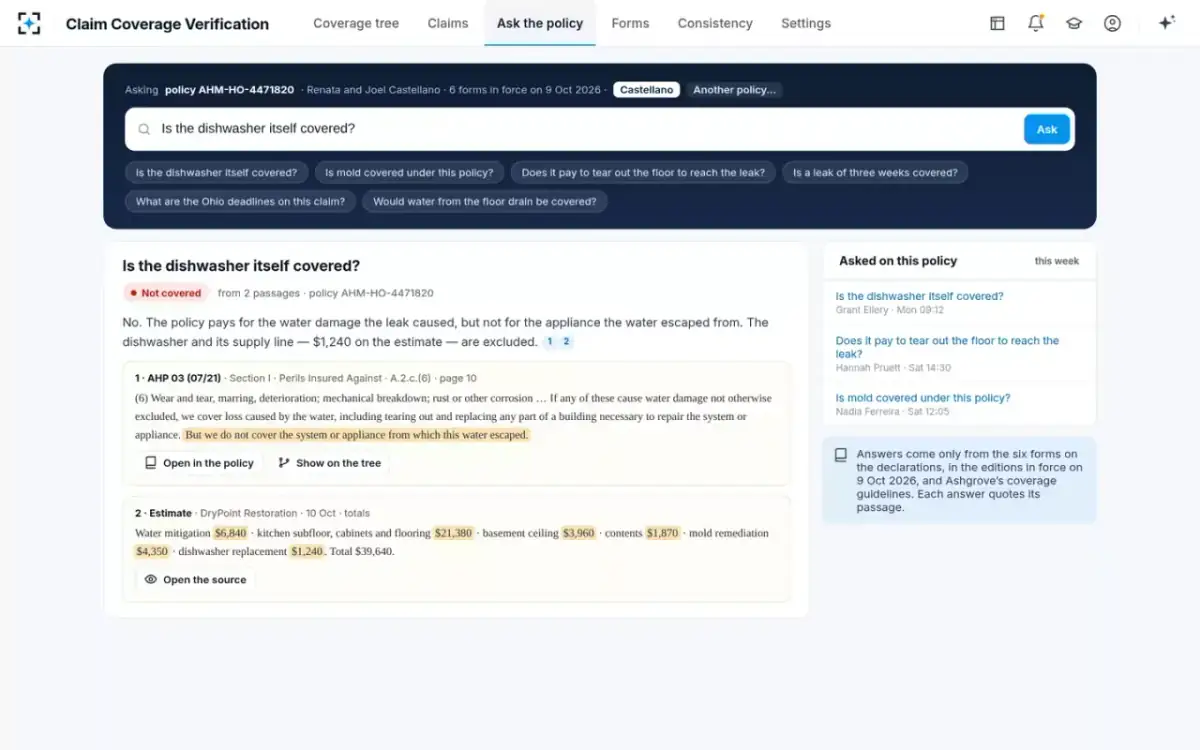
The solution changes what reaches counsel more than what counsel does. Adjusters and supervisors ask the policy in plain words and get an answer quoted from the six forms on the declarations, in the editions in force, and from the carrier's coverage guidelines. On the sample claim, the supervisor's question at 09:12 on Monday, whether the dishwasher itself is covered, was answered from two passages: the wear and corrosion exclusion, which pays for the water damage "But we do not cover the system or appliance from which this water escaped", and the restorer's estimate, which prices the dishwasher and its line at $1,240. Nobody needed to call a lawyer.
Ask the policy: a supervisor's question answered from two passages
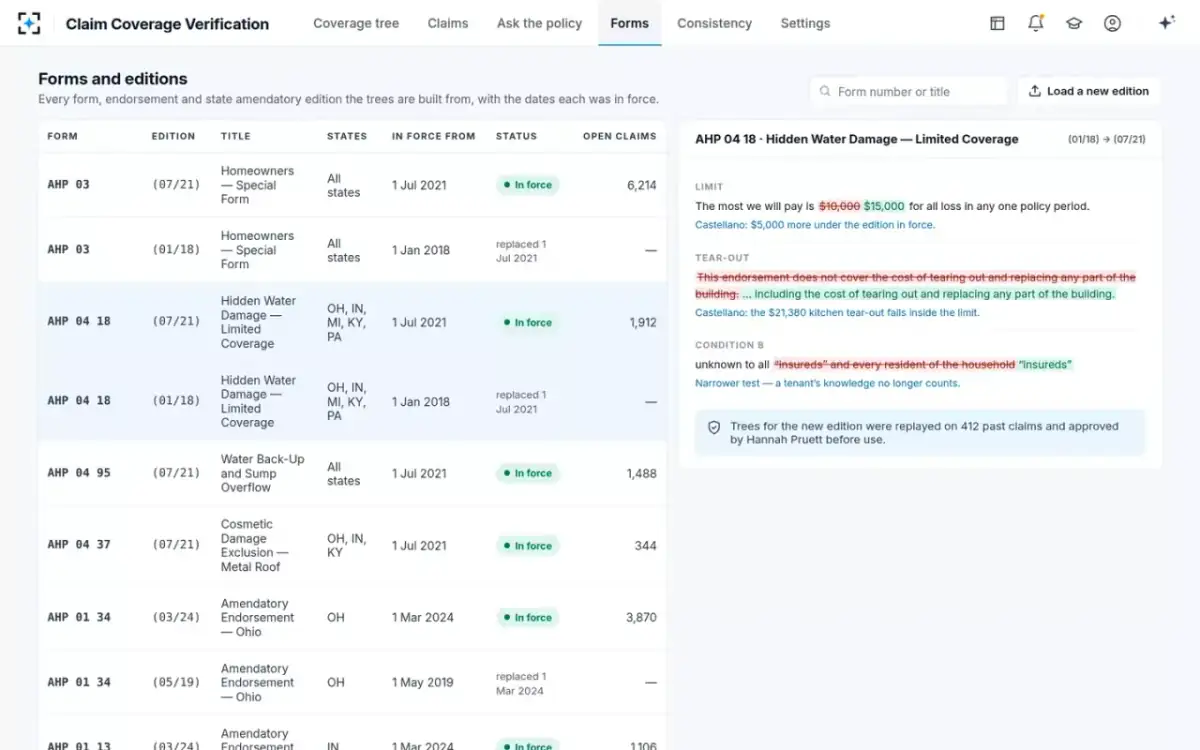
What does reach counsel arrives prepared. When the sample carrier moved its hidden water endorsement from the January 2018 edition to July 2021, the forms screen set out each change, the limit from $10,000 to $15,000, tear-out added, the knowledge condition narrowed to insureds only, and what each meant on open claims. The new trees were replayed on 412 past claims before counsel approved them. That is a coverage opinion counsel can give in an afternoon rather than a week, because the comparison is already done.
What counsel approves: a new edition, compared clause by clause
Two things stay with counsel by design. The agents may never deny coverage, so any "not covered" goes to a person, and the carrier decides which of those reach counsel. And a reservation of rights is signed by counsel, as described in the reservation of rights letter guide. Coverage counsel does not become a reviewer of software; they remain the lawyer the hard questions go to, with fewer easy ones in the way.
Questions people ask
What does coverage counsel mean in insurance?
It means a lawyer who advises on whether and how far an insurance policy covers a claim. Insurers use coverage counsel to interpret disputed wording, draft or review reservations of rights and denials, and approve new forms. Policyholders can hire their own coverage counsel to challenge a denial.
Is coverage counsel the same as defense counsel?
No. Defense counsel defends the insured against a third party's claim; coverage counsel advises on whether the policy requires the insurer to defend and pay. When an insurer reserves its rights on a liability claim, states such as Florida require steps like a non-waiver agreement or mutually agreeable independent counsel to manage the conflict.
Do homeowners need coverage counsel?
Most homeowners claims are resolved without a lawyer. A policyholder whose claim is denied or reduced on an exclusion can first ask the insurer to name the provision and its edition, which the rules in many states require the denial to state. Legal advice on a specific dispute is a matter for a licensed attorney in the policyholder's state.
Who signs a reservation of rights letter?
The insurer decides, through its authority rules: an adjuster, examiner, claims manager or coverage counsel. In the sample carrier, coverage counsel signs every reservation of rights, and a supervisor co-signs every denial and any reduction over $10,000.
Can software replace coverage counsel?
No, and it should not try. Software can retrieve the right edition, quote the passage and show which fact would change the answer, which removes the lookups from counsel's day. Interpreting contested wording, deciding when to reserve rights and standing behind a denial remain a lawyer's and a claims professional's work.