What are insurance policy endorsements? They are forms attached to a policy that change it: an endorsement adds a coverage the base form leaves out, takes one away, raises or lowers a limit, or rewrites a condition, and the state amendatory endorsement brings the whole policy into line with one state's law. The declarations page lists which endorsements a policy carries, each by a form number and an edition date, because carriers revise their forms and the same title can carry different words in different years. That is why, on a claim, the first coverage question is "which form, which edition, on the date of loss?" Getting it wrong pays the wrong amount. Botminds' Claim Coverage Verification answers it before anything else: its Policy assembler reads the declarations in force on the date of loss, fetches that exact edition of every form, and the edition goes on file with the coverage position the adjuster signs.
The examples on this page are sample data on a fictional carrier, Ashgrove Mutual, and a fictional homeowners claim, the Castellanos' kitchen leak in Ohio. The law and research are real and linked.
Two editions of one endorsement, and the date of loss that picks between them
- 01/18 edition: $10,000, no tear-out42 months
- 07/21 edition: $15,000 with tear-out64 months · in force on 9 Oct 2026
- Not yet issued16 months
- 05/19 edition58 months
- 03/24 edition32 months · in force on 9 Oct 2026
What is an endorsement on a policy?
An endorsement is a written form, attached to and made part of a policy, that changes the policy's terms. It can widen coverage, as a hidden water damage endorsement does; narrow it, as a cosmetic damage exclusion on a metal roof does; change a limit, as an ordinance or law endorsement that raises the share of the dwelling limit available for code upgrades does; or alter a condition, such as how long the insured has to sue.
Endorsements exist because the base forms are drafted to be used across many carriers and states, and each carrier then adjusts them. A University of Chicago Law Review study of homeowners policies described the industry's standard-setting body as maintaining "numerous different endorsements that amend policy language", some that insurers require on every policy and some sold as options, with enhanced loss settlement for personal property, scheduled valuables and sewer backup among the most commonly bought. In 1999 that body's own catalogue counted 73 countrywide endorsements and 113 state-specific ones.
For an adjuster, the useful definition is narrower: an endorsement is a piece of the contract that may change the answer, so it is read in full, in the edition listed, before the base form is trusted.
Why the exact wording is hard to find, even for regulators
24
insurance groups whose homeowners policies were compared, in six states
0of 20
largest homeowners insurers then posting their policies online
186
standard endorsements in the industry catalogue in 1999: 73 countrywide, 113 state-specific
Does an endorsement override the policy?
Where the two conflict, generally yes: the endorsement is the later, more specific statement of what the parties agreed. California's Supreme Court put it in one sentence that a federal court there quoted in 2010: "[i]f there is a conflict in meaning between an endorsement and the body of the policy, the endorsement controls." In that order, the judge added the obvious point an insured had resisted: "that is what endorsements do– they change the terms of the policy."
The rule has a limit that matters to anyone drafting or relying on a restrictive endorsement. In the same order, quoting a 2004 California Supreme Court case, a provision "that takes away or limits coverage reasonably expected by an insured must be conspicuous, plain and clear", and the burden of making it so is on the insurer. States word this differently, so the safe practice is to read the base form and every endorsement together, section by section, and to note which words the endorsement replaces.
On the sample claim the reading is easy because each form says what it changes. The Ohio amendatory endorsement states "No change to the water provisions of Section I." The hidden water endorsement adds coverage that the seepage exclusion in the base form takes away. Neither conflicts with the base form; each tells the reader where it attaches.
Five things an endorsement can do, with an example from the sample policy
| What it does | How it reads | Sample form | Effect on the Castellano leak |
|---|---|---|---|
| Adds coverage | We cover … provided … | AHP 04 18 Hidden Water Damage (07/21) | Gives back $15,000 of a loss the seepage exclusion took away |
| Adds a peril | We will pay up to … for loss caused by … | AHP 04 95 Water Back-Up and Sump (07/21) | Not used: nothing backed up through a drain |
| Changes a limit or valuation | Coverage … is increased to … | AHP 04 77 Ordinance or Law 25% (01/22) | Not used on this loss |
| Adds an exclusion | We do not cover … | AHP 04 37 Cosmetic Damage Exclusion, metal roof (07/21) | Not on this policy |
| Brings the policy into line with state law | The following changes apply in [state] … | AHP 01 34 Amendatory Endorsement, Ohio (03/24) | No change to the water provisions |
Amendatory endorsement meaning: the state's version of the form
An amendatory endorsement amends a policy form so that it complies with one state's law, or with a later change to a form. Most often it is a state amendatory endorsement: a single form, attached to every policy written in that state, that rewrites the clauses where state law differs from the carrier's countrywide wording. Its subjects are wherever that state's law and the carrier's wording part ways.
Two practical points follow. A state amendatory endorsement has editions of its own, revised whenever the state's law or the carrier's filing changes, so it can be out of step with the base form's edition. And it is easy to skip, because on most claims it changes nothing. The sample Ohio endorsement changes the concealment or fraud condition, the suit-against-us condition (two years) and cancellation notice periods. Its 03/24 edition replaced the 05/19 edition on 1 March 2024, and its margin note says plainly that it does not touch Section I water provisions. That note is worth having: it is the evidence that someone checked.
Forms and endorsements are filed with the state before they are sold
Insurance forms are regulated products, and endorsements are filed like any other form. Florida's statute shows how it works: a policy form, or a "printed rider or endorsement form or form of renewal certificate", "may not be delivered or issued for delivery in this state unless the form has been filed with the office" and approved, or filed under the state's alternative procedure. Filings must be made at least 30 days before use.
Filing does not make the wording easy to see later. The law review study found that when insurers change a form they "typically submit for review only the specific language they are altering", so regulators often hold "various amendments to an underlying policy but not the policy that is being amended". It also found that some departments did not require insurers to say whether a filed endorsement was optional or mandatory. For a claims team, the lesson is that the regulator's file is not a substitute for the carrier's own forms library, kept by edition with the dates each was in force.
Same name, different wording: two editions of one endorsement
An edition is a dated version of a form. Carriers mark it next to the form number, usually as month and year, and replace editions when they rewrite a clause, respond to a court decision or change pricing. The title often does not change, which is the trap: an adjuster who opens "Hidden Water Damage" from a shared drive may be reading the wrong year.
AHP 04 18 Hidden Water Damage, before and after the July 2021 edition
01/18 edition: The most we will pay is $10,000 for all loss in any one policy period.
07/21 edition (in force on 9 Oct 2026): The most we will pay is $15,000 for all loss in any one policy period.
01/18 edition: Does not cover the cost of tearing out and replacing any part of the building.
07/21 edition (in force on 9 Oct 2026): … including the cost of tearing out and replacing any part of the building.
01/18 edition: Unknown to all “insureds” and every resident of the household.
07/21 edition (in force on 9 Oct 2026): Unknown to all “insureds”: a tenant’s knowledge no longer counts.
01/18 edition: $10,000, and nothing for tearing out the floor to reach the leak.
07/21 edition (in force on 9 Oct 2026): $15,000, tear-out included: $5,000 more under the edition in force.
Three changes, each with a dollar consequence, and none visible from the title. Before the new edition's trees were used on live claims in the sample, they were replayed on 412 past claims and approved by the carrier's coverage counsel. That is the right order: compare the editions clause by clause, test the change on files already decided, then switch. Why that replay matters, and how to run one, is the subject of testing AI policy review on signed positions.
Forms and editions in Claim Coverage Verification
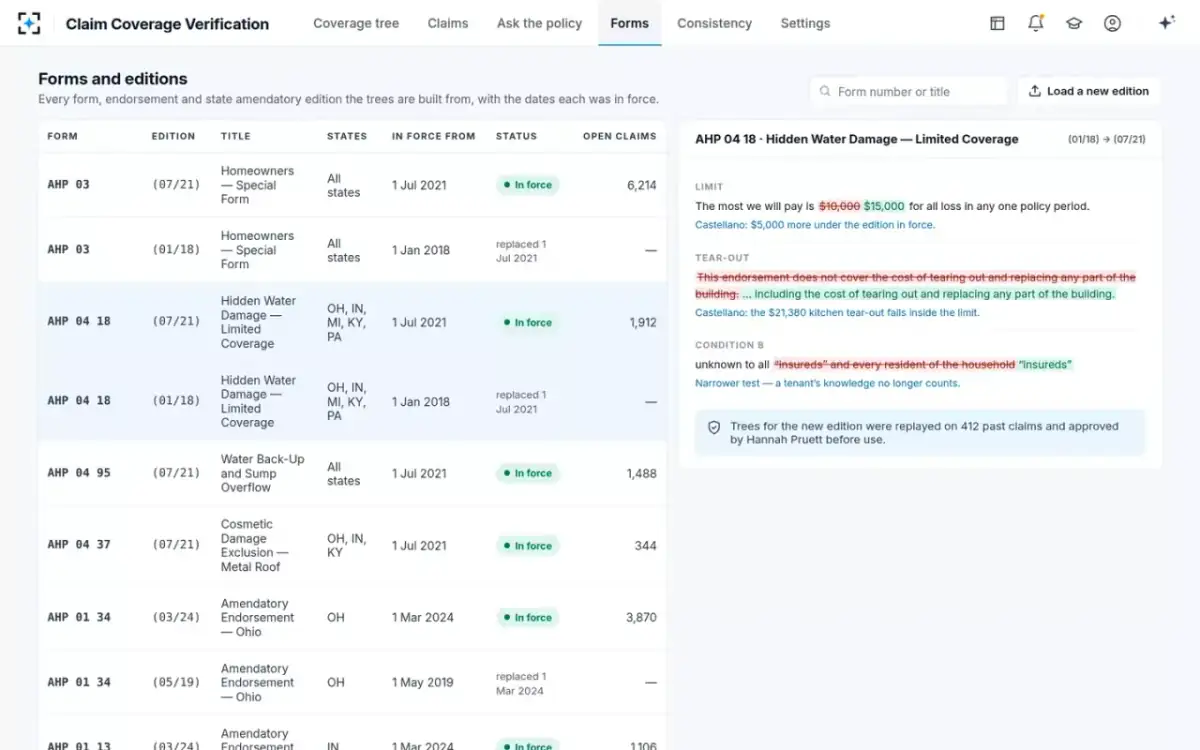
Which edition of a policy form applies to a claim?
As a rule, the edition listed on the declarations of the policy in force on the date of loss. A homeowners policy is usually renewed each year, and each renewal can bring new editions; a loss is judged under the contract in force when it happened, not the one in force when it was reported or when the adjuster opens the file. The sample carrier writes the rule into its settings: "the edition on the declarations in force on the date of loss."
There is a catch, and it is statutory in at least one large market. Florida lets a renewal change policy terms only with advance written notice, titled "Notice of Change in Policy Terms", and a policy for this purpose includes "all clauses, riders, endorsements, and papers that are a part of such policy". If the insurer fails to give that notice, "the original policy terms remain in effect until the next renewal and the proper service of the notice". So on a Florida renewal that swapped an endorsement edition without proper notice, the edition printed on the declarations may not be the one that governs. An edition rule that ignores renewal notices is incomplete.
Two more edge cases deserve a note in any edition rule. A loss that develops over time, like a slow leak, may straddle a renewal; the policy's own definitions of occurrence and policy period decide which contract applies. And mid-term changes, an endorsement added or removed during the policy year, carry their own effective dates, which the declarations or the change endorsement will show.
Carriers' forms differ more than buyers assume
The study that compared policies from twenty-four insurance groups set out to test the common claim that homeowners policies are the same everywhere. It concluded the opposite: "carriers’ homeowners policies differ radically with respect to numerous important coverage provisions", and "A substantial majority of these deviations produce decreases in the amount of coverage relative to the presumptive industry standard". It also observed that "Many insurers maintain numerous mandatory endorsements that substantially change the terms of their policies."
Its findings on two endorsement-heavy subjects show the spread. On ordinance or law, the extra cost of rebuilding to current code, the standard form allows up to 10 percent of the dwelling limit, roughly half the sampled policies followed it, many excluded the cost outright, and some carriers that leave it out of the base policy sell it as an endorsement. On mold, carriers split roughly evenly between excluding it and capping it, with caps from $2,500 to $50,000. The sample policy's Ordinance or Law 25% endorsement and its $10,000 mold limit are two such choices. A coverage answer borrowed from another carrier's form is not an answer.
Recording the edition with the coverage position
The edition belongs in the claim file next to the decision, for the adjuster's sake and the regulator's. Ohio's claims rule, where the sample claim sits, requires an insurer to "fully disclose to first party claimants all pertinent benefits, coverages or other provisions of an insurance contract under which a claim is presented". The NAIC's model act lists as an unfair practice "Knowingly misrepresenting to claimants and insureds relevant facts or policy provisions relating to coverages at issue". Quoting a superseded edition is not knowing misrepresentation, but it is the kind of error an examiner will find, and it is avoidable.
In Claim Coverage Verification the edition is fixed at the start. On the sample claim the Policy assembler logged at 08:31: "6 forms in force on 9 Oct 2026 · AHP 04 18 edition 07/21, not 01/18". The policy view shows each form in its edition, with margin notes where the position uses a passage, and the letter checks before signature include "Editions in force on 9 Oct 2026". When the adjuster signs, the position, its path, the facts and the edition of every form are kept with the signature, so the next reader does not have to reconstruct which PDF was open.
The policy in force on the date of loss
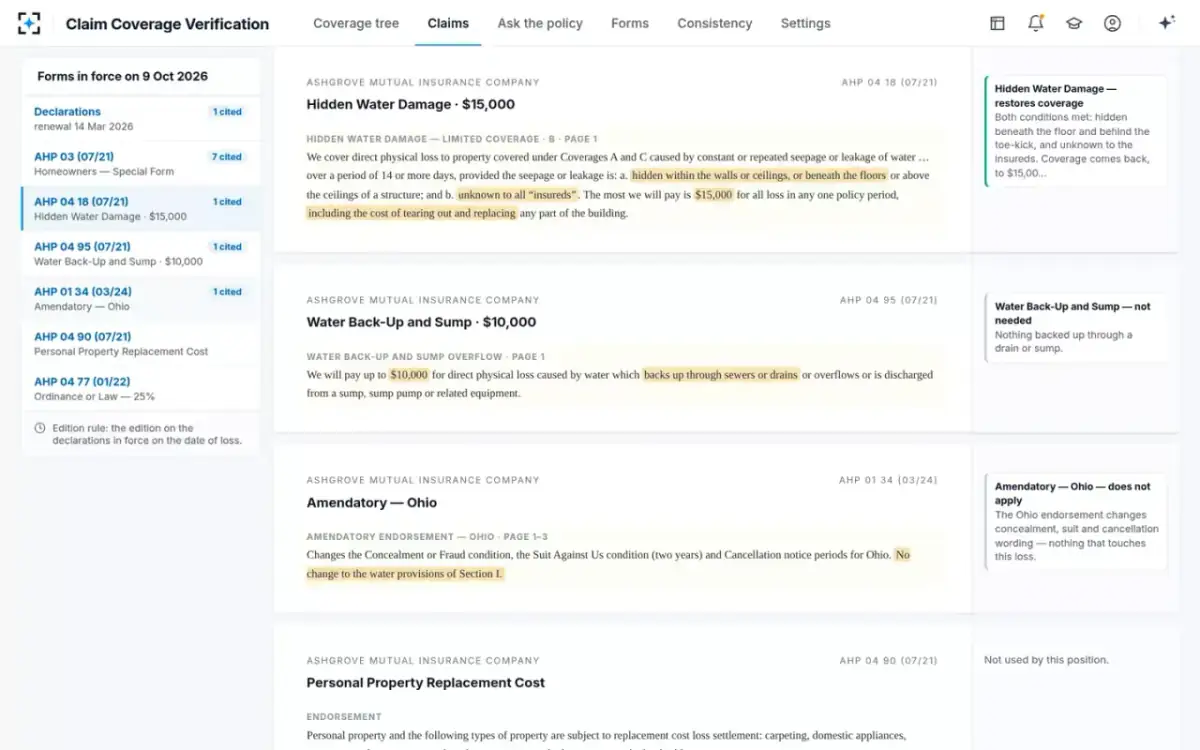
Reading the endorsements on a claim
- Start from the declarations in force on the date of loss
Not the current policy, and not the one in force when the claim was reported.
- List every form by number and edition
Including the state amendatory endorsement and any mid-term change endorsements, with their effective dates.
- Open the exact edition, not a form with the same title
Compare the edition date on the document with the one on the declarations.
- Note what each endorsement replaces
Section and clause, so the base form and endorsement are read together.
- Check renewal notices where the state requires them
A change in terms without the required notice may leave the old terms in force.
- Write the editions into the position and the letter
So a supervisor, examiner or court can see which words decided it.
An edition is only half of the reading; the other half is what the clauses do to each other. How an exception inside an exclusion gives coverage back is the subject of what an ensuing loss provision is, and the whole sequence on a water claim is walked in does homeowners insurance cover leaking pipes.
Questions people ask
What is the difference between a policy form and an endorsement?
The policy form is the base contract, such as a homeowners special form, with its insuring agreements, exclusions and conditions. An endorsement is a separate form attached to it that changes some of those terms. Both carry a form number and an edition date, and both are listed on the declarations.
Are endorsements part of the insurance policy?
Yes. Florida's notice statute, for example, defines a policy as including "all clauses, riders, endorsements, and papers that are a part of such policy." An endorsement listed on the declarations is read together with the base form, and where the two conflict, courts in California and elsewhere give effect to the endorsement.
What is a restriction of coverage endorsement?
It is an endorsement that narrows coverage the base form would otherwise give, for example by adding an exclusion or lowering a limit. California courts require any provision that takes away coverage an insured would reasonably expect to be "conspicuous, plain and clear", with the burden on the insurer. A restrictive endorsement added at renewal may also require advance notice, as Florida's statute does.
How do I know which edition of a form I have?
Look at the declarations page: each form is listed by number and an edition date, often written as month and year. The same date appears in a corner of the form itself. If they differ, the declarations of the policy in force on the date of loss are the starting point.
Can an insurer change an endorsement at renewal?
Generally yes, if the new form is filed where required and the insured gets any notice the state demands. In Florida, a renewal that changes terms needs a written Notice of Change in Policy Terms, and without it the original terms remain in effect until the next renewal with proper notice.
Why did my coverage letter quote a different limit than my old policy?
Most often because an endorsement's edition changed at a renewal. On the sample policy, the hidden water damage endorsement went from a $10,000 limit without tear-out to $15,000 with tear-out in July 2021. The letter should name the form and edition it relied on, so the difference can be traced.