A reservation of rights letter on an insurance claim is the insurer's written notice that it is handling the claim while it investigates a coverage question, and that it keeps the right to rely on a specific policy provision if the facts turn out to support it. It is not a denial. It exists because an insurer that keeps adjusting a claim without saying so can later be argued to have given up a defence; the letter puts the policyholder on notice instead. The craft is in the detail: a letter that "reserves all rights under the policy" tells the customer nothing, while one that names the clause, the open fact and the date of the next letter does the work the state claim rules require in any case. Botminds' Claim Coverage Verification drafts reservations from the coverage tree, with the reserved clause quoted and the open questions taken from the facts that would change the answer, and coverage counsel signs.
The letter annotated below was written for this page on the facts of a fictional sample claim, the Castellanos' kitchen leak insured by a fictional carrier, Ashgrove Mutual. The rules beside it are real and linked.
A reservation of rights letter, paragraph by paragraph, with the rule each line serves
1
Claim PH-26-104471 · Policy AHM-HO-4471820 · Date of loss 9 October 2026. Your policy in force that day is the Homeowners Special Form AHP 03 (07/21) with five endorsements, including Hidden Water Damage AHP 04 18 (07/21).
Name the policy and the editions in force on the date of loss
Ohio 3901-1-54(E)(1): disclose all pertinent coverages
2
We are paying $16,850 now. You told us on 10 October that nobody knew of the leak until the floor went soft, and the restorer’s photos show it was hidden beneath the floor, so this is what your policy pays however long the leak ran, after your $2,500 deductible.
Pay what is not in dispute
FEMA NFIP Claims Manual: payment "based on the undisputed insured loss"
3
We are still deciding whether more is owed, and we reserve our rights under one exclusion: "Constant or repeated seepage or leakage of water or steam over a period of 14 or more days …" (AHP 03, Section I, A.2.c.(5)).
Quote the clause reserved, not "all rights under the policy"
A reservation that names nothing protects little
4
One fact decides it: how long the supply line leaked. If it was under 14 days, the exclusion does not apply and $19,050 more is payable. Your plumber could not date the leak; if you have photos or receipts showing when the cabinet or floor last looked normal, please send them.
Say which fact is open and what it would change
The reasons more time is needed: NAIC Model 902 §7B
5
We will write to you again by 9 November 2026, sooner if we decide.
Give the date of the next letter
California 2695.7(c)(1): every 30 days; NAIC, Ohio: every 45
6
This letter is not a denial. Paying part of the claim now does not waive any of your rights, and investigating does not waive ours.
Say what the letter is and is not
Florida 627.426(1): investigation is not a waiver
7
Signed by coverage counsel, with the desk adjuster named as your contact.
The right person signs
Sample carrier setting: counsel signs reservations
What is a reservation of rights letter?
It is a one-sided written notice from the insurer to the insured saying three things: we are continuing to handle your claim; we have a question about whether part or all of it is covered, under this provision; and we are not giving up our right to rely on that provision while we find out. In property claims it usually follows a fact the adjuster cannot yet confirm, such as late notice, the cause of a loss, how long a leak ran, or whether a rating error changes the coverage.
The federal flood program's claims manual, which FEMA publishes, uses it exactly this way. When a rating change "will potentially restrict coverage", it tells the carrier to "secure a non-waiver agreement, or send a Reservation of Rights letter addressing the coverage issue", and adds: "The adjustment continues and payment is issued based on the undisputed insured loss." The adjustment does not stop, and the money that is not in dispute is not held hostage.
A reservation of rights letter indicates that the insurer has not decided yet
A reservation of rights letter indicates that coverage is in question, not that it has been refused. The insurer is telling the policyholder that a decision is pending on a named issue, and is preserving its position so that continuing to investigate, inspect or even pay part of the claim is not later read as a promise to pay all of it.
The concern behind it is waiver and estoppel: an insurer that acts as if a claim is covered, while knowing of a reason it might not be, risks losing that reason. Statutes in some states narrow the risk. Florida's provides that acknowledging a claim, furnishing claim forms, or "Investigating any loss or claim under any policy or engaging in negotiations looking toward a possible settlement" shall not be deemed a waiver of any provision or defence. Where no such statute applies, the letter is how the insurer makes its position plain.
Non-waiver vs reservation of rights: signed agreement or one-way notice
A non-waiver agreement is signed by both sides; a reservation of rights letter is sent by the insurer alone. Both say that handling the claim does not give up a coverage defence, but the agreement shows the insured's consent and the letter only gives notice. That is why carriers often try the agreement first.
The flood program's manual shows the order. On a late notice of loss: "When there is a delay in reporting the loss, NFIP insurers may require the use of a non-waiver agreement. The non-waiver should include the reason for the non-waiver and the policyholder’s explanation for the delay." And if the policyholder will not sign: "the insurer may decide to send a Reservation of Rights. The adjuster should continue the inspection and review." Florida's statute for liability insurers lists the same two tools side by side: within set times the insurer must either refuse to defend, obtain from the insured "a nonwaiver agreement following full disclosure of the specific facts and policy provisions upon which the coverage defense is asserted", or retain mutually agreeable independent counsel.
Non-waiver agreement and reservation of rights letter, side by side
Non-waiver agreement: Insured and insurer.
Reservation of rights letter: The insurer only; the insured receives it.
Non-waiver agreement: The insured agreed that adjusting does not waive the issue.
Reservation of rights letter: The insured was told, in writing, which issue is reserved.
Non-waiver agreement: Early, often at the first inspection, when the issue is already known.
Reservation of rights letter: When the insured will not sign, or the issue surfaces later.
Non-waiver agreement: The reason for it and, on late notice, the insured’s explanation for the delay.
Reservation of rights letter: The provision reserved, the facts still open and what happens next.
Non-waiver agreement: Adjustment continues.
Reservation of rights letter: Adjustment continues; undisputed amounts can still be paid.
Who sends a reservation of rights letter, and who signs it?
The insurer sends it, through whoever the carrier's authority rules name: often the adjuster or claims examiner on a routine issue, a claims manager or coverage counsel when the issue is serious or the claim is in litigation. What matters more than the title is that the signer has the authority to make the coverage decision the letter defers, and knows the file well enough to say what is still open.
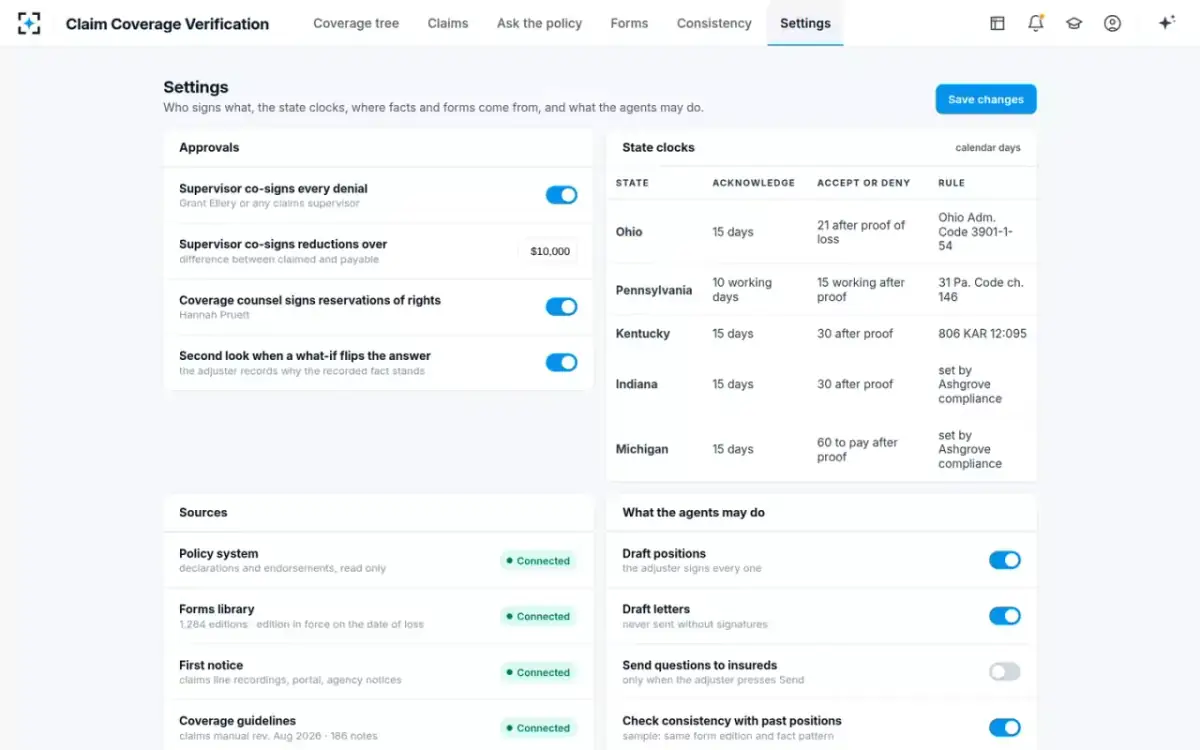
In the sample carrier's settings, coverage counsel signs every reservation of rights, the adjuster signs every coverage position, and a supervisor co-signs every denial and any reduction over $10,000. Those are the carrier's choices, changed by its own team and logged; the point is that they are written down, so no letter goes out under the wrong name.
Who signs what, set by the carrier in Claim Coverage Verification
The clocks a reservation of rights runs against
A reservation buys time to investigate; it does not stop the state's clock. Most claim rules give the insurer a fixed period after proof of loss to accept or deny, then require written notice, with reasons, whenever it needs longer, and repeat notices at fixed intervals until it decides. A reservation of rights letter that does not also meet those notice rules can satisfy the waiver concern and still be a late-claim violation.
When a first-party property insurer must write again while it investigates
| Rule | Decide after proof of loss | If more time is needed | Then write again |
|---|---|---|---|
| NAIC Model 902 §7 | 21 days | Notify within 21 days, giving the reasons | At 45 days and every 45 days after |
| Ohio Adm. Code 3901-1-54(G)(1) | 21 days | Notify within 21 days, explaining the need | In writing at least every 45 days |
| Cal. Code Regs. tit. 10 §2695.7 | 40 calendar days | Written notice of the information needed and the reasons | Every 30 calendar days |
| 31 Pa. Code §146.7 | 15 working days | Notify within 15 working days, giving the reasons | At 30 days, then every 45, saying when a decision may be expected |
California's wording is the most useful drafting guide. The notice must "specify any additional information the insurer requires in order to make a determination and state any continuing reasons for the insurer's inability to make a determination", and where the answer depends on a future event the insurer must provide "an estimate as to when the determination can be made." Pennsylvania asks the same in fewer words: say "when a decision on the claim may be expected." A reservation drafted to those standards is specific by necessity.
Does a reservation of rights mean my claim is denied?
No. It means a decision on part or all of the claim is pending on a named issue, and the insurer may still pay. In the illustrative letter above, $16,850 is paid at once because it is owed under either answer, and the reservation covers only the $19,050 that depends on how long the leak ran.
For a policyholder, a reservation is a prompt to act on what it asks. If it names a fact, such as when a leak was first noticed, the quickest route to a decision is to answer it in writing with whatever evidence exists. If it names a clause, the insured can ask for the full text of that clause and the edition of the form it comes from. If the letter is vague, asking the insurer which provision and which fact it is waiting on is reasonable, and the state rules above require it to give reasons for any delay.
Some reservations come with terms attached, and those deserve care. In a California Supreme Court case on a homeowners claim, the insurer wrote that the policy excluded the loss but offered "to advance you the claimed sum of $11,550 subject to a reservation of rights", on condition that the homeowners repay it if a court agreed with the insurer and waive certain claims. They refused to sign and sued. A reservation that asks the insured to give something up is no longer a simple notice.
“Show me the wording and the fact. If I can’t see both, it comes back.”
Grant Ellery, the sample claim's supervisor
Where reservation of rights letters go wrong
Most weak reservations fail in one of four ways, and each is visible on the page. They reserve "all rights under the policy" without naming a provision, so the insured cannot tell what is in question. They name a clause from the wrong edition, which a renewal may have changed. They list no open fact, so nobody knows what would end the reservation. Or they set no date, and the file goes quiet past the state's notice interval.
A fifth failure is subtler: holding back money that is owed on every reading of the facts. The flood program's manual says plainly that the adjustment continues and "payment is issued based on the undisputed insured loss." The coverage tree makes that amount computable, because every branch is priced: on the sample claim a leak under 14 days pays $35,900, the position as drafted pays $16,850, and prior knowledge by an insured would pay nothing. Which figure is undisputed depends on which facts are settled. In the illustrative letter, written as if the first-notice call had settled who knew, it is $16,850; with both facts open, it would be less.
A reservation of rights letter, checked before it is signed
- The provision is quoted, with its form, edition and section
Not "all rights under the policy". The edition is the one in force on the date of loss.
- The open facts are named, with what each would change
And who has been asked for them: the insured, a contractor, an engineer.
- The undisputed amount is paid or explained
Money owed on every reading of the facts is not held behind the reservation.
- The next letter has a date
Within the state’s interval: 30 days in California, 45 under the NAIC model and in Ohio.
- It says it is not a denial
And that continuing to investigate or paying part does not waive either side’s rights.
- No new terms are slipped in
A demand for repayment or a release turns a notice into an agreement the insured must be free to refuse.
- The signer has authority over the decision it defers
In the sample carrier, coverage counsel.
How Claim Coverage Verification drafts a reservation of rights
The draft starts from the coverage tree, not from a template. Every step on the tree quotes its form, edition, section and page, so the reserved clause can be quoted exactly. The Why-not analyst finds, for each step, the single fact that would change its outcome and the dollar effect, and turns the uncertain ones into questions; those become the letter's open facts. The amounts on each branch give the undisputed figure. The Letter drafter writes it in plain words, and nothing is sent without signatures.
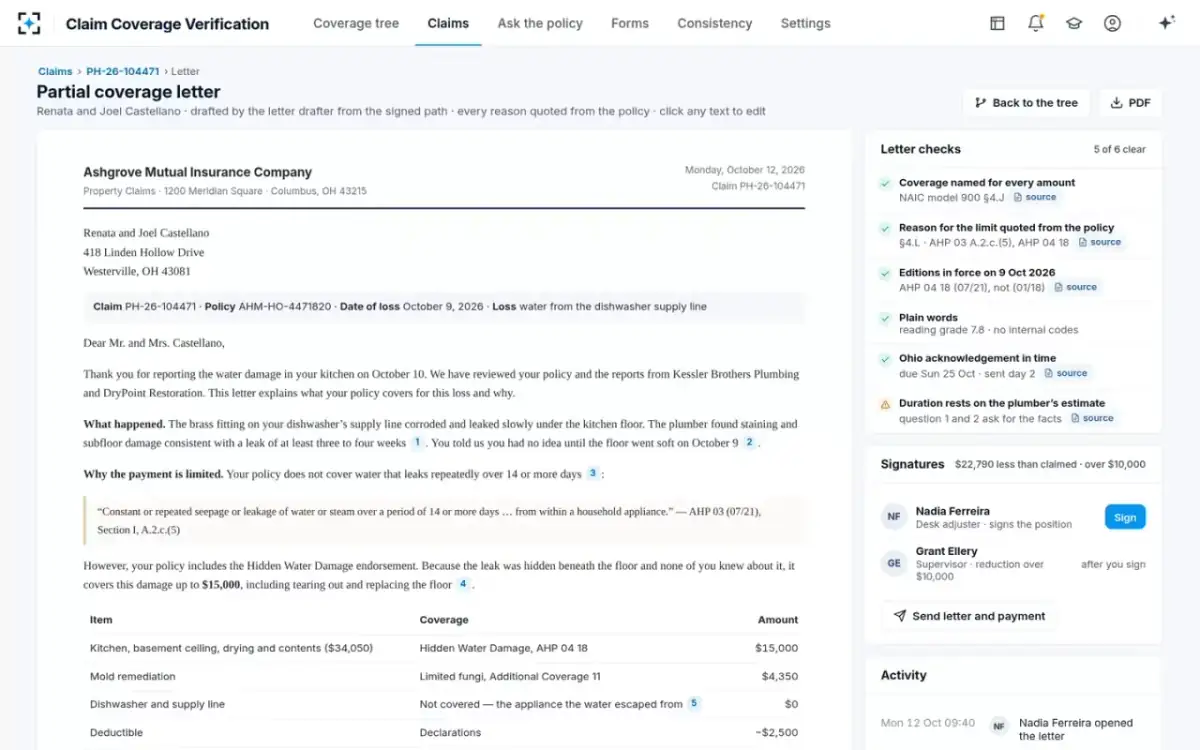
On the sample claim the same machinery produced a partial coverage letter rather than a reservation, because by 11:48 on Saturday the plumber's report had dated the leak at "at least 3–4 weeks". The letter quotes the seepage exclusion as the reason the payment is limited, names the coverage for every amount, and asks the two questions that could change it. Its sixth letter check flags that the leak's duration rests on the plumber's estimate. That flag is the moment a carrier chooses between a partial decision and a reservation, and it is a choice for a person.
The partial coverage letter the sample claim received instead
What a denial letter owes beyond this, and what it costs when it is missing, is covered in the coverage denial letter guide. Who decides when a reservation is warranted, and why so many of those calls reach a lawyer, is the subject of what coverage counsel means.
Questions people ask
What is the purpose of a reservation of rights letter?
To let the insurer keep investigating, and sometimes paying, while preserving its right to rely on a named coverage provision. Without it, an insurer that keeps handling a claim while aware of a coverage problem risks being found to have waived that problem. It also tells the policyholder what is in question and what would settle it.
Can an insurer pay part of a claim under a reservation of rights?
Yes, and often it should. The FEMA flood claims manual says that when a coverage issue is reserved "payment is issued based on the undisputed insured loss." The reservation then covers only the part that depends on the open question.
How long can a reservation of rights last?
There is no single limit, but the state claim rules keep it short in practice by requiring a decision or a written reason for more time at fixed intervals. California requires a written notice every 30 calendar days until a determination is made; the NAIC model and Ohio require one at least every 45 days.
What should a sample reservation of rights letter include?
The claim and policy, the forms and editions in force on the date of loss, the provision reserved quoted in full, the facts still open and who is asked for them, any amount being paid now, the date of the next letter, and a statement that the letter is not a denial. The illustrative letter at the top of this page shows each element on one claim.
Is a reservation of rights the same in liability claims?
No. In liability insurance the reservation also affects who controls the insured's defence, so states add formal rules. Florida, for example, requires written notice of a reservation within 30 days after the liability insurer knew or should have known of the coverage defence, then either a refusal to defend, a non-waiver agreement or mutually agreeable independent counsel.