A coverage denial letter is the insurer's written notice that a claim, or part of one, will not be paid, and the rules on what it must say are among the most uniform in claims handling: the letter must name the specific policy provision, condition or exclusion it relies on, and explain how that provision applies to the facts. The NAIC's model regulation says no insurer shall deny a claim on a specific provision "unless reference to such provision, condition, or exclusion is included in the denial", and Ohio, Pennsylvania, California, Florida and Washington have their own versions. A letter that skips the clause is where a coverage error turns into money: reopened files, complaints, statutory interest and fines by the violation. Botminds' Claim Coverage Verification drafts every coverage letter from a coverage position in which each step already quotes its clause, then checks the letter against the rules before the adjuster signs.
Examples come from a fictional sample carrier, Ashgrove Mutual, and its sample claims. The rules and enforcement figures are real and linked.
How one missing clause becomes a cost: the cascade
The letter omits the provision
A denial on an exclusion that does not reference it breaks the NAIC model rule and its state copies.
NAIC Model 902 §7A · Ohio 3901-1-54(G)(2) · 31 Pa. Code 146.7
The file is reopened
Someone re-reads the policy, redoes the reasoning and writes again; the claim is now late on its own clock.
Sample: two hidden-leak positions reopened by quality review
The policyholder complains
California requires the denial itself to tell the claimant the Department of Insurance can review it.
Cal. Code Regs. tit. 10 §2695.7(b)(3)
Late money bears interest
In Florida, a residential property payment made after 60 days carries statutory interest from the day the insurer received notice.
Fla. Stat. §627.70131(7)(a)
Fines by the violation
Florida: up to $12,500 per nonwillful violation, $25,000 on a declared-emergency claim; far more if willful.
Florida OIR, April 2026
A pattern becomes a practice
Repeated often enough, the same omission is "a general business practice" under the model act, and examiners look for patterns.
NAIC Model 900 §3
What must a coverage denial letter include?
At a minimum: that it is a denial, in whole or in part; the provision relied on, by name and wording; the facts that make it apply; and, in many states, what the policyholder can do next. The rules build up in layers. The NAIC's model act makes it an unfair practice to fail "to promptly provide a reasonable and accurate explanation of the basis for such actions" on denials and compromise offers. The model regulation requires the denial to reference the provision and adds that "The denial must be given to the claimant in writing". California goes furthest, as described below.
Three further items are good practice everywhere and required in some states: the edition of the form, so the reader can find the exact words; the amount, where the denial is partial, with the coverage under which anything is paid; and the contact for questions. The checklist at the end of this page turns these into a letter outline.
Must a denial cite the policy provision?
Yes, in every state that follows the NAIC model, and the wording barely changes from one to the next. The model regulation: "No insurer shall deny a claim on the grounds of a specific policy provision, condition or exclusion unless reference to such provision, condition, or exclusion is included in the denial." Ohio's rule repeats it and adds that "The claim file of the insurer shall contain documentation of the denial". Pennsylvania's says an insurer "may not deny a claim on the grounds of a specific policy provision, condition or exclusion unless reference to the provision, condition or exclusion is included in the denial."
Referencing is the floor, not the standard. A letter that says "excluded under Section I, A.2.c.(5)" references a provision, but a policyholder cannot tell from it what the words are or why they apply. California requires the explanation as well, and Florida requires an explanation "of the basis in the insurance policy, in relation to the facts or applicable law". The safe letter quotes the clause and connects it to the fact.
The same partial denial, written two ways
References the provision: Your claim is limited by exclusion A.2.c.(5) of your policy.
Quotes it and ties it to the facts: “Constant or repeated seepage or leakage of water or steam over a period of 14 or more days … from within a household appliance.” AHP 03 (07/21), Section I, A.2.c.(5).
References the provision: Based on our investigation.
Quotes it and ties it to the facts: The plumber found staining and subfloor damage consistent with a leak of at least three to four weeks.
References the provision: A payment is enclosed.
Quotes it and ties it to the facts: Your Hidden Water Damage endorsement covers this damage up to $15,000, including tearing out and replacing the floor.
References the provision: Total payable $16,850.
Quotes it and ties it to the facts: Kitchen, basement ceiling, drying and contents $15,000 under AHP 04 18; mold $4,350 under Additional Coverage 11; dishwasher $0, the appliance the water escaped from; deductible −$2,500.
Florida: interest from the day of notice, and fines by the violation
Florida turns a weak or late decision into arithmetic. For residential property claims, the insurer must pay or deny within 60 days of notice, must give "a reasonable explanation in writing to the policyholder of the basis in the insurance policy, in relation to the facts or applicable law, for the payment, denial, or partial denial of a claim", and must explain in writing any payment below its own adjuster's detailed estimate. A payment after the deadline bears interest at the statutory rate, and "Interest begins to accrue from the date the insurer receives notice of the claim." The statute adds that its provisions "may not be waived, voided, or nullified by the terms of the insurance policy."
Then come fines. The Office of Insurance Regulation's April 2026 compliance report sets them out: for nonwillful violations, up to $12,500 each with a $50,000 aggregate for the same action; on a claim from a declared emergency, "fines up to $25,000 per violation, up to an aggregate amount of $100,000". Knowing and willful violations reach $100,000 each, or $200,000 on emergency claims, with aggregates of $500,000 and $1 million. In the first quarter of 2026 the Office fined 42 insurers, across all lines of business.
What Florida attaches to claim-handling violations
$25,000
per nonwillful violation on a declared-emergency claim; $12,500 otherwise
$200,000
per knowing and willful violation on an emergency claim
42
insurers fined by Florida’s regulator in the first quarter of 2026, all lines
60days
to pay or deny a residential property claim, with interest from notice after that
California: every basis, with the facts and law behind it
California's regulation reads like a drafting instruction. A first-party denial, in whole or in part, must be in writing and provide "a statement listing all bases for such rejection or denial and the factual and legal bases for each reason given for such rejection or denial which is then within the insurer's knowledge." Where the denial rests on a policy provision, condition or exclusion, the letter must "include reference thereto and provide an explanation of the application" of it to the claim.
The same section requires the letter to tell the claimant that if they believe all or part of the claim "has been wrongfully denied or rejected, the claimant may have the matter reviewed by the California Department of Insurance", with the address and telephone number of the unit that reviews claims practices. Every California denial therefore carries the route to its own complaint. The word "all" matters too: a basis left out of the letter is hard to add later without looking like a new reason found after the fact.
A partial denial is still a denial
Most coverage letters do not refuse a claim outright; they pay part and limit the rest. The rules treat the limited part as a denial. Florida's explanation duty covers "the payment, denial, or partial denial of a claim", California's covers denials "in whole or in part", and the model act's explanation duty extends to "offers of compromise settlement". The model act also lists, as a separate unfair practice, "Making claims payments to an insured or beneficiary without indicating the coverage under which each payment is being made".
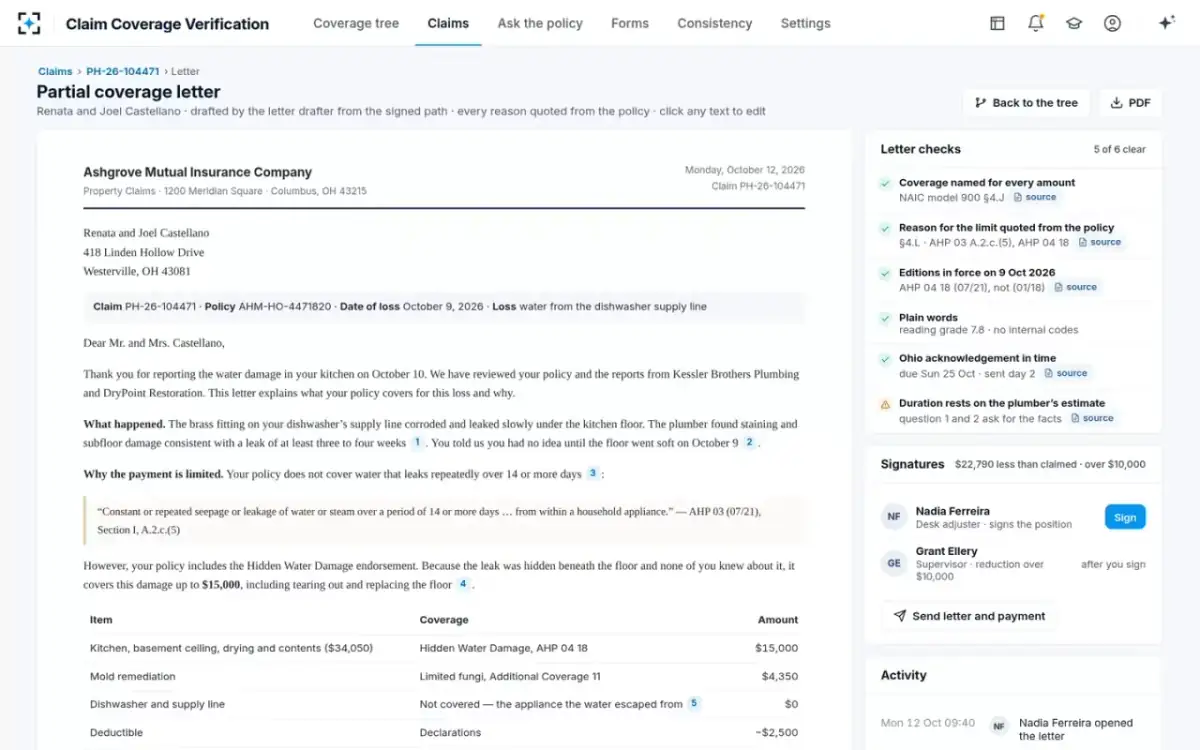
So a partial coverage letter has two jobs: name the clause behind every reduction, and name the coverage behind every payment. The sample letter on the Castellano water claim does both, line by line: $15,000 under the Hidden Water Damage endorsement, $4,350 under the policy's limited fungi coverage, $0 for the dishwasher because it is the appliance the water escaped from, and the deductible from the declarations. The payment is $22,790 less than claimed, so the sample carrier's rules also require a supervisor's co-signature.
A partial coverage letter with every amount tied to its coverage
What happens if an insurer denies without a reason?
The denial is defective in itself, before anyone asks whether it was right. Under the model regulation and its state versions, a denial on a provision that the letter does not reference is not a valid denial on that provision. The policyholder can ask the insurer to state the basis, complain to the state insurance department, and, where state law allows, sue. Regulators read claim files for exactly this: the model regulation requires each file to permit "reconstruction of the insurer’s activities relative to each claim".
For the insurer, an unexplained denial is also a weak position to defend. If the reason was sound, the letter wasted it; if the reason was not yet known, the denial came before a reasonable investigation, which is a separate unfair practice in the model act: "Refusing to pay claims without conducting a reasonable investigation". Washington's 2026 rule sharpened that point for automated tools: "A reasonable investigation may not rely solely on the use of a database".
Reasons insurance companies deny claims, and how each must be written
The top reasons are mundane. When Florida's regulator published why hurricane claims closed without payment, it found that generally "the top reasons for claims closed without payment are the claim damage was below the insurance policy’s deductible, or the claim was denied due to flood coverage that is not covered by the insurance policy." After Hurricane Milton, below-deductible closures were 41 percent of claims closed without payment. Each reason still needs its clause.
Common reasons for a denial or reduction, and what the letter has to show
| Reason | The provision to quote | The fact to tie it to | Watch for |
|---|---|---|---|
| Damage below the deductible | The deductible on the declarations | The adjusted amount of the covered loss | Showing the estimate, so the comparison can be checked |
| Excluded peril, such as flood | The exclusion, in the edition in force | The cause of loss and its evidence | Combined causes: which one counts varies by state |
| Gradual damage: seepage, wear, rot | The exclusion and its time or wear test | Duration or condition evidence, with its source | Exceptions and endorsements that give part back |
| Property not covered | The definition or exclusion of that property | What the item is | Damage the item caused may still be covered |
| Late notice | The policy’s notice condition | Dates, and how the delay harmed the investigation | Ohio bars denying for late notice unless the policy requires notice or the failure breaches the duty to cooperate |
| Limit exhausted | The limit and any sublimit | Amounts already paid under it | Other coverages that may still apply |
The late-notice row is worth reading twice. Ohio's rule says "No insurer shall deny a claim based upon the failure of a first party claimant to give written notice of loss within a specified time limit unless the notice is required by a policy condition", or the claimant's failure after a request is so unreasonable that it breaches the duty to cooperate. A letter that cites late notice without the condition and without that showing is denying on a ground the rule disallows.
A coverage denial letter template, clause by clause
There is no regulator's template, and a fill-in-the-blanks letter is how provisions get left out. What can be standardised is the structure: the sections a letter must contain, in order, each one filled from the claim's own facts and policy. A reservation of rights, which defers a decision rather than making one, has a different structure, set out in the reservation of rights letter guide.
Sections of a first-party coverage denial or partial denial
- Claim, policy and date of loss
With the forms and editions in force on that date.
- What happened, in the policyholder’s terms
The facts the decision rests on, each with its source.
- The decision, stated plainly
Denied in whole, or covered in part, with the amount.
- Every basis, each with its clause quoted
California: all bases, with the factual and legal basis for each.
- The coverage under which each payment is made
NAIC Model 900 §4J; a separate line for each amount.
- Any difference from the insurer’s own estimate, explained
Required in Florida for property claims.
- What would change the decision
The open facts, and how to send evidence.
- Review and complaint rights
California requires the Department of Insurance’s claims review unit, with address and telephone number.
- Signatures under the carrier’s authority rules
In the sample, the adjuster, and a supervisor for any denial or reduction over $10,000.
How Claim Coverage Verification checks a letter before anyone signs
The letter is drafted from the signed path of the coverage tree, so the clause behind every reduction is already quoted with its form, edition, section and page, and every fact already has a source. The letter drafter writes it in plain words, quotes the provision as the reason for each limit, names the coverage for each amount and lists the open questions with the state's complaint rights. The agents never send; any "not covered" goes to a person, and nothing reaches an insured without signatures.
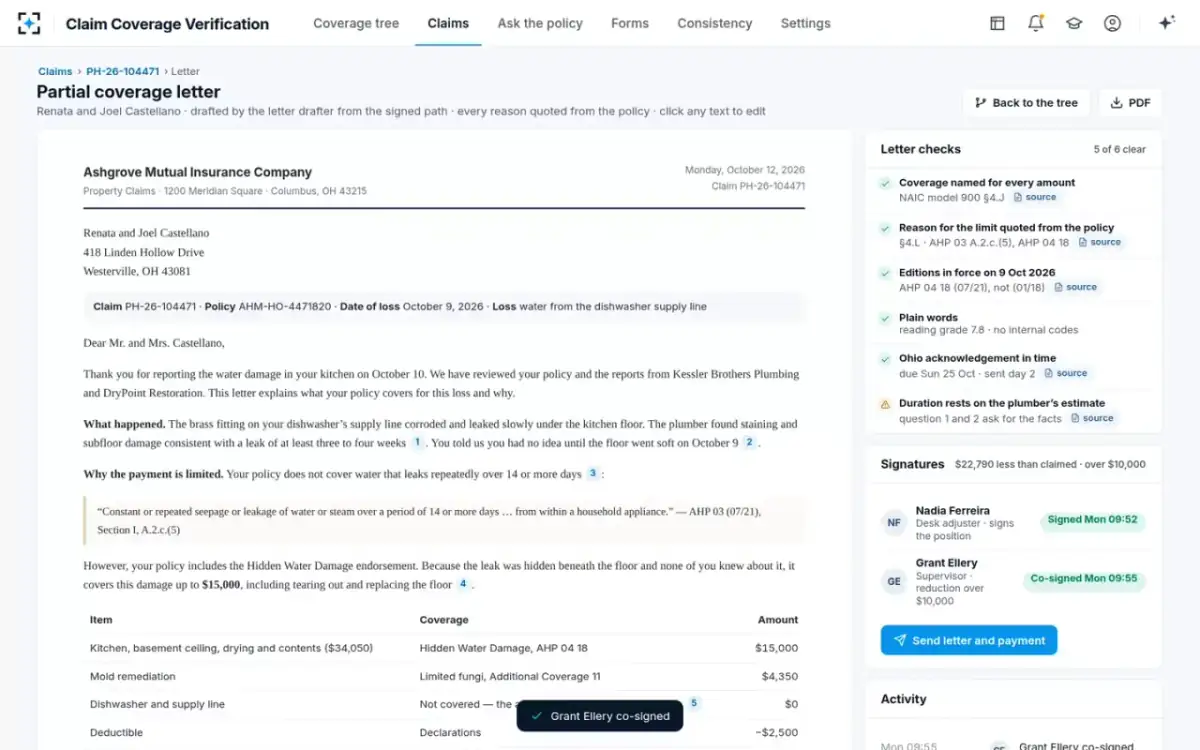
Before signature, letter checks run against the rules the letter must meet. On the sample letter, five of six were clear: coverage named for every amount, the reason for the limit quoted from the policy, editions in force on 9 October 2026, plain words at a reading grade of 7.8, and the Ohio acknowledgement in time. The sixth was flagged: the leak's duration rests on the plumber's estimate, and questions 1 and 2 ask for the facts. A flag does not block the letter; it tells the adjuster and supervisor what they are relying on when they sign.
Signed at 09:52, co-signed at 09:55, ready to send
The arithmetic of the cascade is why the check is worth having. One reopened position costs a re-review and a corrected letter; the sample carrier reopened two on one fact pattern. A pattern of them is what examiners look for. Whether the AI drafting the letter can be trusted at all is a separate question, answered by testing it on signed positions, as described in AI insurance policy review.
Questions people ask
How long does an insurer have to send a denial letter?
It depends on the state and the line. Under the NAIC model and Ohio's rule, a first-party claimant must be told of acceptance or denial within 21 days after proof of loss; California allows 40 calendar days; Florida requires residential property claims to be paid or denied within 60 days of notice. Each allows more time only with written notice of the reasons.
Does a late denial bear interest?
In Florida, yes: a residential property payment made more than 60 days after notice bears interest at the statutory rate, accruing from the date the insurer received notice, and the policy cannot waive it. Other states have their own prompt-payment interest rules.
Can a denial letter be changed later?
An insurer can correct or reopen a decision, and should when it was wrong; the sample carrier reopened two positions that had paid full Coverage A instead of the endorsement limit. Adding new reasons late is harder to justify, which is why California's rule asks for all bases known at the time of the denial.
What should I do if my claim is denied without a reason?
Ask the insurer in writing for the provision it relied on and the facts it applied it to, since the model rule followed by many states requires the denial to reference the provision. If the answer does not come, the state insurance department's consumer services unit takes complaints about claim handling. For advice on a specific dispute, consult a licensed professional in your state.
How much are insurance claim handling fines in Florida?
Per the Office of Insurance Regulation's April 2026 report: up to $12,500 per nonwillful violation (aggregate $50,000), or $25,000 on a declared-emergency claim (aggregate $100,000); up to $100,000 per knowing and willful violation (aggregate $500,000), or $200,000 on an emergency claim (aggregate $1 million).