AI insurance policy review means using a language model to read a policy and answer a coverage question: is this loss covered, under which clause, and for how much. It can be done, and done usefully, but there is no published accuracy figure for it on claims, and the nearest evidence is sobering: a preregistered study found that commercial legal research tools built to answer from real sources still "hallucinate between 17% and 33% of the time". So the question for a claims team is not whether AI can review policies but whether it reviews yours correctly, and the only fair way to find out is to replay it on coverage positions your adjusters and counsel have already signed, scoring agreement fact pattern by fact pattern and adjudicating every disagreement. Botminds' Claim Coverage Verification is built around that test: every new position is compared with signed positions on the same form edition and facts, and new form editions are replayed on past claims before use.
The product figures on this page come from a fictional sample carrier, Ashgrove Mutual, and its sample claims. Research is cited where it appears.
What the evidence says before any vendor demo
17–33%
hallucination rate of commercial AI legal research tools built to answer from sources
0
published accuracy studies of AI coverage review on insurance claims that we found
24
insurance groups whose homeowners policies differed “radically” on key provisions
Can AI review an insurance policy?
Yes, in the sense that a language model can read a policy's text and produce a fluent answer to a coverage question. Legal scholars are divided on how far to trust that reading. In a 2024 New York University Law Review article, two law professors argued that the technique they call generative interpretation, applied to famous contract cases, was "often arriving at the same answers at lower cost and with greater certainty" as the courts. A 2026 reply in the Harvard Journal of Law and Technology answered: "We respectfully dissent. In this Article, we show that LLMs are not yet fit for use in judicial chambers." It found the proponents' experimental results "brittle and frequently arbitrary".
Both are writing about judges interpreting contracts, a harder task than an adjuster applying a policy to facts. But the dispute marks the right line for a claims buyer. A model that interprets is offering an opinion; a system that retrieves the exact clause, in the right edition, and shows which fact it turned on is offering something a person can check. The second is a reasonable thing to deploy on claims; the first needs a lawyer standing behind it.
How accurate is AI insurance policy review?
Nobody can tell you in general, and a single accuracy number would mislead if they did. We found no published study of AI coverage review on real insurance claims. The closest evidence is the legal research study above, which found that tools built to answer from real legal sources reduced hallucinations relative to a general chatbot but still produced them in 17 to 33 percent of answers. A coverage reading has more ways to be wrong than a citation does.
Count them on one water claim. The answer can cite the wrong form: an endorsement not on the declarations. The right form in the wrong edition: the January 2018 hidden water endorsement instead of July 2021, worth $5,000 on the sample claim. The right clause applied to an unsupported fact: a leak "over 14 days" when nobody has dated it. Or the right reasoning with the wrong arithmetic: a deductible taken at a different point in the arithmetic than the policy's loss settlement wording says. A grader who marks only the final "covered / not covered" will miss most of these. Accuracy has to be scored step by step, on your forms, against decisions your people stand behind.
The fair test: replay positions your people already signed
The best benchmark a carrier has is its own closed files: positions signed by adjusters and reviewed by supervisors and counsel, on the carrier's own forms and editions. Replaying an AI reading against them measures what the carrier needs to know, under the conditions it will meet. The NAIC's model bulletin on AI points the same way: it lists validation that can take the form of "comparing model performance on unseen data available at the time of model development to the performance observed on data post-implementation, measuring performance against expert review, or other methods." Signed coverage positions are expert review, already paid for.
A replay test for AI coverage review, from closed files to an agreement table
A person decides
Choose the filesClosed claims with signed positions, grouped by form edition and fact pattern: for example, hidden leak over 14 days that nobody knew of, on one homeowners form and endorsement edition.
Agent
Rebuild the input, not the answerThe policy in force on the date of loss and the facts as they stood when the position was signed, with the signed decision held back.
Never: See the signed outcome before answering.
Agent
Draft the positionPath through the tree with each step quoted, facts sourced, amounts computed.
Agent
Compare step by stepForms and editions used, each step’s outcome, each amount, against the signed file.
A person decides
Adjudicate every disagreementA third reader, often coverage counsel, decides whether the draft, the file or neither was right, and why.
A person decides
Score by fact pattern and decide where to use itAgreement per pattern and per step type; patterns that fail stay with people.
Building the replay set: fact patterns, editions and the signed answer
A replay set is only as honest as its construction. Three rules keep it so. First, group files by form edition and fact pattern, because a model that is right on sewer back-up may be wrong on hidden leaks, and an average hides that. Second, rebuild the inputs as they stood at the time of signing, including the facts that were uncertain then, rather than the facts as later learned; otherwise the test rewards hindsight. Third, hold the signed answer back from the system under test, including any notes in the file that state it.
Size each pattern so that one mistake shows. A pattern with five files cannot distinguish 80 percent from 100; one with forty can at least show whether disagreements cluster. Include the files that were reopened or corrected, which are where the signed answer was itself wrong, and the files that went to counsel, which are where the wording was hard. A replay set of easy, clean files flatters any tool.
Two ways to test AI policy review
The demo test: A handful chosen by the vendor or a sponsor.
The replay test: Closed files chosen by pattern, including reopened and counsel-reviewed ones.
The demo test: Standard or sample forms.
The replay test: Your forms, in the editions in force on each date of loss.
The demo test: Covered or not.
The replay test: Forms and editions used, each step, each fact’s source, each amount.
The demo test: Counted as errors.
The replay test: Adjudicated: the file may be the one that was wrong.
The demo test: One accuracy number.
The replay test: Agreement by pattern, and a list of patterns that stay with people.
Score agreement by fact pattern, not with one number
Agreement varies by pattern, and the human baseline is not 100 percent either. The sample carrier's consistency report shows it among its own signed positions, before any AI is involved. On seven fact patterns, the share of signed positions that agree with their pattern's answer ranges from 92 to 100 percent.
People disagree too: agreement among signed positions, by fact pattern
Two lessons follow. A replay that reports "95 percent agreement" overall may be 100 percent on easy patterns and much lower on the hard ones that matter. And a pattern where people disagree with each other is a pattern where the replay's disagreements need adjudication, not counting. The sample carrier's design target is that 95 percent of new positions match signed past positions on the same form and facts; it is a target, measured in the live system, and it is meaningful only pattern by pattern.
When the AI and the file disagree, who is right?
Sometimes the file. On the sample carrier's hidden-leak pattern, 41 of 43 signed positions paid to the endorsement's $15,000 limit, and two paid full Coverage A without applying it: $31,420 on one claim in January 2025 and $27,980 on another in August 2026, where the plumber had dated the leak at five weeks. Quality review reopened both. A replay that "disagreed" with those two files would have been right, and scoring it as wrong would punish the behaviour a carrier wants.
Same facts, same answer: the outliers a replay should find
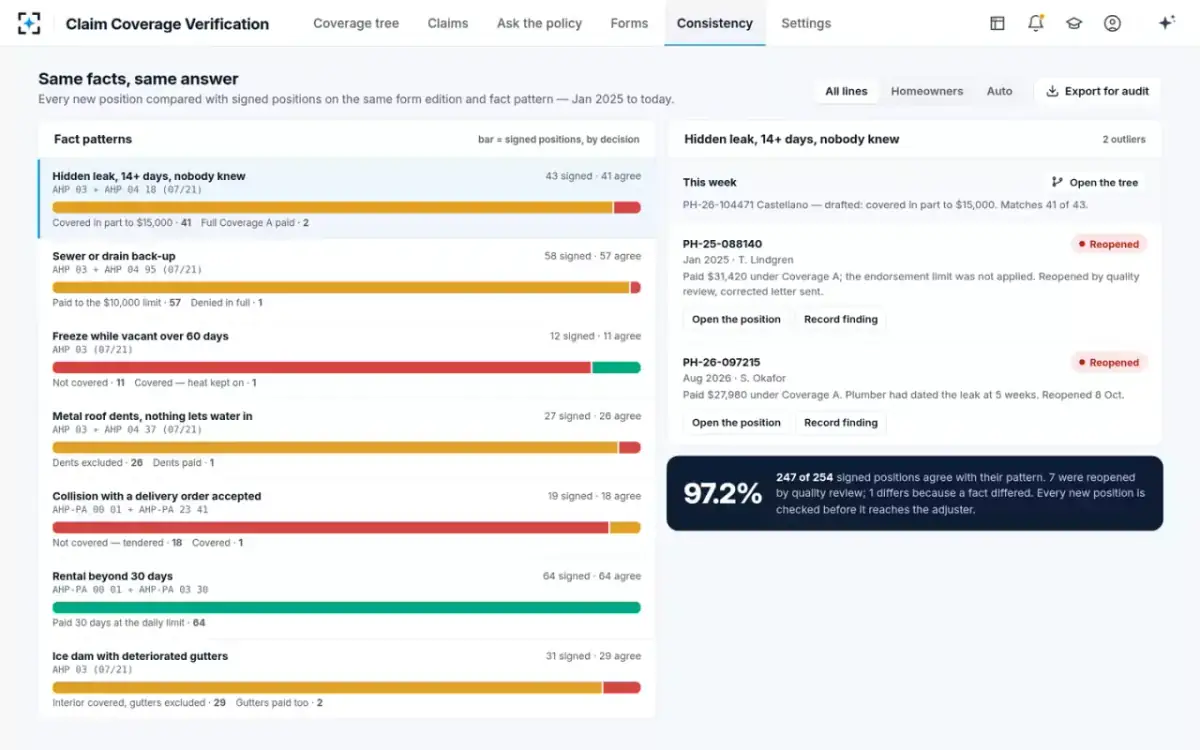
So every disagreement needs a third reader, with three possible verdicts: the draft was right and the file wrong, the file was right and the draft wrong, or the wording is genuinely ambiguous and the pattern belongs with counsel. Only the second counts against the system. The first is found money and a training point for the desk. The third is a finding about the policy form, and may be the most valuable output of the whole exercise.
Replay a new edition before it goes live
Replays are not only for buying decisions. Every time a carrier revises a form, the coverage reasoning built on the old edition has to be rebuilt and checked. In the sample, the July 2021 hidden water endorsement raised the limit from $10,000 to $15,000, added tear-out and narrowed the knowledge condition to insureds. Its trees were replayed on 412 past claims and approved by coverage counsel before any live claim used them. A replay of that kind answers the question a regulator would ask about any change to an automated process: what did it do to decisions, and who approved it? Why editions matter at all is explained in what insurance policy endorsements are.
Can ChatGPT review a contract or an insurance policy?
A general chat assistant can summarise a policy pasted into it and explain terms in plain words, which many people find useful. It cannot know which edition of each form was in force on a date of loss unless it is given exactly those documents, it may not notice an endorsement that is missing from what it was given, and it will answer fluently either way. The legal research study is a warning about even purpose-built tools: grounding answers in sources reduced hallucinations but did not remove them.
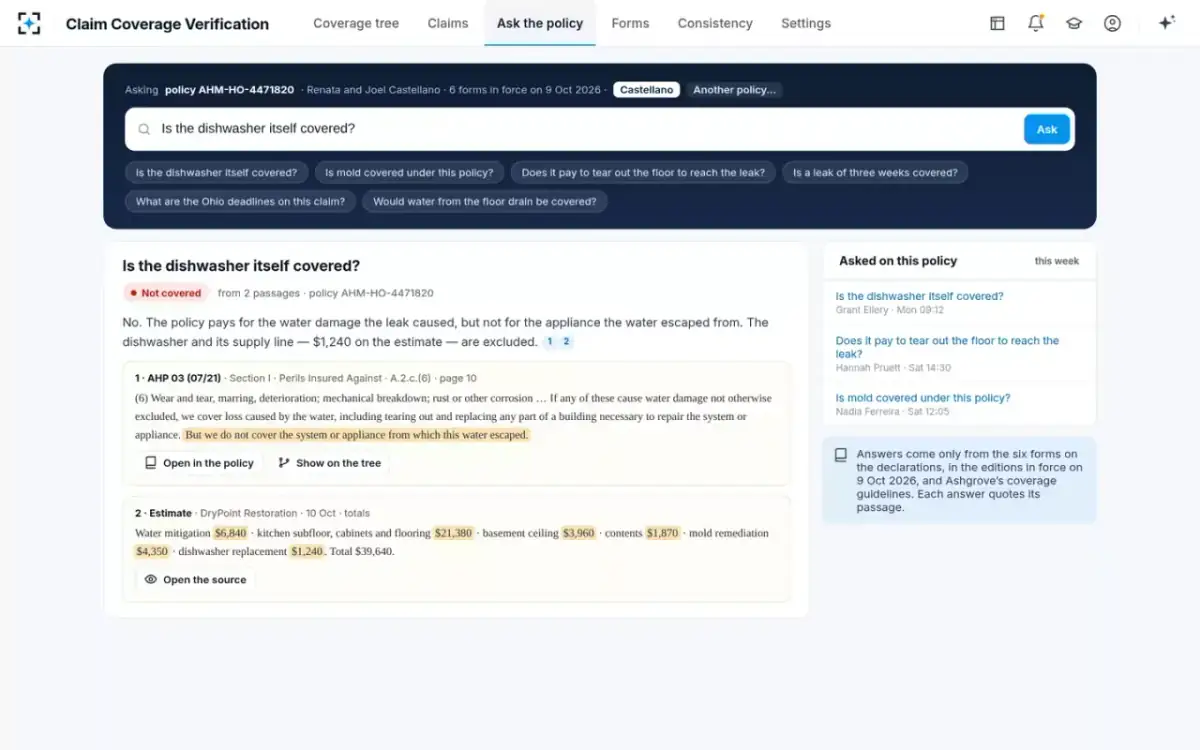
For a policyholder, a chat summary is a starting point for questions to the insurer, not an answer to a claim: the insurer's coverage letter must name the provision it relies on, and that is the text to check. For a carrier, the useful distinction is between an assistant that answers and a system that cites: one where every statement opens to its passage, in the edition on the declarations. In the sample, an answer to "Is the dishwasher itself covered?" comes from two passages, each with an Open in the policy link, and states that answers come only from the six forms on the declarations and the carrier's coverage guidelines.
An answer that cites its passages
What to ask before buying AI insurance policy review
Buy the test before the tool. Any vendor, including us, should be willing to run on a sample of your policies, forms and signed positions, and to show results by pattern with every disagreement open to inspection. The questions below separate systems that can be checked from systems that must be trusted.
Ten questions for any AI insurance policy review tool
- Will you run on our closed files, by fact pattern, before we sign?
And show agreement per pattern, not one number.
- How do you pick the edition in force on the date of loss?
From our declarations and forms library, with the rule written down.
- Does every step quote its form, edition, section and page?
If not, a reviewer cannot check it in one click.
- Does every fact have a source and a confidence?
The call minute, the report page, the photo.
- What happens when a fact is missing?
It should become a question, never an assumption.
- Can it deny coverage?
The answer you want is no: a person decides any “not covered”.
- How are disagreements with our files adjudicated?
With a third reader, and with the file allowed to be wrong.
- What happens when we change a form?
A replay on past claims, approved by counsel, before use.
- Can our team change who signs what, and is the change logged?
Approvals and state clocks should be our settings.
- What does it not do?
An honest answer names its limits.
Here is ours. Claim Coverage Verification drafts coverage positions and letters on first-party claims from your own forms, editions and guidelines, and tests itself against your signed positions. It does not estimate damage, which is a separate job; it does not replace coverage counsel's judgement on contested wording; and it does not decide. How it compares with the other ways carriers reach a position today is set out in insurance policy analysis on a claim, and the rules on AI-assisted denials in insurance companies using AI to deny claims.
Questions people ask
Is AI insurance policy review legit?
It can be, when every answer cites the exact passage and edition it rests on and the system has been tested on the user's own policies. Research on legal AI tools found that even source-grounded systems produced hallucinations in 17 to 33 percent of answers, so an uncited answer should not be relied on for a claim decision.
Is there an AI insurance policy comparison tool?
Tools exist that summarise or compare policies, mostly for buyers choosing cover. A 2011 law review study found homeowners policies from 24 insurance groups differed radically on key provisions, so comparing the actual wording is worthwhile. For a claim, though, the question is narrower: what the one policy in force on the date of loss says about these facts.
How do you test AI coverage analysis?
Replay it on closed claims with signed positions, grouped by form edition and fact pattern, with the signed answer hidden from the system. Score each step, fact source and amount, have a third reader adjudicate every disagreement, and report agreement by pattern. The NAIC AI bulletin names measuring performance against expert review as one form of validation.
Do LLMs hallucinate when reading contracts?
They can. A preregistered study of commercial legal research tools found hallucination rates of 17 to 33 percent despite retrieval from real sources, and a 2026 Harvard Journal of Law and Technology article found claims of reliable LLM contract interpretation "brittle and frequently arbitrary". Citing the passage behind each statement lets a reader catch errors.
What is generative interpretation?
It is a method, proposed by law professors Yonathan Arbel and David Hoffman in a 2024 New York University Law Review article, of using large language models to estimate the meaning of contract terms. Its critics argue it is not yet reliable enough for judges. For claims work, the debate is a reason to keep interpretation with people and use AI to retrieve and quote.