What is an ensuing loss provision? It is a sentence attached to an exclusion that gives coverage back for a loss that follows from the excluded cause, so long as that later loss is caused by a peril the policy does not otherwise exclude. A typical one reads: the exclusion "does not apply to ensuing loss or damage caused by or resulting from a peril not otherwise excluded." The classic illustration comes from a federal appeals court: if a leak caused by faulty construction "had shorted an electrical socket and started a fire, any fire damage would be covered". The exclusion takes away the defect; the exception gives back the fire. Ensuing loss provisions, and exceptions like them, are where many coverage disputes are actually decided, because the exclusion is rarely in doubt while the sentence after it often is. Botminds' Claim Coverage Verification treats every exclusion and its exceptions as separate steps on a coverage tree, each quoting its wording, so a claims team can see which single fact moves the answer.
The worked example uses sample data on a fictional carrier, Ashgrove Mutual, and a fictional homeowners water claim. The cases and research are real.
What the exclusions took and the exception gave back on one kitchen leak
Claimed $39,640
- Given back by the hidden water endorsement, $15,000 · 37.8%
- Excluded beyond the endorsement limit, $19,050 · 48.1%
- Mold under its own limit, $4,350 · 11%
- The appliance itself, excluded, $1,240 · 3.1%
What is an ensuing loss provision?
An ensuing loss provision is an exception to an exclusion that preserves coverage for later damage caused by a covered peril. It answers a problem built into exclusions for causes such as faulty workmanship, wear, rot or settling: those causes rarely do harm on their own; they let something else in, usually water, and the something else does the damage. Without an exception, the exclusion would reach everything downstream. With one, the policy separates the excluded cause from what follows.
The Sixth Circuit's 2010 decision in TMW Enterprises v. Federal Insurance quotes a standard example from a commercial all-risk policy. After excluding loss "caused by or resulting from any faulty, inadequate or defective" design, workmanship or construction, the policy says: "This Planning, Design, Materials Or Maintenance exclusion does not apply to ensuing loss or damage caused by or resulting from a peril not otherwise excluded." Homeowners forms carry the same idea, often in different words. A 2011 University of Chicago Law Review study of homeowners policies notes that the industry's standard HO3 form provides that, for certain excluded perils, "any ensuing loss that involves a covered peril is covered".
What does ensuing loss mean? An example from the courts
Ensuing loss means loss that follows from an excluded cause through a separate, covered peril. The word does the work: one dictionary meaning the TMW court relied on is something that "follow[s] in chronological succession". In that case, water had entered a newly built condominium and retail building through badly constructed walls and corroded its steel frame. The owner argued that the water was a covered peril and its damage an ensuing loss.
The court disagreed, and its reasoning is the clearest explanation of what the clause does and does not do. The clause, it held, covers "independent, non-foreseeable losses caused by faulty construction": "If, say, the water leak in this case had shorted an electrical socket and started a fire, any fire damage would be covered in light of the 'ensuing loss' clause." But where damage comes naturally and continuously from the excluded cause, "the exclusion applies and the ensuing loss provision does not." Defective walls let water in as a matter of course, so the water damage fell under the exclusion. The court sent the case back so the owner could seek coverage for any losses not proximately caused by the faulty work.
“Instead of carving out an exception to this exclusion, this theory of interpretation would create a virtual, if not complete, exclusion of the exclusion.”
Judge Sutton for the majority, TMW Enterprises v. Federal Insurance Co. (6th Cir. 2010)
Ensuing loss clause vs exception to an exclusion
Every ensuing loss clause is an exception, but not every exception is an ensuing loss clause. Some exceptions restore coverage for a named result, such as fire, explosion or water damage; some restore it for a named situation, such as damage hidden inside a wall; and some, the ensuing loss clause proper, restore it for any later loss caused by a peril "not otherwise excluded". The differences matter because each kind turns on a different fact.
The sample policy's wear-and-corrosion paragraph shows all the moving parts in three sentences. It excludes wear and corrosion; it gives back water damage they cause, including tearing out the building to reach the repair, "not otherwise excluded"; and it keeps the failed system or appliance excluded. Read as three steps, the paragraph is easy to apply. Read as one block, it is easy to stop after the first sentence.
One exclusion paragraph, split into what it takes and what it gives back
Takes away
“(6) Wear and tear, marring, deterioration; mechanical breakdown; rust or other corrosion …”
The exclusion: the failed fitting and the wear that caused it.
Gives back
“If any of these cause water damage not otherwise excluded, we cover loss caused by the water, including tearing out and replacing any part of a building necessary to repair the system or appliance.”
The exception: water damage that follows, unless another exclusion takes it.
Takes back
“But we do not cover the system or appliance from which this water escaped.”
The limit on the exception: never the thing that failed.
When the ensuing loss is the excluded risk itself
The hardest ensuing loss cases are the ones where the "later" peril is exactly what the excluded cause was always going to produce. A defective roof lets water in; corrosion lets a fitting leak; rot lets a beam fall. The TMW majority's concern was that treating the water, air or gravity as a separate covered peril would make the exclusion meaningless, and it gave its own examples: the leaking roof that ruins a floor, the humid air that rusts fixtures, the badly built beam that falls. "The very risk raised by the flawed construction of a building came to pass."
The question is close enough that the panel split: one of the three judges dissented, finding the exclusion ambiguous and reading it in the owner's favour, as contract law construes ambiguous terms against the drafter. That is why coverage counsel treats ensuing loss as a question of the exact clause and the state's law rather than of general principle. The adjuster's practical rule is narrower: identify the excluded cause, identify the later peril, and ask whether that peril was the natural result of the cause or an independent event. Write down the evidence for the answer.
What is efficient proximate cause?
Efficient proximate cause is the rule, followed by default in most jurisdictions, that when covered and excluded causes combine to produce a loss, coverage depends on which one was the dominant cause. The law review study summarises it: "In most jurisdictions, the default rule is the efficient proximate cause (“EPC”) rule, which states that a loss is covered if the “dominant” or “primary” cause of the loss was a covered peril." It is related to, but different from, ensuing loss: the same note in the study observes that the HO3's ensuing loss language is "technically more expansive than the EPC rule, as an ensuing loss may not always be the efficient proximate cause of a loss."
In practice the two meet constantly on water claims. A covered peril can start a chain that ends in an excluded one, as when a broken pipe saturates soil and the house settles; or an excluded cause can start a chain that ends in a covered one, as when wear lets water escape. The order of events, and the evidence for it, decides which rule helps whom.
California efficient proximate cause doctrine: Sabella and Garvey
California applies efficient proximate cause by statute and case law, and its leading cases are homeowners claims. In Sabella v. Wisler (1963), a negligently installed sewer line, a covered peril, ruptured and saturated the ground, and the house subsided, an excluded peril; the court found coverage. Its rule, as the California Supreme Court restated it in Garvey v. State Farm in 1989: "the efficient cause -- the one that sets others in motion -- is the cause to which the loss is to be attributed, though the other causes may follow it, and operate more immediately in producing the disaster."
Garvey sharpened two points. It used the term efficient proximate cause to mean the "predominating cause", rejecting "moving cause" because that phrase "can be misconstrued to deny coverage erroneously, particularly when it is understood literally to mean the 'triggering' cause." And it confined a broader concurrent-cause rule to liability insurance, holding that in first-party property cases the jury decides which cause predominated. Among the earlier decisions it cites is one directly on point for plumbing claims: coverage was afforded where "water leaking from plumbing system (covered peril) was the efficient proximate cause of subsidence damage (excluded peril)".
Two ways a policy can treat a loss with a covered and an excluded cause
Efficient proximate cause: Which cause was dominant, the one that set the others in motion?
Anti-concurrent causation wording: Did an excluded cause contribute at all?
Efficient proximate cause: Covered if the dominant cause is covered.
Anti-concurrent causation wording: Excluded if the excluded cause contributed, in any sequence.
Efficient proximate cause: The default rule in most jurisdictions; by statute in California and North Dakota.
Anti-concurrent causation wording: Policy language opting out of the default, where state law allows; in Michigan, a default rule per the Sixth Circuit.
Efficient proximate cause: The sequence of events and the predominant cause, with evidence.
Anti-concurrent causation wording: Whether the excluded cause played any part, with evidence.
Anti-concurrent causation: when the policy opts out
Many policies contract out of efficient proximate cause for some exclusions, and the wording to look for sits before the list of exclusions, not in it. The study found that "Most states, however, permit insurers to opt out of this rule through specific language in their policies", while California and North Dakota "require by statute that insurers provide coverage broadly consistent with the EPC approach." In the standard HO3, it notes, the prefatory language to one group of exclusions "opts out of the EPC rule, specifying that there is no coverage if an exclusion contributes in any way to a loss."
Some courts apply a similar result even without the wording. A federal court in Michigan, deciding a 2024 roof collapse claim, described Michigan's default as the rule that "a loss is not covered when it is concurrently caused by the combination of a covered cause and an excluded cause", while noting that parties can contract out of it for a given exclusion. For an adjuster, the lesson is that the same facts can produce different answers in neighbouring states, and the policy's prefatory language is part of the clause.
Exceptions on one kitchen leak: three sentences after three exclusions
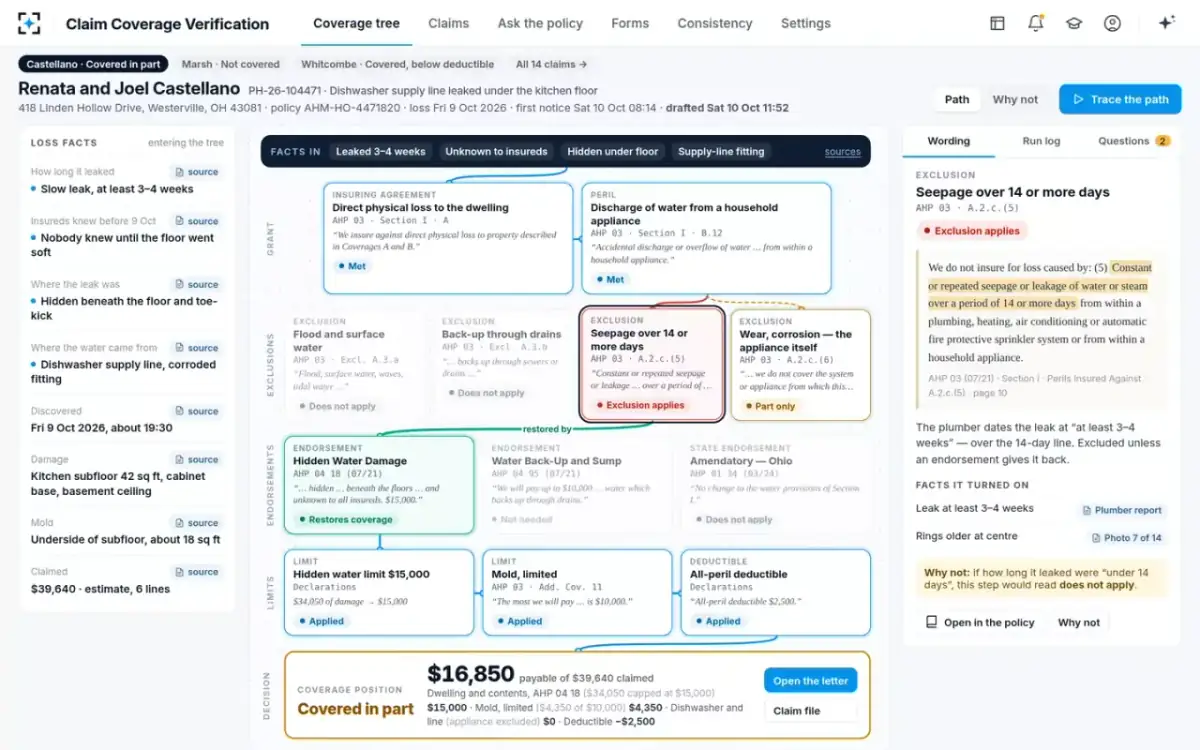
The sample claim shows how exceptions stack. A dishwasher supply line's brass fitting corroded and leaked slowly beneath the kitchen floor for what the plumber dated as "at least 3–4 weeks". Three exclusions are in play, and each has a sentence after it that matters.
First, wear and corrosion: the fitting is excluded, the water damage it caused is given back "not otherwise excluded", and the dishwasher is kept out. Second, the seepage exclusion: water that leaks repeatedly "over a period of 14 or more days" is excluded, and because it is another exclusion, it is what makes the water damage "otherwise excluded" under the first exception. Third, the Hidden Water Damage endorsement: it gives back seepage loss that was hidden inside the structure and unknown to all insureds, up to $15,000 including tear-out. The path on the coverage tree runs red at the seepage exclusion and green again at the endorsement. Mold sits outside the chain, under the policy's own limited fungi coverage. How that endorsement's editions changed the amount is covered in what insurance policy endorsements are.
The wording behind one step, with the facts it turned on
Mapping every exclusion to its exceptions before the call back
Because the dispute is usually about the exception, the reading should be organised around exceptions. For each exclusion that could apply, list the exceptions in its own paragraph, the endorsements that give coverage back, and the prefatory causation language; then name the fact each one turns on. On the sample claim that produces three facts that matter: how long it leaked, whether anyone knew, and where the water came from.
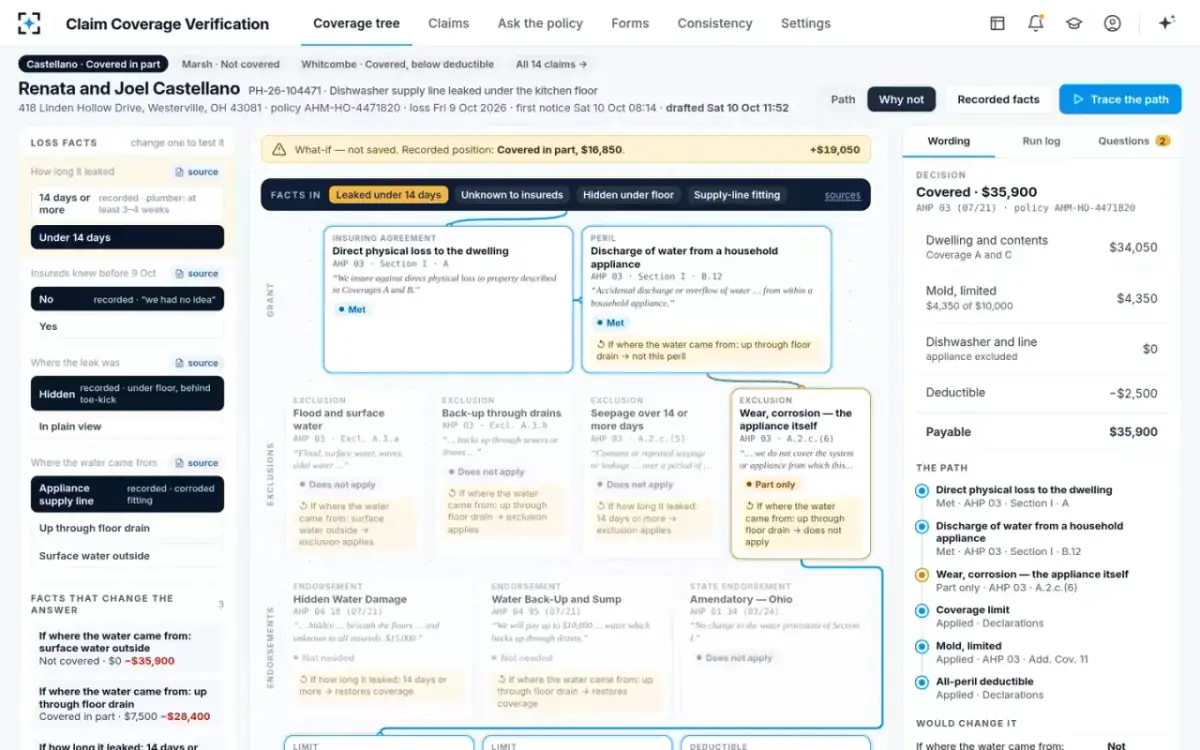
Claim Coverage Verification draws exactly that map. The Coverage mapper turns the forms into a tree with exclusions and their exceptions as separate steps, each carrying its form, edition, section and page. The Why-not analyst finds, for every step on and off the path, the single fact that would change its outcome and the dollar effect. On the sample claim, a leak under 14 days turns the seepage exclusion off and the loss becomes a covered discharge, $35,900 instead of $16,850; water up through the floor drain would pay $7,500 under the back-up endorsement instead. What-ifs are never saved as facts.
Why not: the fact that flips each exception
Reading an exclusion and its exceptions
- Read the prefatory language before the list
It tells you whether a contributing excluded cause defeats coverage regardless of sequence.
- Split each exclusion paragraph into take, give back, take back
Exception sentences often follow in the same paragraph.
- Find the endorsements that restore what the base form excludes
In the edition in force on the date of loss.
- Ask whether the later peril was independent or inevitable
The TMW test: a fire from a shorted socket, or water through a defective wall.
- Establish the sequence with evidence
Which cause came first, which predominated; reports, photos, dates.
- Check the state’s causation rule
Efficient proximate cause by default in most places; statutory in California and North Dakota.
- Name the fact that would flip each step
And ask about it before the decision, not after the complaint.
Where a step is genuinely contested, it belongs with a lawyer; when to bring one in is covered in what coverage counsel means. The full order of reading on a leak claim, from insuring agreement to deductible, is set out in does homeowners insurance cover leaking pipes.
Questions people ask
What is an example of an ensuing loss?
The Sixth Circuit's: water from a construction defect shorts an electrical socket and starts a fire; the fire damage is an ensuing loss and covered even though the defect is excluded. By contrast, the water damage that faulty walls naturally let in was held to fall within the faulty workmanship exclusion.
Does an ensuing loss clause cover the original defect?
No. The clause gives back later damage caused by a covered peril; the excluded defect itself, and the cost of correcting it, stay excluded. Homeowners forms often say so directly, as the sample policy does: "we do not cover the system or appliance from which this water escaped."
What is the efficient proximate cause rule?
It is the default rule in most jurisdictions that a loss with both covered and excluded causes is covered if the dominant or predominating cause is covered. California applies it by statute and through Sabella v. Wisler and Garvey v. State Farm; many policies opt out for some exclusions where state law allows.
Is efficient proximate cause the same as ensuing loss?
No. Efficient proximate cause is a rule for attributing a loss with several causes; an ensuing loss provision is policy wording that restores coverage for later damage by a covered peril. A law review study notes the ensuing loss language in the standard homeowners form is technically broader, because an ensuing loss is not always the efficient proximate cause.
Who decides whether a loss is an ensuing loss?
The insurer's adjuster applies the clause first, often with coverage counsel; if disputed, a court decides, and in California the jury decides which cause predominated where the evidence supports either answer. The TMW panel split two to one on its facts, a sign of how close these questions can be.