Does homeowners insurance cover leaking pipes? Usually it covers the water damage a sudden leak causes, often excludes or caps damage from a slow leak that ran for weeks, and rarely pays to replace the pipe or appliance that failed. Which of those applies to one leak depends on the wording of one policy, read in order: the insuring agreement, the water peril, a seepage exclusion that in many forms turns on 14 days, the exceptions and endorsements that give some cover back, then the limits and the deductible. Reading that chain against the facts is claim coverage verification, the step an adjuster finishes before telling a customer what will be paid. It is slow because the answer turns on one or two facts nobody has written down yet, usually how long the leak ran and who knew. Botminds' Claim Coverage Verification does the reading: it assembles the forms in force on the date of loss, draws the tree, quotes each clause and leaves the decision to the adjuster.
The example on this page is sample data on fictional people and a fictional carrier: Renata and Joel Castellano's kitchen in Westerville, Ohio, insured by Ashgrove Mutual under a homeowners special form numbered AHP 03. The research figures come from regulators, a federal agency and a law review, linked where they appear.
Water claims are common, costly and time-sensitive
5.8%
average yearly homeowners claim frequency, 2018–2022
all perils, more than 330 insurers
$18,206
average homeowners claim severity over the same years
24–48hours
to dry water-damaged areas and items before mold growth
The short answer: sudden damage usually yes, gradual usually no, the pipe rarely
The Texas Department of Insurance puts the general rule in two sentences: "Most homeowner and renters policies cover sudden and accidental water damage", and "Policies usually won’t cover damage from gradual leaks." Its examples of the first are a burst pipe, a toilet overflow and a broken washer hose. That is the rule of thumb a customer hears from an agent, and it is right more often than not.
It is not the answer to a claim. Policies differ from carrier to carrier, and the boundary between sudden and gradual is drawn in different words by different forms. Some forms draw it at a number of days. Some give part of a gradual loss back through an exception or an endorsement. Nearly all separate the water damage from the thing that leaked. So the honest answer for any one leak is: read the policy in force on the day it was discovered, in this order.
One leak, six clauses: the coverage tree drawn from the sample policy
Grant
Insuring agreement
Direct physical loss to the dwelling
“We insure against direct physical loss to property described in Coverages A and B.”
AHP 03 · Section I · A
Met
Peril
Discharge of water from a household appliance
“Accidental discharge or overflow of water … from within a household appliance.”
AHP 03 · B.12
Met
Exclusions
Exclusion
Seepage over 14 or more days
“Constant or repeated seepage or leakage of water or steam over a period of 14 or more days …”
AHP 03 · A.2.c.(5)
Applies: leak ran 3–4 weeks
Exclusion
Wear and corrosion of the appliance
“But we do not cover the system or appliance from which this water escaped.”
AHP 03 · A.2.c.(6)
Part only: the dishwasher
Exclusions
Flood and surface water · back-up through drains
Water from outside or up through a drain.
AHP 03 · A.3.a, A.3.b
Do not apply
Gives back
Endorsement
Hidden Water Damage
“… hidden within the walls or ceilings, or beneath the floors … unknown to all “insureds”.”
AHP 04 18 (07/21)
Restores cover to $15,000
Pays
Limits
Hidden water $15,000 · mold $10,000
$34,050 of damage capped at $15,000; mold $4,350.
Declarations · Add. Cov. 11
Applied
Deductible
All-peril deductible
“All-peril deductible $2,500.”
Declarations
Applied
Coverage position
Covered in part · $16,850 payable of $39,640 claimed
$15,000 hidden water + $4,350 mold + $0 dishwasher − $2,500 deductible
Is water damage from a leaking pipe covered? Start with the insuring agreement and the peril
Yes, at the first step, for almost any leak inside the house: the dwelling part of a typical homeowners special form is written on an open-perils basis, so physical damage to the house is covered unless something later in the policy takes it away. The sample form says so in one sentence: "We insure against direct physical loss to property described in Coverages A and B." Water that soaked the subfloor is direct physical loss. The first box is met.
Contents are usually different. The industry's standard special form, the HO3, provides "“all-risk” coverage for one’s home and other structures" but "“named peril” coverage for personal property", as a University of Chicago Law Review study describes it. For a leak, the listed peril that matters is the accidental discharge or overflow of water from a plumbing system or household appliance. In the sample policy it reads "Accidental discharge or overflow of water … from within a household appliance", and the Castellanos' dishwasher supply line is a household appliance. The second box is met too.
Nothing has been paid yet. Every clause after this one can take some or all of it back, which is why an adjuster who stops at "pipes are covered" will be wrong on exactly the claims that cost the most.
What is sudden and accidental water damage, and what is water damage over time called?
Sudden and accidental water damage is a discharge that happens at once and that nobody intended: a pipe bursts, a hose splits, a toilet overflows. Water damage over time is called seepage or leakage in the policy language, gradual water damage in plainer words. The distinction matters because many policies treat the two in opposite ways.
How differently surprised even specialists. When Daniel Schwarcz compared homeowners policies from twenty-four insurance groups across six states for the University of Chicago Law Review, the industry's standard HO3 form covered gradual water damage so long as it came from an "accidental discharge". Most carriers had gone further: they "absolutely exclude coverage for any seepage or leakage of water". He also found one group that rewrote water cover on the dwelling from all-risk to named perils. The study is from 2011 and forms have moved since, but its finding is the one an adjuster needs: the carrier's own wording, not the industry template, decides.
Sudden and gradual water damage, as most policies separate them
Sudden and accidental: A pipe bursts, a supply hose splits, a toilet overflows.
Gradual: seepage or leakage: A fitting weeps for weeks behind a cabinet or under a floor.
Sudden and accidental: Covered as accidental discharge, subject to limits and deductible.
Gradual: seepage or leakage: Excluded, or covered only when hidden and unknown, often to a lower limit.
Sudden and accidental: Where the water came from: inside the plumbing, or from outside or a drain.
Gradual: seepage or leakage: How long it ran, and whether anyone knew or could see it.
Sudden and accidental: The failed part, the discovery date, the trade report.
Gradual: seepage or leakage: A plumber’s dating of the leak, photos of staining and rot, the insured’s account of when it was first noticed.
Sudden and accidental: Usually not covered: wear and breakdown are excluded.
Gradual: seepage or leakage: Not covered: the same exclusion applies.
The 14-day line: how a seepage exclusion is drawn and read
Many current forms do not say "gradual"; they count. The sample policy's exclusion reads: "Constant or repeated seepage or leakage of water or steam over a period of 14 or more days from within a plumbing, heating, air conditioning or automatic fire protective sprinkler system or from within a household appliance." A number makes the clause look mechanical. It is not, for two reasons.
First, nobody watches a hidden leak start. Duration is an estimate, usually a plumber's or a restorer's, built from the staining, the rot and the corrosion on the fitting. In the sample claim the plumber's report dates the leak at "at least 3–4 weeks", and photo 7 of 14 shows rings older at the centre. That is good evidence, but it is still an estimate, and a coverage position that rests on it should say so.
Second, when a 14-day exclusion is disputed, duration is decided on evidence, and the better-explained evidence tends to win. In a 2024 decision on a collapsed commercial roof, a federal court in Michigan took such an exclusion "in two parts: the water seepage itself and the duration of that seepage". The insurer's engineer said the decay in the photographs "would take months or years of exposure to moisture"; the owner's expert said it was possible the damage happened in fewer than fourteen days, and the court noted he did not explain how. It found no genuine dispute that an excluded cause, prolonged seepage among them, contributed to the loss. The case is commercial and turns on Michigan law, but the lesson travels: the side with dated, explained evidence on duration usually carries the 14-day question.
For the adjuster, the lesson is to write down the duration evidence as evidence: the source, its wording and how confident it is. A position that says "excluded, leak exceeded 14 days" without the plumber's words behind it will not survive the first phone call.
Hidden water damage coverage: the endorsement that gives part of it back
Limited hidden water damage coverage is an endorsement that pays for some seepage the main form excludes, on two conditions: the water was hidden inside the structure, and nobody in the household knew. The sample endorsement, AHP 04 18 in its July 2021 edition, covers loss "caused by constant or repeated seepage or leakage of water … over a period of 14 or more days" when it is "hidden within the walls or ceilings, or beneath the floors or above the ceilings of a structure" and "unknown to all “insureds”". It pays at most $15,000 a policy period, including the cost of tearing out and replacing part of the building to reach the leak.
Both conditions are facts, and both need a source. The Castellanos' leak sat beneath the floor and behind the dishwasher's toe-kick; on the first-notice call they said "we had no idea" until the floor went soft on 9 October. That turns the tree back from red to green, but only to the endorsement's limit. The previous edition of the same endorsement paid $10,000 and nothing for tear-out, so the edition in force on the date of loss is worth $5,000 on this claim alone. Why the edition decides, and how to tell which one applies, is the subject of what insurance policy endorsements are.
Claim Coverage Verification: the tree for the Castellano leak
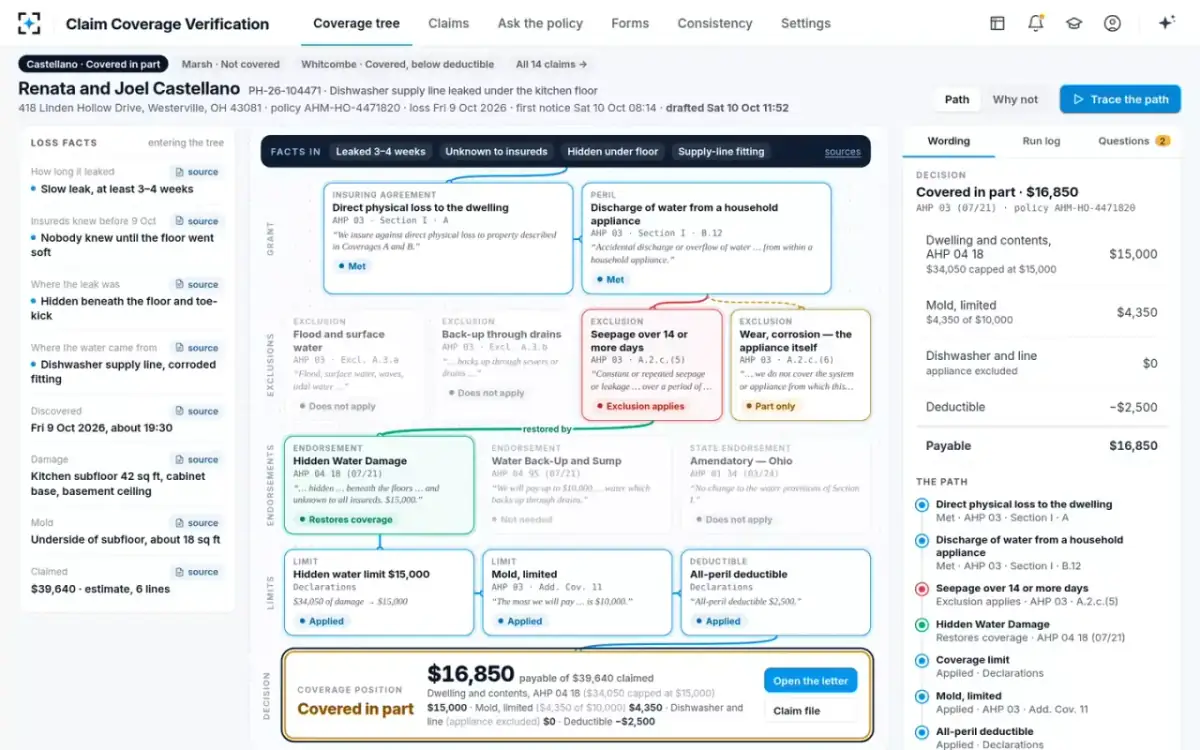
Does homeowners insurance cover the pipe or appliance that leaked?
Usually not. The sample form, like many homeowners forms, excludes wear and tear, deterioration, mechanical breakdown, rust and other corrosion, and then says what happens to the water that escapes because of them: "If any of these cause water damage not otherwise excluded, we cover loss caused by the water, including tearing out and replacing any part of a building necessary to repair the system or appliance. But we do not cover the system or appliance from which this water escaped."
That one paragraph does three things. It excludes the corroded fitting. It gives back the water damage the corrosion caused, unless another exclusion takes it, which is an exception of the kind explained in what an ensuing loss provision is. And it pays to open the floor or wall to reach the leak. On the sample claim, the dishwasher and its supply line are $1,240 of the $39,640 estimate, and they are the $0 line on the letter.
The same logic answers the common question about pipe repair. A homeowner whose burst pipe flooded a bathroom will usually be paid for the drying, the drywall and the flooring, and for cutting into the wall to fix the pipe, but not for the length of pipe or the plumber's time to replace it. Policies vary on the details, which is why the exact clause belongs in the letter.
Limits, mold and the deductible: from covered to payable
A loss can be covered and still pay much less than it cost. Three clauses do most of the shrinking on a water claim: a limit on the endorsement that restored cover, a separate limit on mold, and the deductible.
On the sample claim the arithmetic is short. Water mitigation, the kitchen subfloor, cabinets and flooring, the basement ceiling below and the contents came to $34,050, capped at the endorsement's $15,000. Mold remediation of $4,350 falls under the policy's own limited fungi coverage, which pays up to $10,000. The dishwasher is excluded. The all-peril deductible of $2,500 comes off the total. Payable: $16,850 of $39,640 claimed.
Mold has its own clock. The Environmental Protection Agency advises that it is important "to dry water-damaged areas and items within 24-48 hours to prevent mold growth". A leak hidden for weeks has already missed that window, which is why hidden leaks so often arrive with a mold line, and why the policy's mold limit is part of the coverage answer rather than an afterthought.
Which facts move the answer, and who should ask them?
On a leak claim, three facts move the answer more than anything else: how long the water ran, whether anyone knew or could see it, and where it came from. Each one sits at a branch of the tree, so changing it re-routes the claim. The adjuster's job before the first call back is to know which of them are firm and which rest on a single estimate.
The solution's Why-not view makes that concrete by turning each fact into a switch. Set the leak to under 14 days and the seepage exclusion drops away: the sample loss becomes a covered discharge, payable $35,900, which is $19,050 more. If an insured knew before 9 October, or the leak was in plain view, the hidden-water endorsement fails and nothing is payable. Water coming up through the floor drain instead would pay $7,500 under the sample policy's back-up endorsement. Those what-ifs are never saved as facts; the signed position stays on the facts as gathered.
Why not: one fact changed, the tree re-run
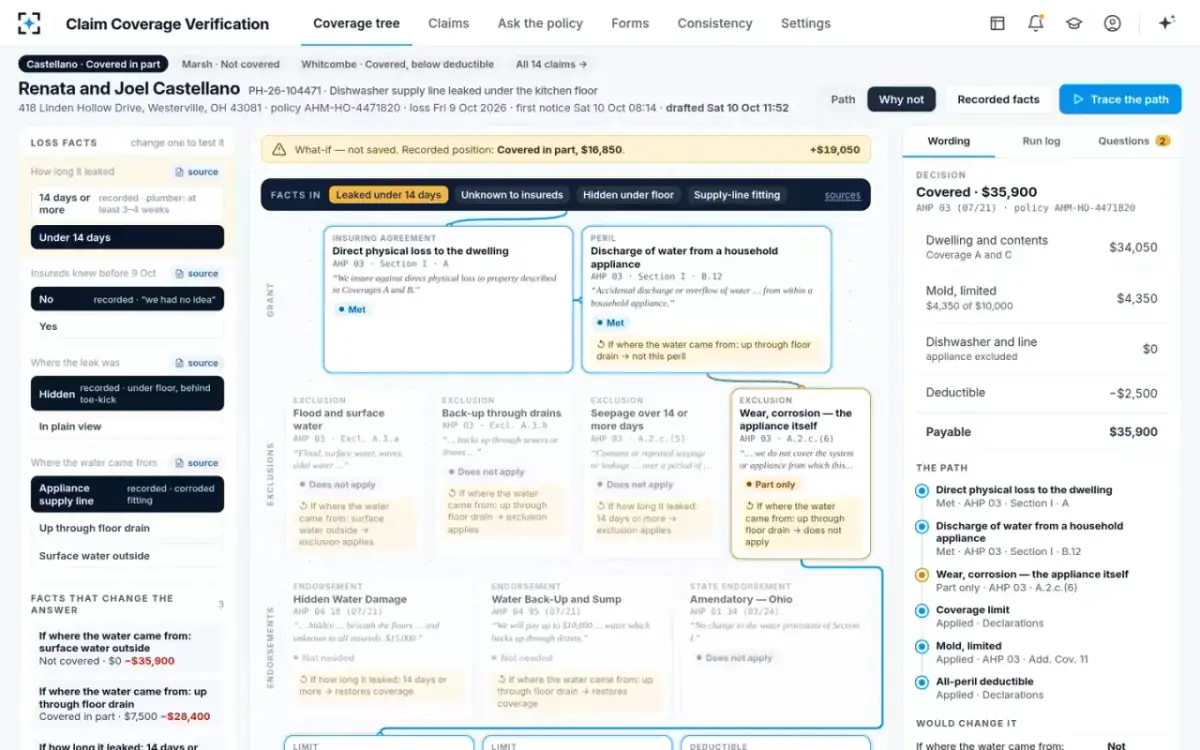
“I can’t call the Castellanos back until I know whether the 14-day clause bites — and if it does, I have to explain it.”
Nadia Ferreira, the sample claim's desk adjuster
That is also why the answer has to be written in the clause's own words. The NAIC's model claims regulation, which many states follow, says no insurer shall deny a claim on the grounds of a specific provision "unless reference to such provision, condition, or exclusion is included in the denial", and Ohio's rule, where the sample claim sits, says the same in Ohio Adm. Code 3901-1-54(G)(2). A partial payment limited by the seepage exclusion is a partial denial, and the letter must name it. What else such a letter owes is covered in the coverage denial letter guide.
Before the first call back on a leak claim
- Pull the declarations in force on the date the leak was discovered
And every endorsement listed on them, in the edition they name. A hidden-water endorsement changes the answer more than any other form.
- Find the source of the water
Supply line, drain, appliance, roof or ground water lead to different perils and exclusions.
- Get the duration evidence in writing
The plumber’s or restorer’s words, the photos they rest on, and how sure they are.
- Ask when the insured first noticed
In plain words, and write the answer down with its date. It decides the hidden-and-unknown test.
- Separate the failed part from the damage
The pipe or appliance is usually excluded; the water damage and the tear-out to reach it often are not.
- Check the mold line against its own limit
And note when drying started, since mold grows within days.
- Quote the clause behind every reduction
If a clause limits the payment, the letter names it.
How Claim Coverage Verification reads one kitchen leak
The sample claim shows the order of work. The first notice came by phone at 08:14 on Saturday 10 October, an 11-minute call. The Policy assembler pulled the declarations from the March renewal and six forms in the editions in force on 9 October, including AHP 04 18 in the July 2021 edition rather than January 2018. The Fact reader took the duration from the Kessler Brothers plumber report, the hidden location from 14 DryPoint Restoration photos, and "we had no idea" from the call. The Coverage mapper built the tree from the forms; the Coverage analyst walked the facts through it. A drafted position was waiting at 11:52.
Everything that matters for a leak claim sits on that one screen: each clause quoted with its form, edition, section and page; each fact with its source; the amounts; and the two questions that could still change the answer. The agents never deny. A "not covered" goes to a person, the adjuster signs every position, and on this claim the supervisor co-signed because the payment was $22,790 less than claimed, over the sample carrier's $10,000 line.
For homeowners, the same order explains the letter they receive. For adjusters, it is a discipline worth keeping with or without software: grant, peril, exclusion, exception, endorsement, limit, deductible, and the evidence for every fact the path turns on.
Questions people ask
Does homeowners insurance cover burst pipes?
Usually, for the water damage: a burst pipe is the classic sudden and accidental discharge, and the Texas Department of Insurance lists it as an example of covered damage. The pipe itself is usually not covered, and limits and the deductible still apply. A pipe that froze in an empty house can fall under a separate freezing or vacancy clause: in the sample carrier's files, a freeze in a home vacant more than 60 days is its own fact pattern, and 11 of its 12 signed positions were not covered.
Does homeowners insurance cover pipe repair?
Typically not the pipe, but often the work to reach it. Forms that exclude wear, corrosion and breakdown commonly pay to tear out and replace the part of the building needed to repair the system, while excluding the system or appliance the water escaped from. On the sample claim, the dishwasher and its line were $1,240 of the estimate and paid nothing.
Does homeowners insurance cover slow leaks?
Often not, unless an exception or endorsement gives cover back. Many forms exclude constant or repeated seepage over a stated period, 14 days in the sample policy, and some carriers exclude seepage of any duration. A hidden water damage endorsement can restore part of it when the leak was concealed and unknown, usually to a lower limit.
Does homeowners insurance cover water damage from a dishwasher?
The water damage from a sudden dishwasher leak is usually covered as accidental discharge from a household appliance; the dishwasher itself usually is not. If the supply line wept for weeks under the floor, a seepage exclusion may apply, and the answer then depends on any hidden-water cover in the policy. That is the exact situation of the sample claim on this page.
Is mold from a water leak covered?
Sometimes, to a limit. The 2011 law review study found a roughly even split between carriers that excluded mold damage outright and those that capped it, with caps from $2,500 to $50,000; the sample policy pays up to $10,000. The Texas Department of Insurance notes that most home policies do not cover damage from gradual leaks or seepage, "and that includes damage from mold."
Who decides whether a leak is covered?
The insurer's adjuster, applying the policy to the facts, with a supervisor or coverage counsel on the larger or disputed claims. In Claim Coverage Verification the agents draft the position and the adjuster decides and signs. A policyholder who disagrees can ask which clause limited the payment, since the denial or reduction must reference it.