Insurance claims adjuster software usually means a claims management system for the file and the workflow, estimating software for the damage, and the policy system for the declarations. Coverage, the decision whether the policy in force on the date of loss pays for this loss and how much, is mostly left to the adjuster reading the forms. Putting coverage into software is hard for one reason: not answering, which a language model will do fluently, but mapping, turning an insuring agreement, perils, exclusions, exceptions, endorsements, limits and a deductible into a structure a person can check. Botminds' Claim Coverage Verification does it with seven specialist agents; this guide opens the one at the centre, the Coverage mapper, which builds a decision tree from the policy's own forms in which every step quotes its wording with form, edition, section and page.
The examples come from a fictional sample carrier, Ashgrove Mutual, and its sample water claim in Ohio. Research and rules are linked.
Anatomy of one node on the coverage tree
Kind
Exclusion
Grant, peril, exclusion, exception, endorsement, limit or deductible.
Wording
“Constant or repeated seepage or leakage of water or steam over a period of 14 or more days from within a plumbing, heating, air conditioning or automatic fire protective sprinkler system or from within a household appliance.”
Quoted, never paraphrased.
Where it lives
AHP 03 (07/21) · Section I · Perils Insured Against A.2.c.(5) · page 10
Form, edition, section and page, so a person can open it in one click.
Facts it reads
How long it leaked: “at least 3–4 weeks” (plumber report); rings older at centre (photo 7 of 14). Source of water: appliance supply line.
Each fact with its source and a confidence.
Outcome on these facts
Applies: 14-day line passed.
Met, applies, does not apply, part only, restores.
What would change it
Leak under 14 days → does not apply; payable rises by $19,050.
The single fact, and the dollar effect.
Connects to
Hidden Water Damage AHP 04 18 (07/21), which can restore coverage.
Exceptions and endorsements linked to the exclusion they answer.
What software do insurance adjusters use, and where does coverage fit?
Adjusters work across three kinds of system. A claims management system holds the file, the diary, reserves and payments. Estimating software prices the damage; the Bureau of Labor Statistics notes that "computer software can evaluate photographs of damaged property and calculate an estimated claim amount." The policy administration system holds the declarations and, somewhere, the forms. The coverage decision sits between them: it needs the policy from one system, the facts from documents and calls, and the damage from the estimate.
Regulators have begun to write rules for the software in that chain. Washington's claims rule, effective 18 October 2026, says a reasonable investigation "may not rely solely on the use of a database, which includes, but is not limited to, estimating software and benchmarks", and makes insurers responsible for "evaluations made on their behalf". The NAIC's AI bulletin asks insurers to govern AI systems in "claim administration and payment", whether built in-house or bought (what the bulletin requires). Software that touches coverage is inside that perimeter, which is why how it reaches an answer matters as much as the answer.
The scale of the reading the mapper replaces
389,700
U.S. jobs for claims adjusters, appraisers, examiners and investigators, 2025
1,284
form editions in the sample carrier’s forms library, each with its in-force dates
14
steps in one sample tree: 1 agreement, 1 peril, 9 exclusions, 3 endorsements
Why coverage is the gap in claims adjuster software
Because the inputs are not standard and the outputs are regulated. Policy wording varies by carrier: a University of Chicago Law Review study found homeowners policies from 24 insurance groups "differ radically with respect to numerous important coverage provisions". It varies by edition: the sample carrier's hidden water endorsement went from a $10,000 limit without tear-out to $15,000 with it. And the output must meet rules that estimating does not face: a denial on a provision must reference it, under the NAIC model regulation and the states that follow it, and the file must permit "reconstruction of the insurer’s activities relative to each claim."
A system that returns "covered: $16,850" meets none of that. One that returns the path, the quoted clause at each step, the facts with sources and the arithmetic, meets all of it and lets the adjuster check the work in minutes. The difference is the mapping.
How the coverage mapper turns forms into a tree
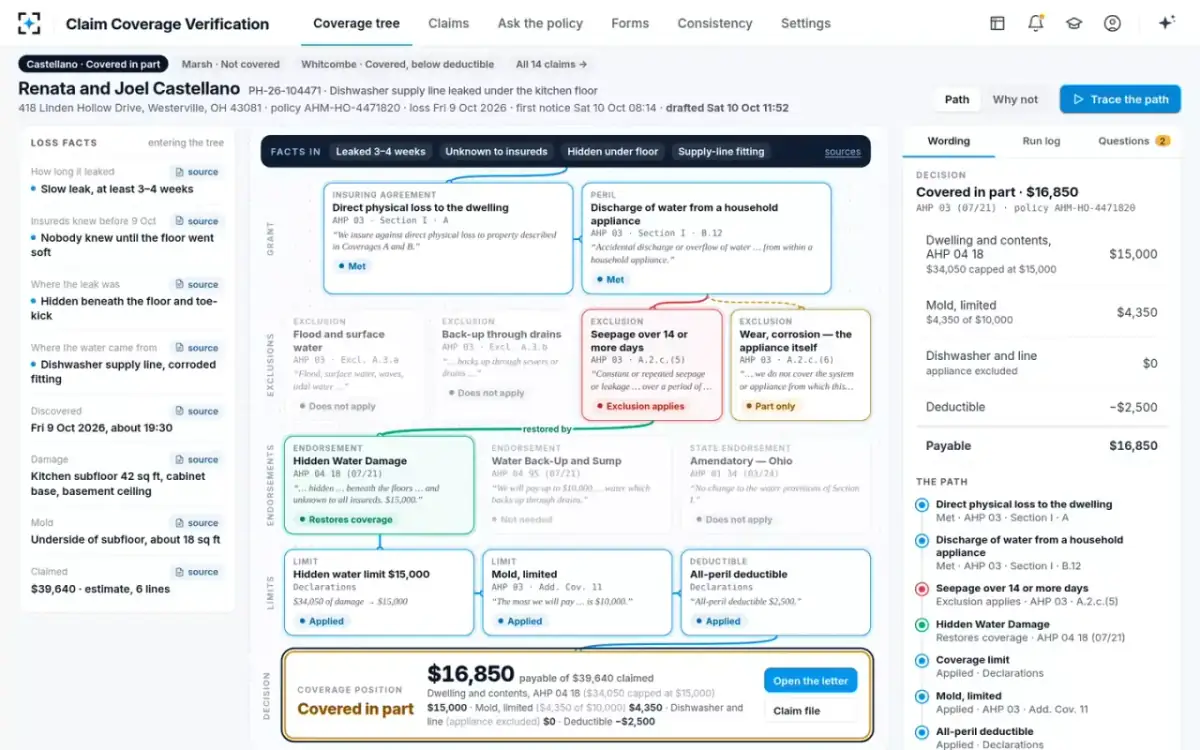
The mapper reads the forms the Policy assembler has fetched, the declarations and every form and endorsement in the edition in force on the date of loss, and lays them out in the order coverage is decided. It does not decide anything; it builds the structure the Coverage analyst will walk the facts through. Each node is one clause, and the edges show what depends on what: which endorsement answers which exclusion, which limit caps which coverage.
The node types a coverage tree needs, with the sample policy's examples
| Node | What it decides | Sample node | On the Castellano claim |
|---|---|---|---|
| Insuring agreement | Whether the property and loss type are within the grant | AHP 03 Section I A: direct physical loss to the dwelling | Met |
| Peril | For named-peril property, whether a listed peril caused it | AHP 03 B.12: discharge of water from a household appliance | Met |
| Exclusion | Whether a cause or condition takes coverage away | AHP 03 A.2.c.(5): seepage over 14 or more days | Applies |
| Exception | Whether part of the excluded loss is given back | AHP 03 A.2.c.(6): water damage given back, appliance kept out | Part only |
| Endorsement | Whether a form adds, restores or removes coverage | AHP 04 18 (07/21): Hidden Water Damage | Restores to $15,000 |
| Limit or sublimit | The most payable under each coverage | Hidden water $15,000; mold $10,000 | Applied |
| Deductible | What comes off the payable amount | All-peril deductible $2,500 | Applied |
Two design choices matter. First, exceptions are separate nodes from their exclusions, because the dispute is usually about the exception; why that is so is explained in what an ensuing loss provision is. Second, every node is built from the carrier's own form in its edition, not from a generic template, because the sample tree for the 01/18 edition of the hidden water endorsement would pay $5,000 less than the 07/21 tree on the same facts.
The tree, built from the sample policy's own forms
How do insurance adjusters calculate claims once coverage is known?
By applying each coverage's limit to the damage it covers, adding the coverages, and subtracting the deductible as the policy directs. The arithmetic is simple; the error is usually upstream, in which coverage a line of the estimate falls under. That is why the tree computes amounts per coverage, not per claim, and why the letter names the coverage for each amount, as the NAIC model act requires of payments.
From $39,640 claimed to $16,850 payable on the sample claim
Dwelling and contents
min($34,050, $15,000) = $15,000
Water mitigation, kitchen, basement ceiling and contents, capped at the hidden water endorsement’s limit.
AHP 04 18 (07/21)
Mold
min($4,350, $10,000) = $4,350
Remediation under the policy’s own limited fungi coverage.
AHP 03 Additional Coverage 11
Dishwasher and line
$1,240 → $0
The appliance the water escaped from is excluded.
AHP 03 A.2.c.(6)
Deductible
$2,500
All-peril deductible from the declarations.
Declarations
What the mapper must never do
Its limits are the product, and they are written as rules the agent cannot override. It never paraphrases a provision without its quote. Each step carries its form, edition, section and page. It never uses a form that is not on the declarations, or an edition not in force on the date of loss, because the Policy assembler only gives it those. It does not judge facts; the Fact reader supplies them with sources, and missing facts become open questions rather than assumptions. And it does not decide: the Coverage analyst computes, and any "not covered" goes to a person.
These limits exist because fluent answers fail quietly. A preregistered study of commercial legal research tools that retrieve real sources found they still "hallucinate between 17% and 33% of the time". A mapper that quotes rather than summarises turns an invisible error into a visible one: if the quoted words do not say what the node claims, a reader sees it in the wording panel.
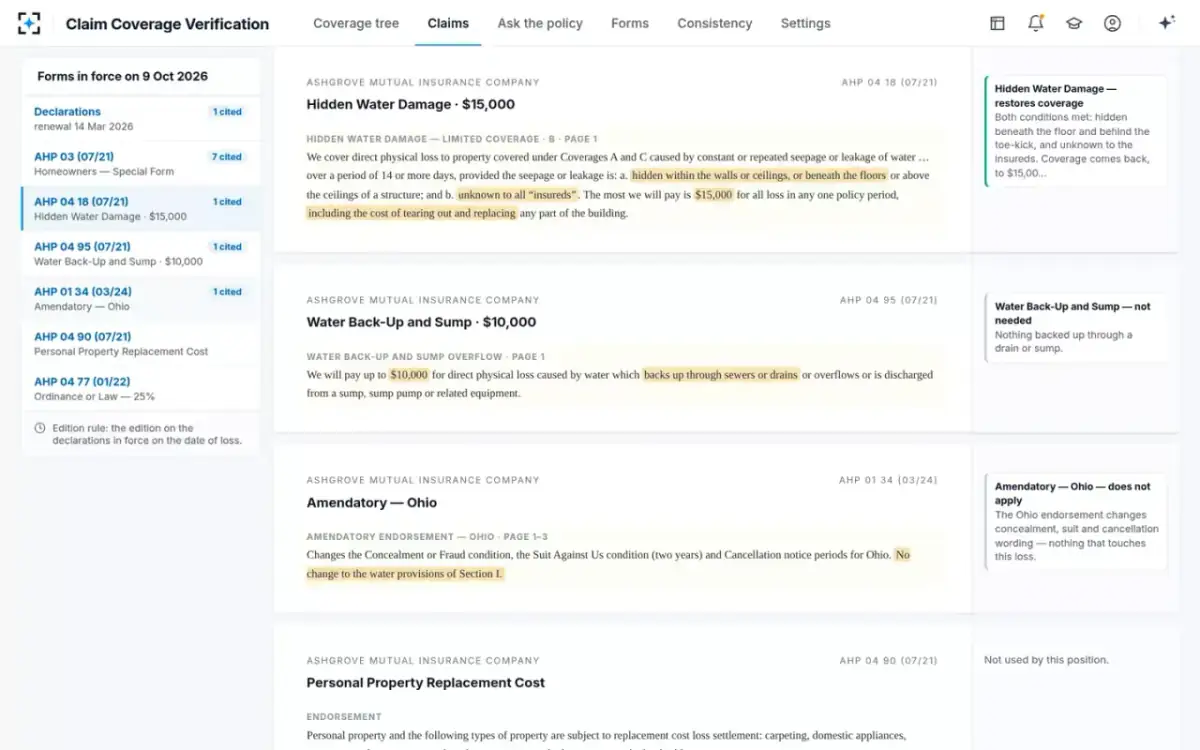
The policy the mapper reads: forms in force, with margin notes
Testing the mapper before a new edition goes live
A tree is a reading of a form, and a new edition needs a new reading. In the sample, when the hidden water endorsement moved from the 01/18 to the 07/21 edition, the trees for the new edition were replayed on 412 past claims and approved by the carrier's coverage counsel before any live claim used them. The forms screen shows what changed clause by clause: the limit, tear-out, and the knowledge condition.
That is the same discipline the NAIC bulletin describes for AI systems generally: validation that can include "measuring performance against expert review". Day to day, the Consistency checker does a lighter version on every new position, comparing it with signed positions on the same form edition and fact pattern; on the sample claim the draft matched 41 of 43, and the two that differed had been reopened by quality review. How to design a full replay is set out in AI insurance policy review.
What is a coverage position letter, and where does the tree go next?
A coverage position letter tells the policyholder what the insurer will pay and why: covered, covered in part, or not covered, with the provision behind each part and the coverage behind each amount. It is the tree written in plain words. The Letter drafter writes it from the signed path, quoting the clause behind every reduction, and checks it before signature: on the sample letter, coverage named for every amount, the reason for the limit quoted from the policy, the editions in force, a reading grade of 7.8 and the Ohio acknowledgement in time. What a denial letter owes is covered in the coverage denial letter guide.
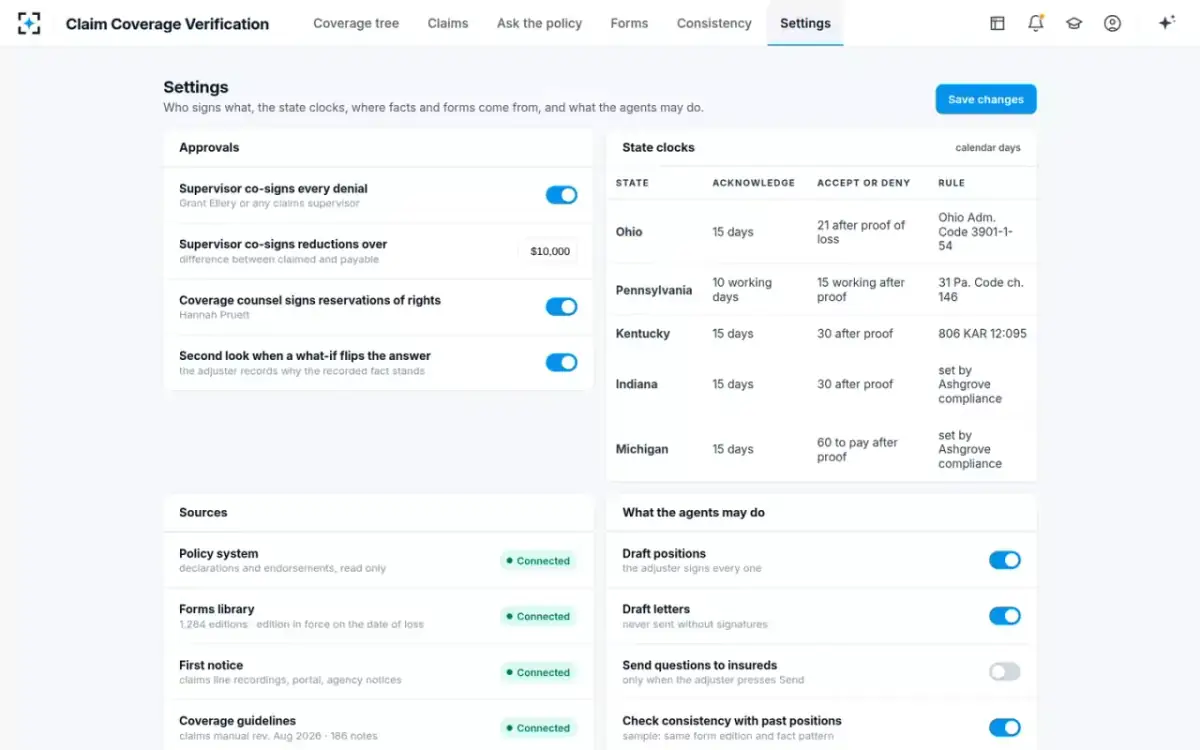
The tree also goes to the people who sign. The adjuster signs every position; a supervisor co-signs every denial and every reduction over the carrier's line, $10,000 in the sample; coverage counsel signs reservations of rights. The position, its path, the facts and the edition of every form are kept with the signatures.
Questions to ask any claims adjuster software vendor about coverage
The questions below test whether a product's coverage features can be checked by a person and defended to a regulator. They apply to us as much as anyone, and the honest answers include what the product does not do.
Coverage questions for claims adjuster software
- Where does the policy come from, and is the edition in force on the date of loss used?
Read-only from the policy system and a forms library with in-force dates.
- Does every step quote the clause, with form, edition, section and page?
If the answer is a summary, ask how a reviewer checks it.
- Are exceptions and endorsements separate steps from the exclusions they answer?
Most disputes are about the exception.
- Does every fact carry its source and a confidence, and do gaps become questions?
Never an assumed fact.
- Are amounts computed per coverage, with the coverage named for each?
NAIC Model 900 §4J requires payments to say what they are paid under.
- Can the software deny coverage on its own?
It should not. Any “not covered” goes to a person.
- How is a new form edition tested before use?
A replay on past claims and an approval by named people.
- Which systems does it connect to, and with what access?
Read-only where it reads; nothing sent without signatures.
- What does it not do?
For example: estimate damage, replace counsel, or decide.
Ours, for the record. Claim Coverage Verification works with the policy system read-only, a forms library with every edition and its in-force dates, first-notice recordings and portal notices, trade reports and photos, the carrier's coverage guidelines, and a table of state clocks. It does not price damage, which stays with estimating; it does not replace a claims management system; and it does not decide. The approvals, clocks and what the agents may do are the carrier's settings, changed by its team and logged.
Sources and limits, set by the carrier
Questions people ask
What software do insurance adjusters use?
Typically a claims management system for the file and payments, estimating software for damage, and the carrier's policy system for the declarations, with the coverage reading done from the policy documents. Software that drafts a cited coverage position is a newer addition that sits between them.
Can software read an insurance policy?
Software can extract and quote policy text reliably; interpreting it is harder, and research on legal AI tools found error rates of 17 to 33 percent even when answers were grounded in sources. The safer design quotes the exact clause at every step, so a person can check the reading rather than trust it.
How do you build a coverage decision tree?
Start from the declarations in force on the date of loss and the exact edition of every form. Lay out the insuring agreement and perils, then each exclusion with its exceptions, then the endorsements that add or restore coverage, then limits and the deductible, linking each endorsement to the exclusion it answers. Quote every node and record which fact it reads.
Is claims management software the same as coverage software?
No. Claims management software runs the file, tasks, reserves and payments. Coverage software applies the policy wording to the facts to reach a coverage position. The second needs the first for the file and the payment, and should hand back a signed position with its reasoning.
Does claims adjuster software need regulatory approval?
Not as a product, but its use is regulated. Under the NAIC AI bulletin, adopted by 29 jurisdictions as of 8 October 2026, insurers are expected to govern AI systems used in claims, including vendors' systems, and Washington's 2026 rule makes insurers responsible for evaluations made on their behalf and bars investigations that rely solely on a database or estimating software.