Are insurance companies using AI to deny claims? Insurers do use AI and algorithms in claims handling, and state regulators have said plainly that a decision made with AI is held to the same law as any other: under the NAIC's model bulletin, adopted by 29 jurisdictions by October 2026, an AI-assisted decision must meet the unfair claims settlement rules "regardless of the tools and methods" used. No regulator accepts "the model decided" as a defence; the insurer remains responsible, including for tools it buys from vendors. For property claims, the line that matters is the coverage decision: whether a loss is covered and how much is payable. Botminds' Claim Coverage Verification is built on the safe side of that line: its agents read the policy, draft the position and draft the letter, but they may never deny coverage. Any "not covered" goes to a person, who signs.
The rules on this page are as published on 27 October 2026, and they are moving; dates are given with each. Product examples use a fictional carrier and sample claims.
Where the rules stood in October 2026
29
jurisdictions that had adopted the NAIC AI model bulletin
by 8 October 2026
4
more states with their own insurance AI regulation or guidance
18 Oct2026
Washington’s claims rule took effect: a database alone is not an investigation
1
state bill requiring a human to make every denial and reduction; it died in March 2026
Are insurance companies using AI to deny claims?
They use AI and automated tools across claims, and regulators write their rules on that assumption. Washington's insurance commissioner, explaining a 2026 claims rule, cited reports that "the insurance industry is changing their claim process from an in-person, on-site, loss examination to the use of artificial intelligence and photo-based loss adjusting to maximize efficiencies." The Bureau of Labor Statistics describes the same shift in plainer words: "computer software can evaluate photographs of damaged property and calculate an estimated claim amount."
Whether a given denial was made by AI is a different question, and usually not visible from outside. Most public controversy about AI denials has concerned health insurance, where search suggestions for this question are dominated by health insurers, and where federal rules for Medicare Advantage plans already require medical necessity decisions to rest on, among other things, "The enrollee's medical history (for example, diagnoses, conditions, functional status), physician recommendations, and clinical notes." Property and auto claims run under state unfair-claims law instead, and that law asks what the decision was and why, not which software produced it.
Is it legal for insurance companies to use AI on claims?
Yes, and the rules that make an unfair denial unlawful apply in full. The NAIC's model bulletin on AI systems, adopted in December 2023, states the principle directly: "Decisions subject to regulatory oversight that are made by Insurers using AI Systems must comply with the legal and regulatory standards that apply to those decisions, including unfair trade practice laws." Those standards require, "at a minimum, that decisions made by Insurers are not inaccurate, arbitrary, capricious, or unfairly discriminatory", and "Compliance with these standards is required regardless of the tools and methods Insurers use to make such decisions."
The bulletin asks each insurer for a written program covering AI "across the insurance life cycle", naming "claim administration and payment" among the areas, and covering systems bought from vendors on the same terms as those built in-house (the bulletin's requirements, section by section). It is not itself a law: it binds an insurer only where a state has issued it, which is why the adoption map matters.
“Compliance with these standards is required regardless of the tools and methods Insurers use to make such decisions.”
NAIC Model Bulletin, Use of Artificial Intelligence Systems by Insurers (2023)
Which states regulate AI in insurance claims?
As of the NAIC's map dated 8 October 2026, 29 jurisdictions had adopted the model bulletin and four more had their own insurance-specific AI regulation or guidance. Washington, which adopted the bulletin in 2024, also rewrote its claims-handling rules in 2026 with technology in mind. Florida, which is not on the adoption list, considered a bill requiring a human to make every denial, and it died. Ohio, where the sample claim on this page sits, was not on the map's lists.
AI and claims: what each kind of rule does, by jurisdiction
| Status | Where | What it requires on a claim |
|---|---|---|
| NAIC model bulletin adopted (29) | Alaska, Arkansas, Connecticut, Delaware, District of Columbia, Hawaii, Illinois, Iowa, Kentucky, Maryland, Massachusetts, Michigan, Mississippi, Nebraska, Nevada, New Hampshire, New Jersey, North Carolina, North Dakota, Oklahoma, Pennsylvania, Puerto Rico, Rhode Island, South Carolina, Vermont, Virginia, Washington, West Virginia, Wisconsin | AI-assisted decisions meet the unfair-claims rules; a written AI program covering claims, including vendors’ systems |
| Own insurance AI regulation or guidance (4) | California (Bulletin 2022-5), Colorado (3 CCR 702-10), New York (Circular Letter No. 7, 2024), Texas (Bulletin B-0036-20 on the map; B-0003-26 issued 12 June 2026) | Varies by state; see each regulator |
| Claims rule written for technology | Washington, WSR 26-17-089, effective 18 October 2026 | A reasonable investigation may not rely solely on a database or estimating software; insurers are responsible for evaluations made on their behalf |
| Human-denial bill, failed | Florida, CS/CS/HB 527 (2026), died in Rules on 13 March 2026 | Would have required a qualified human professional to make every denial and reduction |
| Not on the NAIC map’s lists | Includes Florida and Ohio | General unfair-claims statutes and rules still apply to every decision |
Washington's 2026 rule: a database is not an investigation
Washington's new claims rule, filed on 18 August and effective 18 October 2026, is the clearest statement yet of how claim rules apply to automated tools, and it does so without banning any. Its amended unfair-practice definition reads: denying or refusing to pay claims "without conducting a reasonable investigation. A reasonable investigation may not rely solely on the use of a database, which includes, but is not limited to, estimating software and benchmarks gathered from one or multiple databases."
Two more provisions close the vendor gap. "Insurers are responsible for the accuracy of their evaluations including, but not limited to, evaluations made on their behalf". And an insurer that prices with a database, survey, estimating software or benchmarks must, on request, give the claimant "the date the data was collected, where the data was collected from, and which businesses provided the cost data". The commissioner's stated reason was not technology as such but outcomes: "an increase in consumer complaints and Insurance Fair Conduct Act notices". The compiled code on the legislature's site may still show the old text for a while; the register order is the rule.
Florida's bill that would have required a human to deny
Florida's 2026 House Bill 527 would have prohibited insurers from reducing a claim payment or denying all or part of a claim "based solely on the output of an AI system, algorithm, or machine learning system", and required "a qualified human professional to make all denial and claim payment reduction decisions after analyzing the claim independently". Denial letters would have carried the decision-maker's unique identifier and an affirmation that AI was not the sole basis. The bill's last action, on 13 March 2026, reads "Died in Rules".
It failed, but it is the most specific statement of what legislators are asking for, and it reads like a design specification: a named person decides, after reviewing the machine's output; the file shows who, when and on what basis; the letter says so. A carrier that builds to that standard now is not waiting for the next session.
Who is responsible when AI gets a claim wrong?
The insurer. Every source above points the same way. The NAIC model act's definition of "insurer" reaches "agents, brokers, adjusters and third party administrators". The AI bulletin covers systems bought from vendors. Washington makes insurers responsible for evaluations "made on their behalf". And the denial itself must still meet the ordinary rules: under the NAIC's model regulation no insurer may deny on a specific provision "unless reference to such provision, condition, or exclusion is included in the denial", and California requires a written denial to list "all bases" and "the factual and legal bases for each reason".
That last point is where a poorly designed AI tool fails first. A model that outputs "not covered" with a score cannot meet a rule that demands the provision, the facts and the reasoning. What survives an examination is a decision a person made and can explain, from wording that was quoted and facts that have a source. What such a denial letter must contain, and what it costs when it does not, is the subject of the coverage denial letter guide.
The design that holds: agents draft, a person denies
The safe design does not depend on which bill passes next. It keeps the machine on the reading and the drafting, and keeps every adverse decision with a named person who can see the wording and the facts behind it. In Claim Coverage Verification that is a setting, and the only option is "Never".
Claim Coverage Verification: where the agents stop on a coverage decision
Agent
Policy assembler and Fact readerThe forms in force on the date of loss; each fact from the call, reports and photos with its source and a confidence.
Never: Infer a fact nobody stated.
Agent
Coverage mapper and analystBuild the tree from the forms and walk the facts through it, quoting each step and computing the amounts.
Never: Deny coverage: a “not covered” goes to a person.
Agent
Why-not analyst and Letter drafterShow which fact would change each step; draft the letter with every reason quoted.
Never: Save a what-if as a fact, or send anything.
A person decides
Adjuster signs; supervisor co-signsThe adjuster decides and signs every position; a supervisor co-signs every denial and every reduction over the carrier’s line, $10,000 in the sample.
Signed and co-signed: the decision belongs to named people
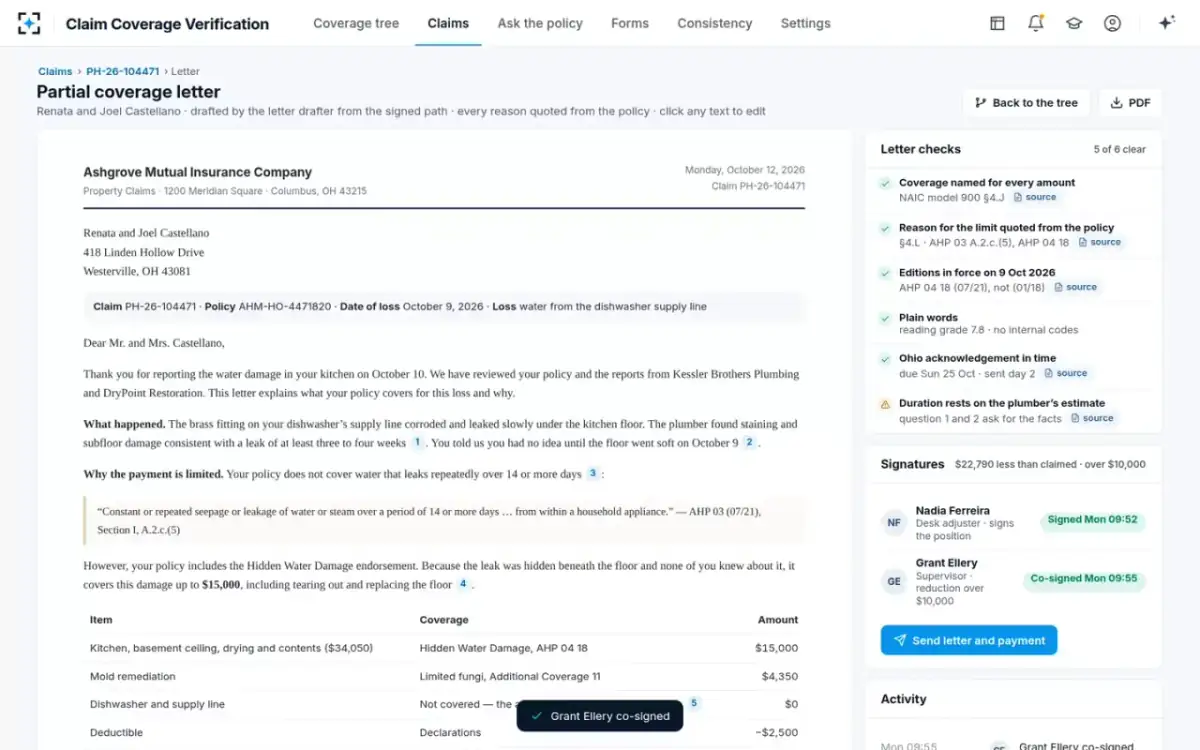
Two features of the design answer the Florida bill's concerns directly. The person decides from the quoted wording and the sourced facts, not from a score, and can open any step to read the clause that decided it. And the file shows who signed, when, and on what reasoning, so the question "was AI the sole basis?" has a documented answer. The rule against agents denying is not a policy statement on a web page; it is a setting the carrier's own team controls, and changing it is logged.
What the agents may do, set by the carrier
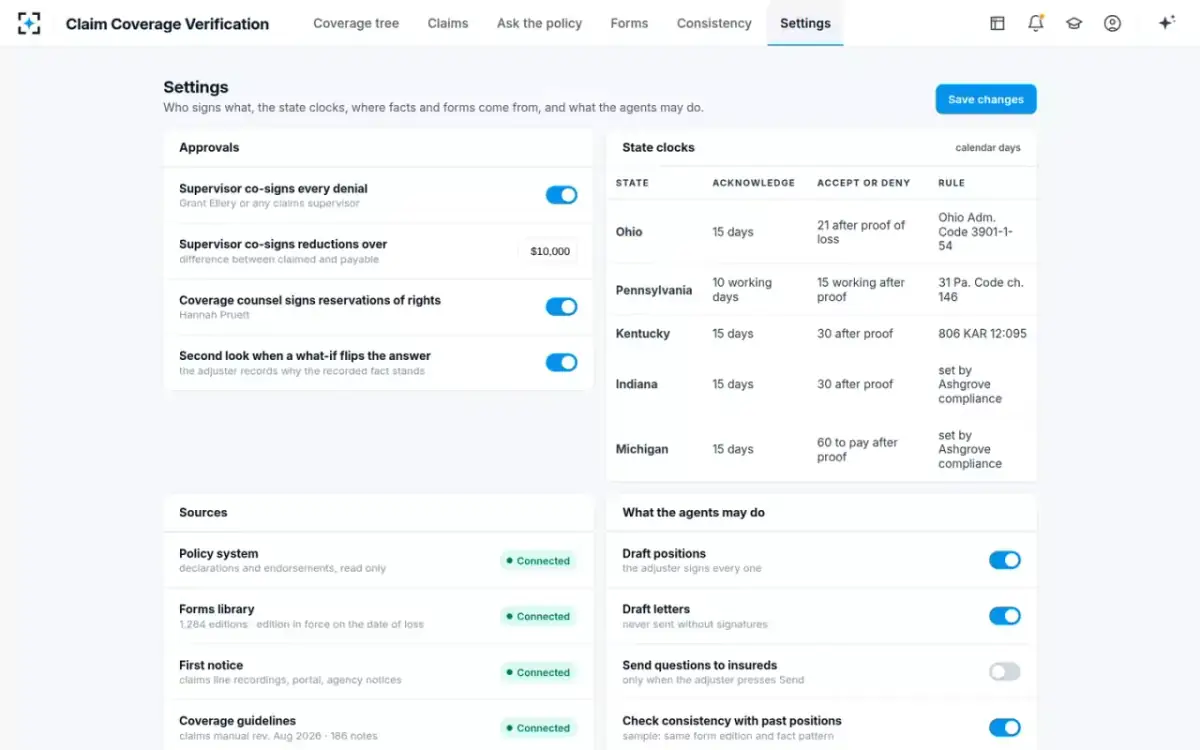
How do I know if AI was used on my claim?
Ask, and ask for the file where the law gives a right to it. The NAIC bulletin expects insurers' programs to include processes "providing notice to impacted consumers that AI Systems are in use", in states that adopted it. Washington goes further on the file: insureds may "request and receive from their insurance company any portion of the first party claim file", including reports, claim notes, estimates and photographs, within 15 business days, subject to limited redactions. Everywhere, a denial must name the provision it rests on, and a policyholder can ask which facts the insurer relied on for each.
Questions a policyholder, or a regulator, can put to any AI-assisted denial
- Which provision, in which edition, was the basis?
The denial must reference it; the edition in force on the date of loss decides.
- Which facts did it turn on, and where did each come from?
A report page, a photo, a recorded statement, not a score.
- Who made the decision, and when?
A named person with authority, as Florida’s failed bill would have required on the face of the letter.
- Was any tool used, and is it the insurer’s or a vendor’s?
The insurer answers for both under the NAIC bulletin and Washington’s rule.
- Can I have a copy of the claim file?
Washington gives insureds that right; elsewhere, ask, and use the state’s complaint process if refused.
For carriers, the same five questions are a readiness test: if the file cannot answer them for an AI-assisted denial, the problem is the process, not the model. How to test an AI reading of policies before relying on it is covered in AI insurance policy review, and the four ways carriers reach a position today are compared in insurance policy analysis on a claim.
Questions people ask
Can an AI deny an insurance claim?
No state rule we found allows a model to be the excuse for a wrong denial: under the NAIC bulletin, AI-assisted decisions must meet the same unfair-claims standards as any other. Florida's 2026 bill would have required a qualified human professional to make every denial; it died in committee. Carriers can choose that design anyway, as Claim Coverage Verification does by never letting its agents deny.
What is the NAIC AI model bulletin?
It is a model regulatory bulletin adopted by the National Association of Insurance Commissioners in December 2023 on insurers' use of AI systems. It applies existing laws, including unfair claims settlement rules, to AI-assisted decisions and asks insurers for a written AI program covering claims and vendors' systems. By 8 October 2026, 29 jurisdictions had adopted it.
Can an AI deny an insurance claim in Florida?
Florida has no AI-specific claims statute: HB 527, which would have required a human to make every denial and reduction, died in the Rules Committee on 13 March 2026. Florida's general claims statutes still apply to every decision, including the requirement to give a reasonable written explanation of the basis in the policy for a denial or partial denial.
Are health insurers using AI to deny claims?
Health insurance is where most public concern has centred, and it runs under different rules. For Medicare Advantage plans, a federal regulation requires medical necessity decisions to rest on criteria that include the enrollee's own medical history, physician recommendations and clinical notes. This page concerns property and casualty claims under state law.
What are the dangers of using AI in insurance claims?
The NAIC bulletin names them: decisions that are inaccurate, arbitrary, capricious or unfairly discriminatory, which AI "has the potential to increase" without proper controls. On coverage, the specific danger is an answer without its basis: a denial that cannot quote the provision, the edition and the facts it turned on fails the ordinary claim rules whatever produced it.