Insurance policy analysis on a claim is the work of reading the policy in force on the date of loss against the facts of the loss, step by step, until it yields a coverage position: covered, covered in part, or not covered, with the amount payable and the clause behind each part. Carriers reach that position in one of four ways: an adjuster reading the PDFs, a coverage checklist or rules engine, a general chat assistant, or agents that draft a cited position for a person to sign. All four can produce the right answer on an easy claim. What separates them is what each leaves on file for the supervisor, the examiner and the next adjuster: which edition was read, which clause decided, and which fact it turned on. Botminds' Claim Coverage Verification is the fourth approach, and this guide compares it honestly with the other three on one claim.
The claim is sample data on a fictional carrier: Ashgrove Mutual's Castellano water claim in Ohio, a dishwasher supply line that leaked for weeks under a kitchen floor. The research cited is real.
One water claim, four approaches: what each produces and what it leaves unrecorded
| Adjuster with the PDFs | Checklist or rules engine | General chat assistant | Cited agents, person signs | |
|---|---|---|---|---|
| Which edition | Whatever PDF was opened; rarely written down | Fixed in the rules; updated by hand when forms change | Whatever text was pasted in | Read from the declarations in force on the date of loss and recorded |
| Which clause decided | In the adjuster’s note, if written | A rule code | Paraphrased in prose | Quoted with form, edition, section and page |
| Which fact it turned on | In the adjuster’s head or note | A field value, without its source | Whatever the prompt said | Each fact with its source and a confidence |
| What would change it | Not usually written down | Not shown | Only if asked | The single fact per step, with the dollar effect |
| Consistency with past positions | Depends on who reads it | High inside the rules, none outside them | Not checked | Checked against signed positions on the same form and facts |
| Who decides | The adjuster | The rule, unless overridden | Unclear | The adjuster signs; supervisor co-signs denials and large reductions |
What insurance policy analysis means on a claim
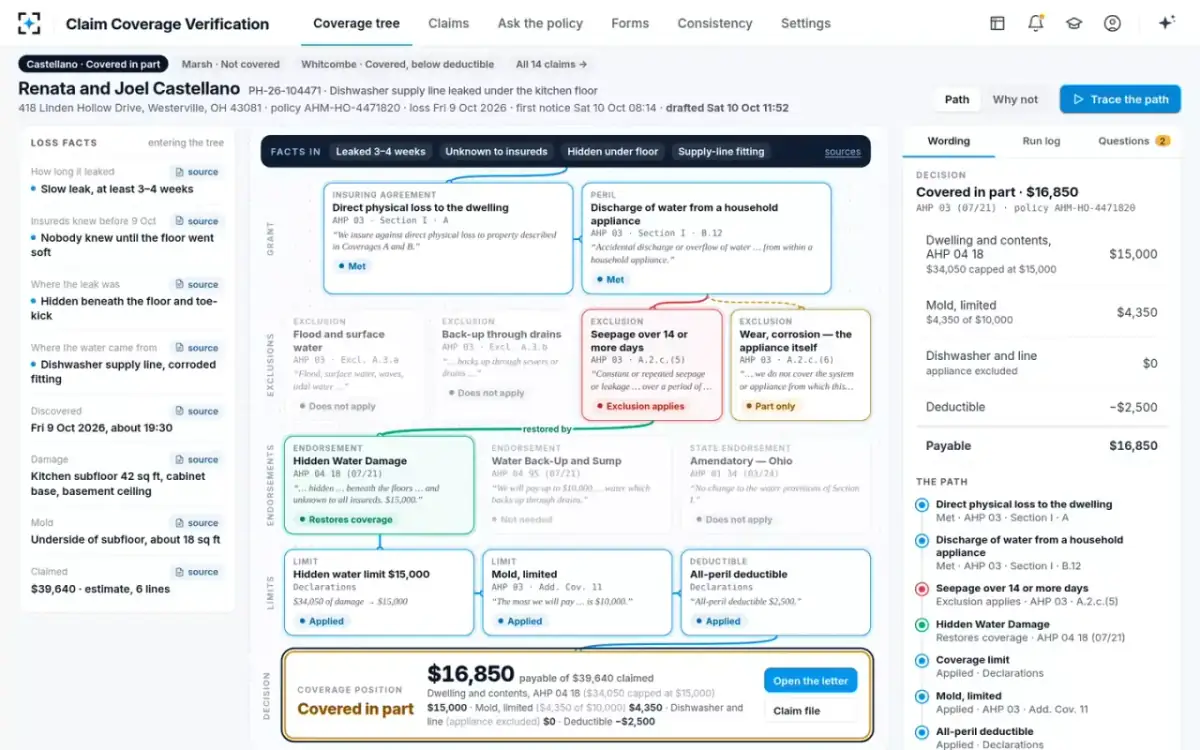
It is not the policy review a buyer or broker does before a sale, comparing limits and premiums across carriers. On a claim, the policy is fixed: the declarations and forms in force on the date of loss. The analysis runs in a fixed order: the insuring agreement and the peril, the exclusions, the exceptions and endorsements that give coverage back, the limits and sublimits, and the deductible. Each step either holds or does not on the facts, and the path through them is the coverage position.
The Bureau of Labor Statistics lists the core of it among the duties of claims adjusters, examiners and investigators: "Determine whether the insurance policy covers the loss claimed". It is harder than it sounds because the wording is not standard. A University of Chicago Law Review study found homeowners policies from 24 insurance groups "differ radically with respect to numerous important coverage provisions", and the same carrier's endorsement can change from one edition to the next.
How do adjusters check coverage today?
Mostly by reading. The sample desk adjuster's routine before each first call back is to open the declarations and read the forms, one by one. Supervisors check the larger and the adverse positions; coverage counsel takes the questions the adjuster cannot settle. Some carriers add a checklist or rules for common claim types; some adjusters now paste wording into a chat assistant to get a summary.
On the sample claim the reading involves six forms: the special form AHP 03, a hidden water damage endorsement, a water back-up endorsement, a replacement cost endorsement, an ordinance or law endorsement and Ohio's amendatory endorsement. The decision turns on four of them and two facts. None of that is unusual, and it is why the four approaches diverge: they differ in how reliably they get the forms right and how much of the reasoning they leave behind.
The people who do this work
389,700
U.S. jobs for claims adjusters, appraisers, examiners and investigators, 2025
$78,020
median pay a year for the occupation, 2025
−6%
projected change in jobs, 2025–2035
Approach one: the adjuster with the PDFs
A skilled adjuster reading the right documents is still the standard every other approach is judged against. Its weaknesses are not judgement but bookkeeping. The edition is whichever PDF was opened, and the sample shows what that costs: the hidden water endorsement's January 2018 edition paid $10,000 without tear-out; the July 2021 edition in force pays $15,000 with it. The reasoning lives in a note written after the fact, if at all.
Consistency depends on who reads. Among the sample carrier's 43 signed positions on the same form edition and fact pattern, a hidden leak of 14 days or more that nobody knew about, 41 paid to the endorsement limit and two paid full Coverage A: $31,420 and $27,980. Quality review reopened both. The cause is the oldest one in claims: two adjusters can read the same wording differently, and a process that leaves no quoted reasoning on file gives a reviewer nothing to compare.
Approach two: a coverage checklist or rules engine
Rules bring consistency: the same inputs give the same output every time, and the logic can be audited. They are a good fit for high-volume, narrow questions, such as whether damage is below the deductible or a rental limit is exhausted. They struggle where coverage turns on wording and facts that do not fit a field: how long a leak ran, whether a cause was hidden, whether an exception inside an exclusion gives coverage back.
Rules engine vs AI agents for coverage decisions
Rules engine or checklist: Written by analysts from the forms, once per edition.
Agents that draft a cited position: Drawn from the forms in force on each claim, every step quoting its clause.
Rules engine or checklist: Structured fields entered by someone.
Agents that draft a cited position: Calls, reports, photos and notes, each fact with its source and confidence.
Rules engine or checklist: Rules rewritten and retested by hand.
Agents that draft a cited position: Trees rebuilt from the new edition and replayed on past claims before use.
Rules engine or checklist: Falls through to a person, often without saying why.
Agents that draft a cited position: Names the fact that would change each step, and turns uncertain ones into questions.
Rules engine or checklist: Stale rules after a form change.
Agents that draft a cited position: A fluent answer that is wrong; mitigated by quoting and by testing on signed positions.
Their quiet risk is staleness. A rule set written for the 01/18 edition of an endorsement keeps paying $10,000 after the 07/21 edition raises the limit, until someone notices. Any approach that encodes the wording once must re-encode it at every edition, which in a forms library of hundreds of editions is a standing job.
Approach three: a general chat assistant
A general assistant reads fast and writes well, and both qualities hide its weakness on claims. Given a pasted policy, it will summarise and answer; it cannot tell whether the pasted text is the edition in force, or whether an endorsement is missing, and it will answer with the same confidence either way. Research on purpose-built legal tools that retrieve real sources found they still "hallucinate between 17% and 33% of the time"; a general assistant has fewer safeguards than those tools.
The regulatory point matters more than the error rate. A denial must reference the provision it relies on, under the NAIC model regulation and the states that follow it, and the claim file must "permit reconstruction of the insurer’s activities relative to each claim." A paraphrase in a chat window is neither. The NAIC's AI bulletin, adopted in 29 jurisdictions as of 8 October 2026, also expects insurers to govern AI systems used in "claim administration and payment", including tools an adjuster adopts on their own.
Approach four: Claim Coverage Verification, cited agents with a person who signs
The fourth approach keeps the reading with software and the decision with people, and it is built to leave everything on file. Seven agents split the work. The Policy assembler pulls the declarations and the exact edition of every form in force on the date of loss. The Fact reader takes each fact from the call, reports, photos and estimates with its source and a confidence. The Coverage mapper turns the forms into a decision tree; the Coverage analyst walks the facts through it and computes the amounts. The Why-not analyst finds the fact that would change each step. The Consistency checker compares the draft with signed positions on the same form and facts. The Letter drafter writes the letter. The adjuster decides and signs.
3 hours 38 minutes on the sample claim, and where they went
- Call to policy and call read19 min
- Before the plumber report and photos were read195 min
- Tree, analysis, checks and letter4 min
Two things stand out on the sample run. Almost all of the elapsed time was before the plumber's report and photos were read; once they were, the tree, the analysis, the consistency check and the letter took four minutes. And the drafted position was waiting when the adjuster opened her queue on Monday, with every step quoted, so her work was to check and decide, not to search.
The claim file: the agents' run, step by step, with the position beside it
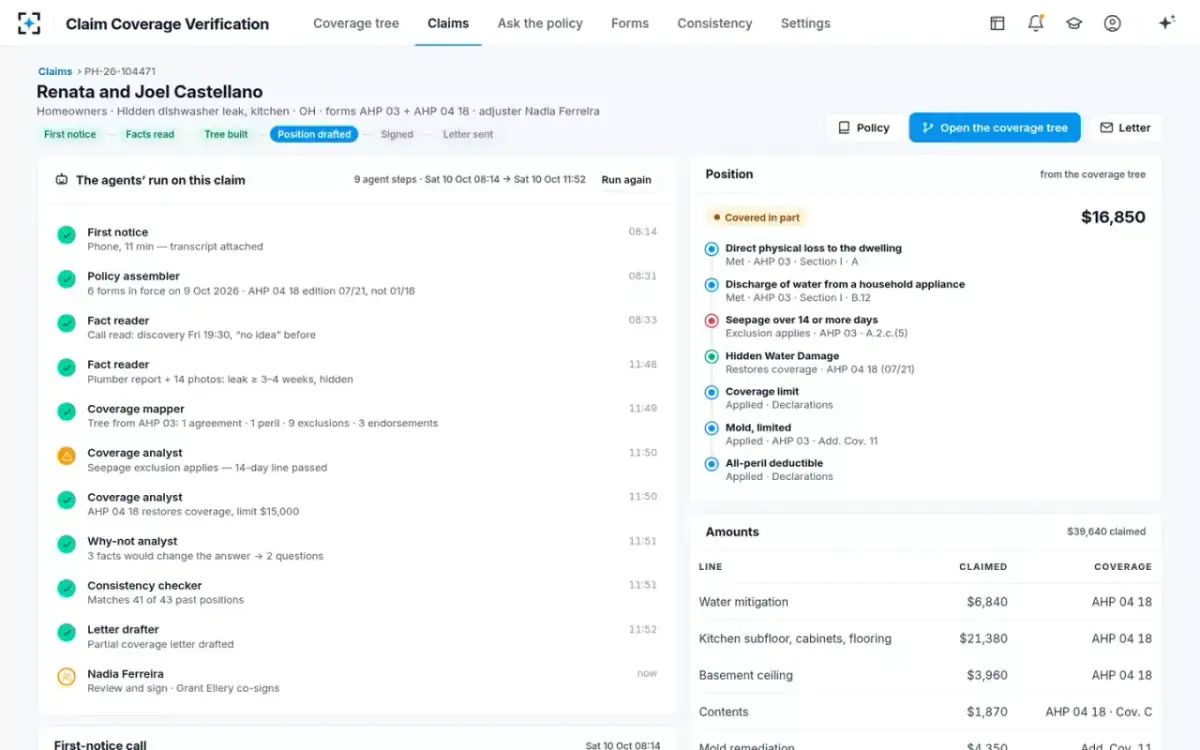
Where it does not fit is as important. It does not estimate damage; it takes the estimate as an input and applies the policy to it. It does not replace coverage counsel on contested wording, or the adjuster's call to the insured. It may never deny coverage: a "not covered" goes to a person, and nothing is sent without signatures. And it needs what any careful approach needs: a forms library with every edition and its dates, the carrier's coverage guidelines, and a sample of signed past positions to test against before go-live.
The coverage tree the adjuster checks and signs
Will AI replace claims adjusters?
Not on coverage decisions, on the evidence so far, and not by design in the approach described here. The Bureau of Labor Statistics projects the occupation's jobs to fall 6 percent from 2025 to 2035, and notes that software already estimates claims from photographs. But the coverage decision carries legal duties that attach to the insurer and its people: a denial must name its provision, the file must show the reasoning, and regulators hold AI-assisted decisions to the same standards. Florida's 2026 bill, which died in committee, would have required "a qualified human professional to make all denial and claim payment reduction decisions"; whatever the next session brings, it shows where legislators draw the line.
What changes is the adjuster's day. In the sample, the desk adjuster's queue holds 14 claims, four ready to sign, each with a drafted position, and her first action on the Castellano claim is to check two uncertain facts rather than read six forms. The supervisor co-signs from a letter whose reasons are quoted. The rules on AI and denials are set out in insurance companies using AI to deny claims.
An insurance policy review checklist for any approach
Whichever approach a carrier uses, the same eight questions test whether a coverage position will hold. They are worth asking of a sample of closed files today; the answers show where the current process leaks. How to test any AI approach on those files is set out in AI insurance policy review.
Eight checks on any coverage position
- Is the edition of every form on file?
Matched to the declarations in force on the date of loss.
- Is the deciding clause quoted, not paraphrased?
With form, edition, section and page.
- Does each deciding fact have a source?
Call, report page, photo; and a note where it is an estimate.
- Were exceptions and endorsements checked after each exclusion?
The sentence after an exclusion often gives coverage back.
- Is every amount tied to its coverage?
Including the deductible and any sublimit.
- Is it consistent with past positions on the same form and facts?
And if not, is the difference explained?
- Are the facts that would change it named, and asked about?
Uncertain facts become questions to the insured or the trades.
- Did the right person sign?
Under the carrier’s authority rules for denials and reductions.
Questions people ask
What is insurance policy analysis?
Before a sale it means comparing policies' coverage, limits and costs. On a claim it means reading the policy in force on the date of loss against the facts to decide what is covered and payable, step by step from the insuring agreement to the deductible, with the clause behind each step.
What software do adjusters use for coverage?
Most coverage review is still done by reading the policy documents in the claims and policy systems, supported by carriers' coverage guidelines and, for some claim types, rules. Software that drafts a cited coverage position is newer. The checklist above applies to any of them.
Is a rules engine or AI better for coverage decisions?
Rules suit narrow, high-volume questions with structured inputs, such as deductibles and fixed limits. Agents that read documents suit questions that turn on wording and unstructured facts. Either needs re-testing when forms change, and either should leave the edition, clause and facts on file for a person to check.
Can an insurance policy review service do this instead?
Outside reviewers, from independent adjusters to coverage lawyers, can review a position, and the insurer remains responsible for the result: the NAIC model act's definition of an insurer reaches adjusters and third party administrators. The same checks apply to their work as to in-house reading.
What should AI never do in a claim?
In the design described here, it never denies coverage, never sends anything to an insured without a person's signature, and never treats a hypothetical as a fact. Those three limits keep the decision, the communication and the evidence with accountable people.