The tripartite relationship in insurance defense is the three-way arrangement created when a liability insurer hires and pays a lawyer to defend its policyholder: the insured is the lawyer's client, the insurer pays and supervises within limits, and defense counsel owes its loyalty and independent judgment to the insured. Courts and bar committees disagree on whether the insurer is also a client, but they agree on the consequences that matter day to day: counsel may report to the insurer, may bill it, and may follow its reasonable guidelines, but may not let it direct the defense, and must protect the insured's confidences, including from the insurer when coverage is in question. Those rules decide who may see each report, bill and note on a litigated claim. Botminds' Claims Litigation Management is built inside them: its agents read what counsel sends to the insurer, never write to counsel, and route every request through a named person.
Who may see what on a defended claim
YesConditionalNo
What is the tripartite relationship in insurance defense?
The tripartite relationship is the name courts and ethics committees give to the triangle of insurer, insured and defense counsel. The insurance policy creates two of its sides: the insurer's duty to defend the insured, and its right, in most liability policies, to control the defense and settlement. The third side, counsel's relationship with each party, comes from the rules of professional conduct, and that is where the tension sits. Oklahoma's bar described the triangle in 2000 as one that "often consists of dual attorney-client relationships between defense counsel with the insured and with the insurer."
The ABA's model rules address the arrangement from the lawyer's side. A lawyer may be paid by someone other than the client only if the client gives informed consent, "there is no interference with the lawyer's independence of professional judgment or with the client-lawyer relationship", and the client's information is protected. The commentary names the insurer directly, listing among third-party payers "an indemnitor (such as a liability insurance company)".
"Because third-party payers frequently have interests that differ from those of the client, including interests in minimizing the amount spent on the representation and in learning how the representation is progressing, lawyers are prohibited from accepting or continuing such representations unless the lawyer determines that there will be no interference with the lawyer's independent professional judgment and there is informed consent from the client."
ABA Model Rule 1.8, comment [14]
That sentence describes an insurer's litigation function exactly. Minimising cost and learning how the case is going are the two things a litigation desk does all day, and the comment accepts both as legitimate interests while drawing the line at interference with counsel's judgment.
Who is the client of insurance defense counsel?
The insured, always; the insurer, in some states. Montana's Supreme Court took the strict view in 2000: "We hold that under the Rules of Professional Conduct, the insured is the sole client of defense counsel." Other authorities describe a dual relationship, with the insurer a client too, at least where their interests coincide. Even under the dual view, the insured's position comes first when the two diverge; Oklahoma's opinion, which accepts dual relationships, still states that when an insurer hires a lawyer to defend its insured, the insured is the lawyer's client with all the ethical considerations that come with that.
One Monday report, seen by the four people it touches
Today
Gets the report in a shared mailbox and reads it when time allows.
With agents
Reads a summary with the five new dates already on the calendar and three requests drafted.
Still theirs: what is sent to the firm, and when
Today
Hears of the trial week at pre-trial review.
With agents
Sees the $3.8M demand against a $2M limit with no authority set, sixteen weeks out.
Still theirs: settlement authority above the threshold
Today
Reads the valuation at the next quarterly review.
With agents
Gets a reserve review with the valuation line attached the hour it arrives.
Still theirs: the reserve
Today
Wonders whether page two was read.
With agents
Gets requests that quote the paragraph they concern, and no instructions on how to defend.
Still theirs: the defense, and the insured’s confidences
Tripartite relationship and attorney-client privilege
In many states, communications between defense counsel and the insurer about the defense are privileged, because the insurer is treated as the insured's representative or as sharing a common interest in the defense. Oklahoma's bar put it this way: such communication "is confidential and subject to the attorney- client privilege because the insurance company is the client’s representative", citing the state's evidence code. The protection has edges, and a litigation system should be designed around them.
Defense bills and outside auditors: where consent comes in
Bills are where the privilege question becomes practical, because carriers often want a second pair of eyes on them. The first edge is people outside the triangle. The Montana court held that outside bill auditors do not share that protected position; their mission, as the court characterised it, is to find fault with legal charges, and it treated disclosure of detailed bills to them as disclosure to a potential adversary. Several bar committees, including Kentucky's and New Mexico's, require the insured's informed consent before defense bills go to an outside auditor. The second edge is coverage: information the insured gives counsel that could defeat coverage belongs to the insured, not to the insurer that may use it.
For a carrier, the consequence is procedural rather than dramatic. Before invoices leave the insurer for review by a third party, someone has to know whether the insured's consent was obtained, in the states that require it. That is a fact to record on the suit, like a date, and a system that moves invoices automatically has to ask for it first.
What is a conflict in insurance defense?
A conflict arises when the insurer's interest and the insured's diverge on something counsel's work can affect. The classic case is a reservation of rights on an issue that the defense itself will decide: if a finding of intentional conduct would both establish liability and defeat coverage, the lawyer the insurer chose is being asked to develop facts that help one of its two masters at the other's expense. The ABA's commentary flags the subtler version, where the lawyer's representation is "materially limited by the lawyer's own interest in accommodating the person paying the lawyer's fee".
Not every divergence is a conflict in the legal sense. California's statute says that a conflict of interest "does not exist as to allegations or facts in the litigation for which the insurer denies coverage", and that none is deemed to exist solely because an insured is sued for more than the policy limits. A suit above limits, like the sample case's $3.8M demand against a $2M primary limit, raises the stakes for the insured and the duty to consider settlement, but it does not by itself require new counsel.
Tripartite relationship in insurance, California: independent counsel
California codified one answer to the coverage conflict. Under Civil Code section 2860, when a conflict creates a duty to provide independent counsel, the insurer must provide it unless the insured waives the right in writing. A conflict "may exist" when the insurer reserves its rights on an issue whose outcome can be controlled by the counsel it first retained. The insurer may set minimum qualifications and pay the rates it actually pays its own panel for similar cases.
The statute also writes a who-sees-what rule into law. Independent counsel and the insured must disclose to the insurer "all information concerning the action except privileged materials relevant to coverage disputes", and must keep it informed and consult on all matters relating to the action. Disclosure to the insurer is not a waiver of privilege as to anyone else. A litigation system in California therefore has a category of material it should never expect from counsel. Coverage questions themselves, and the lawyers who handle them, are covered in coverage counsel versus defense counsel.
Where selected authorities stand
| Authority | Who is the client | What it says about information and control |
|---|---|---|
| ABA Model Rules 1.7, 1.8(f), 5.4(c) | The person represented; a payer can be a co-client | Payment by a third party only with informed consent, no interference with judgment, and the client’s information protected |
| Montana Supreme Court (2000) | The insured, solely | Prior approval of defense tasks violates counsel’s duties; detailed bills to outside auditors need contemporaneous informed consent |
| Oklahoma Ethics Opinion 314 (2000) | Often both, but the insured always | Counsel–insurer communications privileged under state law; auditor review needs the insured’s informed consent |
| Kentucky E-416 (2001) | The insured | Guidelines disclosed to the insured; no approval before discovery, research or motions |
| California Civil Code § 2860 | The insured; independent counsel where a coverage conflict requires | Counsel discloses all information to the insurer except privileged material relevant to coverage disputes |
Can an insurer see defense counsel's file?
It can see what counsel reports, which is most of what it needs, but not everything in the file. Reports on the case, valuations and bills go to the insurer as a matter of course; the Montana court noted that disclosure of billing information to insurers was not disputed as impliedly authorized to carry out the representation. What the insurer should not expect is the insured's confidential information that bears on coverage, or anything the insured has asked counsel to keep from the insurer where the rules allow it. And when the insurer passes counsel's bills to an outside auditor, several states require the insured's informed consent first.
After the case, rules on the insured's access to the file vary; the Montana court recorded other courts holding that, in some bad-faith cases, the insured is entitled to the claim file prepared for the underlying suit. For the insurer, the practical lesson is that its litigation records may one day be read by the insured, which is a good reason to keep them factual: dates with sources, requests with the line that prompted them, and decisions with the name of the person who made them.
A request for information, not an instruction
Building the walls into a litigation system
A litigation system sits in the middle of the triangle, so it has to know where the walls are. The design question is not only who can open a document, but what the system itself is allowed to do with what it reads. A system that reads counsel's reports and then writes back to counsel with instructions has become the insurer's voice inside the defense; a system that forwards bills to a third party has made a disclosure the insured may not have consented to.
Information walls to require of any litigation system
- It never writes to counsel on its own
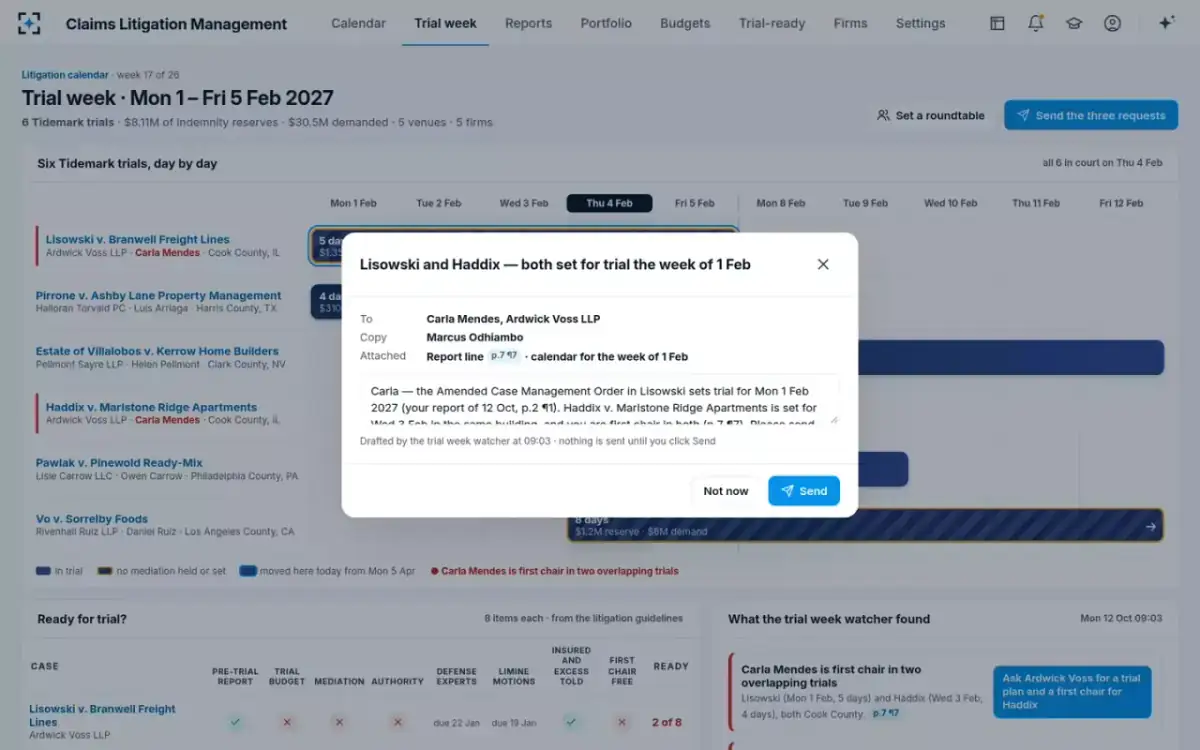
Every request to a firm is drafted for a named person, who sends it; each one sent is logged on the case.
- Requests ask, never direct
For plans, dates and estimates, quoting the report line that prompted them, not for a particular motion or witness.
- Bills go nowhere new without a decision
If invoices will be shared beyond the insurer, someone has to confirm the insured’s consent first.
- Coverage material is kept apart
Coverage correspondence and the defense file are separate, so defense reports are not mined for coverage facts.
- The insurer’s own figures stay the insurer’s
Reserves and authority belong to named people at the carrier; the system may suggest a review, never change them.
- Everything is attributable
Each date, summary and request shows its source and who acted, because the record may one day be read by the insured or a court.
Claims Litigation Management follows the first five by design: its agents read, date and check; they never file with a court, never write to counsel, never change a reserve and never pay or cut a bill. Requests are drafted with the report line attached and sent only when the litigation manager clicks Send. Reserves are changed only by the claim supervisor, and settlement authority above the carrier's threshold sits with claims legal counsel and a roundtable. How the carrier's guidelines express those limits in writing is covered in litigation management guidelines, and the seats that act on counsel's reports in what a litigation adjuster does.
Questions people ask
What does tripartite relationship mean?
In insurance defense it means the three-way relationship among a liability insurer, its insured and the defense lawyer the insurer hires and pays. The insured is the client; the insurer pays, receives reports and may follow reasonable guidelines; the lawyer's duty of loyalty and independent judgment runs to the insured. In labour relations the same phrase describes government, employers and unions, an unrelated use.
Does attorney-client privilege cover reports to the insurer?
In many states, yes, because the insurer is treated as the insured's representative or as sharing a common interest in the defense; Oklahoma's bar cites its evidence code for that view. Protection can be lost by disclosure outside the triangle, and California's statute separately excludes privileged material relevant to coverage disputes from what counsel must give the insurer.
Can defense counsel represent both the insurer and the insured?
Some states treat the insurer as a co-client; Montana's Supreme Court held the insured is the sole client. Under the ABA model rules, representing or being paid by both is permitted only with informed consent and without interference with independent judgment, and a serious divergence, such as a coverage issue the defense will decide, may require separate counsel.
What is a conflict of interest for a defense attorney paid by an insurer?
One where the lawyer's work for the insured could be limited by the insurer's interests or by the lawyer's interest in keeping the insurer's business. A reservation of rights on an issue the defense will decide is the standard example. California's statute says a suit above the policy limits is not, by itself, a conflict.
Should an insurer's litigation system send requests directly to defense firms?
Not without a person. A request to counsel is the insurer speaking inside the defense, and it needs to be a request for information or a plan, not a direction. Drafting is a sensible job for software; sending, and owning what was asked, belongs to a named person at the insurer.