A litigation adjuster, also titled litigation claims specialist or litigation claims examiner, handles an insurance claim after it has become a lawsuit. The adjuster does not try the case. A defense lawyer the insurer hires and pays does that, and in a liability suit that lawyer's client is the policyholder being sued. The litigation adjuster does everything around the lawyer's work on the insurer's side: assigns panel counsel, reads counsel's reports and acts on them, keeps the indemnity and expense reserves honest, approves budgets, holds or seeks settlement authority, and makes sure no trial date arrives unprepared. The job is hard because almost every fact it depends on arrives in someone else's document, from dozens of law firms and courts. Botminds' Claims Litigation Management is software for that desk: specialist agents read every counsel report, court notice and invoice onto one litigation calendar, and people keep every decision.
The litigated desk in four public numbers
18%
of auto injury claimants were in litigation by 2022, up from 10% in 2017
Insurance Research Council
1,462
of 355,243 federal civil cases ended during trial in the year to Sept 2025
U.S. Courts, Table C-5
3.9%
of direct premiums earned went to defense and cost containment in 2024
Federal Insurance Office
389,700
claims adjusters, appraisers, examiners and investigators in 2025
BLS
What does a litigation adjuster do?
A litigation adjuster owns a sued claim for the insurer from the day the complaint arrives to the day the file closes. In practice that means five recurring jobs: getting a defense in place before the answer is due, reading and acting on what defense counsel reports, keeping reserves in step with what those reports say the case is worth, controlling defense spend against a budget, and steering the case toward a settlement or a trial the insurer is ready for. The adjuster also reports upward, to a litigation manager, a claim supervisor and, on larger cases, to claims legal counsel and a roundtable.
The Bureau of Labor Statistics describes the hand-off this way: "If the claimant contests the outcome of the claim or the settlement, adjusters work with attorneys and expert witnesses to defend the insurer's position." That sentence is right for a dispute over the insurer's own payment. It is not quite right for the bodily injury suits that fill most litigation desks, where the claimant sues the policyholder, not the insurer. There the lawyer defends the insured, and the adjuster's job is to fund and supervise that defense while protecting the insurer's interests by means the lawyer's ethics allow.
The workload is growing on the intake side. The Insurance Research Council, an insurer-supported non-profit, found that litigation rates "nearly doubled" among auto injury claimants between 2017 and 2022, from 10% to 18%. Each of those files arrives on a litigation desk with its own court, its own firm and its own clock.
Is an adjuster a lawyer? Who manages defense counsel for an insurer
No. A litigation adjuster is usually not a lawyer, and the job does not need one: BLS says a high school diploma is typically enough to enter the occupation, although some positions want a bachelor's degree or insurance experience. The lawyering on a sued file is done by defense counsel, often a firm on the insurer's approved panel, and in larger carriers by claims legal counsel, the in-house lawyers who set litigation strategy across the portfolio and usually hold the higher settlement authority.
Managing defense counsel is therefore shared. The litigation adjuster manages the file: assignments, reports, budgets, invoices, deadlines. A litigation manager or director manages the panel: which firms get work, how they are measured, what the guidelines say. Neither may manage the lawyer's judgment. The American Bar Association's model rule forbids a lawyer to let whoever pays for the defense direct or regulate the lawyer's professional judgment, and litigation management guidelines are written inside that limit.
Montana's Supreme Court went furthest, holding in 2000 that the insured is defense counsel's only client; other states treat the insurer as a second client. The practical rule for the adjuster is the same everywhere: ask for information, set budgets and reporting clocks, decide money and authority, and leave the conduct of the defense to the lawyer. Who may see which document under that arrangement is the subject of the tripartite relationship in insurance defense.
The five seats on a sued claim
A sued claim has five regular seats, and each holds a different piece of authority. Drawing them before choosing any tool is the point of this page: software that does not know who decides what will either route everything to one person or decide things nobody delegated to it. The seats below are drawn from a fictional sample carrier, Tidemark Casualty, which runs 412 open suits across 37 panel firms; every person, firm and case on this page is invented.
Five seats, five kinds of authority, one sued claim
Today
Opens each firm report, types its dates into the claim system, chases late reports and rebuilds file status before every review.
With agents
Reads a summary with every date already on the calendar and each line quoted; works the drafted requests instead of the inbox.
Still theirs: the file plan, negotiations within authority, what goes to counsel
Today
Learns that two trials collide when a partner calls the week before.
With agents
Sees a week with too many trials the morning the report that caused it arrives.
Still theirs: the panel, the guidelines, every request sent to a firm
Today
Moves the reserve at quarterly review, after the report that justified it has sat for weeks.
With agents
Gets a reserve review the hour counsel’s valuation lands above the reserve, with the line attached.
Still theirs: every reserve change
Today
Finds trials with no mediation and no authority set at the pre-trial review.
With agents
Sees every trial without a settlement plan on one list, weeks ahead.
Still theirs: settlement authority above the adjuster’s limit, roundtables
Today
Sends a nine-page report and wonders whether anyone read page two.
With agents
Gets requests that quote the paragraph they are about.
Still theirs: the defense: motions, discovery, experts, trial
The court is the sixth party and the one nobody manages. It sets the dates that everything else hangs on, through scheduling orders, case management orders and notices of hearing, and it can move them. Under the federal rules, the judge holds a final pretrial conference that a trial lawyer for each side has to attend. A trial date set by a court is the one fixed point the other five seats plan around, which is why the litigation adjuster's calendar has to be the court's calendar, not a typed copy of it.
Who decides what on a sued claim
Most friction on a litigated file comes from decisions that sit between seats: a reserve that should move because of a report, a settlement figure above one person's authority, a budget overrun that is really a trial plan. The table sets out who decides each recurring question in the sample carrier's guidelines, and what agents may do with it.
Who decides what on a sued claim, and what agents may do
| Decision | Who decides | Who must know | What agents may do |
|---|---|---|---|
| Which firm defends | Litigation manager or adjuster, from the panel | Insured, claim supervisor | Nothing: the suit intake reader never chooses counsel |
| Motions, discovery, experts, trial tactics | Defense counsel | Litigation adjuster, through reports | Read the reports and add the dates they contain, each with its line quoted |
| Indemnity and expense reserves | Claim supervisor | Litigation adjuster, actuarial | Suggest a review when counsel’s valuation passes the reserve; never change it |
| Settlement within the adjuster’s authority | Litigation adjuster | Claim supervisor | Flag trials with no mediation or no authority set |
| Settlement above $1M (sample threshold) | Claims legal counsel, with a roundtable | Excess carrier, insured | List every trial over the threshold without a settlement plan |
| Defense budget and re-budget | Litigation adjuster or claim supervisor | Defense counsel | Project spend through trial with counsel’s own estimate; flag at 85% billed |
| Requests to the firm | Litigation manager | Defense counsel, claims counsel when copied | Draft with the report line attached; nothing is sent without a person |
What the litigation adjuster owns, week by week
The week is a cycle of reports in and decisions out. In the sample carrier's guidelines, counsel owes an initial report 30 days after the suit is assigned, a first budget by phase at 60 days, a status report every 90 days, a deposition summary within 10 days of each deposition and a pre-trial report 60 days before trial. Every one of those reports can change a date, a value or a cost, and the adjuster is the person who has to notice.
That is where the hours go. Botminds' own estimate for a director running a few hundred open suits puts about 10 hours a week into reading firm reports and typing their dates, 6 into checking invoices against budgets, 5 into building trial-readiness status for file reviews, 4 into chasing late reports and 3 into spotting stacked trials, against 6 hours of roundtables and settlement decisions. Only the last block needs the person's judgment. How those clocks are written so that firms can meet them is covered in litigation management guidelines.
The volume behind those hours is easy to underestimate. On the sample carrier's calendar on Monday 12 October, the 412 open suits carried 1,183 deadlines in the next 26 weeks and 23 trial dates, and nine firm reports arrived before ten in the morning. The portfolio sat mostly in the middle of litigation: 121 suits in written discovery and 104 in depositions, against 23 set for trial.
Where the seats collide: one Monday report
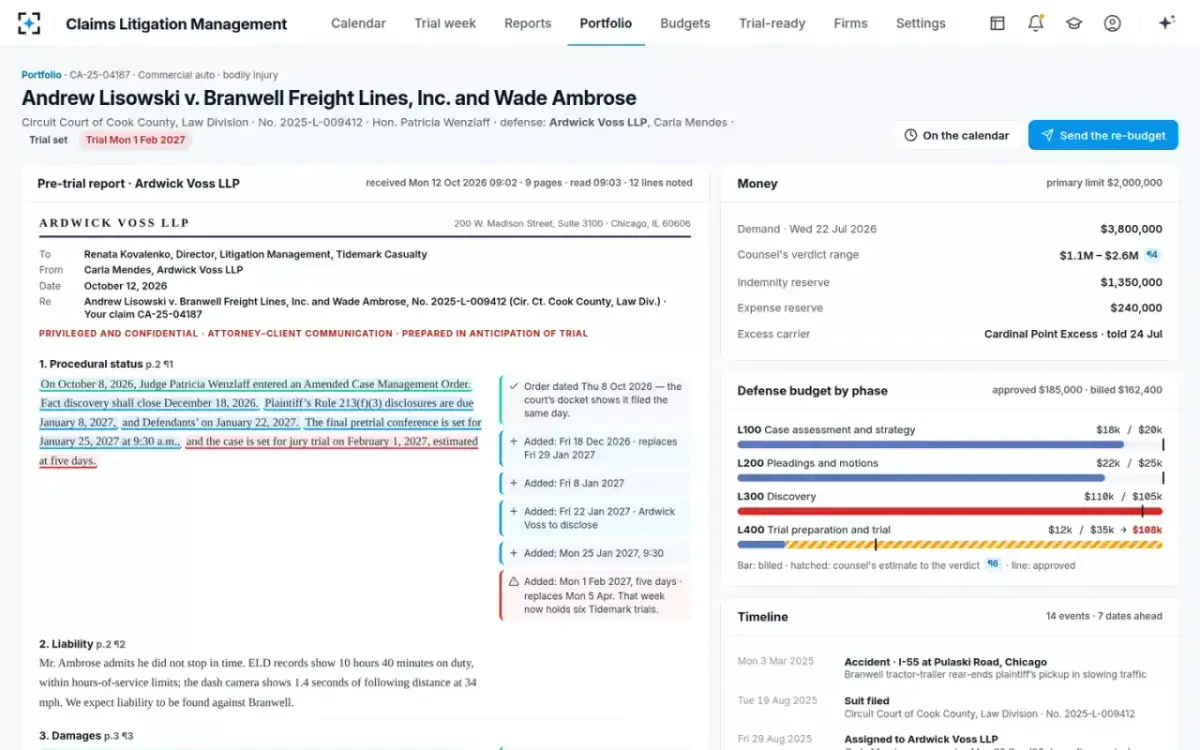
The best way to see the seats is to watch one document cross them. At 09:02 on Monday 12 October, Ardwick Voss LLP sent its nine-page pre-trial report on Lisowski v. Branwell Freight Lines, a commercial auto injury suit in Cook County. Page two reported a new case management order: trial moved from 5 April to 1 February 2027. Page four valued the case at $1.1M to $2.6M before a Cook County jury, against a $3.8M demand, a $2M primary limit and an indemnity reserve of $1.35M.
One pre-trial report, five seats, three decisions
Agent
Counsel report readerReads the report at 09:03, finds the court’s order on p.2, adds five dates with the line quoted and retires the two they replace.
Never: changes a reserve or writes to counsel
Agent
Trial week watcherSees the week of 1 Feb now holds six trials against a limit of five, and the same partner first-chairing two of them.
Never: asks the court for a new date
A person decides
Claim supervisorGets a reserve review: the top of counsel’s range is above the $1.35M reserve. The reserve call stays his.
A person decides
Claims legal counselSees a $3.8M demand above a $2M limit, no mediation held and no authority set, 16 weeks from trial.
A person decides
Litigation managerReads, edits and sends three drafted requests: a trial plan, mediation dates, a re-budget.
Each seat had something to do with the same page. The adjuster needed the new dates on the calendar. The supervisor needed to know that the top of counsel's range sat $1.25M above the reserve. Claims counsel needed to know that a demand above the primary limit was heading to trial with no mediation held, a combination that puts the excess layer above the $2M limit in play. The litigation manager needed to know that the partner trying Lisowski was also first chair in another Cook County trial starting two days later. Before, the report would have reached each of them in sequence, or not at all, depending on who opened it.
The report beside the money: what each seat needed from page two and page four
Litigation claims adjuster job description, honestly written
Most job descriptions for this seat list activities. A better one lists outcomes that can be checked, because the seat is judged on what happens to files, not on how many reports were read. The version below is written that way; each line is something a supervisor can verify from the file.
A litigation claims adjuster job description, written as outcomes
- A defense in place before the answer is due
Counsel assigned, the insured told, and the answer date docketed from the court and the service date, with the rule that set it.
- Every counsel report read the day it arrives
Its dates on the calendar, its valuation compared with the reserve, its requests answered.
- Reserves that move when the evidence moves
A reserve review requested when counsel’s valuation or a demand passes the reserve, not at the next quarter end.
- Defense spend inside an approved budget
Budgets by phase, re-budgets asked for before a phase runs out, invoices checked against the phase they bill.
- No trial without a settlement plan
Mediation held or set, authority set, the insured and any excess carrier told of the trial date in writing.
- Guideline clocks kept for every firm
Late reports chased by name and clock, and a record of what was asked and when.
- Counsel’s judgment left with counsel
Requests for information and plans, never instructions on how to conduct the defense.
The last line is the one most often missing from real postings, and the one bar opinions care about most. The Rhode Island Supreme Court's Ethics Advisory Panel, for example, accepted insurer guidelines that coordinate counsel with the insurer's claim staff, and rejected those that require the insurer's approval before counsel schedules depositions or prepares dispositive motions. A job description that asks the adjuster to approve each deposition writes a conflict into the seat.
Litigation adjuster salary, and the seats around it
BLS does not publish pay for litigation specialists separately; the occupation as a whole earned a median of $78,020 in 2025. The seats the adjuster works with every day are paid on different scales, which is one reason the hand-offs between them are expensive.
Median pay around a sued claim, 2025
The occupation is projected to shrink: the Bureau of Labor Statistics expects the occupation to lose about one job in sixteen between 2025 and 2035, with technology one of the reasons, while about 21,600 openings a year still come from people leaving the work. For a litigation adjuster the useful reading is which part of the week is shrinking. Typing dates and reconciling invoices is; valuing a case, negotiating with a plaintiff's lawyer and running a roundtable are not.
Defense spend gives the seat its weight. The Federal Insurance Office reports that defense and cost containment expense across U.S. property and casualty insurers fell to 3.9 percent of direct premiums earned in 2023 and 2024, after years near 4.5 percent. Most of that line passes through litigation desks, as budgets approved and invoices paid.
Where agents fit on the litigation desk, and where they stop
Agents fit where the work is reading and matching, and stop where it becomes a decision. In Claims Litigation Management six agents divide the reading: a suit intake reader dockets the answer date from the complaint and summons, a docket watcher reads court e-filing notices and orders, a counsel report reader reads every firm report, a budget and invoice checker matches LEDES invoices to budget phases, a trial readiness checker runs eight checks on every trial set in the next 26 weeks, and a trial week watcher looks for stacked weeks and double-booked lawyers.
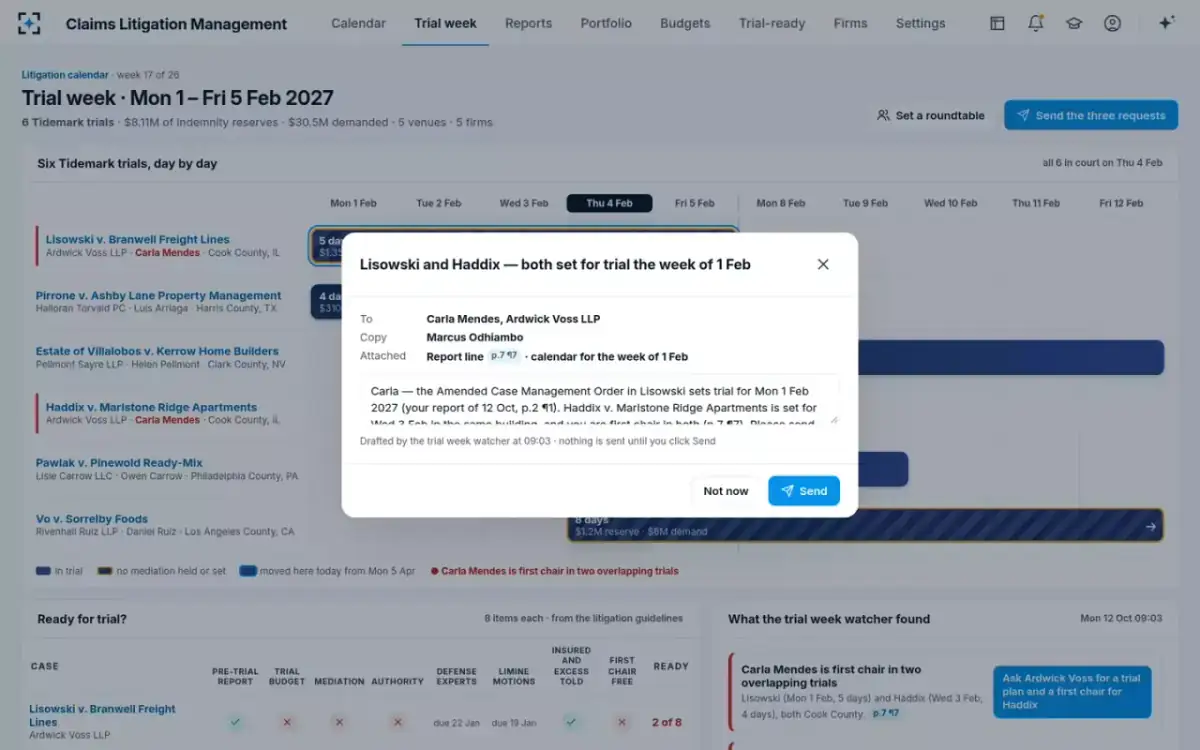
Each has written limits. None files anything with a court, chooses counsel, writes to a firm, changes a reserve or pays or cuts a bill. A date mentioned only in a firm's email is held for the litigation manager to confirm rather than docketed. Requests to firms are drafted with the report line attached and go only when a person clicks Send, and every request sent is logged on the case.
Drafted, quoted, not sent: the request waits for the litigation manager
That split is the honest answer to whether the litigation adjuster's job survives automation. The parts that disappear are the ones nobody hired an adjuster to do. The parts that remain, deciding what a case is worth, when to settle and how hard to push a firm, get more time and better information. Trial dates are where the seats meet hardest, and the eight checks behind a ready trial are set out in trial readiness. To see the Lisowski file screen by screen, start from Claims Litigation Management.
Questions people ask
What is a litigation claims adjuster?
A litigation claims adjuster is an insurance claims professional who handles claims after a lawsuit has been filed. The role manages defense counsel's reports, reserves, budgets and settlement authority on the insurer's side, while the defense lawyer conducts the case. Employers also call it litigation specialist, litigation claims examiner or litigated claims specialist.
What is an adjuster's role in a lawsuit?
In a liability suit against a policyholder, the adjuster funds and supervises the defense and decides on settlement within authority; the lawyer defends the insured. The adjuster does not appear in court as an advocate, but may attend mediation or a settlement conference as the person with authority, since a federal judge may require a party's representative to be "present or reasonably available" to consider settlement.
What is panel counsel?
Panel counsel are the outside law firms an insurer has approved to defend its insureds, usually at agreed rates and under its litigation guidelines. The sample carrier on this page uses 37 panel firms for 412 suits, with ten firms carrying most of them. Panel membership is the insurer's choice; once assigned, the firm's duty runs to the insured it defends.
Who manages defense counsel for an insurer?
The litigation adjuster manages the file relationship (reports, budgets, invoices, deadlines) and the litigation manager manages the panel (assignments, guidelines, firm performance). Claims legal counsel sets strategy on large cases and holds higher settlement authority. None of them may direct the lawyer's professional judgment, under rules modelled on ABA Model Rule 5.4(c).
How many injury claims end up in litigation?
The Insurance Research Council, which is supported by insurers, found that 18% of auto injury claimants in its 2022 data were in litigation, up from 10% in 2017, across 7.4 million claims from nine insurers. Very few of those suits reach a verdict: in the federal courts, 1,462 of 355,243 civil cases ended during trial in the year to September 2025.