Legal matter management software is the system a legal department uses to track its matters: each lawsuit, claim, contract dispute or investigation, with its parties, outside counsel, status, documents, budget and invoices, usually tied to an e-billing system. It was built for corporate legal teams, where the company is the client and directs the strategy. An insurer's litigated claims fit that mould only partly. The carrier pays for the defense of its policyholder, through dozens of panel firms, and every suit is also a claim with a reserve, a policy limit and a demand that live in the claim system. What a claims legal team needs is a claims litigation view: the claim's money, the firms' reports and the court's dates on one timeline per suit, and one calendar across all of them. Botminds' Claims Litigation Management provides that view over the claim and e-billing systems a carrier already runs, and this guide sets out how to compare it with a matter management platform on your own files.
One portfolio, three approaches: what each holds and what switching costs
| Matter management platform, configured for claims | Litigation module of the claim system | Claims litigation view over existing systems | |
|---|---|---|---|
| Unit of record | The matter, with the claim number as a field | The claim, with litigation as a status | The suit, linked to its claim, firm, court and invoices |
| Where dates come from | Typed by staff or the firm; some import rules calendars | Typed by the adjuster, often one trial date | Read from orders, notices and report lines, each sourced |
| Money | Legal spend and budgets; reserves only if integrated | Reserves, payments, limits; legal spend partly | Reserves, limits and demand from the claim system beside budget and invoices |
| Firm reports | Stored as documents | Attached as documents | Read on arrival, summarised, dates and valuations extracted with the line |
| Across firms | Reports by firm and spend | Limited | Trials per week, first chairs per day, reports on time, budgets held |
| Cost to switch | High: new system of record, data migration, firm onboarding | Low if already owned; limited gain | Moderate: connections to mailbox, notices, e-billing and claim system; no new system of record |
What is matter management in legal, and what is matter management software?
A matter is any piece of legal work a department tracks as a unit, and matter management is the discipline of tracking them: who is handling each matter, what it will cost, where it stands and what was decided. Matter management software, sometimes called a matter management system or platform, records those facts for every matter and usually connects to e-billing, so outside counsel's invoices arrive in a standard electronic format and are checked against budgets and billing guidelines before payment.
Many carriers receive defense invoices electronically in a LEDES format (the fictional sample carrier in these guides uses LEDES 1998B), with each line coded under the Uniform Task-Based Management System. For litigation the top-level phases are L100 Case Assessment, Development and Administration; L200 Pre-Trial Pleadings and Motions; L300 Discovery; L400 Trial Preparation and Trial; and L500 Appeal. Both matter tools and claims tools can read these. The difference between them is not the invoice; it is everything around it.
Is matter management the same as claims litigation management?
No, because the unit and the relationship differ. A matter management platform treats the lawsuit as the record and the company as the client. A carrier's litigated claim is first a claim, with a reserve the supervisor sets, a policy limit the demand is measured against and, often, an excess carrier who must be told of trial. The lawsuit is one chapter of it. And the lawyer the carrier hires usually represents the policyholder; the ABA's commentary on Model Rule 1.8 names liability insurers among third-party payers whose interests can differ from the client's, notably in keeping costs down and in hearing how the case is going.
Those two interests, cost and information, are exactly what a carrier's tooling serves, and both are bounded by the lawyer's duty to the insured. A matter platform configured for a corporate department assumes the department may direct counsel. A claims litigation view has to be built the other way round: it collects what counsel reports, checks it against the guidelines, and drafts requests for a person to send, without ever instructing counsel on the conduct of the defense.
The same lawsuit, seen from a legal department and from a claim desk
Legal department matter: The company itself.
Carrier's litigated claim: Usually the policyholder; the carrier pays and supervises.
Legal department matter: Legal spend against budget.
Carrier's litigated claim: Indemnity reserve, expense reserve, policy limit and demand, plus legal spend.
Legal department matter: Dozens of varied matters.
Carrier's litigated claim: Hundreds of similar injury suits across dozens of courts and firms.
Legal department matter: Whatever the matter needs.
Carrier's litigated claim: The trial date, and whether settlement authority and mediation are ready for it.
Legal department matter: Internal governance.
Carrier's litigated claim: Claim files examiners can reconstruct, under state rules based on NAIC Model #902.
What do insurers need beyond matter management?
Four things, all about joining the lawsuit back to the claim. First, the claim's money on the suit's page: reserve, limit and demand beside the budget, so a firm's valuation can be compared with the reserve the morning it arrives. Second, dates from the court, sourced, across every firm, so a trial week can be counted. Third, the firms' reports read, not just stored, because a pre-trial report is where a new trial date, a new valuation and a new cost estimate usually appear together. Fourth, a file an examiner can follow: the NAIC's model claims regulation expects detailed documentation in each claim file, with each relevant document dated as received, processed or mailed.
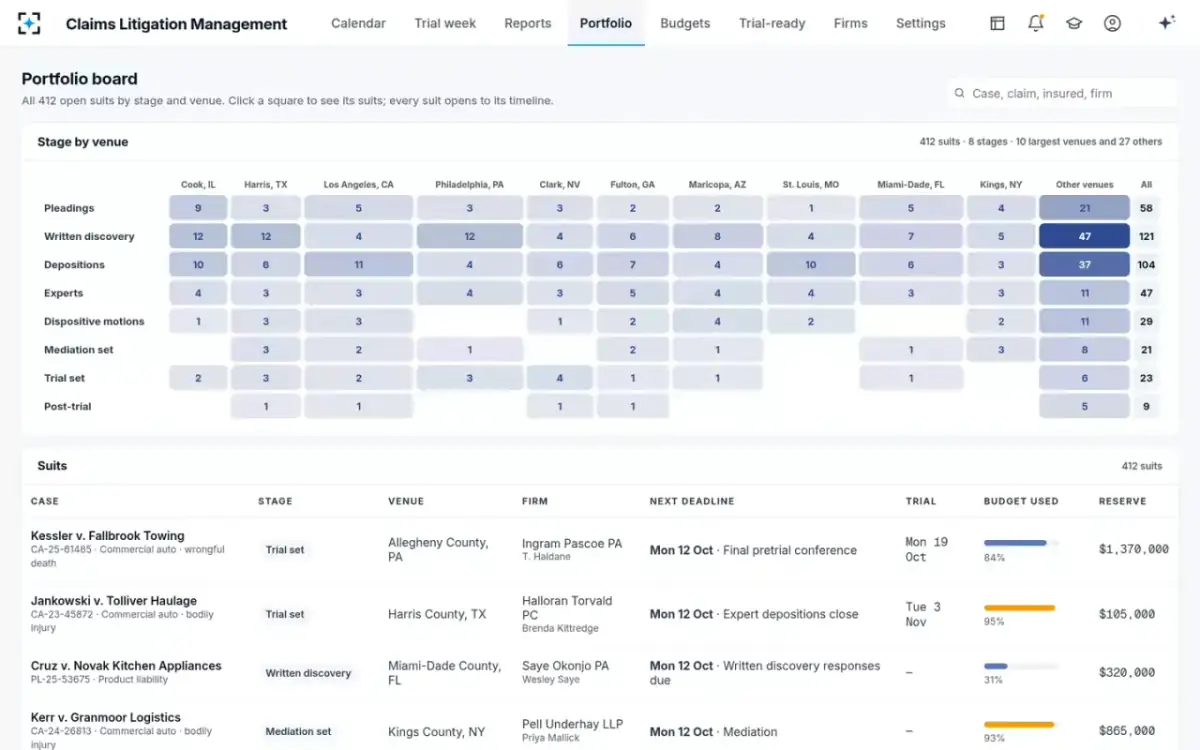
The fictional sample carrier used in these guides shows what joining them looks like. Its portfolio board lists 412 open suits by stage and venue, from 58 still in pleadings to 23 set for trial and 9 after trial, and every suit opens to a timeline that runs from the accident through the suit to the next deadline, with the reserve and budget used on the same row.
The portfolio by stage and venue, with the money on every row
Can matter management software track trial dates?
Yes, as a field; the question is where the field gets its value and what it is compared with. A trial date typed into a matter record from a firm's report is as current as the last report. The federal rules let a scheduling order fix the pretrial conference and trial dates, and amended orders move them, so a trial field that is not tied to the order goes stale silently. And a trial date is only useful to a carrier when it is counted with the others: how many trials in that week, which partner is first chair in two of them, which have no mediation held.
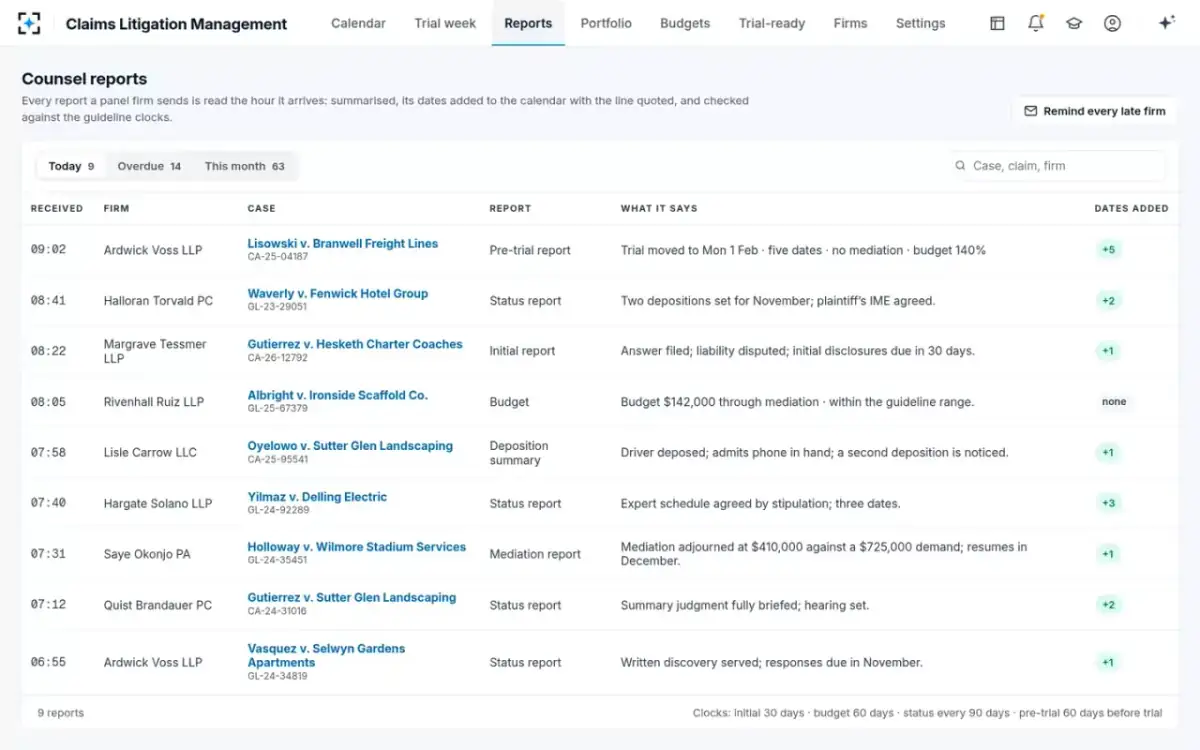
In the sample portfolio, one amended order moved Lisowski v. Branwell Freight Lines from Monday 5 April to Monday 1 February 2027. In a matter record the change is one edit. In a claims litigation view it is a week that now holds six trials against a limit of five, three with no mediation, and three drafted requests waiting for the litigation manager, all visible the morning the report arrived.
How do you migrate litigated files to a new system?
Migrate the sources, not the typed values. The most common migration mistake is copying every date from the old system into the new one, which imports every stale trial date with it. A better migration loads the open suits and their links (claim number, court, case number, firm, lead counsel), then rebuilds the calendar from the latest order and the latest firm report for each suit, and runs the old and new calendars side by side until they agree or the differences are explained.
What to bring to a migration of litigated files
- The list of open suits, linked to claims
Claim number, court, case number, assigned firm and lead counsel for each.
- The latest order and notice of hearing per suit
From the court’s docket. These, not old typed dates, rebuild the calendar.
- The latest report from each firm per suit
Status, budget or pre-trial, with its valuation and dates.
- Approved budgets by phase and invoice history
LEDES invoices with UTBMS codes, so spend can be matched to phases from day one.
- Reserves, limits, demands and excess layers
From the claim system, read rather than copied, so they stay current.
- Your litigation guidelines
Reporting clocks, budget rules, trial-week limits and who may send what.
- A sample for the side-by-side
Thirty suits with known histories, to compare the old and new calendars date by date.
A six-week switch, week by week
A switch should prove itself on the carrier's own suits before it replaces anything. For a portfolio the size of the sample, a few hundred open suits across a few dozen firms, the plan below fits in six weeks, with the old process running throughout. It is a plan to adapt, not a promise; connection work depends on the carrier's systems.
Six weeks from first connection to switching off the old calendar
- Connect mailbox, notices, e-billing, claim systemwk 1–1.5
- Load suits; rebuild dates from orders and reportswk 2–2.5
- Side by side on 30 suits; explain every differencewk 3–4
- Guidelines set; firms told how reports are readwk 5
- Full portfolio; old calendar retiredwk 6
Week five matters more than it looks. Panel firms should be told, before the switch, that their reports are now read on arrival and that requests will quote the paragraph they concern. That changes behaviour in a useful direction: firms that know page two will be read write page two carefully. How each date is then judged, matched to the order, missed, or held, is covered in court deadline calculator vs the court's order.
Questions for any legal matter management platform
Whichever approach a carrier leans toward, the same questions separate a tool that fits litigated claims from one that merely stores them. Ask them with your own suits on the screen, not a demonstration portfolio.
Questions for a legal matter management platform vendor
- Can I see the reserve, the limit and the demand on the suit?
Read live from the claim system, not re-keyed into a custom field.
- Where did this trial date come from?
Ask to open the order or report line behind any date on the screen.
- How many trials do we have the week of the 1st?
Across every firm, with first chairs and mediation status for each.
- What happens when a firm sends a pre-trial report?
Stored, or read? Which dates, valuations and costs come out of it, and with what citation?
- How is spend projected to trial?
From billing history alone, or from counsel’s own estimate of the remaining phases?
- What does the system do on its own?
Anything beyond reading, computing and drafting should be a named person’s action.
- What does switching off cost?
Can you export every date with its source, every report summary and every request sent?
Claims Litigation Management beside a matter platform
Claims Litigation Management is the third column of the first table. It works with the systems a carrier already runs: court e-filing notices, the reports mailbox and firm portal, the e-billing system's LEDES 1998B invoices, the claim system for reserves, payments and limits, and mediation and settlement records. It does not replace the claim system or the e-billing system, and it is not a document management system for a legal department's non-litigation matters. A carrier with a matter platform it likes can keep it for that work and use the claims view for the litigated portfolio.
What the claims view adds to the sample portfolio on one Monday
1,183
deadlines in the next 26 weeks, each with its source
23
trials set, counted by week and by first chair
14
counsel reports overdue against the guideline clocks, across 7 firms
107%
billed against approved defense budgets this year
The right choice depends on what the carrier already owns and where its hours go. If most of the litigation desk's week is reading reports and reconciling dates, the claims view addresses it directly; if the main gap is invoice review, a matter and e-billing platform may be the better first step. The cost lines behind that choice are in litigation management software for insurers, and the trial week the sample portfolio's calendar exposed is examined in trial readiness.
Reports read, not just stored
Questions people ask
What is a matter management system?
A system that records each legal matter a department handles, with its parties, counsel, status, documents, budget and invoices, usually connected to e-billing. It gives the department one place to see its open work and spend. For an insurer it covers the lawsuit but not, without integration, the claim behind it.
What is legal matter management software used for in insurance?
Mostly for outside counsel spend: receiving LEDES invoices, checking them against budgets and billing guidelines, and reporting spend by firm. Some carriers also use it to store firm reports and track key dates. The gaps are the claim's reserve and limit, cross-firm trial calendars, and reading the reports themselves.
What is a claims litigation view?
A view of each litigated claim that joins the claim's money (reserve, limit, demand) with the lawsuit's dates and the defense firm's reports and budget, plus a calendar across all suits. It answers carrier questions a matter list cannot, such as how many trials fall in one week and which have no settlement plan.
Is matter management software good for litigation?
For a legal department's own litigation it can be, especially for tracking spend and status. For an insurer's defense of policyholders across many firms, it needs the claim system joined in, dates tied to court orders and reports read rather than stored. Test it on thirty of your own suits before deciding.
How long does it take to switch litigation management systems?
There is no published benchmark. For a few hundred suits, a staged switch of about six weeks is a reasonable plan: connect sources, rebuild dates from orders, run side by side on a sample, set guidelines and tell the firms, then retire the old calendar. Connection work drives the timeline.