Litigation management software, for an insurer, is the system a claims legal team uses to run its lawsuits across outside defense firms: who is defending which suit, what each firm has reported, every court deadline, the defense budget against the bills, and which cases are heading to trial without a settlement plan. Carriers run that work in one of three ways: on a claim system plus spreadsheets, with people reading every report; with outside services taking over parts of it, usually bill review; or with software agents reading every report, court notice and invoice while people make the decisions. The choice matters because defense spend is material. The Federal Insurance Office puts defense and cost containment at 3.9% of U.S. property and casualty premiums in 2024, more in commercial auto. Botminds' Claims Litigation Management is the third way, and this guide sets out what each way costs and where it fits.
Three ways to run a litigated portfolio
| Claim system, spreadsheets, people reading | Outside services for parts of the work | Agents read, people decide | |
|---|---|---|---|
| Who reads firm reports | Adjusters and the litigation manager, when time allows | Still the carrier’s people; services rarely read reports | An agent, the day each report arrives; people read the summary and the quoted lines |
| Court deadlines | Typed from reports; one trial date per file is common | Unchanged | From orders, notices and report lines, each sourced; email-only dates held |
| Invoices and budgets | Checked by hand, often after the money is spent | Bill review service checks each invoice against guidelines | Each invoice matched to its budget phase and projected through trial |
| Trial readiness | Rebuilt by hand before file review | Unchanged | Eight items checked every morning for every trial in 26 weeks |
| Who decides | The carrier’s people | The carrier’s people; a service may recommend bill cuts | The carrier’s people; agents draft requests and flag, never decide |
| Main cost | Hours of skilled staff on reading and typing | Service fees plus the hours that remain | Software, connections and a pilot, plus the hours that remain |
What is litigation management software for an insurer?
It is a system for overseeing litigation the insurer pays for but does not conduct. That distinguishes it from two neighbours. A law firm's case management system runs the firm's own work, and litigation management software for in-house counsel runs a company's own disputes, where the company is the client. An insurer's litigated claims sit in between: the carrier funds and supervises a defense whose client is usually its policyholder, through dozens of firms, against reserves and policy limits that live in the claim system.
That position defines the features. The carrier needs to see across firms, not inside one; it needs the money (reserve, limit, demand, budget) beside the dates; and it needs every action to respect the line between asking counsel for information and directing counsel's judgment. A system built for a corporate legal department usually has the first two partly and the third not at all. The difference is explored in legal matter management software vs a claims litigation view.
How much do insurers spend on defense costs?
Across all U.S. property and casualty lines, defense and cost containment (DCC) expense came to 3.9% of direct premiums earned in 2023 and 2024, according to the Federal Insurance Office, down from about 4.5% between 2015 and 2020. The ratio varies widely by line, and the lines that fill litigation desks sit well above the average.
Defense and cost containment as a share of premium, 2024
Two other numbers frame the pressure. The Insurance Research Council, an insurer-supported non-profit, found litigation among auto injury claimants rising from 10% to 18% between 2017 and 2022, so more files enter litigation desks each year. And the Casualty Actuarial Society, in an analysis co-authored with the insurer-funded Triple-I, estimates that litigation trends added $231.6 billion to $281.2 billion to liability losses and defense costs over a decade. The second is an estimate from interested sponsors and should be read that way; the direction is not in dispute.
One accounting point matters for this decision. Under the definitions the NAIC adopted for annual statements in 1998, DCC includes "Litigation management expenses", and covers defense and cost containment "whether internal or external." The cost of managing litigation is itself defense cost. A litigation management programme is judged on the same line it is charged to, which the guide on the defense and cost containment definition explains in full.
What each way costs, line by line
Litigation case management software pricing is rarely published, and outsourced services price by file, by invoice or by share of savings, so comparisons on sticker price mislead. A fair comparison adds the same four lines for each option. The first two are visible in every budget; the last two are not, and they are the ones that decide outcomes.
The total cost of running a litigated portfolio, any way you run it
Reading and typing time
hours a week × loaded cost × weeks
Reports read, dates typed, invoices checked, status rebuilt for file reviews.
Claims operations
Fees and licences
service fees + software + connections
Bill review fees, matter or calendar software, e-billing, court notice feeds.
Procurement
Budget leakage
overruns found after payment
Phases billed past budget before anyone projected the trial cost.
Litigation manager
The missed or late date
probability × consequence
A default, an excluded expert, a trial week nobody prepared for.
Claims legal counsel
Reading and typing time is where the options differ most. Botminds' own estimate for a litigation director running a few hundred open suits puts 34 hours of a week into six kinds of work by hand, of which 28 are reading, typing, chasing and reconciling. With agents reading every document, the estimate falls to 12.5 hours, and the 6 hours of roundtables and settlement decisions stay exactly where they were. Those are Botminds' design estimates, not measured customer results; a pilot should measure them on the carrier's own desk.
Where a litigation director's week goes, by hand and with agents (estimated hours)
By hand: 34 hours
- Reading reports, typing dates · 29%
- Invoices vs budgets · 18%
- Trial-readiness status · 15%
- Late reports, stacked trials · 21%
- Roundtables, settlement · 17%
With agents: 12.5 hours
- Reading summaries · 16%
- Budgets · 16%
- Trial status · 8%
- Late reports, stacked trials · 12%
- Roundtables, settlement · 48%
Should insurers outsource litigation management?
Parts of it, sometimes; the decisions, never. Outside services are most common for bill review, where a vendor checks invoices against billing guidelines. That can reduce spend, but it carries an ethical cost on the firm's side: several state bar opinions require the insured client's informed consent before defense bills go to an outside auditor, and the Montana Supreme Court treated auditors as outside the protected circle around the defense (the details are in the tripartite relationship in insurance defense). Outsourcing also leaves the most expensive line, reading reports and keeping dates, with the carrier's own people.
What cannot be outsourced is authority. Reserves, settlement offers, the choice to try or settle, and requests to counsel belong to named people at the carrier. A federal judge may require a party's representative to attend, or be reachable, when settlement is considered, and that representative has to be someone who can say yes. Any option, including software, that blurs who holds authority creates a problem larger than the hours it saves.
The cost nobody prices: a missed date, a stacked week, a budget that runs out
The largest costs of a litigated portfolio are events, not hours, and they are invisible in a budget until they happen. Three examples from the fictional sample portfolio used in these guides, 412 open suits at an invented carrier called Tidemark Casualty, show the pattern.
The stacked week. An amended order moved Lisowski v. Branwell Freight Lines to trial on Monday 1 February 2027. That week already held five Tidemark trials; now it held six, all in court on Thursday 4 February, with $8.11M of indemnity reserves against $30.5M demanded, and one partner first chair in two overlapping Cook County trials. Three of the six had no mediation held or set. Seen in October, that is a set of requests to firms. Seen in late January, it is a scramble for trial counsel and a weak position in every settlement conversation that week.
The budget that runs out. Ardwick Voss had billed $162,400 of an approved $185,000 on Lisowski, and its own report put trial preparation and trial at about $96,000 more: $258,400, 140% of budget. Across the portfolio, firms had billed $41.8M against $38.9M approved in 2026, or 107%. A bill reviewer cutting line items would not have changed either number, because the overrun is a trial plan, not a billing error. It needed a re-budget conversation before the money was spent.
The overrun is a trial plan: suits projected past budget before the verdict
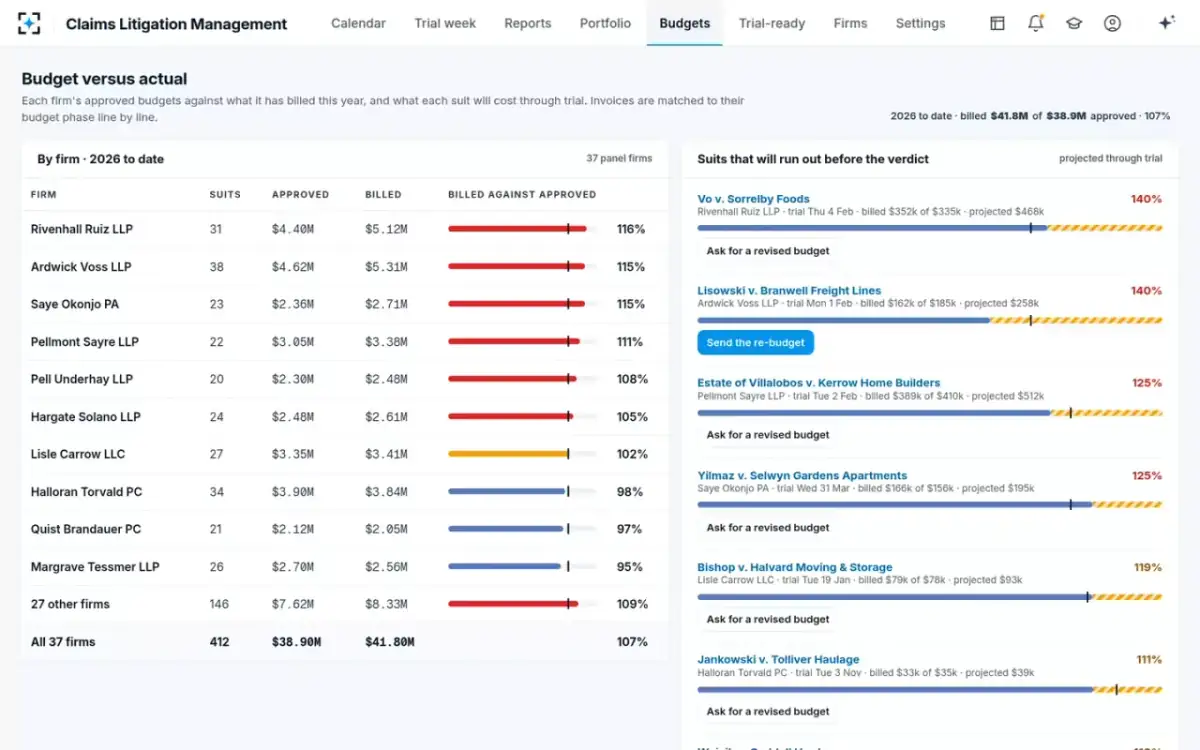
The missed date is the third, and the hardest to price because it is rare and severe. A missed answer date leads to an entry of default; a late expert disclosure can exclude the expert. Most carriers never see these because their firms' dockets catch them. What carriers do see is the softer version: a mediation scheduled after the authority meeting could be held, a pre-trial report arriving after the final pretrial conference. Each is a cost the formula's fourth line has to carry, and the only way to shrink it is to know every date the day it is set.
What features matter in litigation management software
The features that pay are the ones that remove a line from the cost formula without moving authority. The checklist below is ordered by how much of the director's week each one returns, and each item names the evidence a vendor should be able to show on the carrier's own documents.
Features that matter, and the evidence to ask for
- Reads every counsel report the day it arrives
Ask for a summary of ten of your own reports with every date found and its line quoted.
- Dates sourced, not typed
Every deadline opens the order, notice or report line it came from; replaced dates are kept on the history.
- Budget by phase, projected through trial
LEDES invoices matched to UTBMS phases, and a projection that uses counsel’s own estimate of what is left.
- Trial readiness checked continuously
Every trial in the next six months against the items your guidelines require, every morning.
- A portfolio view across firms
Trials per week against a limit, first chairs per day, reports on time and budgets held per firm.
- Drafts, never sends
Requests to firms drafted with the line that prompted them; a named person sends each one.
- Written limits for every automated step
No filing, no writing to counsel, no reserve changes, no bill cuts or payments.
- Your guidelines as settings
Reporting clocks, trial-week limit and budget alerts versioned, with the director approving changes.
Litigation case management software pricing: what to ask
Ask for the total, not the licence. Pricing in this market is quoted per user, per matter, per invoice or per firm, and none of those units maps cleanly onto the cost formula. The questions that make quotes comparable are about the work around the software: what it takes to connect court notices, the reports mailbox, the e-billing system and the claim system; how long a pilot on the carrier's own suits takes; and which of the four cost lines the vendor will measure during that pilot.
A carrier should also ask how the cost will be reported. Since litigation management expenses fall within DCC, the software, any service fees and the staff time spent managing defense counsel may all land on the same line the programme is meant to reduce, depending on how the carrier allocates them. A business case that shows savings in defense spend but ignores the programme's own cost on that line will not survive the annual statement.
Where Claims Litigation Management fits among the three ways
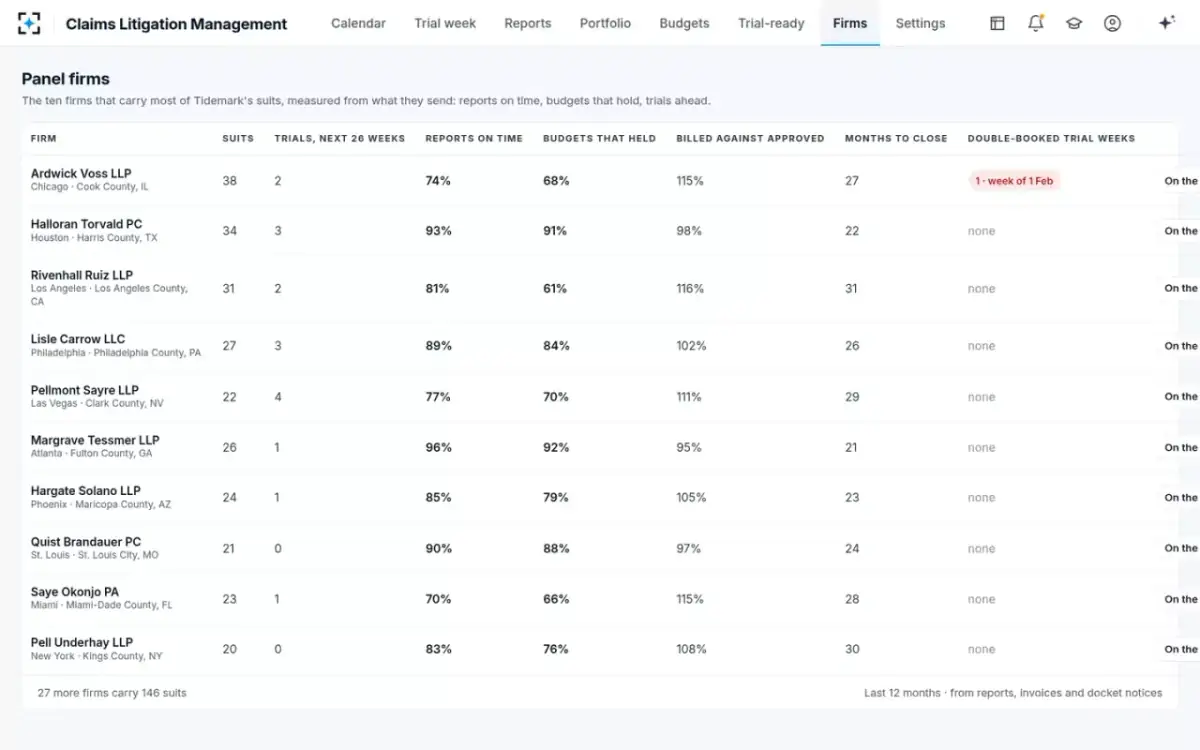
Claims Litigation Management is built for the third way. Six agents read suits, dockets, firm reports and invoices onto one calendar: a suit intake reader, a docket watcher, a counsel report reader, a budget and invoice checker, a trial readiness checker and a trial week watcher. People keep every decision: the litigation manager sends every request, claims legal counsel holds settlement authority above the carrier's threshold, and the claim supervisor sets reserves. The design targets are that a firm report's deadlines reach the calendar the same day, each with its quoted line, and that 100% of counsel reports are checked against the guideline clocks.
The panel, measured from what each firm sends
It does not replace a bill review service's line-item guideline audit, and it does not cut, approve or pay a bill; its budget work is projection and alerting. It is not a law firm's docketing system, and it does not file with any court. And in its current form, a carrier's court notice feeds, mailbox, e-billing and claim system connections have to be set up for its own environment, which is the first job of a pilot. The honest comparison, then, is not software against people but where each hour goes. How dates are handled at the source is covered in docket management software for claims; to see the Lisowski file end to end, start from Claims Litigation Management.
Questions people ask
What is a litigation management system?
A system for overseeing lawsuits that an organisation is party to or pays for: deadlines, outside counsel's reports, budgets and invoices, and outcomes. In insurance it usually means overseeing the defense of policyholders across many panel firms. It differs from a law firm's case management system, which runs the firm's own work.
What is litigation case management?
The day-to-day running of a lawsuit: deadlines, filings, discovery, experts and trial preparation. Defense counsel does it inside each case. The insurer's litigation management sits above it, watching many cases at once for dates, spend and settlement opportunities without directing counsel's judgment.
How much do insurers spend on defense costs?
About 3.9% of direct premiums earned across U.S. property and casualty lines in 2023 and 2024, according to the Federal Insurance Office. Commercial auto runs higher, at roughly 6.5% in 2024 on FIO's chart, and Florida's all-lines ratio reached 6.6% in 2022 before its reforms.
Is litigation management software for in-house counsel the same?
Not quite. In-house tools manage a company's own disputes, where the company is the client and directs strategy. An insurer's defense counsel usually represents the policyholder, so the carrier's tool must support oversight and reporting without directing counsel's professional judgment, and it needs reserves and policy limits beside the dates.
What does litigation management software cost?
Vendors rarely publish prices, and units vary by user, matter, invoice or firm. Compare total cost instead: staff hours on reading and typing, fees and licences, connections to court notices and e-billing, budget overruns caught late, and the cost of missed dates. Ask each vendor to measure those lines in a pilot on your own suits.