Trial readiness means a case set for trial has everything in place to be tried, or settled on good terms, on the date the court has fixed. In court the phrase often names a hearing, the trial readiness or final pretrial conference, where the judge checks the same thing. For an insurer defending a policyholder, readiness has two halves: the defense must be ready (experts disclosed, motions in limine filed, a pre-trial report in hand, a lawyer free to try it) and the carrier must be ready (a trial budget approved, mediation held, settlement authority set, the insured and any excess carrier told). Botminds' Claims Litigation Management checks eight such items every morning for every trial set in the next 26 weeks, because the hard part of trial readiness is not knowing what to check. It is checking every trial, early enough, when trials are rare enough that nobody expects one.
The 26 weeks before trial: what the rules fix, and what the carrier must do
- Discovery, motions: by order
- Experts by day 90; rebuttal 30 days later60 d
- Disclosures, day 3016 d
- Pretrial conf.14 d
- Daily checks: budget, mediation, authority, notices122 d
- Pre-trial report due 60 days out; roundtable; final authority60 d
What is trial readiness?
Trial readiness is the state of a case in which nothing the trial needs is still missing. For the defense that means the evidence is disclosed on time, the witnesses and experts are prepared, the motions that shape the trial are filed, and the lawyer who will try the case is available. Under the federal rules, the attorney who will try the case must be at the final pretrial conference, and the order that follows it binds the trial: the court "may modify the order issued after a final pretrial conference only to prevent manifest injustice."
For the insurer paying for the defense, readiness has a second meaning that no court checks. A trial is the most expensive and least predictable way to end a claim, so a ready carrier is one that has already done everything that might end it sooner, and is prepared for the cost if it does not: a trial budget approved, mediation held, authority set, the insured and any excess carrier told in writing. A case can be ready for the judge and unready for the carrier, and the second kind of gap is the one that costs most.
What is a trial readiness conference, and what happens at a final pretrial conference?
A trial readiness conference is a hearing some state courts hold shortly before trial to confirm the case will proceed: witnesses, exhibits, estimated length, outstanding motions, and whether settlement is still possible. Many courts ask the parties for a written trial readiness statement beforehand. The federal equivalent is the final pretrial conference under Rule 16(e), held to "formulate a trial plan, including a plan to facilitate the admission of evidence."
The federal rule does not set a fixed time for it. The committee that drafted the rule declined to, though it noted that "An optimum time of 10 days to two weeks has been suggested by one federal judge." In the sample case used in these guides, a state-court suit, the final pretrial conference fell one week before trial. Either way, the conference is too late to fix a carrier-side gap. By then, the mediation either happened or did not, and the authority to settle either exists or has to be found in days.
Why trial weeks surprise carriers
Because trials are rare and slow, and rare events are planned for badly. In the federal courts, 1,462 of the 355,243 civil cases that ended in the year to September 2025 ended during trial, at a median of 30.7 months from filing, according to U.S. Courts Table C-5. A litigation adjuster can work dozens of suits that settle in discovery before one reaches a jury, and by the time it does, the file has changed hands, firms and reserves more than once.
Trials are rare, slow and short
1,462of 355,243
federal civil cases ended during trial, year to Sept 2025
U.S. Courts, Table C-5
33.7months
median from filing to trial in federal civil cases, year to June 2026
U.S. Courts, caseload profile
15
trials completed per federal judgeship in that year
U.S. Courts, caseload profile
3.7days
average length of a tort jury trial in state courts, 2005
Bureau of Justice Statistics
The carrier's portfolio concentrates what the national figures spread out. The fictional sample carrier, Tidemark Casualty, had 412 open suits and 23 trials set in the next 26 weeks on Monday 12 October. Trials are short, a few days each in the BJS data, so they bunch: a carrier with several firms in the same county can find several trials in the same week with no one having planned it. Each firm sees only its own calendar, and nobody at the carrier was counting.
A trial readiness checklist: the eight items, and why each one
The eight items below are the sample carrier's, drawn from its litigation guidelines; a carrier should adapt them to its own. Four belong to the defense and four to the carrier. Each is checked for every trial set in the next 26 weeks, every morning, and marked done, due later or missing now.
Eight items for every trial set in the next 26 weeks
- Pre-trial report received
Counsel’s report with procedural status, liability, damages, verdict range and trial cost. Due 60 days before trial in the sample guidelines.
- Trial budget approved
Trial preparation and trial (UTBMS L400) budgeted from counsel’s estimate, before the money is spent.
- Mediation held or set
Federal district courts must require litigants in civil cases to consider alternative dispute resolution; a trial with no mediation on the calendar has skipped a step.
- Settlement authority set
A figure, and a person who can say yes on the day, before mediation and the final pretrial conference.
- Defense experts disclosed
By the ordered date or, absent an order in federal court, at least 90 days before trial. A late expert can be excluded.
- Motions in limine filed
The motions that decide what the jury hears, by the date the order or local rule sets.
- Insured and excess carrier told of trial
In writing, with the date and, where the demand exceeds the limit, the exposure.
- First chair free that week
The lawyer who will try the case is not first chair in another trial on overlapping days.
Two of the items carry rules behind them. Rule 26(a)(2)(D) puts federal expert disclosures, absent a stipulation or order, "at least 90 days before the date set for trial", and pretrial disclosures of witnesses and exhibits must be made "at least 30 days before trial." On mediation, federal law requires each district court to make litigants in all civil cases "consider the use of an alternative dispute resolution process at an appropriate stage in the litigation." The other items are the carrier's own discipline, and they are the ones most often missing.
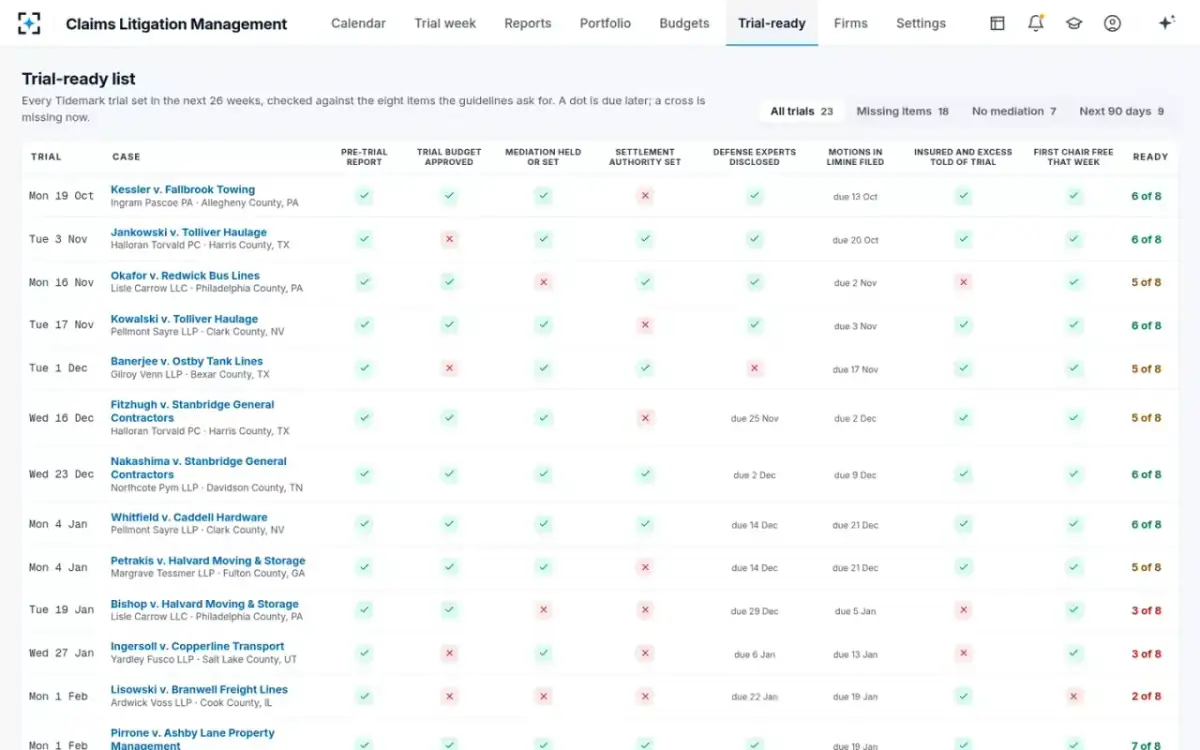
Four trials on the sample carrier's list, checked on the morning of 12 October
| Trial | Date | Ready | What is missing |
|---|---|---|---|
| Kessler v. Fallbrook Towing, Allegheny County | Mon 19 Oct | 6 of 8 | Settlement authority not set, one week out; final pretrial conference today |
| Bishop v. Halvard Moving & Storage, Philadelphia County | Tue 19 Jan | 3 of 8 | No mediation; no authority; insured and excess not told |
| Ingersoll v. Copperline Transport, Salt Lake County | Wed 27 Jan | 3 of 8 | Trial budget not approved; no authority; insured and excess not told |
| Lisowski v. Branwell Freight Lines, Cook County | Mon 1 Feb | 2 of 8 | No trial budget, mediation or authority; first chair in a second trial that week |
Every trial in 26 weeks, against the same eight items
What happens if two trials are scheduled the same week?
For a carrier, two trials in the same week are routine; two trials with the same first chair on overlapping days are a problem, and so is a week with more trials than the litigation team can staff with roundtables and authority. The court will not resolve it for the carrier. A scheduling order changes only for good cause and with the judge's agreement, and asking for a new date is defense counsel's motion to make, not the insurer's. What the carrier can do is find the collision early and ask the firm for a plan.
The sample portfolio shows how a collision forms. On Monday 12 October an amended order moved Lisowski v. Branwell Freight Lines from April to Monday 1 February 2027. That week already held five Tidemark trials; now it held six, against the carrier's limit of five, with all six in court on Thursday 4 February, $8.11M of indemnity reserves against $30.5M demanded, across five venues and five firms. Carla Mendes of Ardwick Voss was first chair in Lisowski, five days from Monday, and in Haddix v. Marlstone Ridge Apartments, four days from Wednesday, both in Cook County.
Six trials in one week, all in court on Thursday 4 February
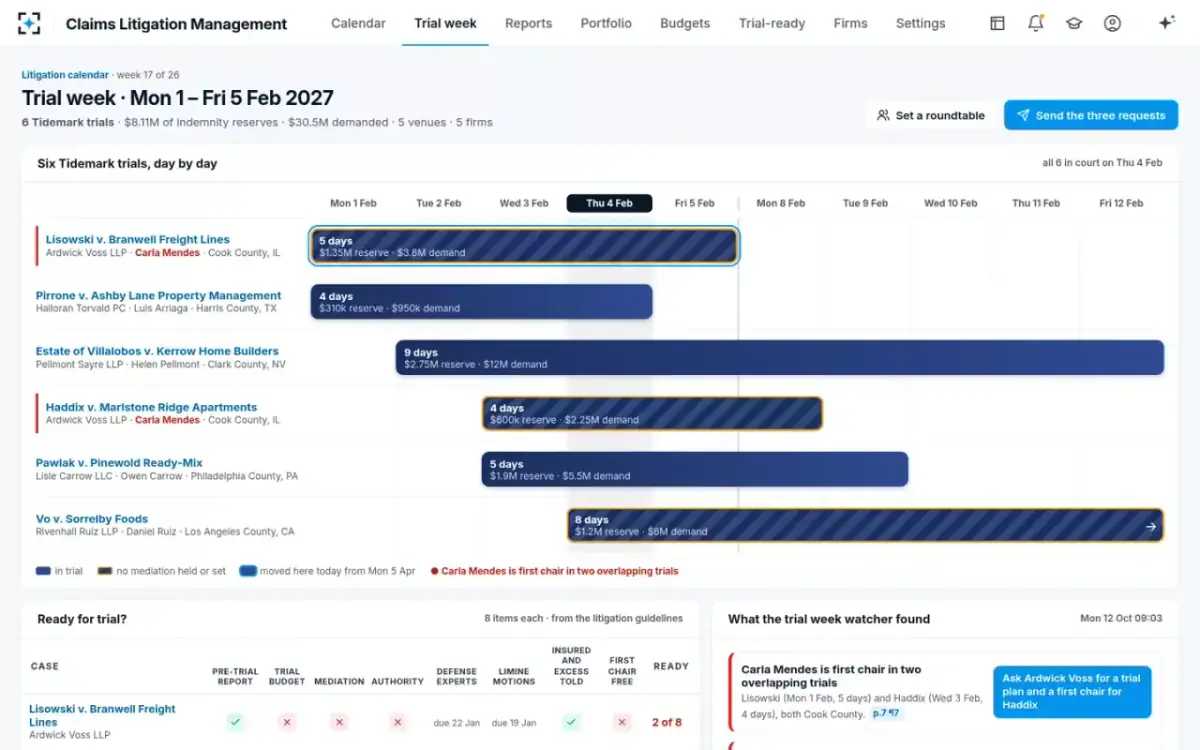
The trial week watcher drafted three requests that morning: to Ardwick Voss for a trial plan covering both cases and a named first chair for Haddix if Lisowski was still in trial; to both affected firms for mediation dates before the new discovery cutoff in Lisowski, Haddix and Vo; and to the claim supervisor for a re-budget. None was sent until the litigation manager read and sent it, and none asked anyone to approach the court. Whether to seek a different date stayed with counsel.
When should settlement authority be set before trial?
Before the first event at which someone may need to accept or make an offer: the mediation, the settlement conference, or the final pretrial conference, whichever comes first. Under Federal Rule 16 a judge may order a party or its representative to attend or be reachable while settlement is considered, and a representative without authority is not much use to the court or to the insured; who holds that authority, and at what level, is set out in what settlement authority is. In the sample guidelines, authority above $1M sits with claims legal counsel and a roundtable, so that meeting has to be scheduled weeks ahead, not found on the morning of mediation.
The final pretrial conference "must be attended by at least one attorney who will conduct the trial for each party."
Fed. R. Civ. P. 16(e)
Limits demands make the timing sharper. When a demand exceeds the policy limit, as Lisowski's $3.8M demand did against a $2M primary limit, the insured's exposure above the limit becomes the excess carrier's concern and, if a reasonable offer within limits is refused, potentially the primary insurer's too. The way a missed limits demand turns into an excess judgment is covered in what one missed limits demand can cost. Settlement also has its own clock after agreement: Florida's market conduct examiners, for example, test whether payment is made within 20 days after a settlement agreement, as section 627.4265 requires.
What is a pre-trial report?
A pre-trial report is defense counsel's report to the insurer before trial: where the case stands procedurally, how liability and damages look, a verdict range, what trial will cost, and a recommendation. Most litigation guidelines set a clock for it; the sample carrier's is 60 days before trial. It is the most decision-heavy document counsel sends, because it usually carries a new date, a new value and a new cost at once.
Ardwick Voss's nine-page pre-trial report on Lisowski did all three. Page two reported the amended order and five new dates. A later page valued the case at $1.1M to $2.6M before a Cook County jury, against an indemnity reserve of $1.35M. And it put the remaining cost of trial preparation and trial at about $96,000, which took the projected spend to $258,400 against a $185,000 budget. Read on arrival, the report produced a reserve review, a re-budget and a mediation request on the same morning. The way a pre-trial report's due date and contents are written into guidelines is covered in litigation management guidelines; the way the months before trial add up is in how long a personal injury lawsuit takes.
Running trial readiness every morning, without taking over the defense
The checks above are simple; doing them for every trial, every day, is not. Claims Litigation Management runs them with two agents. The trial readiness checker checks the eight items for every trial set in the next 26 weeks at 07:00 each morning. The trial week watcher counts trials per week against the carrier's limit, checks first chairs day by day, and lists trials with no settlement plan. Neither contacts a court or asks for a continuance, and neither sends anything to a firm; requests are drafted with the report line attached and sent by the litigation manager. Who sits in each seat around a trial is set out in what a litigation adjuster does; the sample case itself is on the Claims Litigation Management page.
Questions people ask
What is a trial readiness date?
It is a date a court sets to confirm that a case will go to trial as scheduled, often a trial readiness conference or a deadline for filing a readiness statement. Local rules decide what must be filed and when. For an insurer it is a hard stop: anything still missing on the carrier side has to be resolved before it.
What goes in a trial readiness conference statement?
Typically the parties' witnesses, exhibits, estimated trial length, pending motions and settlement status, in the form the local court requires. The federal counterpart is the pretrial disclosure of witnesses and exhibits, due at least 30 days before trial under Rule 26(a)(3) unless the court orders otherwise.
How long does a civil jury trial last?
Usually days, not weeks. In the last national survey of state civil trials, for 2005, general civil jury trials averaged 3.9 days and tort jury trials 3.7, and 13% of jury trials finished within one day. Complex cases run much longer; the longest in that sample lasted 69 days.
Can a trial date be moved?
Only by the court. In federal court, a schedule may be changed only for good cause and with the judge's consent, and the order after the final pretrial conference only to prevent manifest injustice. Defense counsel decides whether to ask; the insurer can ask counsel for a plan.
How far ahead should trial preparation start?
For the carrier, about six months. In federal court, expert disclosures default to 90 days before trial and pretrial disclosures to 30, and a pre-trial report, mediation and authority have to come before those. Checking every trial set in the next 26 weeks gives time to fix what is missing.