An excess judgment is a court judgment against an insured defendant for more than the liability insurance limit. The policy pays up to the limit; the excess falls on the policyholder, unless the insurer is found to have failed unreasonably to settle within the limit when it had the chance, in which case the insurer can be liable for the whole judgment. That is why a missed policy limits demand is priced by the verdict, not by the limit: in one Georgia case, a $25,000 per-person policy ended in a judgment that included more than $5.3 million for one claimant. Botminds' Time-Limited Demand Management exists to take the most common cause of that exposure, a demand found late or answered wrong, off the table: it finds each time-limited demand wherever it lands, keeps its clock, and leaves the decision and signature with a named person.
Limit against judgment in two court records
What is an excess judgment?
It is the part of a judgment that the insurance does not cover. If a jury awards $3.24 million against a defendant whose policy limit is $1 million, the insurer pays the limit and the remaining $2.24 million is the excess, owed by the defendant personally. The phrase is also used loosely for the whole verdict in such a case, which is why "excess verdict" and "excess judgment" appear side by side in claims departments.
The Fifth Circuit's 2025 opinion in Golden Bear shows the sequence. Two men sued a Texas bar and its owner after a fight with a bouncer. Their lawyer sent what he called a Stowers demand for "the payment of all policy limits of any and all insurance contracts"; the insurer refused. The jury returned $960,000 for one plaintiff and $2.28 million for the other, the judgment added interest and costs, and after trial the insurer tendered the rest of its limit. That, the court recorded, left the bar and its owner "personally liable for at least $2.24 million".
Who pays an excess judgment?
The insured defendant, unless someone else is liable for it. The policy's promise ends at the limit, and the judgment creditor can pursue the defendant's own assets for the rest. The insured's route to relief is a claim against the insurer for failing to settle within limits; that claim can be assigned to the injured claimant, which is why Missouri's statute speaks of a lawsuit filed "by a claimant as an assignee of the tort-feasor".
In Golden Bear the insureds took that route, claiming that the insurer had to indemnify them for the excess under its Stowers duty. The insurer sued in federal court for a declaration that the demand letter was too vague to trigger the duty and won in the district court; the Fifth Circuit vacated that judgment because a declaratory action was the wrong vehicle, and ordered the federal case dismissed, leaving the question to the state courts. Years after the demand, the question of who pays $2.24 million was still open.
Is an insurer liable for a verdict above policy limits? The Stowers doctrine
It can be, where it failed to settle within limits when it should have. Texas puts it most directly. Under the Stowers doctrine, named for a 1929 Texas decision, an insurer that receives a demand within limits, on a covered claim, proposing a full release for a stated sum that an ordinary prudent insurer would accept, must settle; if it does not, and a jury returns a verdict above the limit, the insurer is exposed to the whole of it.
If the insurance company fails to settle the claim, and a jury returns a verdict in excess of the policy limit, then the insurance company is potentially liable in damages for the entire judgment, even the excess.
U.S. Court of Appeals for the Fifth Circuit, Golden Bear v. Clemens (2025)
Georgia reaches the same result through its failure-to-settle tort, which the Supreme Court of Georgia ties to a valid offer within limits. Florida says it in its statute: the damages recoverable for a violation of its civil remedy provision "may include an award or judgment in an amount that exceeds the policy limits". The mechanics differ; the exposure is the same shape everywhere: the gap between the limit and the verdict.
How does an excess verdict happen?
A serious injury, a modest limit and a trial. Most injury trials are not excess cases: in the Bureau of Justice Statistics' national survey of state civil trials, which dates from 2005, "The median award in motor vehicle accident cases was $15,000" and 40% of winning plaintiffs in those trials received $10,000 or less. An excess verdict sits in the tail, where injuries are severe and limits are low, which is exactly where claimants' lawyers send time-limited demands for the limits.
The tail is growing. A study by the Insurance Research Council, a research body funded by insurers, of 7.4 million auto injury claims closed with payment between mid-2017 and mid-2022 found that average bodily injury payments "increased 7.8% annualized, from approximately $14,000 in 2017 to more than $20,000 in 2022", and that litigation rates nearly doubled, from 10% to 18% of claimants. An analysis by the Casualty Actuarial Society with the insurer-funded Insurance Information Institute concluded that "claim severity, not claim frequency, is driving loss increases". When severity rises and limits do not, more claims cross the limit, and more demands for the limit arrive.
Why more claims reach the limit
7.8%
a year: growth in average bodily injury payments, 2017 to 2022
Insurance Research Council (insurer-funded)
18%
of auto injury claimants in litigation in 2022, up from 10% in 2017
Insurance Research Council (insurer-funded)
$15,000
median award in motor vehicle trials, 2005
Bureau of Justice Statistics; latest national survey
When several claimants share one limit
Excess exposure is sharpest when one accident produces more injured people than the per-accident limit can pay. Every claimant's demand then competes for the same money, and settling one can leave the insured exposed to the rest. First Acceptance was that case: a five-claimant collision against limits of $25,000 per person and $50,000 per accident, in which the insurer's adjusters had assessed early that the insured "was liable for the loss and that his exposure for claims exceeded the policy limits".
One collision, five claimants, $50,000 per accident
| Claimant | Injuries as the court described them | What their lawyers did |
|---|---|---|
| Jina Hong | Fractured skull, bleeding on the brain, four to five days in a coma | Offered, with her mother, to settle for the available limits or attend a settlement conference; withdrew the offer after 41 days and sued |
| Julie An | Neck injury; arm permanently scarred | Joined in the same letters and the same suit |
| Catherine Bishop | Head, neck and back injuries | Not described as making a time-limited demand |
| Chris Bishop | Soft tissue injuries | Not described as making a time-limited demand |
| Jose Rodriguez | Neck and back injuries | Demanded all available limits within 20 business days, then agreed to extend in favor of a global settlement conference |
The court accepted the insurer's strategy: settling all the claims together reduced the insured's overall risk, and the law did not require it to settle the most serious claim first. Florida has written a route for the same problem into its statute: an insurer facing competing claims that together may exceed the limits is not liable beyond them if, within 90 days of notice, it files an interpleader or makes the full limits available in binding arbitration that the claimants agree to. Either way, the insurer has to know about every claimant's demand, and its date, at once; a demand that sits in a branch while another claimant's is answered can decide who receives the limit.
The arithmetic of a missed demand
Answering a valid limits demand in time costs the limit, which the insurer will usually owe anyway once liability is clear and damages exceed it. Missing it can cost the limit, the excess, interest, a full trial and a second lawsuit, spread over years. The difference between the two columns below is the price of the missed date.
A valid limits demand, answered in time or missed
Answered in time: The limit, or the demand if lower.
Missed, then tried: The limit, then possibly the whole judgment if failure-to-settle liability follows.
Answered in time: None beyond the agreed payment.
Missed, then tried: Pre- and post-judgment interest and court costs, as the Golden Bear judgment awarded.
Answered in time: Little; the claim closes before suit.
Missed, then tried: A full defense to trial, then the defense of the bad-faith or Stowers case.
Answered in time: Weeks.
Missed, then tried: Years: First Acceptance ran from a 2008 crash to a 2019 decision.
Answered in time: Released.
Missed, then tried: Personally liable for the excess while the insurer’s liability is argued.
Answered in time: A file showing the answer arrived in time.
Missed, then tried: Discovery into what the insurer knew, and when, from its own file.
The defense column is not small. Defense and cost containment took 3.9% of U.S. property and casualty premium in 2023 and 2024 by the Federal Insurance Office's count, down from about 4.5% in earlier years; in Florida it rose to 6.6% in 2022 before that state's reforms. A demand that turns into two lawsuits draws on that line twice.
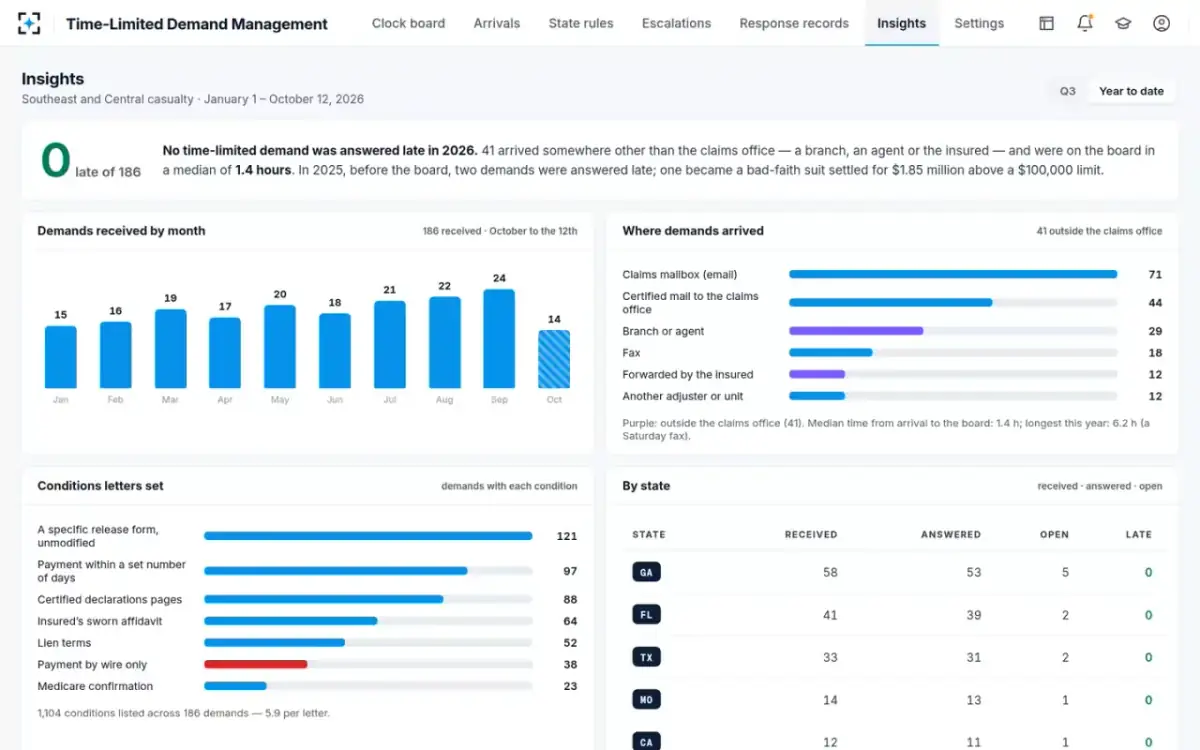
The sample carrier in Time-Limited Demand Management carries the story a step further. In its fictional 2025, before the board, two demands were answered late, and one became a bad-faith suit settled for $1.85 million above a $100,000 limit. That is sample data, not a customer's history, but its proportions match the court records: the excess is many times the limit.
What Time-Limited Demand Management reports to a VP of casualty claims: demands answered late
Will insurance pay more than policy limits?
Not under the policy's own promise, which ends at the limit. An insurer pays more than its limit only when it is liable outside the contract, most often for failing to settle within limits, or when other coverage applies, such as an umbrella or excess policy above the primary one. That second possibility is why Georgia now lets a claimant require the insurer's sworn statement on whether all liability and casualty insurance it issued that may cover the claim has been disclosed.
From the claimant's side, a limits demand is therefore a choice: take the limit now, or try the case and pursue the excess from the insured and, through the insured, the insurer. From the insurer's side, the demand is an offer to cap its exposure at the number it already wrote. The meaning of tendering that number, and how a tender differs from an acceptance by state, is set out in tender policy limits meaning.
How can an insurer avoid excess exposure?
By answering valid offers within limits, in time and on their terms, and by being able to prove it. The statutes now give insurers defined routes. Florida bars a bad-faith action if the insurer tenders the lesser of the limits or the demand within 90 days of actual notice of a supported claim, and protects an insurer facing several claimants whose claims exceed the limits if it files an interpleader or offers the limits in agreed arbitration within 90 days. Georgia bars a failure-to-settle action where the insurer delivers the acceptance, sworn statement and payment of the lesser of demand or limits by the offer's dates, and warns that missing a compliant offer loses that protection on "any subsequent offer" on the claim.
Five controls against excess exposure, three of them run by Time-Limited Demand Management
- Find every demand the day it lands
Branch mail, agents, the policyholder and departed adjusters’ inboxes, not just the claims mailbox.
- Run each clock to the earliest date
The letter’s date or the statutory floor, whichever comes first, with an act-by that allows for delivery.
- Decide early, at the right level
Authority to pay the limit granted days before the deadline, not hours.
- Use the statutory safe harbors deliberately
Florida’s 90-day tender; Georgia’s acceptance, statement and payment by the offer’s dates.
- Keep the proof
Arrival, discovery, each condition met, signatures and delivery tracking, sealed when sent.
Time-Limited Demand Management covers the first, second and fifth directly and makes the third visible: escalations go to the supervisor at 72 hours, counsel at 48 and the VP of casualty claims at 24 unless the acceptance is signed. It does not decide whether to pay the limit; that rests on the carrier's own evaluation and a named person's authority. What the file must show if the question ever reaches a court is set out in bad faith failure to settle, and the software boundary in deadline tracking software for limits demands. To see a demand go from a branch in-tray to a sealed acceptance, start from Time-Limited Demand Management.
Questions people ask
What is the difference between an excess verdict and an excess judgment?
The verdict is the jury's award; the judgment is the court's order that the defendant pay, which can add interest and costs. In Golden Bear the verdicts were $960,000 and $2.28 million, and the final judgment added prejudgment and postjudgment interest and court costs.
Can an insured assign a bad faith claim to the claimant?
Statutes contemplate it: Missouri's applies to a lawsuit filed by a claimant as an assignee of the tortfeasor, or by the tortfeasor for the claimant's benefit. Whether an assignment is valid and what it carries is a question of each state's law.
Does an excess judgment mean the insurer acted in bad faith?
No. An excess judgment shows only that the verdict exceeded the limit. In First Acceptance the judgment far exceeded the $25,000 limit, yet the court held the insurer acted reasonably because the claimants' offer set no deadline.
How large can the excess be compared with the limit?
Many times the limit. In the two court records on this page, the excess was more than 200 times a $25,000 per-person limit in Georgia and more than twice a $1,000,000 limit in Texas, before interest.
Does paying the limit after the deadline fix the problem?
Not necessarily. In First Acceptance the insurer later offered the full $50,000 limit and the claimants rejected it; in Golden Bear the insurer tendered the rest of its limit after the verdict. A tender after the offer has lapsed does not bind the claimant to accept it.
Is an umbrella policy part of the limit in a limits demand?
Only if the demand reaches it, and letters differ on that. Georgia lets a claimant require the insurer's sworn statement on all the liability and casualty coverage it issued that may apply, so an umbrella policy should be found before the answer goes out; what a particular letter demands is a question to settle with counsel before signing.