Bad faith claim avoidance, on the liability side, means making sure that every valid offer to settle within limits is found, understood, decided by the right person and answered before it expires, with a file that shows each step. Failure-to-settle cases are built on missed or mishandled demands; regulators' unfair claims practices rules ask for prompt acknowledgment, reasonable standards and documentation; and the statute states have now written the deadlines and the safe harbors down. A tool that tracks demands is only as good as its answers to those rules. The ten questions below each come from a statute, a model regulation or a court decision. Put them to any vendor, to an internal build, and to Botminds' Time-Limited Demand Management, which is built to answer each of them with a named person, not software, making the decisions.
Ten questions for any demand-tracking tool, and the rule behind each
- 1. Does it find demands that reach a branch, an agent or the policyholder?
Georgia and Missouri count from receipt, and the NAIC model treats notice to an agent as notice to the insurer.
- 2. Does it record when and how each letter was sent and received?
California counts from transmission, 30 days by email, fax or certified mail, 33 by ordinary mail.
- 3. Does it quote every condition, with its page?
Georgia’s seven material terms must be accepted in their entirety; everything else still needs a decision.
- 4. Does it test each demand against its state’s statute, and cite it?
Missouri’s eight terms and two enclosures; California’s seven terms; Georgia’s seven.
- 5. Does it always run the clock to the earliest date?
The letter’s date or the statutory floor, whichever comes first; a short letter is still a deadline.
- 6. Does it set an act-by that allows for delivery?
Missouri counts the postmark of the acceptance; Georgia’s offer names where acceptance goes.
- 7. Does it send rule questions to counsel instead of deciding them?
Whether a demand “substantially” complies, in California’s word, is a legal judgment.
- 8. Does it escalate to named people by hours left?
A deadline seen by the adjuster alone is a deadline one absence away from being missed.
- 9. Does it keep a dated record no one can edit?
The NAIC model requires each document noted as to date received, processed or mailed.
- 10. Can it sign, send or pay anything?
The right answer is no: authority to settle belongs to a named person.
What is bad faith claim avoidance?
It is the set of practices that keep an insurer's handling of a claim on the reasonable side of the line courts and regulators draw. On a liability claim the line is drawn at settlement: courts ask whether the insurer acted reasonably on a valid offer within limits, and regulators ask whether it handled claims with reasonable standards and in good faith. Bad faith claim avoidance on these claims is therefore mostly about demands.
The regulators' version is written in the NAIC's model act, which states adopt in their own form. Among the practices it treats as improper when committed flagrantly and in conscious disregard of the law, or so often as to indicate a general business practice:
Failing to adopt and implement reasonable standards for the prompt investigation and settlement of claims arising under its policies;
NAIC Unfair Claims Settlement Practices Act (#900)
The courts' version is the failure-to-settle tort, or in Texas the Stowers duty. The two meet in the claim file: an examiner tests the file against the rules, and a jury reads the same file to decide what the insurer knew and did. What that file should hold is set out in bad faith failure to settle: the file that proves you answered.
How do insurers avoid bad faith claims on limits demands?
By finding every demand on the day it arrives, deciding at the right level in time, answering each term in writing, and keeping proof, and by using the safe harbors the statutes now provide. Georgia bars a failure-to-settle action against an insurer that, by the offer's dates, delivers a writing accepting the material terms, any required sworn coverage statement, and payment of the lesser of the demand or the limits. Florida bars a bad-faith action against an insurer that tenders the lesser of the limits or the demand within 90 days of actual notice of a supported claim.
The rest of the work is discipline. Florida's statute reminds both sides that negligence on its own does not make bad faith, but it also lets a jury weigh whether the claimant set deadlines in good faith; California makes the insurer's written reasons for declining a demand relevant in any later excess suit. A desk that answers every demand on time and in writing makes those provisions work for it.
Why each question matters, and what a weak answer sounds like
A vendor's answer to each question should be specific enough to test on the carrier's own letters. The table pairs each question with its source and with the answer that should worry a buyer.
The ten questions: where each comes from, and the answer to worry about
| Question | Where it comes from | A weak answer |
|---|---|---|
| 1. Branch, agent and policyholder mail | Receipt starts the clock (O.C.G.A. § 9-11-67.1(b)(1)(A); Mo. § 537.058.2(1)); NAIC #902 § 6A on agents | “We monitor the claims inbox.” |
| 2. Transmission and receipt | Cal. CCP § 999.1(a): 30 or 33 days from transmission | “Users enter the received date.” |
| 3. Every condition, quoted | O.C.G.A. § 9-11-67.1(b)(1), (c), (d) | “It summarizes the letter.” |
| 4. State statute, cited | Mo. § 537.058.2–.3; Cal. CCP § 999.1; O.C.G.A. § 9-11-67.1(b), (g) | “Rules are configured per customer,” with no review dates |
| 5. Earliest date | Statutory floors and the letter’s own date | “It uses the statutory period,” even when the letter is shorter |
| 6. Act-by for delivery | Mo. § 537.058.4 (delivered or postmarked); O.C.G.A. § 9-11-67.1(g) | “Alerts fire on the due date.” |
| 7. Counsel decides validity | Cal. CCP § 999.4 (“substantially comply”); state law on the duty to settle | “The AI determines whether the demand is valid.” |
| 8. Named escalation | Settlement authority sits with people | “The adjuster gets a reminder.” |
| 9. Dated, sealed record | NAIC #902 § 4 (documentation to reconstruct the file) | “Notes are editable by the adjuster.” |
| 10. No signing, sending or paying | Authority to settle; the duty of good faith to the insured | “It can auto-send acceptances.” |
Five follow-up questions for multi-state and multi-claimant books
The ten questions cover a single demand. A larger book raises five more, each where the statutes or the cases show a tool can be right about one letter and wrong about the claim.
Does it see every claimant on the same accident? Florida protects an insurer facing competing claims that may exceed the limits if, within 90 days of notice, it interpleads or offers the limits in agreed arbitration; in First Acceptance the court weighed an insurer’s pursuit of a global settlement of five claims against a $50,000 per-accident limit. A tool that tracks demands one at a time cannot show that picture.
Does it know which version of a statute applies? Georgia's statute has three versions since 2013, and the 2024 one applies only to offers made on or after 22 April 2024. Does it count in each demand's own time zone? A 5:00 p.m. Pacific deadline is three hours later than 5:00 p.m. Eastern. Does it carry the dates after acceptance? Florida requires payment within 20 days of a written settlement, with interest at 12% a year after that, and Georgia's payment date is part of its safe harbor. Does it reach every policy the carrier issued? Georgia lets a claimant require the insurer's sworn statement on all liability and casualty coverage it issued that may apply, so the search has to go beyond the auto policy on the claim.
What is bad faith claims handling?
Handling that fails the reasonableness standard: claims not acknowledged or investigated promptly, settlements not attempted where liability has become reasonably clear, insureds forced to sue for what the policy owes, and, on liability claims, offers within limits ignored or answered too late. The NAIC model lists those practices; the courts' failure-to-settle cases supply the liability-side examples.
The difference from an honest mistake is often the system around it. A single misfiled letter, as in First Acceptance, where letters were filed with medical records, is a mistake; a desk with no way of finding letters that land outside the claims mailbox invites the argument that the mistake was a practice. The Supreme Court of Georgia held for the insurer in that case because the offer set no deadline, a defense that a statute-compliant demand no longer leaves open.
What records protect an insurer from bad faith?
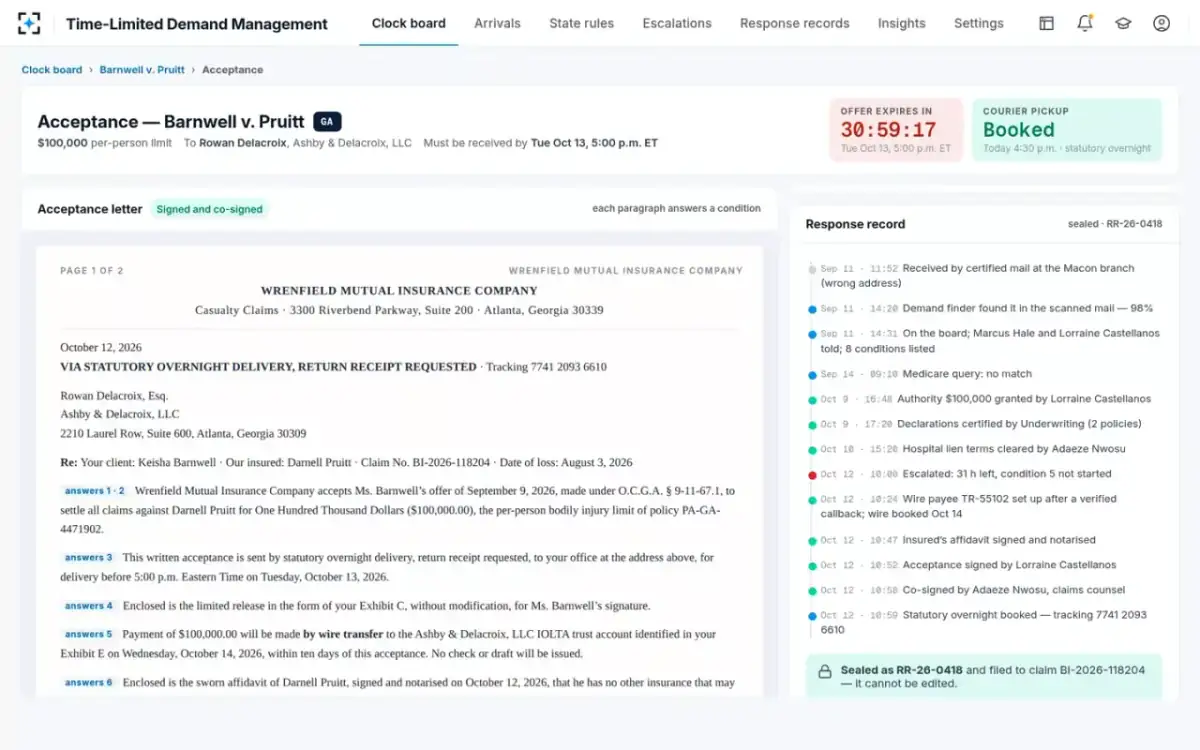
Records made at the time, dated, and kept unchanged: the letter as received with its envelope or transmission record, where and when it arrived, when it was found, each condition with the proof that met it, every question and answer, who decided and within what authority, and how the answer traveled. The NAIC model asks for documentation sufficient to reconstruct the insurer's activities on each claim, with each relevant document noted as to the date it was received, processed or mailed.
A response file sealed by Time-Limited Demand Management when the answer left
How examiners test a claim file
With a random sample, a named rule and an error rate, which is also how a carrier should test its own demand process. The Florida Office of Insurance Regulation's 2024 report on one auto insurer drew samples of 109 claims, or 107 in some categories, and reported each finding as instances out of the sample and a percentage against the rule breached.
How one state examination reported claim-handling errors
109
claims in each random sample the examiners reviewed
107 in some categories
3.7%
of sampled claims where communications were not acknowledged within 14 calendar days
0.9%
of a sample where payment did not follow a settlement agreement within 20 days
10.1%
of a sample where PIP benefits were not paid within 30 days of written notice of a covered loss
A carrier can apply the same method to its limits demands before buying anything: draw a sample of past demands, and for each, record when it arrived, when it was found, whether every condition was met, and whether the answer arrived before the deadline. The share that missed is the baseline any tool has to beat. How to measure in the first month after go-live is set out in deadline tracking software for limits demands.
Can AI help avoid bad faith claims?
It can help with the mechanical work that most often fails: reading every channel, matching letters to claims, quoting conditions, counting days and escalating. It should not decide whether a demand is valid, whether to pay the limit, or what to send; those are legal and authority decisions. The NAIC's model bulletin on insurers' use of AI applies the unfair claims practices standards whatever methods an insurer uses, so automation raises the standard of proof rather than lowering it.
In Time-Limited Demand Management six agents divide the mechanical work: the demand finder, claim matcher, condition extractor, state rule checker, clock keeper and response drafter. Their limits are part of the design: the finder never discards or moves mail, the matcher never changes a reserve, coverage position or assignment, the rule checker never decides validity, the clock keeper never extends a deadline, and the drafter never sends, signs or pays.
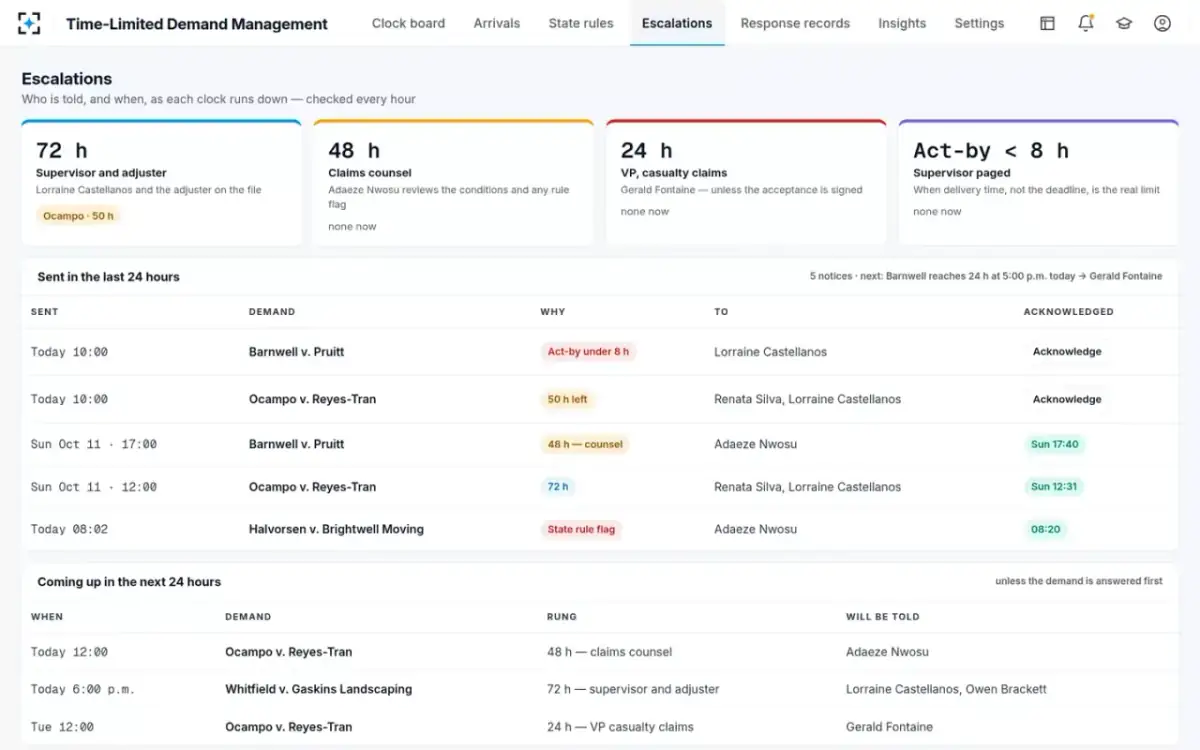
Named people told at set hours, each acknowledgment kept
How do you evaluate claims deadline software?
On your own past letters, against your own outcomes. Give the tool a sample of demands the desk handled, including the hard ones that arrived at branches, gave short periods or carried unusual conditions, and compare what it finds, when, which conditions it quotes, which state flags it raises and what dates it computes with what the desk did at the time. Differences in either direction are the evidence.
Then test the boundary. Ask the vendor to show what the tool does when it is unsure whether a letter is a demand, what happens when a letter gives less time than the statute requires, who reviews the state rule table and when, and whether any path exists for the software to send an acceptance or release a payment. In Time-Limited Demand Management the answers are: anything under 90% confidence goes to a person; the clock runs to the earlier date while counsel considers; claims counsel reviews each state's rule and the review date is shown; and no agent can sign, send or pay.
Where Time-Limited Demand Management fits, and where it does not
Botminds' Time-Limited Demand Management answers the ten questions for the stretch from a letter's arrival to a sealed, delivered response. It does not replace the claim system, evaluate the claim, set reserves, docket litigation deadlines once suit is filed, or supply legal conclusions. Its sample year shows the design target: no demand answered late, 0 of 186 in the fictional carrier's data. Whether a carrier reaches that depends on giving it every mail channel and on the people who decide acting within the time it buys them.
The most useful first step is the one the questions point to: run it on a sample of the carrier's own past demand letters and compare. To see how a demand moves from a branch in-tray to a sealed acceptance, start from Time-Limited Demand Management; the integration questions are covered in claims diary system or demand clock.
Questions people ask
Is bad faith claim avoidance the same as claims compliance?
They overlap. Compliance tests claim handling against regulations, such as acknowledgment and payment deadlines; bad faith avoidance on liability claims adds the settlement decisions a court may later review. Both are proved from the same dated claim file.
Does meeting a statutory safe harbor remove all bad faith risk?
It removes the claim the statute names, if every condition is met by the dates. Georgia's safe harbor bars a failure-to-settle action; Florida's bars a bad-faith action. Other obligations, such as unfair claims practices rules, still apply to the handling.
Does a demand-tracking tool reduce bad faith claims?
We know of no independent published study that measures it. What a tool can change is the share of demands found late, answered late or answered incompletely, which a carrier can measure on its own sample before and after.
How many time-limited demands should a desk expect?
It depends on the book. The fictional sample carrier in Time-Limited Demand Management received 186 between January and 12 October, about 20 a month across its southeast and central casualty units, 41 of them outside the claims office.
What should a claims leader report to the board?
One number first: demands answered after their deadline. Then where demands arrive, how long they take to reach the deadline board, and how close acceptances run to the deadline, each measured on the carrier's own data.
Who owns bad faith claim avoidance in a carrier?
The claim function owns the handling and the decisions; claims counsel owns the legal calls on validity and the release; compliance tests the files. A demand-tracking tool should make each of their parts visible on the same demand.