A claims diary system is the part of a claim system that schedules follow-ups: a date, a task and an owner, raised to the adjuster when the date comes. It is excellent at dates people already know, and it is blind to a date nobody has typed. A time-limited policy limits demand creates exactly that kind of date. Its deadline is written in a letter, measured from when the insurer received it, and checked against a state statute; until someone finds the letter, reads it and does the arithmetic, the diary holds nothing. Botminds' Time-Limited Demand Management sits in front of the claim system to close that gap: its agents read every channel a letter can arrive by, tie each demand to its claim, compute the deadline and an act-by, and escalate as it approaches, while the claim system stays the system of record for reserves, coverage and assignments.
Where Time-Limited Demand Management sits between the mail and the claim system
Where letters arrive
- Claims mailboxes
- Branch mail scans
- Fax lines
- Agent portal uploads
- Policyholder forwards
- Former adjusters’ inboxes
What the solution adds
- Find the demand, record its arrival
- Match it to claim, policy, limits, adjuster
- Quote every condition with its page
- Test it against the state’s reviewed rule
- Compute the deadline and act-by
- Draft the response; escalate by hours left
Systems that stay yours
- Claim system: claims, policies, limits, insureds, assignments, diaries
- Courier: overnight booking and tracking
- Treasury: payee set-up and payment
- Claim file: the sealed response file, exported
What is a claims diary system?
It is the scheduling layer of a claim system: every open claim carries diary entries, each a date and a next step, and an adjuster's day is the list of diaries due. Diaries carry the regulatory clocks a claim department already lives by, such as those in the NAIC's model claims regulation, which states adopt in their own versions.
That model is the reason diaries exist in the form they do. It asks for claim files detailed enough to reconstruct the insurer's activity, with each relevant document dated, a 15-day acknowledgment of a claim, a 15-day reply to communications that expect one, written notice to an unrepresented third-party claimant at least 60 days before a limitation period runs, and payment within 30 days once liability is affirmed and the amount is not in dispute. Each of those is a date a diary can hold because the trigger is an event the claim system already records.
How do claim adjusters manage diaries?
By setting them when something happens and clearing them when the step is done. A new claim sets the acknowledgment diary; a call from a claimant sets a reply diary; a represented claimant's letter sets a review. The trigger comes from the claim system or from the adjuster's own reading of the file.
Common claim clocks, and where each one's trigger date comes from
| Clock | Rule | Trigger the diary needs | Who supplies it |
|---|---|---|---|
| Acknowledge a claim | 15 days (NAIC model; states vary) | Notice of the claim, including notice to an agent | Intake, often automatically |
| Reply to a pertinent communication | 15 days (NAIC model) | Date the communication arrived | The adjuster who reads it |
| Limitation notice to an unrepresented claimant | At least 60 days before it expires (third party) | Loss date and the state’s limitation period | The claim system |
| Pay once liability is affirmed | 30 days (NAIC model) | Date of affirmation | The adjuster |
| Accept a time-limited demand | The letter’s date; floors of 30 (GA), 90 (MO), 30 or 33 (CA) days | Receipt or transmission of the letter, its method, the state and the stated date | Nobody, until the letter is found and read |
Why a claims diary system misses demand deadlines
Because the diary depends on a person to create the entry, and the person depends on the letter reaching them. Every other clock in the table starts from an event the claim system sees. A demand's clock starts from an envelope, which may arrive at a branch, an agent's office or the policyholder's home, and its deadline must be read from the letter and compared with the statute before anyone can type it.
Three things go wrong in that gap. The entry is late, because the letter took days to reach the adjuster while the statute counted from receipt. The entry is wrong, because someone typed the letter's date without checking the state's floor, or typed the deadline without allowing for how the acceptance will travel. Or the entry is missing, because the letter never reached anyone who knew it mattered. The sample carrier's year shows how many letters start in the wrong place.
Where the sample carrier's 186 time-limited demands arrived
Can a claims system track demand deadlines?
It can store them; it cannot find them. Any claim system can hold a deadline once it is entered, and some can flag a claim as carrying a time-limited demand. What it cannot do on its own is read a scanned letter in a branch's mail, recognize that it is a time-limited demand, match it to the right claim, and work out the earliest date the letter or the statute allows. That is the work that sits in front of the diary.
The arithmetic is not trivial either. California counts from transmission and adds three days for ordinary mail; Georgia and Missouri count from receipt; a deadline at noon on a Saturday moves the act-by to Friday; a letter that gives less than the statute requires runs on its own date while counsel decides. How each of those is counted is worked through in CCP 999: 30 days or 33. A diary entry is the end of that work, not the start.
The letters a diary never sees, as Time-Limited Demand Management screens them
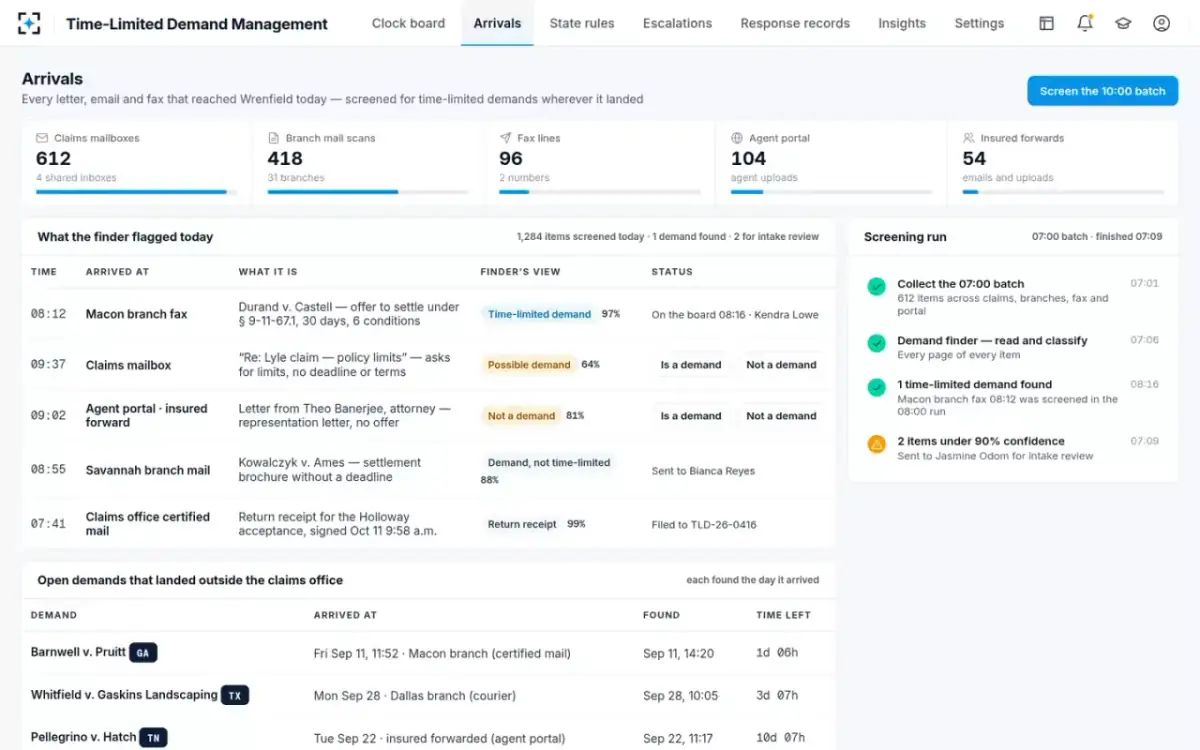
What systems does a demand tracker need to read?
Every channel a letter can arrive by, and the claim system that tells it whose claim the letter concerns. On the input side that means the claims mailboxes, branch mail scans, fax lines, the agent portal and forwards from policyholders, plus the inboxes of adjusters who have moved on. On the claim side it means claims, policies, limits, insureds, adjuster assignments and diaries, read so that a demand can be matched by claim number, insured, claimant, date of loss and policy.
California adds one channel an insurer controls. Its statute lets an insurer designate an email or physical address for time-limited demands, which the Department of Insurance publishes; the Department's notice told insurers that "the Department will post the information on its public website". A designated address is a channel worth reading first, and worth giving out on every claim acknowledgment.
What a diary entry for a limits demand should carry
A single date is not enough. A demand's diary entry has to say which date, why, and how sure anyone is about it, because the people who act on it, a supervisor at 72 hours, counsel at 48, a vice president at 24, will not reread the letter. The fields below are the ones the sample carrier's board shows for every open demand.
Fields a diary entry for a time-limited demand should carry
| Field | Example from the sample board | Why it is there |
|---|---|---|
| Arrival: where, when, how | Macon branch, certified mail, Fri 11 Sep 11:52 | Georgia and Missouri count from receipt; California from transmission |
| State rule and version | Georgia, § 9-11-67.1 as rewritten in 2024 | Decides the floor, the content rules and the safe harbor |
| Stated deadline, in its own time zone | Tue 13 Oct, 5:00 p.m. Eastern | An Arizona demand on Mountain Standard Time is not due at 5:00 p.m. Eastern |
| Statutory floor, and the earlier of the two | 32 days given against Georgia’s 30 | The clock runs to whichever comes first |
| Act-by | Mon 12 Oct, 4:30 p.m., the last overnight pickup | The deadline is when the answer must arrive, not when it must leave |
| Conditions: met, in hand, not started | Eight conditions, quoted with page and paragraph | The unstarted one is the risk |
| Counsel flag | None, or the rule the letter misses | Validity is counsel’s call, before anyone signs |
| Owner and escalation ladder | Adjuster; supervisor at 72 h, counsel at 48 h, VP at 24 h | Each rung is a person told in time, not a late surprise |
Does demand tracking replace the claim system?
It should not, and in Time-Limited Demand Management it cannot. The claim system remains the system of record for the claim, the reserve, the coverage position and who is assigned; the solution's claim matcher reads those and never changes them. What the solution adds is the layer the claim system lacks for this work: finding the letter, quoting its conditions, applying the state's rule, keeping the clock and drafting the answer.
The output goes back to the claim. Each demand's response file, from arrival to delivery tracking, is sealed, filed to the claim and exportable for the claim file. Whether the deadline is also mirrored as a diary entry in the carrier's own claim system is an integration choice, settled during a pilot against the carrier's own system; what matters is that one clock governs, and that it is the earliest date the letter or the statute allows.
The dates after acceptance a diary must still carry
Accepting the demand starts new clocks, and those are diary work. In Florida, once a person and an insurer have agreed in writing to settle a claim, the insurer "shall tender payment according to the terms of the agreement no later than 20 days after such settlement is reached", and a late payment bears interest at 12 percent a year. In Missouri, a demand may require payment no sooner than 10 days after the insurer receives the executed release. In Georgia, the offer's payment date and the date for the insurer's sworn coverage statement are both at least 40 days from receipt.
Clocks that run after a demand is accepted
- Agreement to payment20 days, then 12% interest
- Receipt to acceptance date≥ 30 days
- To payment≥ 40
- Release received to payment≥ 10 days
Examiners test these dates. In its 2024 market conduct report on one auto insurer, Florida's Office of Insurance Regulation found one claim in a sample of 107 in which the insurer "did not tender payment within 20 days after a settlement agreement was reached", an error rate of 0.9%. A carrier that answers a limits demand perfectly and then pays late has traded one exposure for another; in the solution, payment is set up before the acceptance is signed, so the payment date is not a new scramble.
How long does integration with the claim system take?
It depends on access more than on software. Reading mail channels requires the carrier to grant access to its mailboxes, scans and fax images; reading the claim system requires a connection to claims, policies, limits and assignments; courier and treasury steps require the carrier's existing processes, approved by people. None of that is unusual, but each is owned by a different team, and the sequence matters more than the calendar.
An integration order that delivers value at each step
- Run it on past letters first
A sample of the carrier’s own past demands shows what it finds, quotes and counts before anything is connected live.
- Connect the claims mailboxes and the designated address
The largest single channel; in the sample year, 71 of 186 came by email to a claims mailbox.
- Add branch scans, fax and the agent portal
The channels where the late letters are; 41 of the sample carrier’s 186 arrived outside the claims office.
- Connect the claim system read-only
Claims, policies, limits, insureds, assignments and diaries, so each demand is matched and the right people told.
- Have claims counsel review the state rule table
Each state’s row dated and signed off before live demands are tested against it.
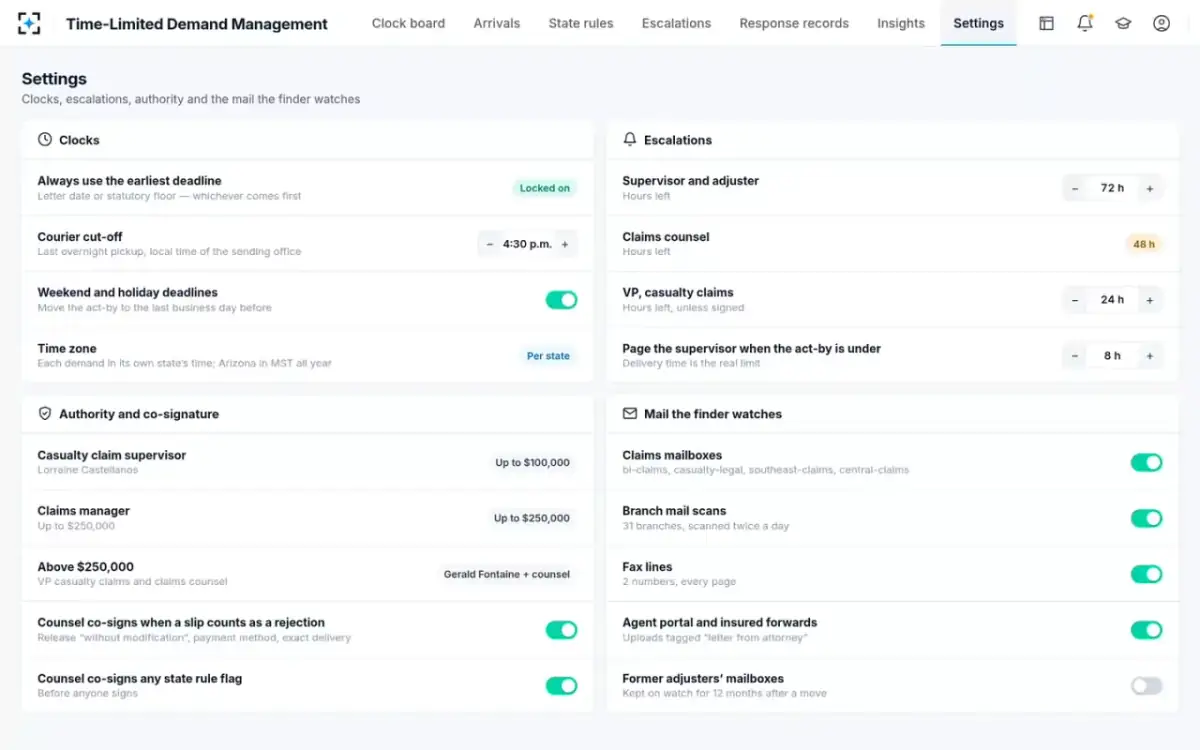
- Set authority, escalations and courier cut-off
Settings, not code: who signs to what limit, who is told at what hour, when the last overnight pickup leaves.
The channels watched and the clocks kept, as settings
Where the solution fits is in front of the diary, not instead of it. Time-Limited Demand Management will not manage general claim diaries, set reserves or reassign files, and it does not run litigation docketing once a suit is filed. It makes sure that every time-limited demand is found, matched, counted and answered by its earliest date, with a sealed file to prove it. What the software may and may not decide is set out in deadline tracking software for limits demands, and the people the letter passes on its way in who a policy limits demand letter waits on. To see the board on the sample carrier's demands, start from Time-Limited Demand Management.
Questions people ask
What is a diary in insurance claims?
A scheduled follow-up on a claim: a date, a task and an owner. Diaries carry the regulatory clocks, such as acknowledging a claim within 15 days or paying within 30 days of affirming liability under the NAIC model regulation, and the adjuster's own next steps.
Can diary entries be created automatically from demand letters?
Only after the letter is found, read, matched and counted. That is the work Time-Limited Demand Management does; the resulting deadline can then drive escalations and be reflected in the claim system as the carrier chooses.
What happens to a demand sent to an adjuster who has left?
It sits in an inbox nobody reads unless someone is watching it. The solution can keep a former adjuster's mailbox on watch for 12 months after a move; in the sample year, 12 of 186 demands reached another adjuster or unit first.
Who owns the deadline: the diary or the demand clock?
There should be one deadline, the earliest the letter or the statute allows, and one owner, the adjuster on the claim with the supervisor escalated in time. Two systems with two dates are worse than one, which is why the clock should be computed once and shown wherever people work.
Does it work with any claim system?
It needs to read claims, policies, limits, insureds, assignments and diaries, which every claim system holds. How it connects to a particular system is settled in the pilot; it does not require the claim system to change.
Do weekend deadlines change the diary date?
They change the act-by. In the solution, a deadline that falls on a weekend or holiday moves the act-by to the last business day before; the deadline itself is never extended.