Holt demand requirements are set by O.C.G.A. § 9-11-67.1, which Georgia rewrote in 2024. For offers made on or after 22 April 2024, an attorney's pre-suit offer to settle a motor vehicle collision claim must be in writing, sent by certified mail or statutory overnight delivery, cite the statute, enclose records sufficient to evaluate the claim, and contain seven material terms, which "shall be the only material terms": an acceptance date at least 30 days from receipt, the amount, who is released, full or limited release and what the claimant will provide to each releasee, the claims released, a payment date at least 40 days from receipt, and the insurer's sworn statement on its coverage. Every other term in the letter is immaterial. That rewrite moved the risk in a Georgia demand from page four of the letter to seven fields and three dates, and Botminds' Time-Limited Demand Management is built to find each Georgia offer wherever it lands, quote its terms and keep those dates, with claims counsel ruling on validity and a named supervisor signing.
Georgia's statute in 2021 and after the 2024 rewrite
2021 version (HB 714): Not defined; an acceptance that added a provision could fail, as Redfearn v. Moore (2024) held.
2024 version (SB 83): "An offer to enter into a bilateral contract."
2021 version (HB 714): Offers before the defendant’s answer, on causes of action accruing on or after 1 July 2021.
2024 version (SB 83): Offers from accrual until every named defendant has answered or defaulted, made on or after 22 April 2024; product liability excluded.
2021 version (HB 714): Five: acceptance period (30 days minimum), amount, parties released, type of release, claims released.
2024 version (SB 83): Seven, and "the only material terms": the five, plus a payment date and a sworn coverage statement, each at least 40 days from receipt.
2021 version (HB 714): Allowed only if both sides agreed in writing.
2024 version (SB 83): Immaterial; a variance from one does not expose an insurer that meets the safe harbor.
2021 version (HB 714): An optional term the offer may include.
2024 version (SB 83): A material term with its own date, which the claimant may waive.
2021 version (HB 714): An address, or a fax number, or an email address.
2024 version (SB 83): An address, and either a fax number or an email address.
2021 version (HB 714): A written request is not a counteroffer.
2024 version (SB 83): The same, but asking to modify a material term is not a clarification.
2021 version (HB 714): None in the statute.
2024 version (SB 83): No failure-to-settle action if the insurer delivers the acceptance, statement and payment of the lesser of demand or limits by the offer’s dates.
What is a Holt demand in Georgia?
A Holt demand is Georgia shorthand for a time-limited, policy-limits settlement offer on an injury claim. The name most practitioners use comes from Southern General Insurance Co. v. Holt, a 1992 Supreme Court of Georgia decision on an insurer's liability for refusing to settle within limits, which the court still cites for the rule that a jury decides whether the insurer "has accorded the insured the same faithful consideration it gives its own interest".
The statute is narrower than the nickname. Section 9-11-67.1 governs offers on claims for personal injury, bodily injury or death arising from a motor vehicle collision, prepared by or with the help of an attorney, made between the accrual of the cause of action and the defendants' answers. A policy-limits demand on a premises claim in Georgia is still a demand, but it is governed by the common law of the duty to settle, not by this section.
What changed in O.C.G.A. 9-11-67.1 in 2024?
Three things: the offer became an offer to a bilateral contract, the seven listed terms became the only material terms, and the statute added a safe harbor. The Georgia General Assembly passed the change as Senate Bill 83, which the Mercer Law Review's annual survey records "became effective on April 22, 2024, and applies to all offers made on or after April 22, 2024".
The change answered a line of cases in which a small slip defeated a settlement. The same survey describes Redfearn v. Moore, decided by the Court of Appeals in 2024 under the earlier version: the insurer's check was made payable to the claimants, the estate and their law firm, marked "MUST BE ENDORSED BY ALL PAYEES", and the claimants returned it as a rejection. The court held that no settlement had been reached. The survey's authors, who practice insurance defense, read the new text to mean that "once an offer is accepted, a contract is entered and disputes about the manner of performance will not be construed as a counteroffer".
Any offer to settle a tort claim for personal injury, bodily injury, or death arising from a motor vehicle collision shall be an offer to enter into a bilateral contract.
O.C.G.A. § 9-11-67.1(a), as rewritten in 2024
What are the material terms of a Holt demand?
There are seven, listed in subsection (b)(1), and the statute says they are the only ones. An acceptance has to answer each of them; nothing else in the letter is a material term.
The seven material terms of a Georgia pre-suit offer, and what the response must do with each
- (A) A date by which the offer must be accepted
At least 30 days from receipt of the offer sent by certified mail or statutory overnight delivery, return receipt requested. The response must be written acceptance, delivered by that date.
- (B) The amount of monetary payment
Usually the per-person limit. The safe harbor requires payment of the lesser of the amount demanded or the available bodily injury limits.
- (C) The parties to be released
Check them against the insureds and drivers on the policy; a mismatch is a question for counsel before signing.
- (D) Full or limited release, and what each releasee receives
The offer must say which and itemize what the claimant will provide to each releasee.
- (E) The claims to be released
Read with the parties: which claims, against whom.
- (F) A date by which payment shall be delivered
No sooner than 40 days from receipt of the offer. The payer chooses the means: cash, money order, wire, cashier’s check, insurer’s draft or check, or electronic transfer.
- (G) The insurer’s sworn statement on its coverage
Whether all liability and casualty insurance the insurer issued that may cover the claim has been disclosed, by a date at least 40 days from receipt. The claimant may waive it.
Two further requirements sit outside the seven but still decide whether the offer is one the statute governs. The offer must include medical or other records in the claimant's possession "sufficient to allow the recipient to evaluate the claim". And it must be sent by certified mail or statutory overnight delivery with return receipt, specifically reference the Code section, and give an address and either a fax number or an email address for the written acceptance.
How many days does an insurer have to accept a Holt demand?
Until the acceptance date in the offer, which must be at least 30 days from receipt. The payment date and the date for the sworn coverage statement must each be at least 40 days from receipt. Because receipt starts all three clocks, the date of receipt, not the date the adjuster read the letter, is the date that matters.
The three minimum dates in a Georgia pre-suit offer, counted from receipt
- Receipt to acceptance date30 days
- Receipt to statement date40 days
- Receipt to payment date40 days
A letter that names dates inside those floors raises a question for counsel, but it does not hand the insurer more time. The safe course is to work to the date the letter states and let counsel decide what the shortfall means. Time-Limited Demand Management's clock keeper works the same way: it runs each Georgia offer to the earlier of the letter's date and the statutory floor, and sets an act-by time early enough for the acceptance to arrive by the method chosen.
What is the sworn statement requirement in a Georgia demand?
It is the seventh material term: the claimant may require the insurer to state under oath whether all liability and casualty insurance it issued that covers, or may cover, the claim has been disclosed, by a date at least 40 days from receipt. In 2021 such a statement was something an offer "May include"; since 2024 it is a material term with its own deadline, which the claimant may waive.
Two features make it operationally hard. The statement covers every policy the insurer issued that may apply, not only the auto policy on the claim, so it needs a search across the carrier's lines, such as a household's umbrella or homeowner policies. And it is the insurer's statement, made by the recipient. A letter that also asks for an affidavit from the policyholder is asking for something outside the seven terms.
Is a Holt demand a bilateral contract?
Yes, since 2024: subsection (a) says every such offer is an offer to enter a bilateral contract, accepted by "providing written acceptance of the material terms" in their entirety. The practical meaning is that the contract forms on the written acceptance; how payment is later made is performance, not a condition of acceptance.
That changes how a desk should read the rest of the letter. Subsection (c) says any term outside the seven is an immaterial term that the parties may agree in writing, and that a variance from it does not expose the insurer to a failure-to-settle suit if the insurer otherwise meets the safe harbor. Subsection (h) lets the payer choose how to pay among six listed means. Subsection (e) bars either side from requiring the other to waive the statute as a condition of settlement. The table shows where common letter conditions sit in the 2024 text.
Where common demand-letter conditions sit in Georgia's 2024 text
| Condition in the letter | Where the statute deals with it | What the desk should do |
|---|---|---|
| Accept by a stated date | Material term (A): at least 30 days from receipt | Deliver written acceptance of all seven terms by the date |
| Pay by a stated date | Material term (F): at least 40 days from receipt | Book payment to arrive by the date; the safe harbor requires it |
| Sworn statement of the insurer’s coverage | Material term (G), waivable by the claimant | Search every policy the carrier issued; deliver under oath by the date |
| Payment by one method only | Subsection (h): the payer may elect any of six means | Counsel decides how to answer; meeting a reasonable request costs little |
| A specific release form | Material term (D) covers full or limited and the itemization | Compare the form with the offer’s release terms; send differences to counsel |
| An affidavit from the policyholder | Not among the seven terms; immaterial under subsection (c) | Counsel decides; gathering it early removes the argument |
| Lien terms, Medicare confirmation | Not among the seven; clarification on liens is a statutory right under (f) | Ask in writing before the acceptance date if unclear |
Immaterial does not mean ignorable. A claims team that can meet a reasonable request in the letter without cost, a policyholder's affidavit or certified declarations pages, removes an argument before it starts. What the 2024 text changes is the consequence of a slip on such a term, not the value of meeting it.
The safe harbor in subsection (i)
There is no failure-to-settle action against an insurer that, on or before the dates in the offer, provides a writing that accepts the material terms in their entirety (except the amount of payment), the sworn coverage statement where it is a material term, and payment of the lesser of the amount demanded or the available bodily injury limits. That is the 2024 statute's central protection for the insurer, and its conditions are dates. How it compares with Florida's 90-day tender rule is set out in what it means to tender policy limits.
The safe harbor reaches further than the offers the statute regulates. It applies to any offer on a motor vehicle collision claim, "even where such offer expressly provides that any or all of this Code section does not apply to such offer". It has one trap: an insurer that does not comply in response to a compliant offer loses the safe harbor for any later offer on the claim. A missed Georgia demand can therefore cost the protection on the next one too. What a missed demand costs in money is the subject of excess judgment.
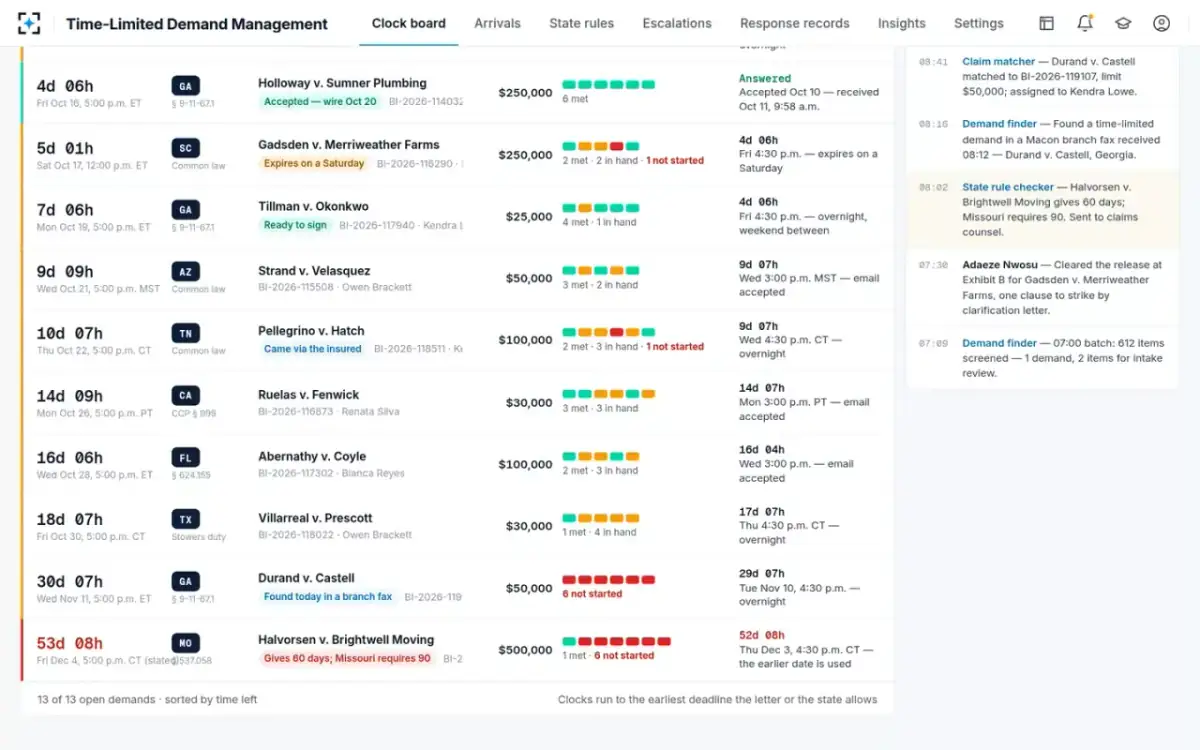
Georgia offers on the Time-Limited Demand Management board, each counted from receipt
Does 9-11-67.1 apply to offers made before April 2024?
No. The 2024 version applies to offers made on or after the date the Governor approved the act, 22 April 2024. An offer made earlier on a cause of action that accrued on or after 1 July 2021 is governed by the 2021 version; the original 2013 text governs older causes of action, which the Supreme Court of Georgia noted applied to claims "arising from the use of a motor vehicle on or after July 1, 2013".
Which version applies therefore depends on two dates: when the cause of action accrued and when the offer was made. For a desk with older claims still open, the version belongs on each claim, not in a single rule. The other states' rules, set beside Georgia's, are compared in time limit demands by state.
A Georgia response, checked line by line
Every Georgia offer on a motor vehicle claim gets the same checks, in the same order, before anyone signs. The list follows the 2024 text; the solution runs it on each offer and puts any shortfall in front of counsel.
Before signing an acceptance of a Georgia pre-suit offer
- Which version governs
Offer on or after 22 April 2024: the 2024 text. Earlier offers: 2021 or 2013, by accrual date.
- The receipt date and the three dates
Acceptance at least 30 days from receipt; payment and sworn statement at least 40. Work to the dates the offer states.
- All seven terms answered in writing
One paragraph per material term, accepting each in its entirety.
- The sworn coverage statement
Every policy the carrier issued that may apply, searched and sworn, unless waived.
- Payment that arrives by the payment date
Of the lesser of the demand or the bodily injury limits; the payer chooses the means.
- Delivery to the acceptance address
The offer must give an address and a fax number or email; book delivery with time to spare and keep the tracking.
- Questions asked in writing, early
Clarification on terms, releases, liens or records is protected; asking to change a material term is not.
Who Time-Limited Demand Management tells, and when, as a Georgia date approaches
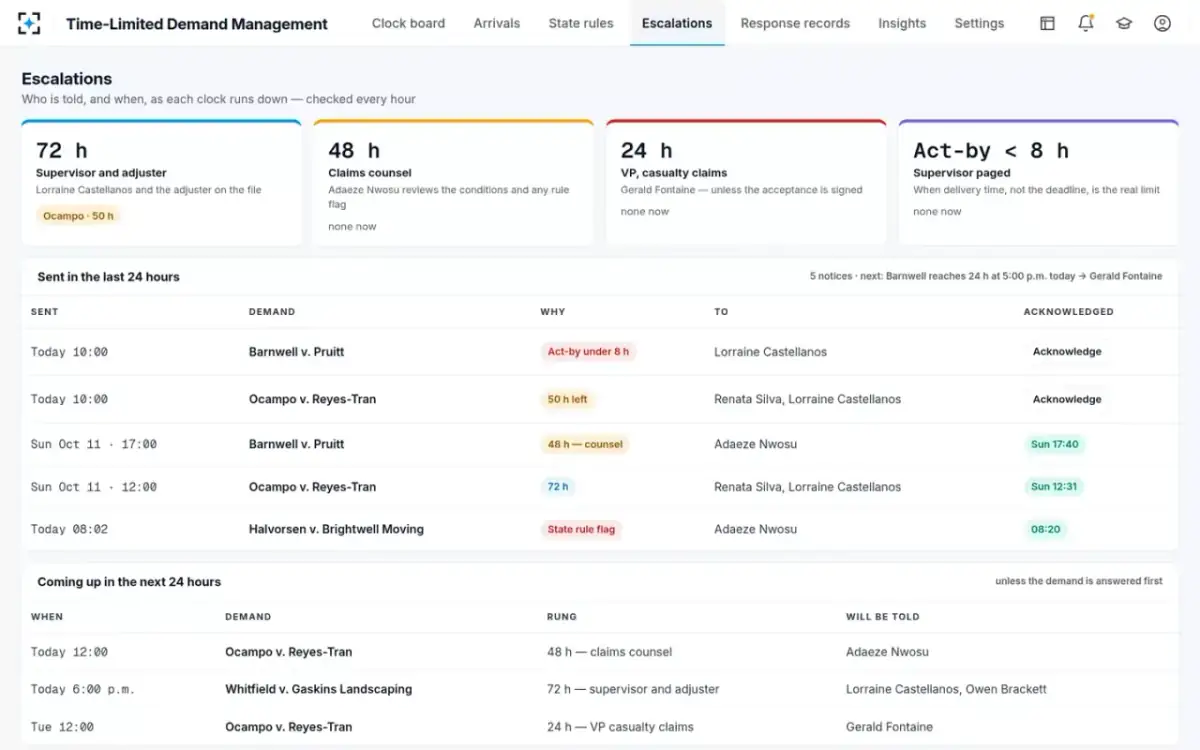
In Time-Limited Demand Management the condition extractor quotes each term with its page and paragraph, the state rule checker tests the offer against the 2024 text and cites the subsection, claims counsel rule on anything flagged, and a supervisor signs within authority. The rule checker never decides validity, and no agent signs, sends or pays. To see a Georgia offer go from a branch fax to a sealed acceptance, start from Time-Limited Demand Management.
Questions people ask
Does a Holt demand have to be sent by certified mail?
The offer must go by certified mail or statutory overnight delivery, return receipt requested, and the 30-day minimum is counted from receipt of an offer sent that way. The acceptance can go to the address, fax number or email address the offer must give for it.
Can a Georgia demand require payment by wire only?
The statute lets the payer choose among six means, including wire, cashier's check and a draft or check issued by an insurance company, and since 2024 terms outside the seven are immaterial. Counsel should decide how to answer such a condition; meeting it, where it is practical, removes the argument.
What records must come with a Georgia pre-suit offer?
Medical or other records in the claimant's possession, incurred as a result of the claim, that are sufficient to allow the insurer to evaluate it. The insurer may ask in writing for clarification about medical bills, records, liens and other relevant facts without that being a counteroffer.
What if the offer says the statute does not apply?
The safe harbor still applies. Subsection (i)(2) applies it to any offer on a motor vehicle collision claim, even one that expressly says the Code section does not apply, and subsection (e) forbids either side from requiring a waiver of the statute as a condition of settlement.
Does the statute apply to trucking or product liability claims?
It applies to injury claims arising from a motor vehicle collision, whatever the vehicle, but since 2024 it does not apply to any offer to settle a product liability claim, including failure to warn.
Is acceptance of only the amount enough?
No. Acceptance means written acceptance of all the material terms in their entirety. For the safe harbor, the writing must accept every material term except the amount, and the payment must be the lesser of the demand or the available limits.