To tender policy limits means that the liability insurer offers, or pays, the full amount of its policy limit to resolve a claim against its policyholder. It is the insurer saying: this is everything the policy provides. The phrase sounds final, but in law a tender, an acceptance and a counteroffer are three different acts. Answering a claimant's policy limits demand with a check is a tender; it settles the claim only if it also accepts the demand's terms as the state requires, and a response that changes a material term can be read as a counteroffer that rejects the demand. Florida gives a tender its own statutory effect: no bad-faith action lies if the insurer tenders the lesser of the limits or the demand within 90 days of actual notice of a supported claim. Botminds' Time-Limited Demand Management helps a casualty desk give the right one of the three, on time: its agents find each demand, quote every condition and apply the state's rule, and a named supervisor signs a written answer that addresses each term.
Tender, acceptance and counteroffer: three different answers to a limits demand
| A tender of limits | An acceptance | A counteroffer | |
|---|---|---|---|
| What it is | The insurer offers or pays its full limit | Written agreement to the demand’s material terms | A response that changes a material term |
| Who it binds | No one, until the claimant accepts it | Both sides: the settlement is formed | No one; the original demand is rejected |
| Florida | Within 90 days of actual notice of a supported claim, bars a bad-faith action | Settles the claim; payment due within 20 days of a written settlement | Leaves the 90-day window running |
| Georgia (offers since April 2024) | Part of the safe harbor only with a writing accepting the material terms and any required sworn statement, by the offer’s dates | Written acceptance of the seven material terms in their entirety forms a bilateral contract | Seeking to modify a material term is not a protected clarification |
| California | Not a defined term | Written acceptance of the material terms in their entirety | A request for clarification, information or an extension within the period is not, in itself, a counteroffer |
| Missouri | Not a defined term | Written acceptance of the material terms, delivered or postmarked within the period | Not addressed by the statute |
What does it mean to tender policy limits?
It means putting the full limit on the table: the insurer offers, in writing, to pay the per-person or per-accident limit that applies, and usually sends or stands ready to send the payment. A tender can answer a demand or come without one. Either way, it marks the point beyond which the policy will not pay, so whatever the claimant does next determines whether the policyholder is released or left facing the rest.
The word matters most in Florida, whose bad-faith statute is built around it. The insurer that tenders in time is protected even against common-law claims:
An action for bad faith involving a liability insurance claim, including any such action brought under the common law, shall not lie if the insurer tenders the lesser of the policy limits or the amount demanded by the claimant within 90 days after receiving actual notice of a claim which is accompanied by sufficient evidence to support the amount of the claim.
Fla. Stat. § 624.155(4)(a)
Is tendering policy limits the same as accepting a demand?
No. An acceptance answers the claimant's offer on the claimant's terms; a tender offers the insurer's money on whatever terms the insurer attaches. Where a demand sets conditions, such as the form of release, the parties released, the payment date, or a sworn statement, a check alone does not accept them, and a letter that pays the limit but proposes a different release may reject the demand instead.
The statute states say exactly what acceptance takes. California's recipients may accept "by providing written acceptance of the material terms outlined in Section 999.1 in their entirety". Missouri lets an insurer accept by written acceptance of the material terms, delivered or postmarked within the demand's period. Georgia's 2024 statute says the same of its seven material terms and adds that the result is a bilateral contract. In each, the writing is the acceptance; the payment is performance.
Florida: a tender as a statutory exit
Florida is where a tender does the most work. Within 90 days of actual notice of a claim with sufficient supporting evidence, a tender of the lesser of the limits or the amount demanded bars a bad-faith action, statutory or common law. If the insurer does not tender in that window, the window's existence cannot be used against it in a later bad-faith case, and any limitation period is extended by 90 days.
Florida also has a tender rule for crowded accidents. Where several claimants' claims arising from one occurrence may together exceed the limits, the insurer is not liable beyond the limits if, within 90 days of notice of the competing claims, it files an interpleader or makes the entire limits available in binding arbitration the claimants agree to. And once an insurer and a claimant agree in writing to settle, the insurer must tender payment within 20 days, or pay interest at 12 percent a year.
Florida's tender clocks
90days
from actual notice of a supported claim to tender the lesser of limits or demand
90days
from notice of competing claims to interplead or offer the limits in agreed arbitration
20days
to pay once a settlement is agreed in writing
12%
a year in interest on a settlement paid late
Georgia: the safe harbor needs a writing, a statement and payment
Georgia's 2024 statute protects an insurer that answers in full, not one that only pays. There is no failure-to-settle action where, on or before the dates in the offer, the insurer provides a writing that accepts every material term except the amount, the sworn statement on its coverage if the offer requires one, and payment of "the lesser of: (i) The amount demanded in such offer; or (ii) The available bodily injury liability limits" of its policies.
Two details change how a Georgia tender should be built. The payer chooses how to pay among six listed means, including wire transfer and a draft or check issued by an insurer. And an insurer that fails to comply in response to a compliant offer loses the safe harbor for any later offer on the claim. A tender that arrives after the offer's dates, or without the writing, is just a payment. The seven terms the writing must accept are set out in Holt demand requirements since 2024.
What counts as a counteroffer, and what does not
Asking questions is protected; changing terms is not. California says an attempt to seek clarification or more information, or a request for an extension because of the need for more information, made within the acceptance period, shall not "in and of itself, be deemed a counteroffer or rejection of the demand". Georgia gives the recipient a right, exercised in writing, to seek clarification about terms, the release, liens, subrogation claims, standing to release, medical bills and records, but says that seeking to modify a material term is not a clarification.
Georgia's courts showed the risk before 2024. In Redfearn v. Moore, decided under the earlier statute, the insurer's settlement check was payable to the claimants, the estate and their law firm and marked "MUST BE ENDORSED BY ALL PAYEES"; the claimants returned it as a rejection, and the Court of Appeals held no settlement had been reached. The Mercer Law Review's survey reads the 2024 text as aimed at such cases, so that once an offer is accepted, "disputes about the manner of performance will not be construed as a counteroffer and defeat the existence of the settlement".
Two answers to the same Georgia limits offer
A tender that may fail: A cover letter enclosing a check “in full settlement”.
An acceptance that holds: A letter accepting each of the seven material terms in its entirety, one paragraph per term.
A tender that may fail: The insurer’s standard release, enclosed for signature.
An acceptance that holds: The release the offer describes, full or limited as stated, with what each releasee receives.
A tender that may fail: Not sent; nobody searched the other policies.
An acceptance that holds: Delivered under oath by the offer’s date, covering every policy the insurer issued that may apply.
A tender that may fail: Sent when the check was cut, after the payment date.
An acceptance that holds: The lesser of demand or limits, delivered by the payment date, by a means the statute allows.
A tender that may fail: Ordinary mail, no tracking.
An acceptance that holds: To the acceptance address the offer gives, with tracking kept.
Does tendering limits protect the insured?
Only if the claimant accepts. A tender that becomes a settlement releases the parties the release names, and the policyholder is done. A tender the claimant refuses releases no one: the claimant can sue, and a verdict above the limit is still owed by the policyholder personally. Florida's statute bars the bad-faith action against a timely-tendering insurer; it does not release the insured.
That is why a tender should be timed and framed for acceptance, not just for the record. A limits demand is the claimant's offer to release the insured for the limit; accepting it, on its terms and in time, is usually the surest protection the insured will get. What happens when it is missed, and who pays the excess, is the subject of excess judgment: what one missed limits demand can cost.
Can an insurer tender limits before a demand?
Yes. Nothing requires an insurer to wait for a demand, and Florida's 90-day window runs from actual notice of a supported claim, not from a demand. Where there is no demand, the lesser of the limits or the amount demanded is simply the limits. An early tender is an offer the claimant may accept or refuse; it is not a release.
Waiting has its own logic in some cases. In First Acceptance, a five-claimant collision against a $50,000 per-accident limit, the insurer pursued a global settlement rather than paying the first claimant who asked, and the Supreme Court of Georgia held that reasonable. A desk deciding whether to tender early needs to know every claimant and every demand, and their dates, before it commits the limit to one of them.
What happens if an insurer tenders limits after the deadline?
The demand has lapsed, so the tender is a new offer the claimant is free to refuse. In First Acceptance, after the claimants withdrew their offer and sued, the insurer offered $25,000 and later $25,000 to each of two claimants, the full $50,000 limit; "The offers were rejected", and the case went to a 2012 verdict. In Golden Bear, the insurer tendered the remainder of its limit only after a jury had returned $3.24 million against its insureds.
A late tender can still matter in Florida, whose statute measures its 90 days from actual notice of a supported claim, not from the demand's own deadline. But no tender can revive an offer the claimant has withdrawn, and that offer was the insured's release.
How do you respond to a policy limits demand?
In writing, to every condition, by the earliest date the letter or the statute allows, with proof of delivery. The order matters because the conditions take days to meet while the reading and the deciding take hours.
Responding to a policy limits demand step by step, with Time-Limited Demand Management
- Record where and when it arrived
Receipt starts the clock in Georgia and Missouri; transmission in California.
- Match it to the claim and every claimant
Other claimants change whether and how to commit the limit.
- Quote every condition
Each with the sentence that sets it, and its page.
- Apply the state’s rule and send flags to counsel
Below-floor deadlines, missing enclosures, terms beyond the material ones.
- Ask questions in writing, early
Clarification is protected in California and Georgia; changing terms is not.
- Decide at the right authority level
A named person, with counsel where a slip could be a rejection.
- Accept each term in writing and deliver it in time
With the payment, release and sworn statement the terms require, and tracking kept.
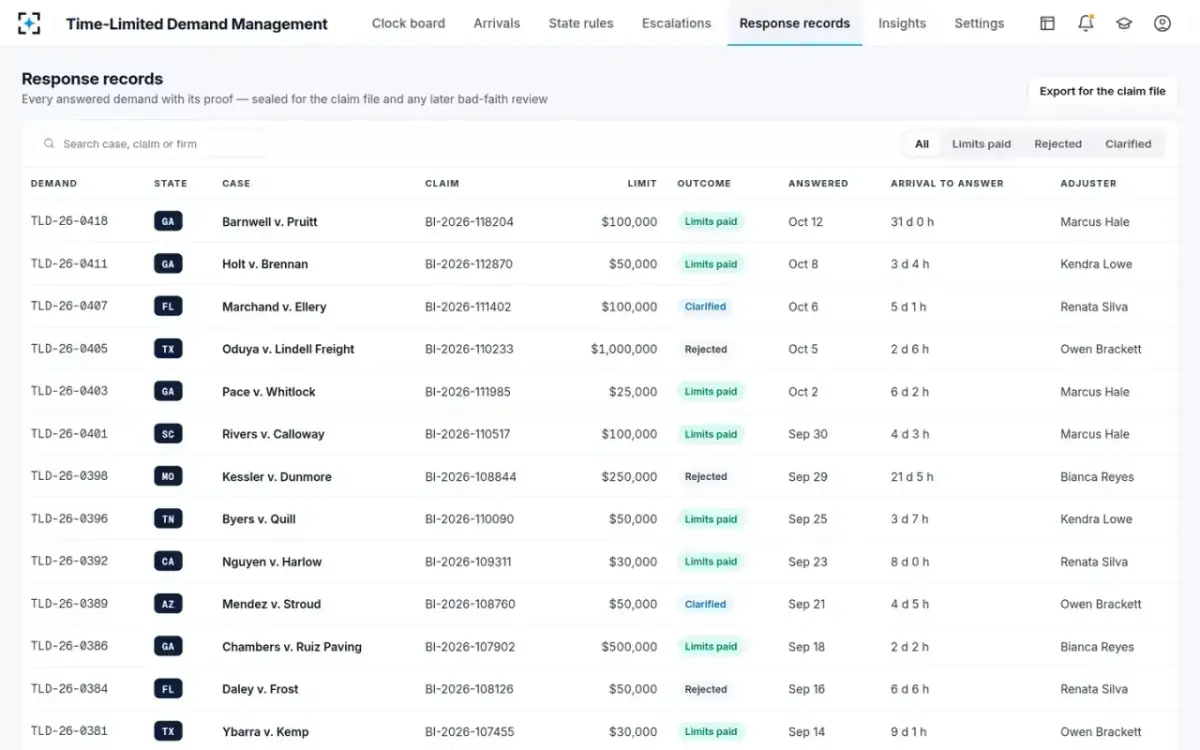
In Time-Limited Demand Management, the response drafter writes the acceptance in the carrier's own template with one paragraph per condition, the supervisor signs within authority, counsel co-signs where a slip would count as a rejection, and the whole response is sealed to the claim. The agents never sign, send or pay. Across the sample carrier's answered demands, outcomes are recorded as limits paid, rejected or clarified, so the desk can see which answers were tenders, which were acceptances, and which were questions.
Time-Limited Demand Management records each answer as limits paid, rejected or clarified
How the same letter is governed in different states is compared in time limit demands by state. To see an acceptance built condition by condition on the sample carrier's demands, start from Time-Limited Demand Management.
Questions people ask
What is a policy limits tender letter?
A letter in which the insurer offers its full limit to resolve the claim, usually stating the limit, the parties to be released and how payment will be made. Answering a time-limited demand, it should accept each of the demand's terms in writing rather than propose new ones, or it may be read as a counteroffer.
Does an insurer have to tender limits when liability is clear?
No statute quoted here orders a tender, but the duty to settle and the unfair claims practices laws push the same way. The NAIC model act treats failing to attempt in good faith to settle claims where liability has become reasonably clear as an unfair practice.
Who should sign a tender of policy limits?
A named person with authority for the amount. In the sample carrier's settings the casualty claim supervisor signs up to $100,000, a claims manager up to $250,000, and the VP of casualty claims with counsel above that, and counsel co-signs wherever a slip on the release, payment or delivery could be read as a rejection.
Can a claimant reject a tender of policy limits?
Yes. A tender binds no one until it is accepted, and a claimant may prefer to try the case and pursue the excess. That is the scenario the excess-judgment cases describe.
What if the demand asks for less than the limits?
Then the lesser amount is what Florida's tender rule and Georgia's safe harbor refer to: each speaks of the lesser of the limits or the amount demanded.
Does a tender stop the demand's deadline?
Only if it is an acceptance. A tender that does not accept the demand's terms leaves the demand's clock running, and the demand expires on its date if no acceptance arrives.