Under California Code of Civil Procedure § 999.1, a time-limited demand must give the insurer at least 30 days to accept, counted from the date of transmission, if it is sent by email, fax or certified mail, and at least 33 days if it is sent by ordinary mail. The 30 days in "CCP 999 30 days" is therefore a floor, not the deadline: the deadline is the date the letter states, which may be later, and the count starts when the claimant's lawyer sends the letter, not when the insurer's adjuster reads it. Georgia and Missouri count differently, from the insurer's receipt, so a desk that stores only the day someone opened the letter will compute the wrong date in all three states. Botminds' Time-Limited Demand Management records how and when each demand was sent and received, applies its state's floor, and runs the clock to the earlier of the letter's date and the floor, with an act-by that leaves time for the answer to arrive.
One letter sent on 5 October, counted on four calendars
- 30 days from transmission30 d
- 33 days from transmission33 d
- In the post
- 30 days from receipt30 d
- In the post
- 90 days from receipt90 d
How many days does CCP 999 give to respond?
At least 30 days from transmission by email, fax or certified mail, and at least 33 by ordinary mail; the letter may give more. The rule sits in the first of the material terms a California time-limited demand must contain:
The time period within which the demand must be accepted shall be not fewer than 30 days from date of transmission of the demand, if transmission is by email, facsimile, or certified mail, or not fewer than 33 days, if transmission is by mail.
Cal. Code Civ. Proc. § 999.1(a)
The section applies to a demand made before a complaint or demand for arbitration is filed, to settle a claim for personal injury, property damage, bodily injury or wrongful death within the insurer's limits, under an auto, motor vehicle, homeowner or commercial premises liability policy, and transmitted on or after 1 January 2023. The letter must be in writing and be labeled as a time-limited demand or cite the section.
Does CCP 999 30 days include mail time?
For ordinary mail the statute adds three days, making 33; for certified mail, email and fax it adds nothing. Because both periods run from transmission, whatever time the letter spends in the post, in a mailroom or at a branch comes out of the insurer's 30 or 33 days. A certified letter that takes four days to arrive and two more to reach the right adjuster leaves 24 days of a 30-day floor.
California helps insurers shorten that path. The claimant must send the demand to the email or physical address the insurer has designated for time-limited demands, if the insurer has given one to the Department of Insurance and the Department has published it, or to the insurance representative assigned to the claim, if known. The Department invited insurers to submit those addresses before the chapter took effect, by email to TLD.address@Insurance.ca.gov. A carrier that has designated an address, and reads it continuously, gets most of the 30 days.
California's time-limited demand chapter in four numbers
30days
minimum from transmission by email, fax or certified mail
33days
minimum from transmission by ordinary mail
4
policy types covered: auto, motor vehicle, homeowner, commercial premises liability
2023
demands transmitted on or after 1 January 2023 are covered
How a mailroom should record a California demand's transmission date
Because California counts from transmission, the insurer needs the sender's date, not its own. Each channel carries it differently: an email's sent timestamp, a fax's transmission header, the certified mail receipt and tracking history, the postmark on an ordinarily mailed envelope. The letter's own date is not the transmission date; a letter dated on a Friday and mailed on a Monday starts its count on Monday.
Those artifacts are easy to lose. A branch that scans the letter and discards the envelope has thrown away the postmark; a forward from an agent strips the original email header. The demand finder in Time-Limited Demand Management records when and where each item arrived in every channel it reads, and the response file keeps the letter as received, so the transmission evidence survives alongside the arrival time. Where the two disagree, the clock runs to the earlier date.
When does a time-limited demand deadline start?
On transmission in California, on receipt in Georgia and Missouri, and on the date the letter names in every case. Georgia's acceptance date must fall at least 30 days after the insurer receives an offer sent by certified mail or statutory overnight delivery; Missouri's period runs at least 90 days from the date the liability insurer receives the demand. The statute floors tell a desk whether a letter's date is lawful; they do not move the letter's date.
That is why the timeline above shows the same Monday letter landing on three different floors. Sent by ordinary mail in California, its floor is a Saturday, 7 November. Sent certified in Georgia and received on Thursday 8 October, its floor is the same Saturday, by a different route. In Missouri the floor is 6 January. A desk that works several states needs the transmission method, the transmission date, the receipt date and the state for every letter, because each floor uses a different pair.
A worked set of dates
The table counts one hypothetical demand sent on Monday 5 October 2026, under each state's floor, and compares it with a letter that states its own date of Friday 6 November at 5:00 p.m. It shows the two questions every count must answer: is the letter's date lawful, and which date governs?
One letter sent Monday 5 October 2026, stating Friday 6 November: is the date lawful, and which governs?
| Rule | Counted from | Floor | Letter’s date against the floor | Date to work to |
|---|---|---|---|---|
| California, email, fax or certified mail | Transmission, 5 Oct | Wed 4 Nov | Later than the floor: compliant on time | Fri 6 Nov, the letter’s date |
| California, ordinary mail | Transmission, 5 Oct | Sat 7 Nov | Earlier than the floor: below the statute | Fri 6 Nov, while counsel considers the shortfall |
| Georgia, certified mail received 8 Oct | Receipt, 8 Oct | Sat 7 Nov | Earlier than the floor: below the statute | Fri 6 Nov, while counsel considers the shortfall |
| Missouri, certified mail received 8 Oct | Receipt, 8 Oct | Wed 6 Jan | Far earlier than the floor | Fri 6 Nov, while counsel considers the shortfall |
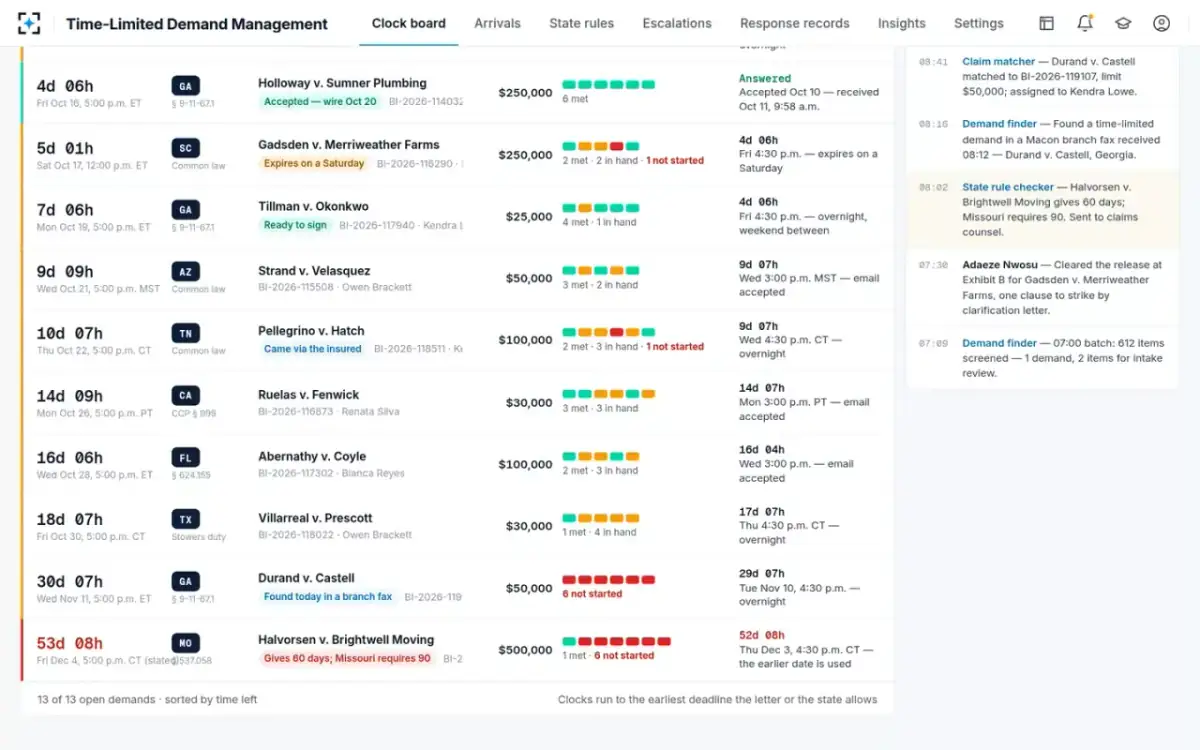
Time-Limited Demand Management's clock keeper works exactly this way. Its locked setting is to use the earliest deadline, the letter's date or the statutory floor, whichever comes first, and it never extends a deadline. The sample carrier's board shows the Missouri case in practice: a demand giving 60 days where § 537.058 requires 90, flagged to claims counsel and still running to its own, earlier date.
Every demand on its own state's clock and time zone in Time-Limited Demand Management
Do weekends count in a time-limited demand?
Calendar days count; neither § 999.1 nor Georgia's or Missouri's statute speaks of business days. California has general rules for computing time. Section 12 says the time in which any act provided by law is to be done "is computed by excluding the first day, and including the last, unless the last day is a holiday, and then it is also excluded". Section 12a extends a period whose last day is a holiday to the next day that is not one, and defines holiday to include "all day on Saturdays".
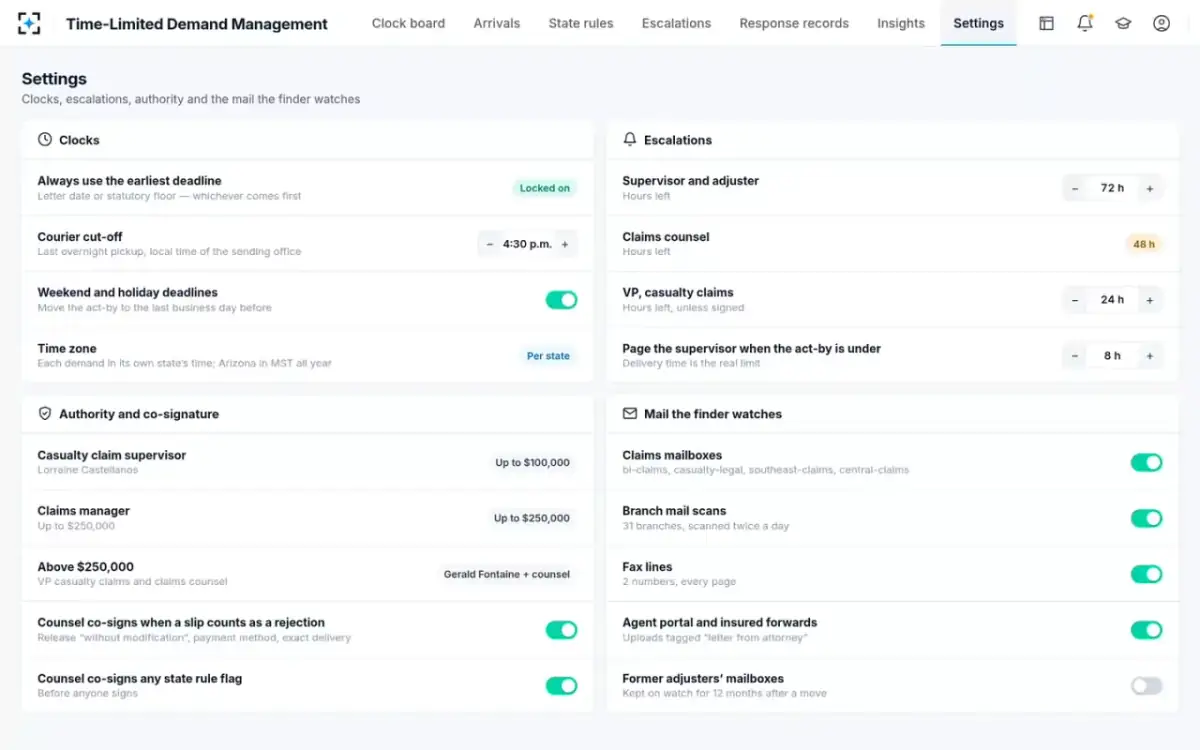
Whether those general rules stretch the date a claimant's letter itself states is a question for counsel, and a desk should not bet a policy on the answer. The worked example shows why it matters: an ordinary-mail floor in California, or a Georgia floor counted from a Thursday receipt, can land on a Saturday. The safe course is to treat the letter's stated date as final and to finish early. In the solution, a deadline that falls on a weekend or holiday moves the act-by to the last business day before, so a demand expiring at noon on a Saturday is answered by Friday afternoon; the deadline itself never moves.
What if the deadline falls on a holiday?
Plan as if it does not move. California's § 12a extends periods set by law whose last day is a holiday, but a claimant's stated deadline is a term of an offer, and claimants' offices are often closed that day. The sample carrier's board carries a South Carolina demand that expires at noon on a Saturday when the claimant's law firm is closed; its act-by was set for Friday at 4:30 p.m.
Time zones matter as much as holidays. A demand stating 5:00 p.m. means 5:00 p.m. where the letter says, and the solution counts each demand in its own state's time, with Arizona on Mountain Standard Time all year. A California deadline of 5:00 p.m. Pacific gives an Atlanta claims office until 8:00 p.m. Eastern; a Georgia deadline at 5:00 p.m. Eastern gives a Los Angeles office until 2:00 p.m.
Earliest date, weekend rule and time zone, set once in Time-Limited Demand Management
What is the difference between CCP 998 and CCP 999?
They govern different stages and different documents. Section 999 governs a time-limited demand made before a complaint or demand for arbitration is filed, to settle within the insurer's limits; its 30 or 33 days protect the insurer's chance to evaluate. Section 998 governs offers to compromise between parties once an action or arbitration is under way, with cost consequences for a party that refuses an offer and then does no better at trial.
The two are easy to confuse because both involve written offers and short periods. For a claims desk the practical difference is the trigger: a § 999 demand arrives before suit, often at a branch or with an agent, and its consequences are argued in a later excess case; a § 998 offer arrives through litigation counsel in a filed case, and belongs on the litigation team's docket.
What does CCP 999.3 require for acceptance?
Written acceptance of the material terms of § 999.1 in their entirety. While the insurer considers, a request for clarification, more information or an extension because more information or investigation is needed, made within the acceptance period, is not in and of itself a counteroffer or rejection. And if the insurer does not accept, for any reason, it must notify the claimant in writing of its decision and the basis for it, before the demand expires.
Counting and answering a California time-limited demand
- Record the transmission date and method
Email, fax and certified mail start a 30-day floor; ordinary mail a 33-day one.
- Check the label or citation
The letter must be labeled a time-limited demand or reference the section.
- Compare the letter’s date with the floor
Work to the earlier; send any shortfall to counsel.
- Count in the letter’s time zone
A 5:00 p.m. Pacific deadline is not 5:00 p.m. where the claims office sits.
- Ask questions in writing, inside the period
Clarification, information and extension requests are not, in themselves, counteroffers.
- Accept every material term in writing, or explain in writing
Acceptance of the terms in their entirety, or a written decision and its basis, before expiry.
Who the chapter does not cover matters as much. Its rule that a non-compliant demand is not a reasonable offer to settle in a later excess suit does not apply to a claimant without counsel, and the chapter applies only to the four policy types it names. A demand on another line, or from an unrepresented claimant, still has its own date and still deserves the same care. How California's rules sit beside other states' is set out in time limit demands by state; how the computed date reaches the people who act on it, in claims diary system or demand clock; and what software may compute and what it must leave to counsel, in deadline tracking software for limits demands. To see the clocks on the sample carrier's demands, start from Time-Limited Demand Management.
Questions people ask
Is the CCP 999 period 30 calendar days or 30 business days?
Calendar days: § 999.1 says "not fewer than 30 days" from transmission, with no reference to business days. Weekends inside the period count; whether a period ending on a weekend extends is governed by general rules such as §§ 12 and 12a, and counsel should decide how they apply to a letter's own date.
Does certified mail get the extra three days?
No. Section 999.1 gives 30 days for email, fax and certified mail alike, and 33 only for ordinary mail, so a certified letter's transit time comes out of the insurer's 30 days.
Can a California demand give more than 30 days?
Yes. The statute sets a minimum; the letter's own date governs when it is later. A desk should record both, so that a letter giving less than the minimum is flagged.
Does CCP 999 apply to unrepresented claimants?
The chapter's provision that a non-compliant demand is not a reasonable offer to settle in a later excess suit does not apply to a claimant who is not represented by counsel. An unrepresented claimant's deadline is still a deadline.
Where should a California demand be sent?
To the email or physical address the insurer designated with the Department of Insurance, if one has been published, or to the insurance representative assigned to the claim, if known.
Does an extension request stop the clock?
Not by itself. A request for an extension made because more information is needed is not a counteroffer, but the clock runs to the original date unless the claimant agrees in writing to extend it; § 999.3 counts the period with any extension the parties have agreed, and no other.