Bad faith failure to settle is a claim that a liability insurer unreasonably failed to accept an offer to settle within its policy limits, leaving its policyholder exposed to a judgment above them. The Supreme Court of Georgia put the core of it in 2019: an insurance company may be liable for the excess judgment entered against its insured based on "the insurer's bad faith or negligent refusal to settle a personal claim within the policy limits". Such a case is tried years after the demand, and what decides it is what the insurer knew, when it knew it, and what it did, which survives only in the claim file. Botminds' Time-Limited Demand Management keeps that file as the work happens: when each demand arrived and where, when it was found, every condition with its proof, who signed and what the signature meant, and how the acceptance traveled, sealed so it cannot be edited.
The file below is a sample. The carrier, people and claim are fictional; the dates and steps are as the solution recorded them on its sample data for one Georgia demand on a $100,000 per-person limit.
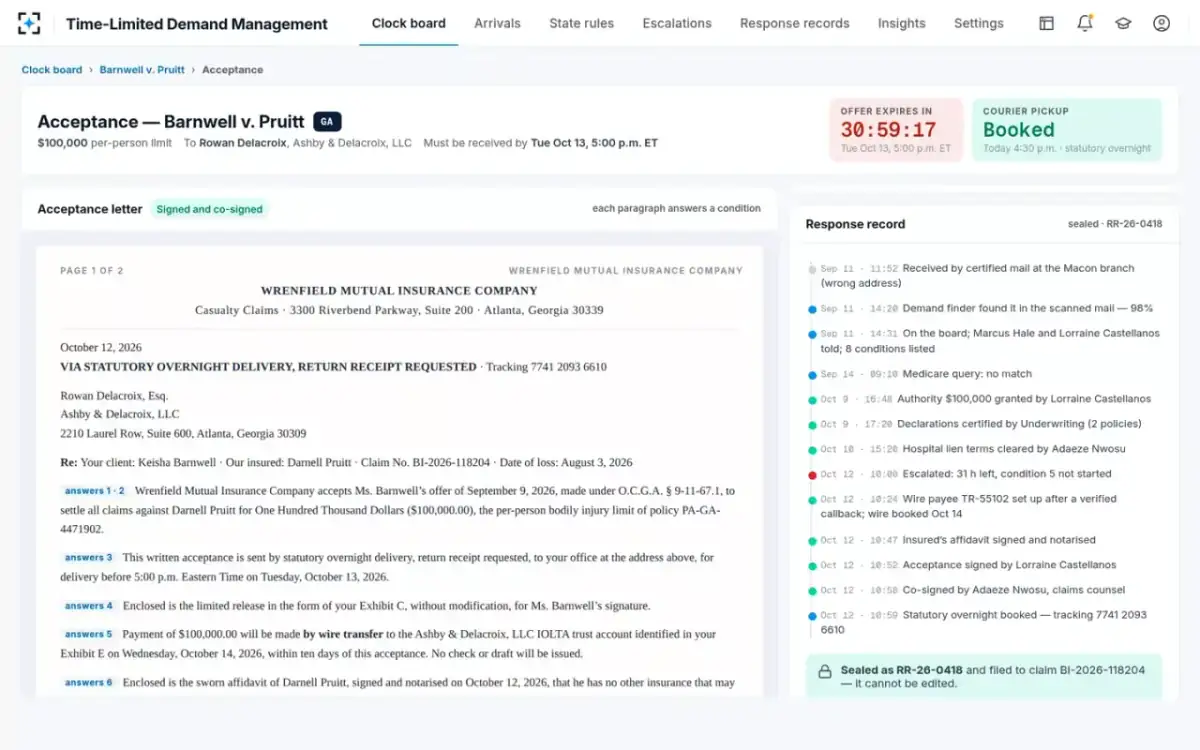
One limits demand's response file in Time-Limited Demand Management, and what each line proves
Fri 11 Sep, 11:52
Offer received by certified mail at the Macon branch, not the claims office
The receipt date that starts the clock, and where the letter actually arrived
Fri 11 Sep, 14:20
Found in the branch’s scanned mail
Discovery 2 h 28 m after arrival, the gap a court will ask about
Fri 11 Sep, 14:31
On the deadline board; adjuster and supervisor told; eight conditions listed
Who knew, from when, and what they were told the offer required
Mon 14 Sep, 09:10
Medicare query: no match
Lien diligence done early, not on the last day
Fri 9 Oct, 16:48
Authority of $100,000 granted
The decision to pay the limit, by a named person
Fri 9 Oct, 17:20
Declarations for two policies certified by underwriting
A condition met, with the document that meets it
Sat 10 Oct, 15:20
Hospital lien terms cleared by claims counsel
Counsel’s review, dated
Mon 12 Oct, 10:00
Escalated: 31 hours left, one condition not started
The process caught the gap before the deadline
Mon 12 Oct, 10:24
Payment set up after a callback to an independently verified number
Payment ready before acceptance, and protected against a forged account
Mon 12 Oct, 10:52
Acceptance signed by the casualty claim supervisor, within authority
Every condition met or in hand at signature, stated in the signature’s meaning
Mon 12 Oct, 10:58
Co-signed by claims counsel
Legal review of the release and payment terms before sending
Mon 12 Oct, 10:59
Statutory overnight delivery booked, tracking number recorded; certified mail as backup
Delivery due 10:30 a.m. Tuesday, 6 h 30 m before the 5:00 p.m. deadline
Sealed and filed to the claim. Arrival, discovery, conditions, signatures and tracking can no longer be edited.
What is bad faith failure to settle?
It is a tort claim, usually brought by the policyholder or by the injured claimant as the policyholder's assignee, that the insurer should pay a judgment above the limits because it failed to settle within them when it should have. It is a third-party claim: it arises from a liability policy and a claimant's offer, not from a dispute over the policyholder's own benefits.
The standard is reasonableness, judged from the insured's side as well as the insurer's. The Georgia court quoted its earlier rule that bad faith in refusing to settle depends on whether the insurer acted reasonably in responding to a settlement offer, "bearing in mind that, in deciding whether to settle, the insurer must give the insured's interests the same consideration that it gives its own". Texas reaches the same place through its Stowers duty, which the Fifth Circuit described as essentially a negligence claim sounding in Texas tort law.
Regulators reach the same conduct by another route. The NAIC's model act lists among unfair claims practices "Not attempting in good faith to effectuate prompt, fair and equitable settlement of claims submitted in which liability has become reasonably clear". A market conduct finding and a bad-faith verdict are different proceedings, but both are proved from the same file.
When does an insurer have a duty to settle?
In Georgia, only when the injured party presents a valid offer to settle within the insured's limits; the court in First Acceptance rejected a broader duty based on what the insurer knew or should have known. In Texas, when the insurer receives a demand within limits, on a covered claim, proposing a full release for a stated sum, that an ordinary prudent insurer would accept. In both, the offer is the trigger, so the first thing a bad-faith case examines is the offer itself.
The court explained why it drew the line at an offer. Without one, it reasoned, quoting the Eleventh Circuit, an insured would try to prove the case with after-the-fact testimony that the claimant would have settled, testimony that "would be unreliable because it is speculative". An offer is a document with a date. A claim file that captures the offer exactly as it arrived, and when, is capturing the one piece of evidence the duty depends on.
First Acceptance’s failure to promptly accept An and Hong’s offer was reasonable as an ordinarily prudent insurer could not be expected to anticipate that, having specified no deadline for the acceptance of their offer, An and Hong would abruptly withdraw their offer and refuse to participate in the settlement conference.
Supreme Court of Georgia, First Acceptance v. Hughes (2019)
Does a demand without a deadline create a duty to settle?
It can create a duty, but not a deadline. In First Acceptance the court found that two letters were a valid offer within limits but set no time for acceptance, so the offer stayed open for a reasonable time and the insurer was not on notice that it had to answer within any particular period. The insurer had not acted unreasonably when the claimants withdrew the offer 41 days later.
First Acceptance v. Hughes: an offer with no deadline, and an insurer that won
| Date | What happened |
|---|---|
| 29 Aug 2008 | Multi-vehicle collision caused by the insured, whose policy had limits of $25,000 per person and $50,000 per accident; five people were known to be injured. |
| Late Sep 2008 | The insurer retained counsel to resolve the five claims and, if possible, reach a global settlement. |
| 2 Jun 2009 | Two claimants’ lawyer faxed two letters expressing interest in a settlement conference and, in the alternative, offering to settle for the available limits. |
| 10–13 Jul 2009 | The claimants sued, then wrote that 41 days had passed without a response and revoked the offer. |
| Feb and Sep 2010 | The insurer offered $25,000, then $25,000 to each claimant, equal to the $50,000 limit; both offers were rejected. |
| Jul 2012 | Jury verdict for the claimants; the judgment included over $5.3 million for one claimant’s injuries. |
| 11 Mar 2019 | The Supreme Court of Georgia held the insurer was entitled to summary judgment: the offer had no deadline, and failing to accept it promptly was reasonable. |
The insurer won because of what the letters lacked, not because of how it handled them. A letter that names a date, cites the statute and goes by certified mail removes that defense, and in the statute states it now must do exactly that. The court also leaned on context the file could show: the claimants had said they wanted to attend a settlement conference with the other claimants, and the insurer was working toward a global settlement of five claims against limited coverage.
What the statutes now make relevant
The statute states have written parts of the bad-faith analysis down, and each provision points at something the file has to contain. Florida says "Mere negligence alone is insufficient to constitute bad faith". California makes the insurer's written reasons for declining relevant in any later excess suit. Missouri and California say a demand that does not meet the statute is not a reasonable opportunity, or offer, to settle in such a suit. Georgia says there is no failure-to-settle action at all where the insurer meets its safe harbor.
Statute provisions that decide what a bad-faith file must show
| Provision | What it says | What the file must show |
|---|---|---|
| Georgia § 9-11-67.1(i) | No failure-to-settle action if, by the offer’s dates, the insurer gives a writing accepting the material terms, the sworn coverage statement where required, and payment of the lesser of demand or limits | Three dated deliveries, each with proof of when it arrived |
| Florida § 624.155(4) | No bad-faith action if the insurer tenders the lesser of limits or demand within 90 days of actual notice of a supported claim | The date of actual notice, the evidence received, and the tender date |
| Florida § 624.155(5) | Negligence alone is not bad faith; a claimant’s bad faith in setting deadlines may reduce damages | The deadlines the claimant set, and what the insurer asked and when |
| California CCP § 999.3(c) | An insurer that does not accept must give written notice of its decision and basis before expiry; the notice is relevant later | The notice, its reasons and its delivery date |
| California CCP § 999.4; Missouri § 537.058.7 | A non-compliant demand is not a reasonable offer, or opportunity, to settle in a later excess suit | The letter as received, with how and when it arrived, so compliance can be judged |
What is the Florida bad faith safe harbor?
Florida bars any bad-faith action on a liability claim, including a common-law one, if the insurer tenders the lesser of the policy limits or the amount demanded within 90 days after receiving actual notice of a claim accompanied by sufficient evidence to support its amount. It is a tender rule, not an acceptance rule, and the clock starts on notice plus evidence, which is why the file must record both: when notice arrived and when the evidence was enough.
The same section restrains claimants. The insured, the claimant and their representatives have a duty to act in good faith in furnishing information, making demands, setting deadlines and attempting settlement, and where they did not, "the trier of fact may reasonably reduce the amount of damages awarded against the insurer". An insurer can argue that point only if its file shows exactly what the claimant sent, what deadline it set, and when it arrived. How a tender differs from an acceptance across states is set out in what it means to tender policy limits.
What evidence shows an insurer acted in good faith on a demand?
Evidence that the insurer found the offer promptly, understood every term, did the work to meet each one, asked its questions in writing and in time, decided through a person with authority, and delivered its answer before the deadline in a way it can prove. Every line of the sample file above maps to one of those.
Three lines carry the most weight. The arrival line fixes the start of the clock where the statute fixes it, at receipt. The discovery line shows the gap between arrival and attention, 2 hours 28 minutes in the sample, and a court will ask about that gap whatever its length. The delivery line, with tracking, shows the answer arrived in time; in the sample, statutory overnight delivery was booked for 10:30 a.m., six and a half hours before the deadline, with certified mail as a backup.
The acceptance and its timeline, sealed to the claim by Time-Limited Demand Management
What should be in a claim file for a limits demand?
Enough to reconstruct what the insurer did and when, which is the standard examiners already apply. The NAIC model regulation requires every relevant document in the claim file to carry the date it was received, processed or mailed. A limits demand adds conditions, a statute and a deadline to that baseline.
What a limits demand file should hold, line by line
- The letter exactly as received
Every page and enclosure, with the envelope or transmission record.
- Where and when it arrived, and when it was found
Branch, agent, fax or mailbox; the time of each.
- Each condition, quoted with its page
And for each, the document or action that met it, with its date.
- The state rule applied, and counsel’s view
The statute and version, any flag, and counsel’s dated decision.
- Every question asked, and the answer
Written requests for clarification or records, with delivery proof.
- The decision and its authority
Who decided, within what limit, and what the signature meant.
- The answer and its delivery
The acceptance or written reasons, how they traveled, tracking and receipt.
- A lock on the whole
A file that can be edited later proves less than one sealed when the work was done.
Why the file must be sealed when the work is done
Because a bad-faith case is tried long after the demand, often by people who were not there. In First Acceptance the collision was in 2008, the verdict in 2012, the bad-faith suit in 2014 and the decision in 2019. A file assembled after a suit is filed invites the question of what was added and when; a file sealed on the day of delivery answers it.
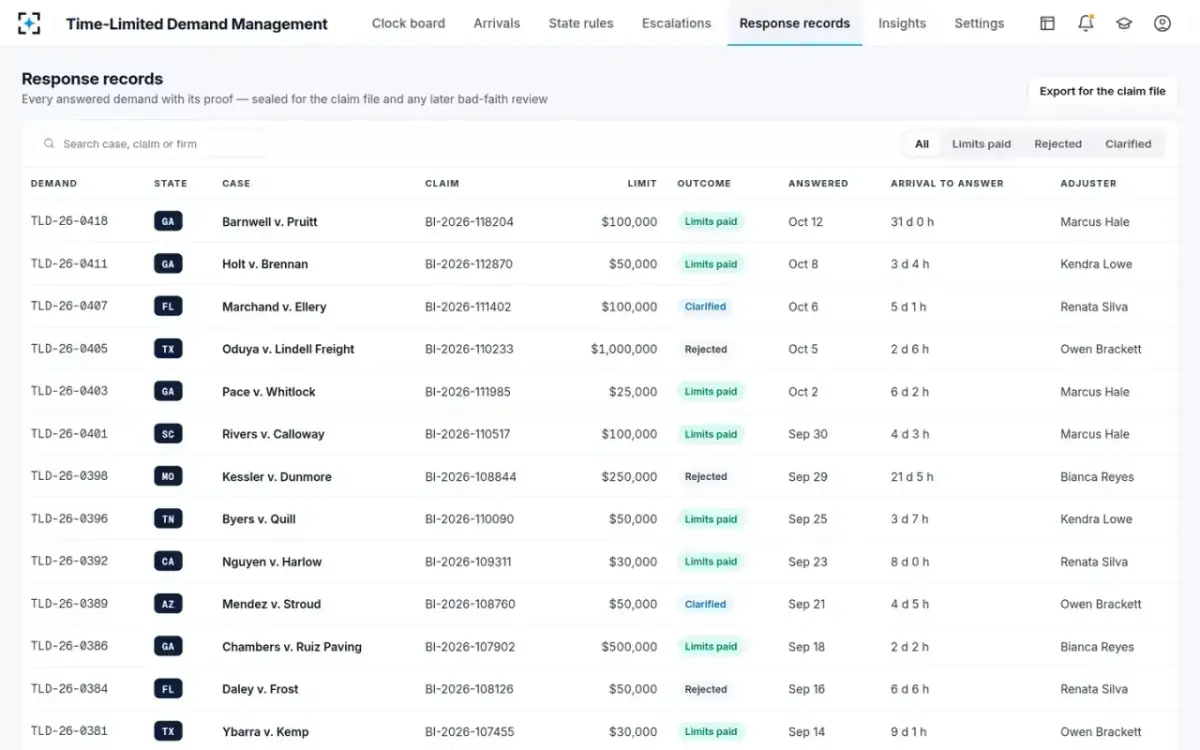
In Time-Limited Demand Management the response file is built as each step happens, from the branch's receipt to the courier booking, and sealed once the acceptance or response is sent. It is filed to the claim, can be exported for the claim file, and cannot be edited. Answered demands are listed with their outcome, time from arrival to answer and adjuster, so a reviewer can pull any of them.
Every answered demand, with its outcome and the time it took
The solution's agents read, check and draft; they never sign, send, pay, or change a reserve or coverage position, so the decisions in the file are always a named person's. What the file is worth in avoided exposure, and how a missed demand turns into an excess judgment, is the subject of excess judgment. The questions to put to any tool that claims to keep such a file are in ten questions for any demand-tracking tool. To see the sample file built step by step, start from Time-Limited Demand Management.
Questions people ask
Is negligence enough for a failure-to-settle claim?
It depends on the state. Georgia's rule speaks of a "bad faith or negligent refusal to settle", and Texas treats a Stowers claim as essentially negligence; Florida's statute says mere negligence alone is insufficient to constitute bad faith.
Who can bring a bad faith failure to settle claim?
The policyholder, or the injured claimant as the policyholder's assignee. Missouri's statute refers expressly to a lawsuit filed by a claimant as an assignee of the tortfeasor, or by the tortfeasor for the claimant's benefit.
Does rejecting a limits demand mean bad faith?
No. The question is whether the insurer acted reasonably, giving the insured's interests the same consideration as its own. California requires a written explanation of a decision not to accept, sent before the demand expires, and that explanation is relevant if a suit follows.
Does a late answer always lead to liability?
No. Liability also requires a valid offer within limits and, in practice, a verdict above them; in First Acceptance the insurer won because the offer had no deadline. A late answer to a valid, time-limited offer is, however, the fact pattern these cases are built on.
How long should a demand file be kept?
As long as a claim or suit on it can follow, which is years. The NAIC model regulation sets a floor for claim data: available for all open and closed files for the current year and the two preceding years.
Is first-party bad faith the same thing?
No. First-party bad faith concerns an insurer's handling of its own policyholder's claim for benefits; failure to settle is a third-party claim arising from a liability policy and a claimant's offer.