Time limit demands by state follow different rulebooks, and a casualty desk that handles more than one state needs all of them at once. Georgia, Missouri and California have statutes that say what a time-limited settlement demand must contain and how long it must stay open: at least 30 days from receipt in Georgia, 90 days from receipt in Missouri, and 30 or 33 days from transmission in California. Florida has no statute for the demand's content, but bars a bad-faith action against an insurer that tenders the lesser of the limits or the demand within 90 days, and puts a duty of good faith on the claimant. Texas relies on the Stowers duty, which comes from the courts rather than a demand statute. The same nine-page letter can therefore be compliant, deficient or simply governed by case law depending on where the crash happened. Botminds' Time-Limited Demand Management keeps one reviewed table of these rules and tests every incoming demand against its own state, with claims counsel deciding whatever the table flags.
Time limit demands by state: what each rulebook sets
| State | Where the rule lives | Minimum time to accept | Counted from | Claims covered | The consequence that matters |
|---|---|---|---|---|---|
| Georgia | O.C.G.A. § 9-11-67.1, rewritten 2024 | 30 days; payment and the insurer’s sworn coverage statement no sooner than 40 days | Receipt of the offer, sent by certified mail or statutory overnight delivery | Motor vehicle collision claims, offers made between accrual and the defendants’ answers; not product liability | Terms outside the seven material ones are immaterial; a safe harbor protects an insurer that meets the statute’s conditions |
| Missouri | Mo. Rev. Stat. § 537.058, in force since 28 Aug 2017 | 90 days | Receipt by the liability insurer | Personal injury, bodily injury and wrongful death; not demands within 90 days of a jury trial | Not a reasonable opportunity to settle, and not admissible, in a later excess suit |
| California | Code Civ. Proc. §§ 999–999.5, in force since 1 Jan 2023 | 30 days, or 33 by ordinary mail | Transmission | Pre-suit claims under auto, motor vehicle, homeowner and commercial premises liability policies | Not a reasonable offer to settle within limits in a later excess suit unless it substantially complies; that rule does not apply to a claimant without counsel |
| Florida | Fla. Stat. § 624.155(4)–(6), from 2023 | No minimum for the demand; a 90-day window for the insurer | Actual notice of a claim with sufficient supporting evidence | Liability insurance claims | A timely tender bars a bad-faith action; the claimant’s own bad faith in setting deadlines may reduce damages |
| Texas | Common law: Stowers (1929), as courts apply it | None set by statute; the letter’s own time | The letter | Any third-party claim within the policy’s scope | A demand that does not propose a full release for a stated sum within limits does not trigger the duty |
| South Carolina | H.4670, a bill (passed the House 114–0, March 2026) | Would be 30 days | Receipt of the demand | Personal injury, bodily injury, property damage and wrongful death | Not law; the common-law Tyger River doctrine continues |
Which states have time limited demand statutes?
Of the states compared here, Georgia, Missouri and California have statutes written for the time-limited demand itself; Florida legislates the insurer's response; Texas leaves it to the courts. That is not a list of every state, and it changes: bills were moving in South Carolina, Missouri and Arizona in 2026. A desk should treat its state table as a document with a review date, not a fact learned once.
The three statutes were written in different decades for different problems. Georgia's arrived in 2013 and has been rewritten twice, in 2021 and 2024; the Georgia Supreme Court noted the original applied to causes of action "arising from the use of a motor vehicle on or after July 1, 2013". Missouri's took effect in August 2017 and has not changed since. California's chapter took effect on 1 January 2023 and opens with a policy statement that every side of the table can quote:
It is declared to be the public policy of the State of California that prompt settlements of civil actions and claims are encouraged as beneficial to claimants, policyholders, and insurers.
Cal. Code Civ. Proc. § 999(a)
The numbers a multi-state demand desk lives by
90days
Missouri’s minimum, from receipt by the liability insurer
33days
California’s minimum by ordinary mail; 30 by email, fax or certified mail
40days
Georgia’s earliest payment date, counted from receipt
90days
Florida’s window to tender the lesser of limits or the demand
What is the minimum time to respond to a time limited demand in Georgia?
Thirty days from receipt. Since April 2024, a Georgia pre-suit offer on a motor vehicle collision claim must name a date by which it must be accepted that is at least 30 days from receipt of an offer sent by certified mail or statutory overnight delivery, a payment date at least 40 days from receipt, and, unless the claimant waives it, a date at least 40 days out for the insurer's sworn statement on its coverage.
The 2024 rewrite changed more than dates. It makes every such offer "an offer to enter into a bilateral contract", limits the material terms to seven, treats any other term as immaterial, and adds a safe harbor for an insurer that delivers a written acceptance of the material terms, the sworn statement where required, and payment of the lesser of the demand or the limits by the dates in the offer. The statute covers offers from the moment a cause of action accrues until every named defendant has answered or defaulted. The 2021 version, by contrast, applied "Prior to the filing of an answer" and listed five material terms. Each of the seven terms, and what they mean for a response, is set out in Holt demand requirements since 2024.
How long does an insurer have under Missouri 537.058?
At least 90 days from the date the liability insurer receives the demand. Missouri's statute also requires the demand to be in writing, cite the section and go by certified mail with return receipt, and to enclose a list of the claimant's health care providers with HIPAA-compliant authorizations, plus employers and authorizations where lost wages are claimed.
Three further details change how a Missouri desk works. Acceptance is written acceptance of the material terms, delivered or postmarked within the period the demand sets, so the post office's stamp, not the claimant's in-tray, can decide timeliness. A claimant may require payment within a set period, but not less than "ten days after the insurer's receipt of a fully executed unconditional release". And none of it applies to demands made within 90 days of a jury trial in a filed suit.
The consequence of a non-compliant demand is narrow and specific. In a later suit brought by the claimant as the insured's assignee, or by the insured for the claimant's benefit, a demand that does not comply "shall not be admissible in any lawsuit alleging extracontractual damages against the tort-feasor's liability insurer". The statute does not say the insurer may let the stated date pass.
A 2026 bill, HB 2927, would rename the device a "settlement demand"; the House research summary says the bill "is the same as HB 437 (2025)" and records committee votes of 9 to 1 and 8 to 1. It is a bill, not law. The Revisor of Statutes, which posts new text on its effective date, still shows the 2017 section.
What does California CCP 999 require?
A pre-suit, written demand, labeled as a time-limited demand or citing the section, that stays open at least 30 days from transmission by email, fax or certified mail, or 33 days by ordinary mail. It must offer to settle all claims within limits including liens, offer a complete release of the insureds, give the date and place of loss, the claim number if known and all known injuries, and enclose reasonable proof of the claim.
California is the only one of the three that tells the insurer what it may do while it thinks. A request for clarification, more information or an extension made during the acceptance period is not, in and of itself, a counteroffer or a rejection. An insurer that declines must say so in writing, with its reasons, before the demand expires. California also tells claimants where to send the letter: to an address the insurer has designated and the Department of Insurance has published, or to the claim's assigned representative.
The chapter's reach is deliberately limited. It covers only "automobile, motor vehicle, homeowner, or commercial premises liability insurance policies", only demands transmitted on or after 1 January 2023, and its compliance rule does not apply to a claimant without counsel. How to count its 30 or 33 days, and the difference from a CCP 998 offer, is worked through in CCP 999: 30 days or 33.
What is Florida's 90 day safe harbor?
No bad-faith action lies against an insurer that tenders the lesser of the policy limits or the amount demanded within 90 days after actual notice of a claim accompanied by sufficient evidence to support its amount. Florida added that rule, and a duty of good faith on claimants, in its 2023 tort reform (ch. 2023-15), and the Florida Legislature's 2026 statutes still carry both.
The rest of § 624.155 shapes how a Florida demand is answered. If the insurer does not tender within the window, the existence of the window is inadmissible against it, and any statute of limitations is extended by 90 days. Mere negligence alone is insufficient to constitute bad faith. Claimants and their lawyers owe a duty of good faith in furnishing information, making demands and "in setting deadlines", and a jury that finds they fell short may reduce the damages. Where several claimants' claims together exceed the limits, an insurer that files an interpleader or makes the full limits available in agreed arbitration within 90 days of notice is not liable beyond the limits.
Florida also gives the claimant a tool that often arrives before the demand: a written request for the insurer's coverage details, which the insurer must answer under oath within 30 days, naming each insurer, each insured, the limits, any coverage defense and a copy of the policy (§ 627.4137). The difference between tendering under § 624.155 and accepting a demand is the subject of what it means to tender policy limits.
Does Texas have a time limited demand statute?
Texas governs these demands through the Stowers doctrine, a common-law duty named for a 1929 decision, rather than through a statute like Georgia's or Missouri's. The Fifth Circuit summarized it in March 2025: so long as the claim falls within the policy's scope, the demand is within limits, and an "ordinary prudent insurer would accept" it, "the insurance company must settle the case".
What triggers the duty is the content of the demand, not a statutory form. The court said the duty arises on a demand proposing to release the insured fully in exchange for a stated sum. In the case before it, a district court had found that a letter asking for every limit under every policy, with no stated sum, lacked the specificity to trigger the duty; the Fifth Circuit vacated that judgment on procedural grounds without deciding the point. For a desk, the Texas column is the hardest to automate: there is no statutory floor to test against, so a Texas demand goes to counsel on its content.
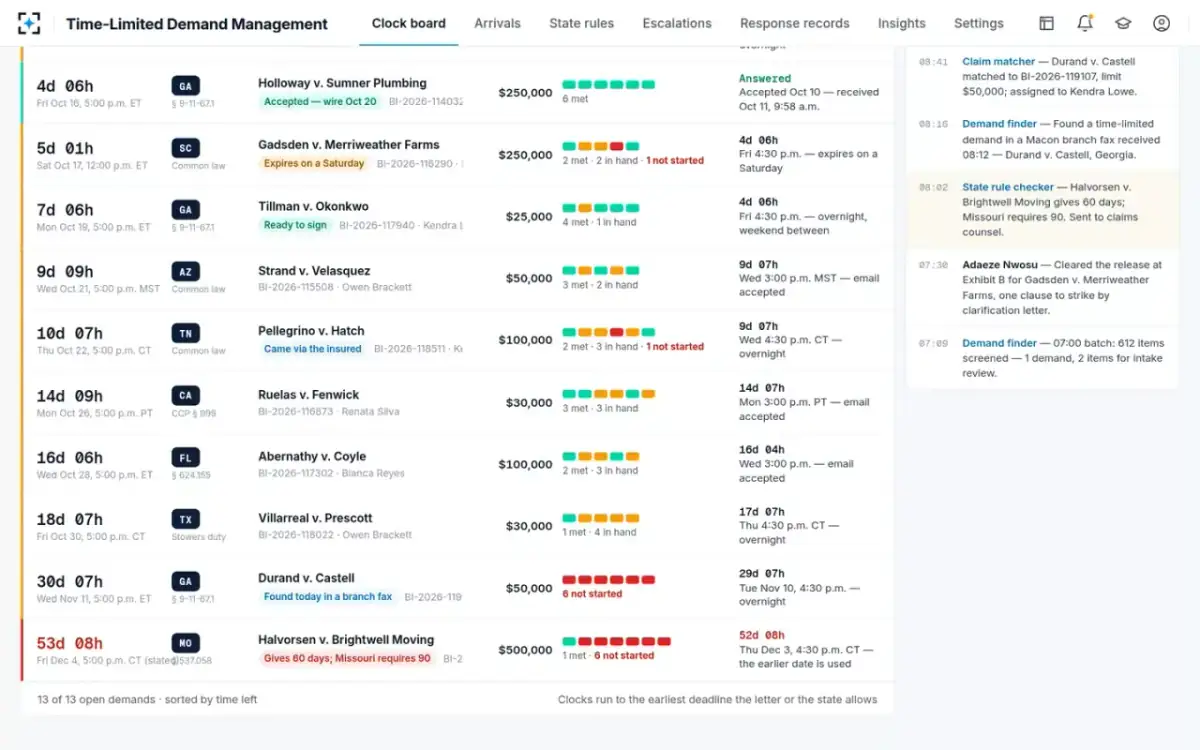
Thirteen open demands in eight states on the Time-Limited Demand Management board
Do time limited demand statutes apply only to auto claims?
Georgia's does; the others reach further. Georgia's statute covers claims for personal injury, bodily injury or death arising from a motor vehicle collision and since 2024 expressly excludes product liability claims. California's covers auto, motor vehicle, homeowner and commercial premises liability policies, including property damage claims. Missouri's covers any claim for personal injury, bodily injury or wrongful death against a tortfeasor with liability insurance, whatever the line.
The common-law duties are wider still. The Texas case the Fifth Circuit decided in 2025 arose from a fight with a bar's bouncer, under a policy limit of $1,000,000 for assault and battery, not a car crash. South Carolina's bill would cover personal injury, bodily injury, property damage and wrongful death demands. A multi-state desk that watches only its auto mail will miss demands on premises, general liability and commercial policies.
Which states are considering time limited demand laws?
Three bills were live in 2026, and none had become law in the records checked for this guide. South Carolina's H.4670 passed the House 114 to 0 on 25 March 2026 and was read a second time in the Senate on 12 May. Its Senate text would require a demand to be made in good faith, be reasonable in its terms, give the insurer enough to evaluate the claim and allow "a reasonable time not less than thirty days from receipt of the demand", while preserving the state's 1931 Tyger River doctrine.
Missouri's HB 2927 would replace the 2017 framework, as described above. Arizona's SB 1414, introduced in the 2026 session, would give an insurer 30 days to review and respond to a third-party settlement demand, counted from the postmark or from the date it was emailed or faxed (introduced text). Until a governor signs, each is a bill: a state table that adopts one early will compute wrong deadlines.
Minimum days a time-limited demand must allow, by state rule
What a multi-state desk needs from its state table
A state table earns its place only if each row is tied to a dated source, a person who reviewed it, and the demands it is applied to. A row that silently goes stale is worse than no row, because adjusters trust it. The checks below come from the differences on this page.
Six things every row in a time-limited demand state table should carry
- The source and its effective date
Georgia has three versions since 2013; the 2024 one applies to offers made on or after 22 April 2024.
- What starts the clock
Receipt in Georgia and Missouri, transmission in California, actual notice of a supported claim for Florida’s window.
- Which claims it covers
Motor vehicle collisions only in Georgia; four policy types in California; any injury claim in Missouri.
- How acceptance must travel
Missouri counts a postmark; Georgia’s offer must give an address and a fax number or email for acceptance.
- What a defective demand means
Inadmissible or not a reasonable offer in a later excess suit; never a license to let the date pass.
- Who reviewed it, and when
Bills change the answer only when signed; the table should show counsel’s last review date.
In Time-Limited Demand Management the state rule checker tests every demand against its state's row, cites the section, and sends anything that does not fit to claims counsel, who decide whether the demand is valid; the checker never decides. The clock keeper runs every demand to the earlier of the letter's date and the statutory floor, in the state's own time zone, so a Missouri letter that gives 60 days runs on 60 while counsel considers it. Each state row shows who in claims counsel reviewed it and when.
Answered demands across states in Time-Limited Demand Management, with outcome and time to answer
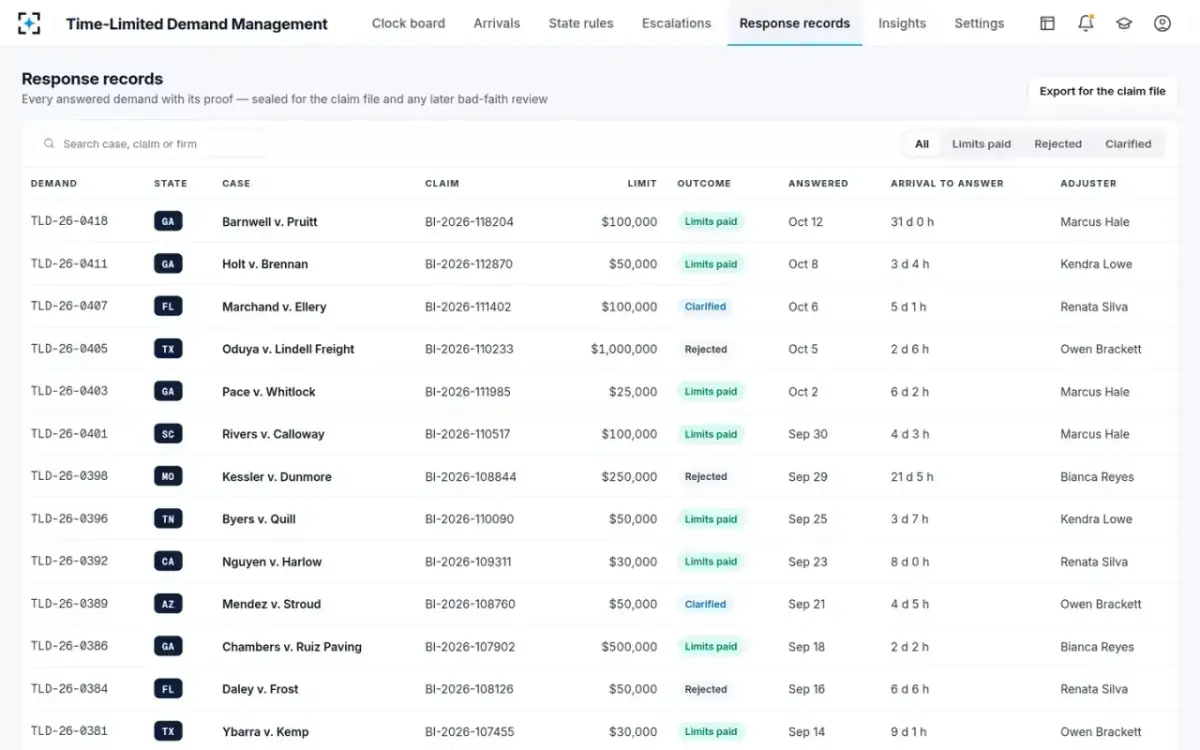
To see a multi-state board of demands as a supervisor sees it on a Monday morning, start from Time-Limited Demand Management.
Questions people ask
What is a time limit demand?
An offer to settle a claim within the defendant's liability limits that must be accepted by a stated time. Missouri defines it as an offer "which by its terms must be accepted within a specified period of time", and California uses almost the same words; in Texas the equivalent is called a Stowers demand.
Does the time to accept start when the letter is sent or when it is received?
It depends on the state. Georgia and Missouri count from receipt; California counts from transmission and adds three days for ordinary mail. Where no statute applies, the letter's own wording governs, which is why the arrival date of every letter should be recorded.
Can a demand give less time than the state minimum?
It can be sent, but it does not comply. In Missouri and California a non-compliant demand loses the weight it would have in a later excess suit, which is a question for counsel. An insurer that wants to stay safe treats the letter's own date as the deadline while that question is answered.
Do these statutes apply to demands made after a lawsuit is filed?
Mostly not. California's chapter covers offers made before the complaint or demand for arbitration is filed; Georgia's covers offers until every named defendant has answered or defaulted; Missouri's excludes demands made within 90 days of a jury trial but otherwise applies to filed claims.
What is the Tyger River doctrine?
South Carolina's common-law rule on an insurer's liability for failing to settle within limits, from Tyger River Pine Co. v. Maryland Casualty Co. (1931). South Carolina's pending bill, H.4670, says nothing in it would alter or affect that doctrine.
Do other states have rules on time-limited demands?
States without a demand statute rely on court decisions about the duty to settle, as Texas and South Carolina do, and the picture changes as bills pass. Any table, including the one on this page, should be checked against the state's own legislature site before a deadline depends on it.