Deadline tracking software for policy limits demands has a harder job than a calendar or a court docketing tool, because its trigger date is hidden in the mail and its rule is split between the letter and a state statute. Good software for this work finds each time-limited demand in every channel it can arrive by, records when it was received, computes the earliest deadline the letter or the state allows, works back to an act-by time that leaves room for delivery, and tells the right people early. It should not decide whether a demand is valid, and it should never sign, send or pay. Botminds' Time-Limited Demand Management is built on that division: six agents find, match, quote, check, count and draft; claims counsel rule on validity; a named supervisor signs within authority. This guide sets out the boundary step by step, the flags a buyer should expect, and where the solution fits and where it does not.
A policy limits demand from envelope to acceptance: what Time-Limited Demand Management's agents do, and what they never do
Agent
Demand finderScreens every email, scan, fax and portal upload; flags time-limited and policy-limits demands with their arrival time.
Never: discards, moves or answers mail; anything under 90% confidence goes to a person
Agent
Claim matcherTies the demand to its claim, policy, limits, insured and adjuster by claim number, names, date of loss and policy.
Never: changes a reserve, coverage position or assignment
Agent
Condition extractorLists each condition as its own item, quoting the sentence with page and paragraph, and marks those where a slip could be a rejection.
Never: paraphrases a condition away
Agent
State rule checkerTests the demand against its state’s reviewed rule on time, delivery, content and release, and cites the section.
Never: decides whether a demand is valid
Agent
Clock keeperComputes the deadline in the state’s time zone and an act-by for the delivery method; escalates at 72, 48 and 24 hours.
Never: extends a deadline; it always uses the earliest
Agent
Response drafterDrafts the acceptance or the written response, one paragraph per condition, and assembles each condition’s proof.
Never: sends, signs or pays
A person decides
Claims counselRules on every state-rule flag before anyone signs, and co-signs where a slip would count as a rejection.
A person decides
Supervisor, within authorityAccepts or rejects and signs; above the supervisor’s limit, a claims manager or the VP of casualty claims with counsel.
What is deadline tracking software, and why a limits demand needs more?
Deadline tracking software records a trigger date, applies a rule, and reminds people before the result. That works when someone already knows the trigger and the rule: a filing date and a court's response period, a tax return's due date. A policy limits demand supplies neither cleanly. The trigger is the day the letter reached the insurer, which may be a branch or an agent; the rule is the letter's stated date, checked against a floor that differs by state and by how the letter was sent.
A general deadline tracker against what a limits demand needs
General deadline tracker: Typed in by whoever opens the matter.
Built for policy limits demands: Taken from the letter’s arrival in any channel, with the time it landed.
General deadline tracker: One calendar rule per matter type.
Built for policy limits demands: The letter’s stated date, tested against the state’s floor: 30 days from receipt in Georgia, 90 in Missouri, 30 or 33 from transmission in California.
General deadline tracker: Not read; a person summarizes them in a note.
Built for policy limits demands: Each quoted with page and paragraph, with the ones a slip could turn into a rejection marked.
General deadline tracker: Due at midnight on the day.
Built for policy limits demands: An act-by that allows for the acceptance’s route: courier cut-off, certified mail, fax or email.
General deadline tracker: Reminders to the matter owner.
Built for policy limits demands: Escalations to supervisor, counsel and VP by hours left, and a flag when the letter misses its statute.
General deadline tracker: A completed task.
Built for policy limits demands: A dated file of arrival, discovery, each condition met, signatures and delivery tracking.
Can software calculate a time-limited demand deadline?
Yes, given four inputs: when the letter arrived or was sent, how it was sent, which state's rule governs, and the date the letter states. From those it can compute the statutory floor, compare it with the stated date, use the earlier, convert to the right time zone, and work back to the last moment the acceptance can leave. That is arithmetic, and software does it more reliably than a desk under pressure.
The sample carrier's board shows the arithmetic in three cases. A South Carolina demand under common law expires at noon on a Saturday, when the claimant's law firm is closed, so the act-by moves to Friday at 4:30 p.m. A Missouri demand gives 60 days where § 537.058 requires at least 90 from receipt; the clock runs to the earlier, stated date while counsel considers the shortfall. A Georgia offer expires at 5:00 p.m. Eastern on a Tuesday, and the carrier has chosen statutory overnight delivery for the acceptance, so the act-by is Monday's last overnight pickup at 4:30 p.m. How the floors are counted, transmission method by transmission method, is laid out in CCP 999: 30 days or 33.
One sample Monday on the board
13
open time-limited demands, in eight states
2
under 72 hours to their deadline
1,284
items screened that day across mailboxes, branch scans, fax and portal
2
items under 90% confidence sent to intake staff to confirm or dismiss
Can AI decide whether a demand is valid?
It should not, and the statutes show why. Whether a demand meets its state's rule turns on legal judgments a rule table cannot settle: California asks whether a demand does "not substantially comply with the terms of this chapter"; Georgia separates seven material terms from immaterial ones; Texas asks whether a demand offers a full release for a stated sum that an ordinary prudent insurer would accept. Software can compare a letter with a reviewed table and say where they differ. A lawyer has to say what the difference means.
Regulators frame the use of AI in claims the same way. The NAIC's model bulletin on insurers' use of AI, listed by the NAIC as adopted in 29 jurisdictions as of 8 October 2026, lists claim management among the uses it covers and holds insurers to the same unfair claims practices laws however a decision was reached or supported. Legislators have gone further in places: Florida's SB 202 in 2026 would have required claim denials to be made by qualified humans and barred AI as their sole basis, though it died in the Senate Rules Committee on 13 March 2026. A tool that keeps the legal call with counsel does not depend on how that debate ends.
Who should sign a policy limits acceptance?
A named person with settlement authority for the amount, and counsel wherever the acceptance carries legal risk. The software's job is to make the signature informed and recorded: what was signed, by whom, when, and what the signature meant.
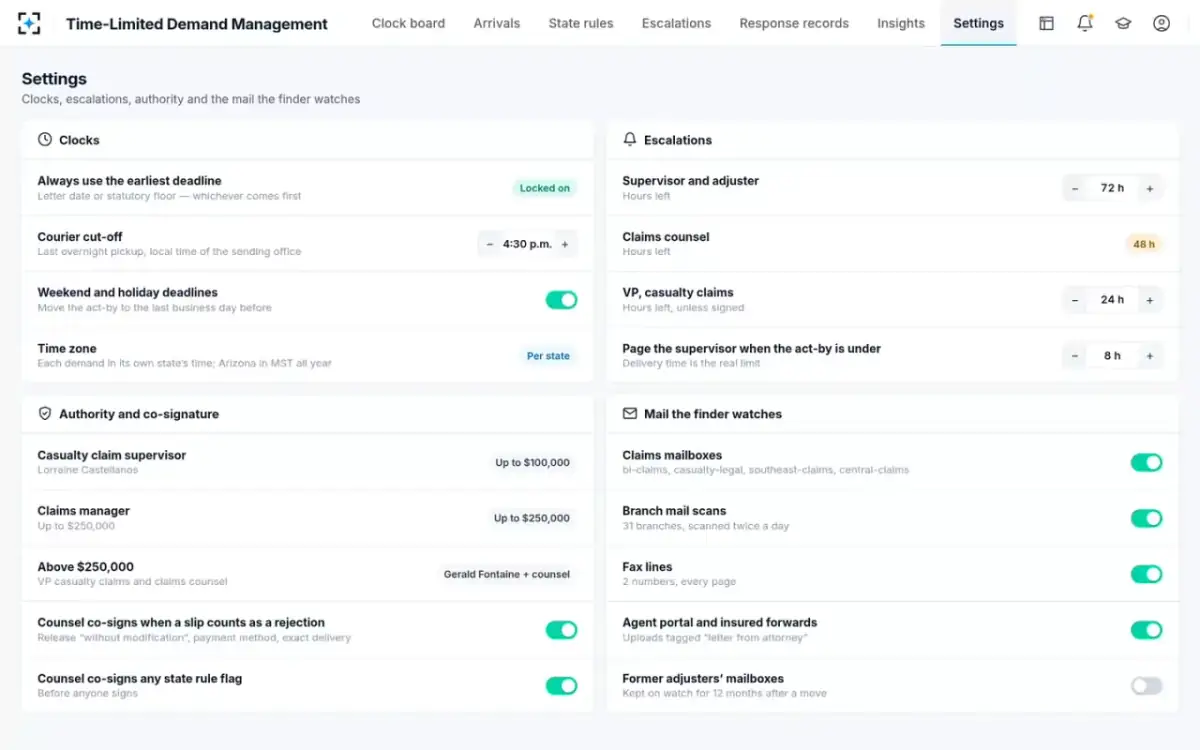
The sample carrier's settings are a common pattern. The casualty claim supervisor signs up to $100,000; a claims manager up to $250,000; above that, the VP of casualty claims with counsel. Counsel co-signs any demand the state rule checker flagged and any acceptance where a slip on the release, the payment or the delivery could be read as a rejection. Signing waits until no condition is left unstarted, and each signature records its meaning, such as "I accept the offer on its stated terms, and every condition is met or in hand", with the time.
In Time-Limited Demand Management, clocks, escalations, authority and channels are settings
What should a demand tracking tool flag for counsel?
Every difference between the letter and its state's rule, and every fact that changes which rule applies. The table lists the flags a buyer should expect, each tied to the text that creates it.
Flags a policy limits demand tool should raise for claims counsel, and why
| Flag | Why it matters | Where it comes from |
|---|---|---|
| Time to accept below the state floor | The demand may not comply; the stated date still runs | Mo. § 537.058.2(1); Cal. CCP § 999.1(a); O.C.G.A. § 9-11-67.1(b)(1)(A) |
| No citation of the statute, or no label | May take the letter outside the statute | Mo. § 537.058.2; Cal. CCP § 999.1; O.C.G.A. § 9-11-67.1(g) |
| Sent by a method the statute does not allow | Changes when, or whether, the statutory clock runs | Certified mail in Missouri; certified or statutory overnight in Georgia |
| Missing enclosures | Provider list and HIPAA authorizations in Missouri; records sufficient to evaluate in Georgia; reasonable proof in California | Mo. § 537.058.3; O.C.G.A. § 9-11-67.1(b)(2); Cal. CCP § 999.1(g) |
| Payment demanded too soon | Missouri: no less than 10 days after the executed release; Georgia: no earlier than 40 days from receipt | Mo. § 537.058.5; O.C.G.A. § 9-11-67.1(b)(1)(F) |
| Terms beyond the material ones | Immaterial in Georgia since 2024, but counsel decides how to answer them | O.C.G.A. § 9-11-67.1(c) |
| Demand within 90 days of a jury trial | Missouri’s statute does not apply | Mo. § 537.058.6 |
| Claimant without counsel | California’s compliance rule does not apply | Cal. CCP § 999.4(b) |
| Several claimants whose claims exceed the limits | Florida offers interpleader or agreed arbitration within 90 days of notice | Fla. Stat. § 624.155(6) |
How do you track demands sent to agents and insureds?
By reading those channels the same way as the claims mailbox, the same day. Letters reach branches, agents, policyholders and adjusters who have moved on, and in states that follow the NAIC's model regulation, notice to an agent of the insurer counts as notice to the insurer. A tool that watches only the claims inbox tracks the demands that were already easy.
In the sample carrier's year, 41 of 186 demands arrived outside the claims office: 29 at a branch or an agent, 12 forwarded by the insured. Each was on the deadline board in a median of 1.4 hours, the slowest in 6.2 hours. A buyer should ask which channels a tool reads, how often, and what it does when it is unsure; in the solution, anything under 90% confidence goes to intake staff to confirm or dismiss, and the finder never moves or discards mail. The connections to mail, branch scanning and the claim system, and how the clock writes back into existing diaries, are covered in claims diary system or demand clock.
What to measure in a demand desk’s first month
Measure the tool the way an examiner measures a claim file: a sample, a rule, and the share that missed it. Florida's Office of Insurance Regulation, examining one auto insurer in 2024, drew "A random sample of 109 claims" per category and reported each finding as an error rate against a named rule, such as four of 109 claims in which communications were not acknowledged within 14 calendar days, an error percentage of 3.7%. A carrier can hold its demand process to the same standard before and after any software.
Five measures for a policy limits demand process, with the sample carrier's figures
| Measure | Why it matters | Sample carrier, 1 Jan to 12 Oct |
|---|---|---|
| Demands answered after their deadline | The only number that maps directly to excess exposure | 0 of 186 (sample data; zero is the design target) |
| Arrival to the deadline board | Every hour here is borrowed from the insurer’s own time | Median 1.4 hours for the 41 found outside the claims office; slowest 6.2 hours |
| Share arriving outside the claims office | Shows which channels the process must watch | 41 of 186: 29 at a branch or agent, 12 from the insured |
| Conditions per letter | Sizes the work of meeting them | 5.9 on average, 1,104 across 186 letters |
| Margin at delivery | How close acceptances run to the deadline | One Georgia acceptance delivered 6 h 30 m before the deadline, with certified mail as a backup |
Does deadline tracking software send responses?
It should draft them and leave sending to a person. A response to a limits demand is a legal act: in California, an insurer that does not accept must notify the claimant in writing of its decision and the basis for it before the demand expires, and that notice is relevant in any later excess suit. Sending it is a decision about what the insurer is saying, not a task to automate.
What the software can do is make sending early and certain. In the solution the response drafter writes one paragraph per condition in the carrier's own template, states the delivery method, and assembles each condition's proof; once signed and co-signed, the courier booking and tracking go into the file. The NAIC's model regulation on claim settlement practices expects that kind of file, requiring "Detailed documentation" sufficient to reconstruct the insurer's activities on each claim.
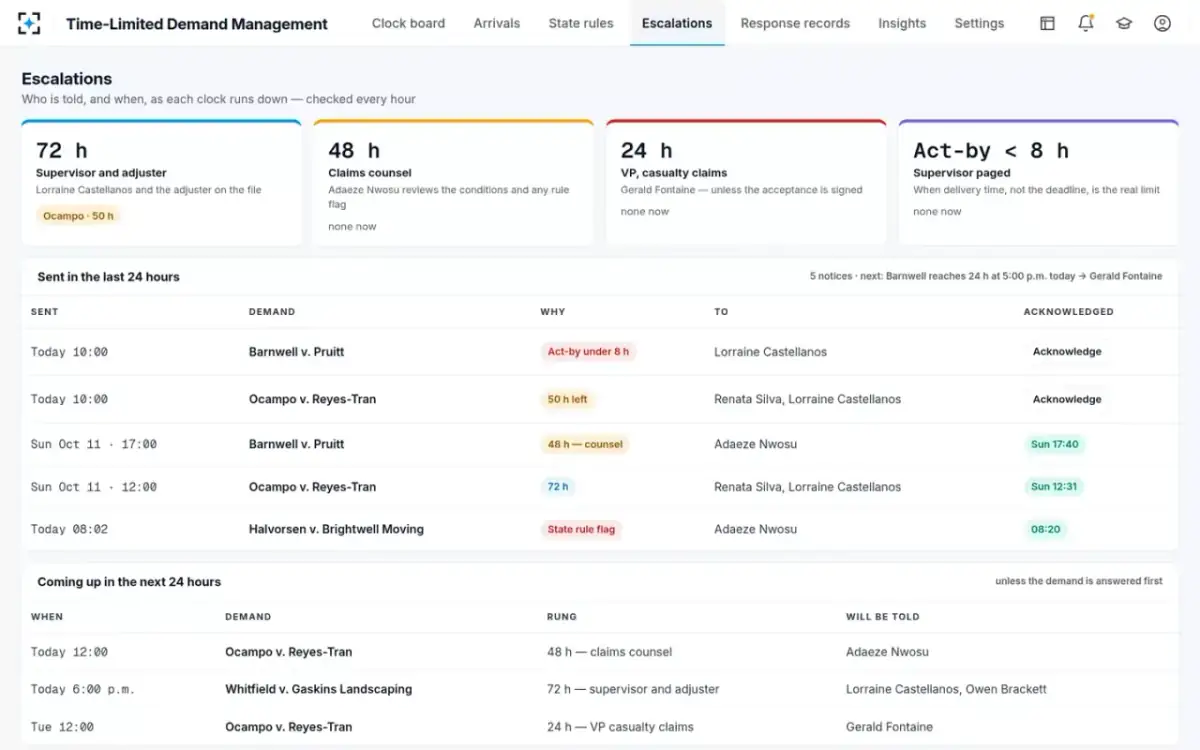
Escalations by hours left, each acknowledged and kept
Where demand tracking software fits, and where it stops
Botminds' Time-Limited Demand Management covers the stretch from a letter's arrival to a signed, delivered and recorded response. It does not replace a claim system, which remains the place for reserves, coverage positions and assignments, and its agents cannot change any of them. It does not value the claim; the decision to pay the limit rests on the carrier's own evaluation. It is not a court docketing system for deadlines once a suit is filed. And it does not supply legal conclusions: the state rule table is reviewed by the carrier's claims counsel, and the checker flags rather than decides.
Its value depends on reaching the mail. A carrier that cannot give it the claims mailboxes, branch scans, fax lines and agent uploads will get a better clock on the demands it already found, not the ones still in a branch in-tray. The honest first step is to run it on a sample of the carrier's own past demand letters and compare what it finds, quotes and counts with what the desk did at the time.
Questions to put to any deadline tracking software for limits demands
- Which channels does it read, and how often?
Claims mailboxes, branch scans, fax, agent portal, policyholder forwards, former adjusters’ inboxes.
- Does it record arrival time, transmission method and state?
The three inputs every statutory floor depends on.
- Does it always use the earliest deadline?
The letter’s date or the statutory floor, whichever is first, and never an extension.
- Does it quote every condition with its page?
A summary can lose the sentence on page four.
- Who maintains the state rule table, and is each row dated?
Your counsel, with a review date per state.
- Can it sign, send or pay anything?
The answer should be no.
A longer list, with the statute or ruling behind each question, is in ten questions for any demand-tracking tool. To see the board, the conditions and the escalations on the sample carrier's demands, start from Time-Limited Demand Management.
Questions people ask
Is there software made for time-limited demands?
Some claims and legal tools offer generic diaries and docketing; software built for these demands reads the letters, applies state rules and keeps the clock. Time-Limited Demand Management is one such solution, with six agents and named people deciding.
Can deadline tracking software read a scanned letter?
It needs to. Certified mail to a branch arrives as a scan and a fax as an image, and the deadline and conditions are in the text; a tool that only indexes email subject lines will miss them.
What happens when the software is unsure whether a letter is a demand?
A person decides. In the solution, anything the finder is less than 90% confident about goes to intake staff to confirm or dismiss, and nothing is discarded or moved; on the sample Monday, two of 1,284 items went to intake review.
Does it handle demands made after a suit is filed?
It tracks any time-limited demand that arrives, and Missouri's statute applies to filed claims except within 90 days of a jury trial. Court deadlines in a litigated case belong in the litigation team's docketing system.
How do you test demand tracking software before buying?
Replay a sample of your own past demand letters through it and compare its arrival times, conditions, state flags and deadlines with your files. Differences in either direction are the evidence a buyer needs.
Does it decide whether to pay the limit?
No. Whether to accept is the carrier's decision on its own evaluation, made by a person within authority; the solution makes sure that decision is taken in time and recorded.