A policy limits demand letter is a claimant's written offer to release an insurer's policyholder in exchange for the liability limit, open only until a stated date. Where a statute governs the letter, that date is counted from the insurer's receipt: Georgia requires at least 30 days from receipt of an offer sent by certified mail or statutory overnight delivery, and Missouri at least 90 days from the day the liability insurer receives it. The letter does not always arrive where claims work happens. It can land at a branch, with an agent, at the policyholder's kitchen table or in the inbox of an adjuster who has moved on, and every day it spends travelling is a day the claim team loses. Botminds' Time-Limited Demand Management is built for that work: specialist agents read every mailbox, scan and fax line, find each time-limited demand, tie it to its claim and keep its clock, and a named supervisor decides and signs.
The examples on this page come from a fictional sample carrier, Wrenfield Mutual, as its year of bodily-injury demands runs through the solution. Every person, law firm and claim in them is invented, and their numbers are sample data, not a customer's results. The law quoted is real and linked where it appears.
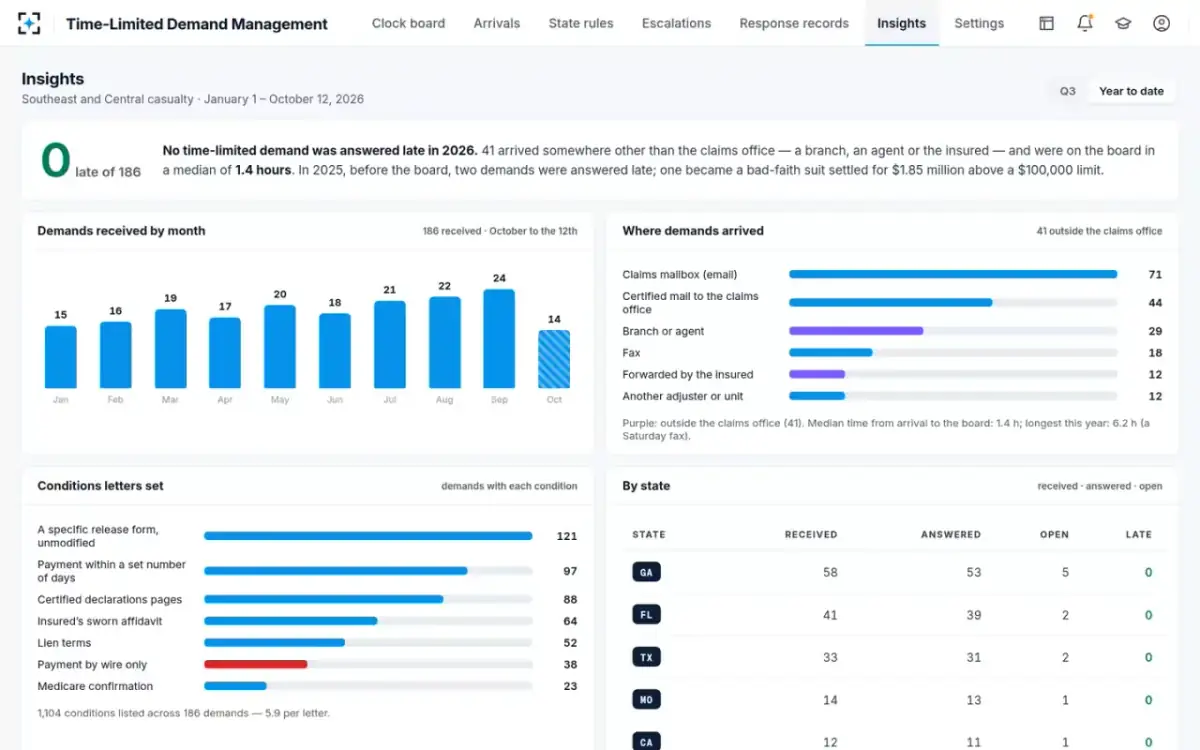
One sample year of policy limits demands, January to 12 October
186
time-limited demands received by the sample carrier
41
arrived outside the claims office: a branch, an agent or the insured
1.4h
median from arrival outside the claims office to the deadline board
5.9
conditions set by the average letter, 1,104 across the 186
Who receives a policy limits demand?
The statutes name the insurer, but the paper goes wherever the claimant's lawyer sends it. Missouri says a time-limited demand "shall be sent certified mail return-receipt requested to the tort-feasor's liability insurer". California tells the claimant to send it to an address the insurer has designated and the Department of Insurance has published, or to "The insurance representative assigned to handle the claim, if known." Georgia sets the delivery method, certified mail or statutory overnight delivery with return receipt, but not the department or the person.
In practice a letter reaches whoever the sender believes handles the claim. That can be the branch on the policy jacket, the agent who sold the policy, the policyholder, an adjuster who left the unit, or defense counsel. The NAIC's model regulation on claims settlement practices, which states adopt in their own versions, closes one of those gaps outright: "Notification given to an agent of an insurer shall be notification to the insurer." A letter on an agent's desk can therefore already be running on the insurer's time.
Seven people a policy limits demand letter may have to pass before anyone signs
Today
Sorts certified mail, faxes and scans by hand; a letter addressed to a branch or a former adjuster waits for someone to recognize it.
With agents
Sees what the demand finder flagged in every channel and confirms or dismisses only the items it is less than 90% sure of.
Still theirs: the call on anything uncertain
Today
Receives certified mail meant for claims and forwards it in the next internal pouch, or the one after.
With agents
Its scanned mail is screened the same day, so a demand found there goes to the claim team with the time it arrived.
Still theirs: scanning on schedule
Today
Gets a letter from an attorney and emails it on when the day allows.
With agents
Uploads to the agent portal are read with the rest of the mail.
Still theirs: the relationship with the policyholder
Today
Receives a frightening letter at home and may sit on it for days.
With agents
A forward from the policyholder is read the hour it arrives, like any other channel.
Still theirs: cooperation the policy requires
Today
Reads nine pages to find the sentence on page four that decides acceptance.
With agents
Gets each condition quoted with its page and paragraph, and the next step for each.
Still theirs: the evaluation and the work to meet each condition
Today
Knows the demands on the desk and worries about the one still in a branch in-tray.
With agents
Starts the day on one board of clocks with the act-by time and any unstarted condition.
Still theirs: the decision and the signature, within authority
Today
Learns about a demand with a day or two left.
With agents
Sees every state-rule flag before anyone signs.
Still theirs: the ruling on whether a demand is valid
Each arrow in that chain is a wait. The mailroom waits for a name it recognizes, the branch for the pouch, the adjuster for the letter, the supervisor for the adjuster's read, counsel for the supervisor's question. None of them is careless. The letter is simply moving through a building organized around claims, not around a clock that started on the day it arrived.
Florida shows the same chain running the other way. Its disclosure statute obliges the policyholder or the agent, on a claimant's written request, to name each known insurer and to "forward such request for information as required by this subsection to all affected insurers", after which the insurer has 30 days to answer under oath. The law expects a request to travel through people outside the claims office, and it starts a clock anyway.
When does the clock start on a policy limits demand?
In Georgia and Missouri it starts on receipt; in California it starts on transmission; in Florida a separate 90-day window runs from actual notice of a supported claim. None of those statutes starts it when the adjuster reads the letter, so the gap between arrival and reading is borrowed from the insurer's own time.
Georgia's minimum is a date "not less than 30 days from receipt of the offer sent by certified mail or statutory overnight delivery, return receipt requested". Missouri's is a period that "shall not be less than ninety days from the date such demand is received by the liability insurer". California counts from the sender's side: at least 30 days from the day the demand is transmitted by email, fax or certified mail, and 33 by ordinary mail. Florida's bad-faith safe harbor protects an insurer that tenders the lesser of the limits or the amount demanded within 90 days of actual notice of a claim backed by enough evidence to support its amount, the rule read closely in tender policy limits meaning.
The Georgia, Missouri and California figures are minimums for the period a letter must allow, not deadlines a claimant must give in full. A letter can give more. The working deadline is the one the letter states, provided it meets the floor; how to count the days, transmission method by method, is set out in how to count a time-limited demand under CCP 999.
What should a policy limits demand letter include?
Where a statute applies, the letter must carry a fixed list of terms, and the lists differ. Georgia's 2024 statute calls its seven terms the only material terms; Missouri's has eight terms plus two enclosures; California's has seven. An adjuster reading a letter is therefore checking two things at once: what the claimant asks for, and whether the letter is the kind of demand the state's statute governs.
What a time-limited demand must contain in three statute states
| Item | Georgia, § 9-11-67.1 (2024) | Missouri, § 537.058 | California, CCP § 999.1 |
|---|---|---|---|
| Time to accept | A date at least 30 days from receipt of the offer sent by certified mail or statutory overnight delivery | At least 90 days from receipt by the liability insurer | At least 30 days from transmission by email, fax or certified mail; 33 days by mail |
| Amount | Amount of monetary payment | Amount requested, or a request for the policy limits | A clear offer to settle all claims within policy limits, including all liens |
| Release | Who will be released; full or limited release, itemizing what the claimant will provide to each releasee; the claims released | Parties and claims to be released; an unconditional release of the insureds from all present and future liability | A complete release of the insureds from all present and future liability for the occurrence |
| Loss and injury | Not listed as a material term | Date and location of loss, claim number if known, all known injuries | Date and location of loss, claim number if known, all known injuries |
| Records | Medical or other records in the claimant’s possession sufficient to evaluate the claim | Provider list with HIPAA-compliant authorizations; employers and authorizations if wages are claimed | Reasonable proof, which may include medical records or bills |
| Payment and coverage | Payment date at least 40 days from receipt; a sworn statement on the insurer’s coverage, due at least 40 days from receipt (waivable) | A payment period, if the letter sets one, at least 10 days after the insurer receives the executed release | Not specified |
| How it is sent | Certified mail or statutory overnight delivery; must reference the section and give an address plus a fax number or email for acceptance | Certified mail, return receipt requested, to the liability insurer; must reference the section | In writing, labeled as a time-limited demand or referencing the section; to the designated address or the assigned representative |
The table shows why a single checklist fails. A Missouri letter that gives 60 days is short of its statute; the same letter in Georgia is generous. A California letter with no label and no citation may fall outside its chapter altogether. Comparing the five rulebooks a multi-state desk meets is the subject of time limit demands by state.
Does a policy limits demand have to be sent by certified mail?
In Georgia and Missouri, yes; in California, no. Georgia requires certified mail or statutory overnight delivery with return receipt, and Missouri certified mail with return receipt. California lets the claimant choose email, fax, certified mail or ordinary mail, and the choice changes the minimum: 30 days for the first three, 33 for ordinary mail.
The return route matters as much. Georgia's 2024 text requires the offer to include "an address, and either a facsimile number or email address, to which a written acceptance ... may be provided". Missouri lets the insurer accept by written acceptance of the material terms "delivered or postmarked to the claimant or the claimant's representative within the time period set in the time-limited demand". Those two sentences decide how late the acceptance can leave the building, which is why the act-by time on a demand is often earlier than its deadline.
California added an option for insurers. An insurer may designate an email or physical address for time-limited demands and send it to the Department of Insurance, which posts it publicly; the Department's notice gave insurers TLD.address@Insurance.ca.gov as the place to submit it. A designated inbox does not stop letters arriving elsewhere, but it gives the claimant's lawyer a right address to use.
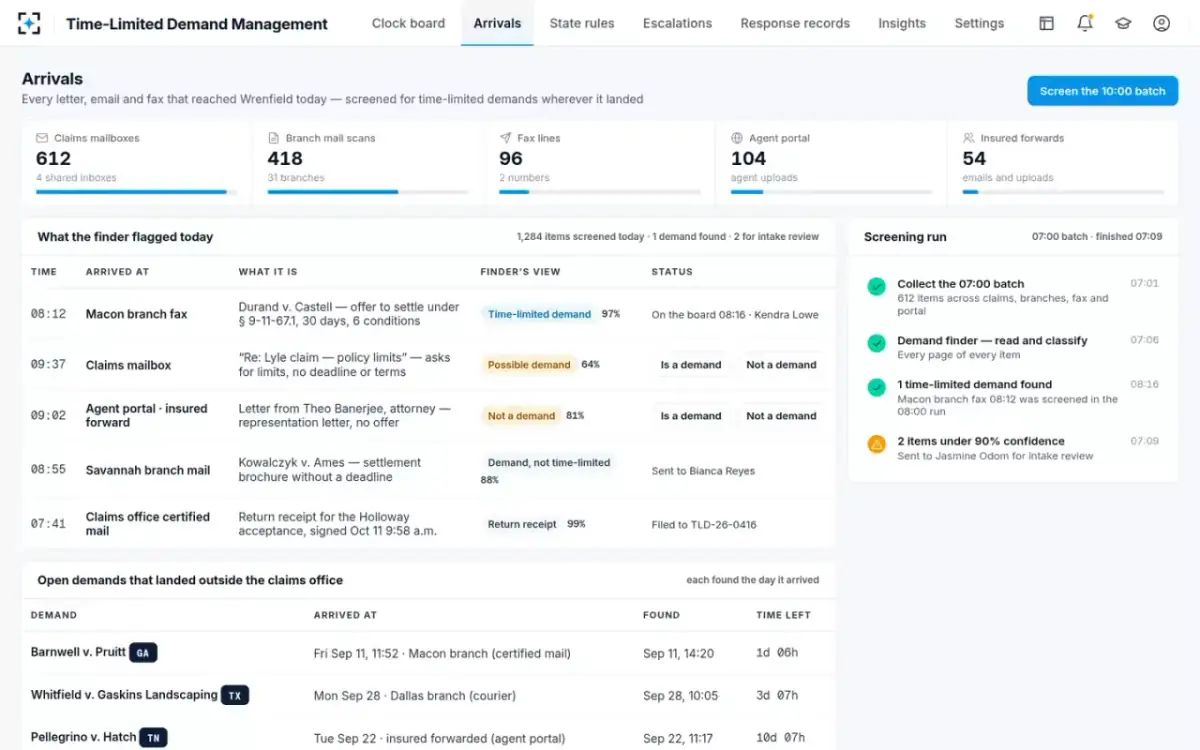
Every channel a letter can arrive by, screened the same day
Where a 30-day demand's days go between arrival and signature
On Botminds' own estimate, about 12 of a typical 30-day demand's days go on handling when the work is done by hand: three for the letter to reach the right adjuster, a day each to read every condition, check the state's rules and draft and send the acceptance, and six to meet the conditions themselves. The solution is designed to cut the first four close to zero. Meeting the conditions still takes days, because releases, affidavits and payments involve other people.
Where a 30-day policy limits demand's days go, by hand and with Time-Limited Demand Management
- Find, read, check rules5 d
- Meet conditions, send7 d
- Left for the decision18 d
- All handling5 d
- Left for the decision25 d
The days that matter most are the first three. A letter that reaches the right adjuster on day four leaves the same work and less time for it. Measured in the sample year, the 41 letters that arrived outside the claims office reached the deadline board in a median of 1.4 hours; the slowest took 6.2 hours, a fax that came in on a Saturday.
From the envelope to the signature in Time-Limited Demand Management: who does each step
Agent
Demand finderReads every email, scan, fax and portal upload, flags time-limited demands and records when each arrived.
Never: discards, moves or answers mail
Agent
Claim matcherTies the demand to its claim, policy, limits, insured and adjuster, and tells the adjuster and supervisor.
Never: changes a reserve, coverage position or assignment
Agent
Condition extractorLists each condition as its own item, quoting the sentence with page and paragraph.
Never: paraphrases a condition away
Agent
Clock keeperComputes the deadline in the state’s time zone and an act-by that allows for delivery; escalates at 72, 48 and 24 hours.
Never: extends a deadline
A person decides
Adjuster and supervisorEvaluate the claim, meet each condition, and accept or reject within authority.
A person decides
Claims counselRules on any state-rule flag and co-signs where a slip would be a rejection.
The letter that was filed with the medical records
The Supreme Court of Georgia's 2019 decision in First Acceptance v. Hughes is a reminder of how ordinary a lost letter is. Two injured claimants' lawyer faxed two letters offering to settle for the available limits, which were $25,000 per person and $50,000 per accident. The lawyer First Acceptance had retained to resolve the claims read them and did not take them for a time-limited demand, and the letters, in the court's words, "were inadvertently filed with some medical records".
Forty-one days later the claimants' lawyer wrote that he had heard nothing and revoked the offer. At trial in 2012 the jury found for the claimants, and the judgment included an award of over $5.3 million for one claimant's injuries. The insurer won the bad-faith suit that followed, but only because the court read the letters as having no deadline: "an insurer's duty to settle arises only when the injured party presents a valid offer to settle within the insured's policy limits", and this offer had set no date.
The lesson for a claims team is the reverse of the outcome. A letter with a clear date, sent the way the statute requires, leaves no such argument; misfiling it costs the deadline. How courts weigh what an insurer did with a demand, and what the file has to show, is the subject of bad faith failure to settle.
Who decides whether to accept a policy limits demand?
A person with settlement authority for the amount decides, usually with claims counsel where the letter or the state rule raises a legal question. The decision cannot be delegated to the calendar, and in the solution it cannot be delegated to the agents either: they find, match, quote, check and draft, and never sign, send or pay.
The sample carrier's settings show how that looks in practice. The casualty claim supervisor signs up to $100,000, a claims manager up to $250,000, and above that the vice president of casualty claims signs with counsel. Counsel co-signs any demand the state rule checker has flagged and any acceptance where a slip on the release, the payment terms or the delivery could be read as a rejection. Each signature records what it means and when it was given.
Saying no is also a decision with rules. California requires an insurer that does not accept to give the claimant its decision and its reasons, in writing, before the demand expires, and that notice "shall be relevant in any lawsuit alleging extracontractual damages against the tortfeasor's liability insurer".
Where the sample year's letters actually landed
How long does an adjuster have to respond to a policy limits demand?
Until the date the letter states, provided that date meets the state's floor: at least 30 days from receipt in Georgia, 90 from receipt in Missouri, and 30 or 33 from transmission in California. Other clocks run alongside. Where a state follows the NAIC model regulation, a claimant's letter that reasonably calls for an answer gets one within 15 days; the clocks around a reply are compared in how long an insurer has to respond to a demand letter.
Texas works differently. Its Stowers duty is common law: as the Fifth Circuit summarized it in 2025, the duty arises when an insurer receives a demand proposing "to release the insured fully in exchange for a stated sum of money" within limits, on a covered claim, that an ordinary prudent insurer would accept. The letter sets the time; whether the insurer's handling of it was reasonable is a question a court answers later.
What a claims supervisor can change on Monday
Most of the delay in the chain above is fixable with rules and routes before any software is bought. The checks below follow the statutes quoted on this page; the solution runs them on every letter, every hour.
Seven changes that take days out of a policy limits demand
- Publish one address for demands
In California, designate an email or physical address with the Department of Insurance; elsewhere, put it on every claim acknowledgment.
- Record the arrival time, not the reading time
Georgia and Missouri count from receipt; the stamp on the envelope is the start of the clock.
- Screen branch, agent and policyholder channels daily
Notice to an agent can be notice to the insurer; a forward from the policyholder is a demand the day it lands.
- Keep watching departed adjusters’ inboxes
Claimants’ lawyers write to the last name they had.
- Quote every condition before deciding
Read to the last paragraph; list each condition with the sentence that sets it.
- Set an act-by time, not just a deadline
Work back from how the acceptance will travel: courier pickup, certified mail, fax or email.
- Send rule questions to counsel early
A letter that gives less than the statutory minimum, or misses a required term, is a legal question, not an adjuster’s.
Botminds' Time-Limited Demand Management runs these checks on every letter in every channel, puts each demand on one board by time left, and leaves the decision and the signature with the people who own them. To see the sample carrier's Monday morning screen by screen, start from Time-Limited Demand Management.
Questions people ask
Is a policy limits demand the same as a time-limited demand?
Usually, but not always. A time-limited demand is any offer to settle within limits that must be accepted by a set time; Missouri's statute also covers a demand for a stated amount below the limits. A letter asking for "the limits" with no date is a policy limits demand without a deadline, and in Georgia's First Acceptance case that difference decided the outcome.
What happens if a demand is sent to the insured instead of the insurer?
It should be forwarded at once, and the insurer should assume its clock may already be running. Statutes such as Missouri's direct the demand to the insurer, but a letter that reaches the policyholder or the agent first is still the insurer's problem, and the NAIC model regulation treats notice to an agent as notice to the insurer.
Can a policy limits demand be sent by email?
In California, yes: email, fax and certified mail each give a 30-day minimum, ordinary mail 33. Georgia and Missouri require certified mail (Georgia also allows statutory overnight delivery) for the offer, although Georgia's offer must give an email address or fax number to which the acceptance may be sent.
What if the demand gives less time than the statute requires?
Treat the stated date as the deadline and send the question to counsel. Missouri says a non-compliant demand "shall not be considered as a reasonable opportunity to settle for the insurer" in a later excess suit, and California says a demand that does not substantially comply is not a reasonable offer for that purpose; neither statute tells an insurer it may ignore the stated date.
Should an adjuster call the claimant's lawyer about a demand?
Asking questions is protected in both statute states that address it. California says a request for clarification, more information or an extension made within the time to accept is not, in and of itself, a counteroffer or rejection, and Georgia gives the recipient a right to seek clarification on terms, releases, liens and records, in writing. Asking to change one of Georgia's material terms is not a clarification.
Does a policy limits demand letter have to say it is a time-limited demand?
In the statute states it has to identify itself. California requires the letter to be "labeled as a time-limited demand or reference this section"; Georgia's offer "shall specifically reference this Code section"; Missouri's "shall reference this section". A letter that does neither may fall outside the statute, which is a question for counsel, not a reason to let its date pass.