How long an insurance company has to respond to a demand letter depends on what kind of response, which state, and whether the demand sets its own deadline. Three clocks are usually running at once. A reply to the letter is generally due within about 15 days under the NAIC model rules that many states' claims rules follow, and within 14 days in Florida. A decision on a time-limited demand is due by the date the demand sets, which statutes require to be at least 30 days from receipt in Georgia, 30 or 33 days in California and 90 days in Missouri. And payment, once a claim is accepted, runs on a clock of its own. For the adjuster on the other end of the letter, the answer is a calendar built from the date of receipt; Bodily Injury Demand Package Review, Botminds' solution for answering injury demands, reads the demand's terms and starts that calendar the day the package arrives. Nothing on this page is legal advice to a claimant or an insurer; it sets out what the rules say.
How long an insurer has, by situation
| Situation | Clock | Source |
|---|---|---|
| A claimant’s letter that expects a reply (NAIC model) | Reply within 15 days | NAIC model regulation #902, § 6(C); state versions vary |
| The same, in California | A complete response within 15 calendar days | 10 CCR § 2695.5(b) |
| The same, in Florida | Acknowledge within 14 calendar days | Rule 69O-166.024(1), F.A.C., as Florida examiners apply it |
| Accept or deny a claim once proof is received, in California | Within 40 calendar days | 10 CCR § 2695.7(b) |
| A time-limited demand on a Georgia motor vehicle claim | The demand’s date, at least 30 days from receipt | O.C.G.A. § 9-11-67.1(b)(1)(A) |
| A time-limited demand in California | At least 30 days (email, fax, certified mail) or 33 (mail) | Code Civ. Proc. § 999.1(a) |
| A time-limited demand in Missouri | At least 90 days from receipt | Mo. Rev. Stat. § 537.058 |
| A Florida liability claim with sufficient evidence | A tender within 90 days of actual notice avoids a bad-faith action | Fla. Stat. § 624.155(4)(a) |
| A Florida claimant’s written request for policy information | A sworn statement within 30 days | Fla. Stat. § 627.4137 |
How long does an insurance company have to respond to a demand letter?
Usually about 15 days to reply, and as long as the demand allows to decide. The two are different obligations. The reply is an obligation in its own right: an acknowledgment and, where possible, a substantive answer, so the claimant knows the letter has been received and what happens next. The decision, whether to accept, reject or counter, is due by the demand's own deadline if it is time-limited, and within a reasonable time if it is not.
Payment is the third clock. The NAIC's model regulation expects an insurer to "affirm or deny liability on claims within a reasonable time" and to tender payment within 30 days of affirming liability where the amount is determined and not in dispute. Georgia's pre-suit offer statute, rewritten in 2024, lets the claimant set a payment date but requires it to be at least 40 days from receipt of the offer.
The minimum windows, drawn to the same scale
- Reply15 d
- Accept by the demand’s date≥ 30 d
- Accept by the demand’s date≥ 33 d
- Tender to avoid a bad-faith action90 d
- Accept by the demand’s date≥ 90 d
The first answer: a reply within about 15 days
Many states' unfair claims rules are built on two NAIC models, and both reach a claimant's letter. The model act makes it an unfair practice to leave pertinent communications about a claim unacknowledged for longer than is reasonable, when done flagrantly or as a general practice; how states turn that into day counts is traced in the guide to prompt payment laws by state. The model regulation puts a number on it: an appropriate reply "shall be made within fifteen (15) days on all other pertinent communications from a claimant which reasonably suggest that a response is expected." A demand letter plainly expects a response.
States vary the number and the standard. California's regulation requires a licensee, on any claimant's communication that reasonably suggests a response is expected, to send the claimant a complete response, on the facts known at the time, within 15 calendar days; once the claimant has given notice of legal action, that rule stops applying. Florida's examiners test acknowledgment against 14 calendar days: a 2024 market conduct report cites an insurer that "did not acknowledge receipt of claims communications within 14 calendar days, as required by Rule 69O-166.024(1), Florida Administrative Code".
The second: accept or reject within the demand's own window
A time-limited demand sets its own deadline, and several states now set a floor under it. Georgia's statute for pre-suit offers on motor vehicle claims, rewritten for offers made on or after 22 April 2024, requires the offer to name an acceptance date at least 30 days after the insurer receives it, sent by certified mail or statutory overnight delivery with a return receipt; the statute's seven terms are read line by line in the guide to Holt demand requirements. California requires at least 30 days from transmission by email, fax or certified mail, or 33 by ordinary mail (CCP § 999.1). Missouri requires the offer to stay open at least 90 days from receipt (§ 537.058).
California adds two rules that shape the answer. Asking for clarification, more information or an extension during the window is not, in itself, a counteroffer or rejection. And if the insurer does not accept, it must say so in writing before the demand expires: "the insurer shall notify the claimant, in writing, of its decision and the basis for its decision." Without a time-limited demand, California's claims regulation separately expects an insurer to accept or deny a claim within 40 calendar days of receiving proof of claim, or to explain in writing why it needs more time. State-by-state detail on time-limited demands, including pending bills, is in time limit demands by state, from Botminds' Time-Limited Demand Management.
How long does an insurance company have to respond to a demand letter in Florida?
Florida does not have a time-limited demand statute of the Georgia or Missouri kind; its clocks around a demand come from three other rules. Acknowledgment is due within 14 calendar days under Florida's administrative rule. A claimant's written request for the insurer's policy information must be answered within 30 days with a statement under oath (§ 627.4137). And the 2023 reforms created a 90-day window that matters most on limits demands: no bad-faith action lies against an insurer that tenders the lesser of its limits or the amount demanded within 90 days of actual notice of a claim backed by enough evidence to support its amount. What counts as a tender, and how it differs from acceptance, is set out in tender policy limits meaning.
The same section places a duty of good faith on claimants and their lawyers, including in setting deadlines, and lets the trier of fact in a later bad-faith action weigh their conduct and reduce damages. A Florida demand with a very short deadline is therefore not meaningless, but it is not the only clock either. Florida's separate rule on medical damages in litigation, which shapes what a Florida demand is worth, is covered in the guide to Florida's letter of protection statute.
What happens if an insurance company does not respond to a demand letter?
A missed reply is a regulatory problem; a missed limits demand can be a financial one for the insurer and its insured. On the regulatory side, failures to acknowledge or to act promptly are what market conduct examiners count, sampling claim files and reporting error rates against the rule. On the claim side, letting a valid offer within the policy limits expire can expose the insurer to a claim that it failed to settle, and to a judgment above the limits if the case is tried.
When that duty arises is itself a matter of state law. Georgia's Supreme Court held in 2019 that no duty to settle arises until the injured party makes a valid offer within the insured's limits, and found the insurer had not acted unreasonably where the offer in that case set no deadline for acceptance. California's statute says that a time-limited demand that does not substantially comply with its requirements is not to be considered a reasonable offer to settle within limits, for the purposes of a later suit against the insurer. Neither rule excuses silence; both make the content and timing of the demand, and of the reply, the evidence.
This notification shall be sent prior to the expiration of the time-limited demand, including any extension agreed to by the parties …
Cal. Code Civ. Proc. § 999.3(c)
How long does it take an insurance company to respond, in practice?
A reply and a settlement are very different measures. The rules above govern the reply and the decision on a demand; how long a whole claim takes to close is a separate number, and it is long for represented claimants. The Insurance Research Council, a non-profit research organisation supported by insurers, studied more than 7.4 million auto injury claims closed between mid-2017 and mid-2022 and found that the median represented bodily-injury claimant waited almost 440 days to close, over twice as long as a claimant without a lawyer. What representation does to a claim is examined in attorney involvement in auto injury claims.
Much of that time passes before any demand is sent, while treatment continues. Once a demand arrives, the insurer's clock is short by comparison, and the work inside it is reading. A demand package of a thousand pages has to be read, totalled and checked inside a 30-day window; how long that takes by hand is worked out in how long it takes to review 100 pages of medical records.
Counting the days from receipt, in Bodily Injury Demand Package Review
Every clock above runs from an event, usually receipt, so the date the package arrived is the first fact to capture and keep. In the solution, the demand terms reader reads the letter's amount, deadline, release, payment period and any extra conditions, checks them against the carrier's rule table for the state, and starts the clock from the date of receipt. It never decides whether a demand is valid, which goes to claims counsel, and it never moves a deadline.
Every open demand in Bodily Injury Demand Package Review, on its response window
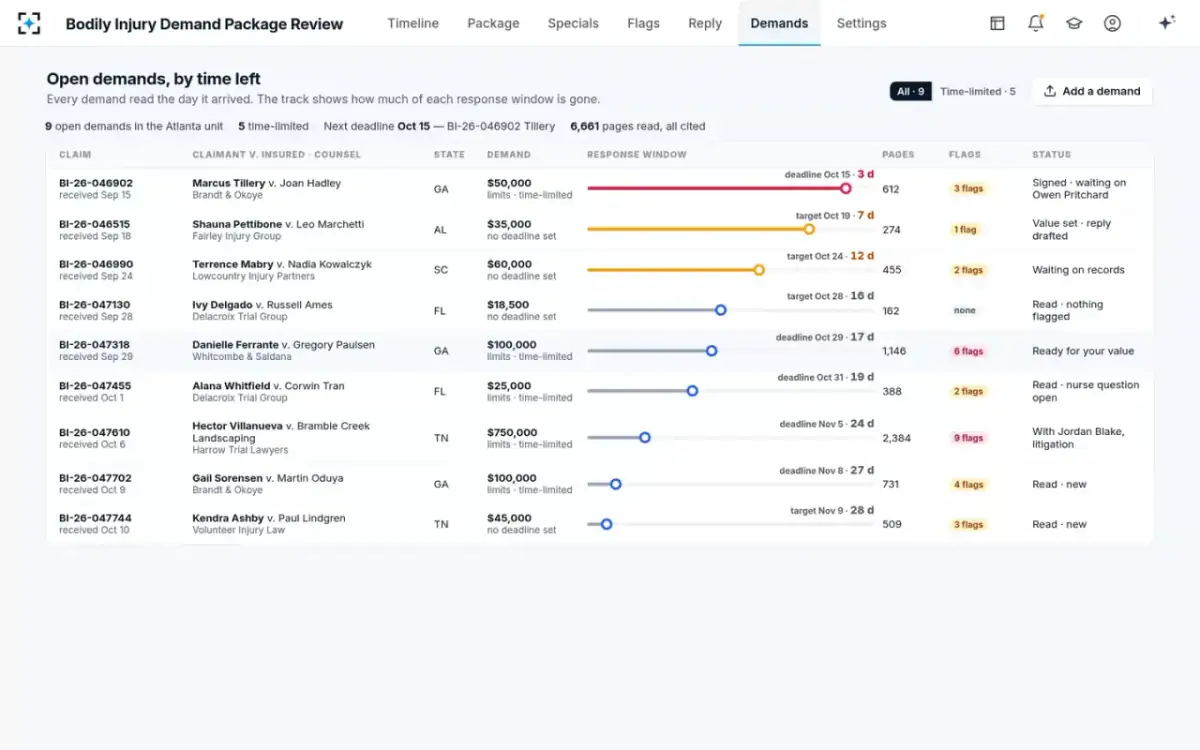
The sample limits demand, from receipt to a reply 17 days early
Agent
Demand terms readerReads the offer received 29 September by certified mail: $100,000 limit, accept by 29 October, 5:00 pm ET. Starts the clock; sends one term, a sworn statement from the insured about other insurance, to claims counsel.
Never: decides validity; never moves a deadline
Agent
Summarizer, bill reader, checkerRead the 1,146 pages the same morning: chronology, specials and six flags, each with its pages.
A person decides
Claims counselConfirms on 10 October that the sworn statement can be given.
A person decides
Bodily-injury adjusterSets a range and an offer, and signs the reply on 12 October at 10:24.
A person decides
Casualty claims supervisorCo-signs at 10:41, as the carrier requires for any reply to a time-limited demand; it goes by email and certified mail at 10:43.
The claim's header counts the days to answer from receipt
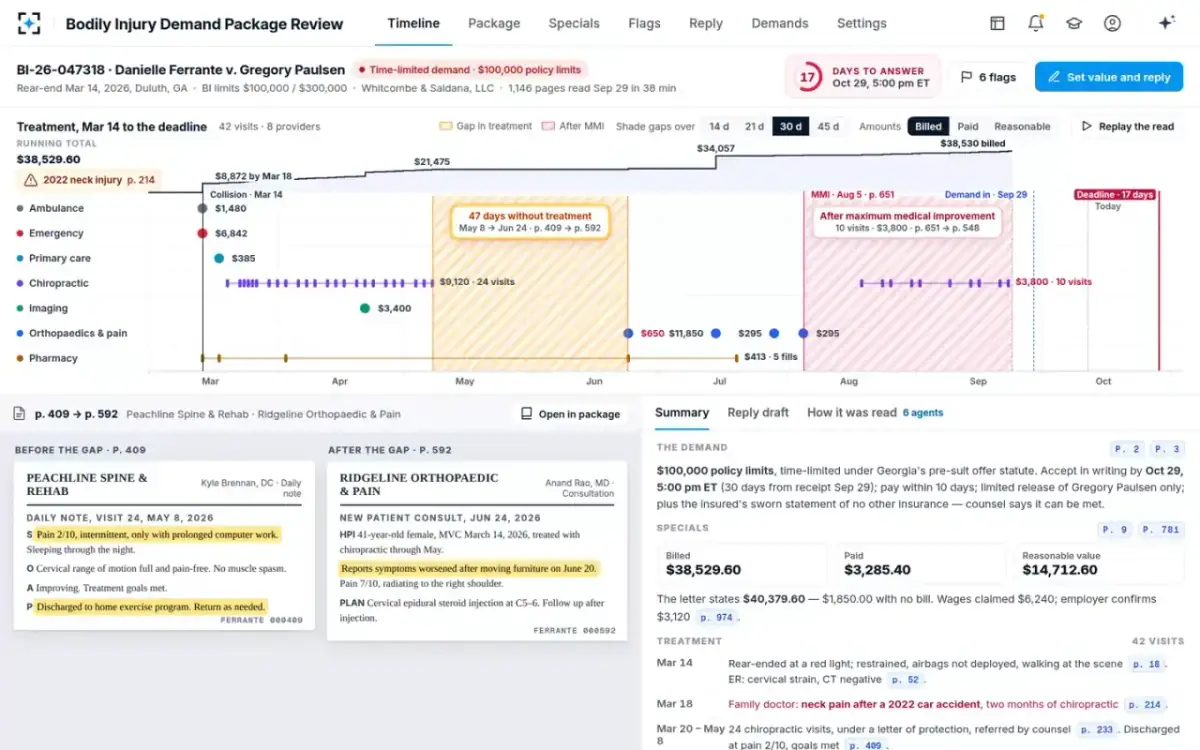
The reply in the sample declined the $100,000 offer as made, offered $31,500 with every figure cited to its page, and asked for four sets of records: treatment during a 47-day gap, the records of a 2022 neck injury, any written surgical recommendation, and the bill for a charge that had none. It went 17 days before the deadline, which left time for the claimant's lawyer to answer.
What a complete response contains
A reply that meets the clock but says nothing useful helps nobody, and California's regulation asks for a complete answer on the facts known at the time. Whether the insurer accepts or not, a response that can stand up later has a recognisable shape.
What a complete response to an injury demand contains
- The date the demand was received, and how
Certified mail, email or portal; it starts every clock above.
- A clear decision on the offer as made
Accepted, not accepted, or a counteroffer, stated as such.
- The basis, with the pages
The bills, records and wage proof the evaluation relied on, each cited, so the claimant can answer specifically.
- What is missing, asked for specifically
Records of a gap, earlier treatment, a bill with no visit. A specific request can be answered inside the window.
- Who signed it, and who co-signed
The adjuster and, where the carrier requires, a supervisor; counsel where the stakes require.
- Sent before the deadline, by a traceable route
With proof of sending and a copy in the claim file.
Questions people ask
How long does an insurance adjuster have to respond to a demand letter?
Under the NAIC model regulation that many states draw on, a reply to a claimant's communication that expects one is due within 15 days; California requires a complete response within 15 calendar days and Florida acknowledgment within 14. The decision on a time-limited demand is due by the demand's own date, which Georgia requires to be at least 30 days from receipt.
Does an insurance company have to acknowledge a demand letter?
Yes. The NAIC model act treats failing to acknowledge pertinent communications with reasonable promptness as an unfair claims practice when it is flagrant or a general practice, and state rules put a number of days on it. Acknowledgment is not acceptance; it confirms receipt and what happens next.
What is a reasonable time to respond to a demand with no deadline?
There is no fixed number; the reply is still due within the state's acknowledgment period, and the decision within a reasonable time for the investigation. Georgia's Supreme Court held in 2019 that an insurer did not act unreasonably in failing to accept an offer that set no deadline before it was withdrawn.
Can an insurer ask for more time to answer a time-limited demand?
It can ask; whether it gets it is up to the claimant. In California, a request for clarification, more information or an extension made within the window is not, in itself, a counteroffer or rejection. If the insurer then does not accept, it must say so in writing, with its basis, before the demand expires.
How long does an insurance company have to pay after accepting a demand?
The NAIC model regulation expects payment within 30 days of affirming liability where the amount is not in dispute. A demand can set its own payment date; Georgia's statute requires that date to be at least 40 days from receipt of the offer.